
Why Does My Car Start Sometimes but Not Others? 7 Causes & Fixes for 2026
Quick Answer
Why does my car start sometimes but not others? It usually means one part works only part of the time. A loose battery cable, a dying starter, a worn ignition switch, a weak fuel pump relay, or a failing crankshaft sensor can all cut power or fuel for one start and work fine on the next. AAA car care guidance also points to loose or corroded battery connections as a first check.
Most likely causes, in order
- Loose battery connection: Corrosion or a loose clamp can break the circuit on one try and connect on the next.
- Failing starter motor: A worn starter solenoid or motor may click once, then crank fine after a tap or a second try.
- Worn ignition switch: A loose switch can lose contact when you turn the key, then work when you try again.
- Fuel pump relay: A relay that sticks when hot can stop fuel for one start and work again after it cools.
- Bad crankshaft sensor: A failing sensor can send no signal on one start and a good signal on the next.
- Neutral safety switch: A worn switch may not see Park or Neutral on the first try.
Do this first
- Note the sound, the dash lights, and the weather each time it fails. That pattern points to the cause faster than any guess.
- Wiggle the battery cables gently with the car off, then check for white or green crust on the terminals.
- Try starting in Neutral if it will not start in Park, and try your spare key if you have one.
I’ve had a car start fine on Monday, refuse on Tuesday, then fire up like nothing happened on Wednesday.
That random pattern is the clue. It tells me the part is not fully dead yet, so I can catch it before it leaves me stuck.
In This Guide
- What Does Intermittent Starting Actually Mean?
- Why Does My Car Start Sometimes but Not Others When It Cranks?
- Why Does My Car Start Sometimes but Not Others When It Won’t Crank at All?
- Is It the Starter Motor or the Ignition Switch?
- Could a Fuel Problem Cause Intermittent Starting?
- Can Sensors and the Anti-Theft System Stop Your Car From Starting Sometimes?
- How Do I Diagnose an Intermittent Starting Problem Step by Step?
- When Should I Stop DIY Testing and See a Mechanic?
- Frequently Asked Questions
What Does Intermittent Starting Actually Mean?
An intermittent starting problem is a fault that appears on some starts and disappears on others. The car may crank slowly one morning and start fast the next.
Cranks, clicks, or nothing: why the sound matters
Start with the sound. It splits the whole problem into three paths.
- Normal crank, no start: The starter turns the engine, but fuel, spark, or a sensor signal is missing.
- Click, no crank: Power is not reaching the starter, or the starter solenoid is not engaging.
- No sound, no lights: The battery, main cable, or ground path is open.
- Slow, weak crank: The battery is low, the cables are corroded, or the starter is dragging.
Write down which one you heard. I keep a short note on my phone, with the date, temperature, and whether the car sat overnight.
Section Takeaway: Intermittent means partly failed, not fully dead, so track the sound, the dash lights, and the temperature to find the pattern.
Why Does My Car Start Sometimes but Not Others When It Cranks?
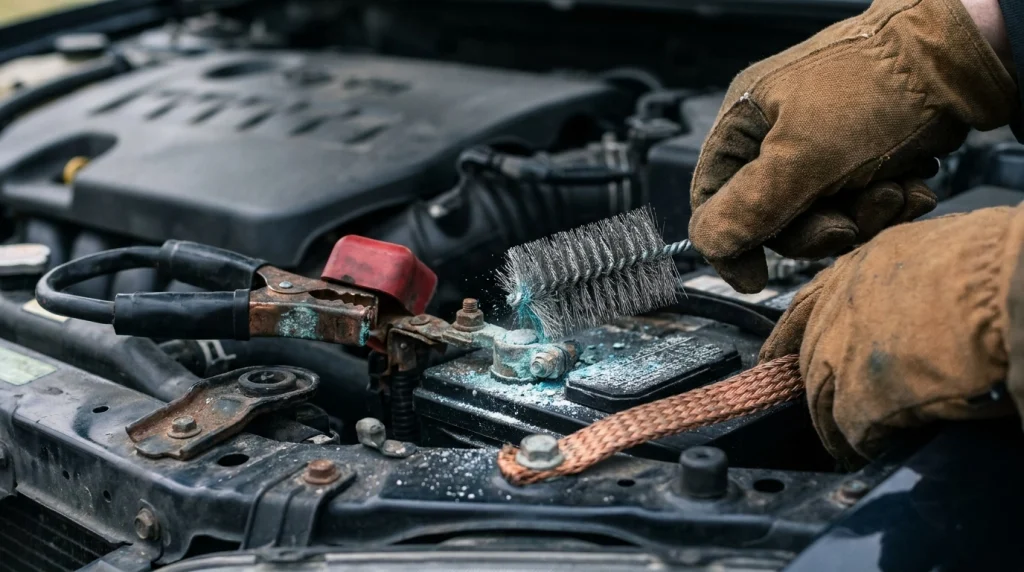
If the engine turns over but will not fire, the starter is doing its job. The missing piece is fuel, spark, or timing.
That narrows the list fast. I check fuel and sensors first when the crank sounds normal.
Loose or corroded battery cables can still crank sometimes
A battery cable can look tight and still fail under load. Corrosion hides under the clamp, where you cannot see it.
Heat makes the metal expand, and a cold morning makes it contract. That small shift can break the connection for one start.
Check the terminals for white, green, or blue crust. Clean them with a battery terminal brush, then tighten the clamp until it does not move by hand.
Safety note: disconnect the negative cable first and reconnect it last, and wear eye protection when you clean corrosion.
Weak battery, bad ground, and voltage drop
A battery can show 12 volts at rest and still drop too low while cranking. A multimeter helps here, and it costs less than one wrong part.
- Clean the terminals: Remove crust, tighten the clamps, and add a thin coat of terminal protector if you have it.
- Check the ground: Look for rust, frayed wire, or a loose bolt at the body and engine ends.
- Load-test the battery: Many auto parts stores test batteries for free, and a load test beats a simple voltage check.
The Car Care Council lists battery and cable checks as basic maintenance, and I treat them as step one for any random no-start.
Section Takeaway: A normal crank with no start points to fuel, spark, or sensors, but always rule out loose cables and a weak battery first.
Why Does My Car Start Sometimes but Not Others When It Won’t Crank at All?
No crank means the starter never got the signal or the power it needed. The engine stays silent, or you hear a single click.
That click often comes from the starter solenoid. It tries to engage, but low voltage or a worn contact stops it.
Bad starter solenoid and worn starter brushes
A starter motor uses brushes and a solenoid to spin the engine. Both wear with age and heat.
When the brushes wear thin, they may touch on one try and miss on the next. A light tap on the starter body can sometimes free it, but that is a test, not a fix.
Neutral safety switch and shift position
An automatic car will only start in Park or Neutral. The neutral safety switch, also called the transmission range sensor, tells the car which gear you picked.
A worn switch may not see Park on the first try. Try shifting to Neutral and starting again, with your foot firm on the brake.
If it starts in Neutral but not in Park, the switch or the shift linkage is a strong suspect. Do not force the shifter, and check your owner’s manual for the correct start procedure.
Ignition switch wear and key problems
A worn ignition switch can lose contact inside the column. The dash lights may flicker, or the radio may cut out when you turn the key.
Try a spare key if you have one. A worn key or a weak key fob battery can also confuse the immobilizer on some cars.
Safety note: never work under the dash with the battery connected if you are not sure which wires are live, and have a qualified mechanic handle steering-column work if you are unsure.
Section Takeaway: No crank with a click points to the starter, solenoid, or power path, while no crank in Park but a start in Neutral points to the safety switch.
Is It the Starter Motor or the Ignition Switch?
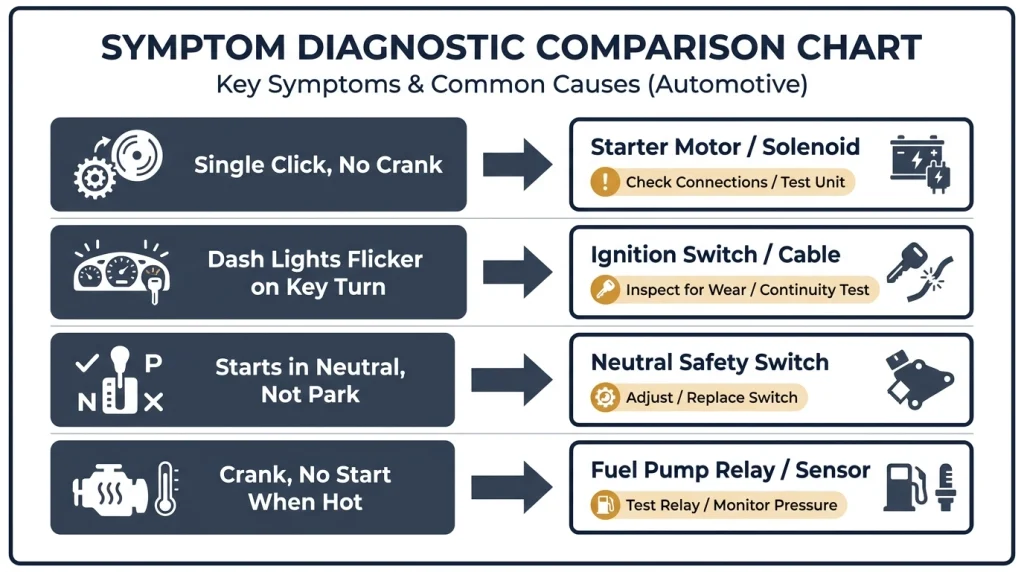
The starter and the ignition switch fail in different ways. The table below shows the split I use in the driveway.
| Symptom | Most likely part | Quick check | DIY difficulty |
|---|---|---|---|
| Single loud click, no crank | Starter solenoid or starter motor | Check battery voltage, then tap the starter lightly as a test only | Medium to hard |
| Dash lights flicker or die when you turn the key | Ignition switch or battery cable | Wiggle the key gently, check cable tightness | Medium |
| Starts in Neutral, not in Park | Neutral safety switch | Try Neutral with foot on brake | Medium |
| Normal crank, no fire, hot engine only | Fuel pump relay or crankshaft sensor | Listen for the fuel pump hum, scan for codes | Easy to medium |
| Slow crank on cold mornings | Weak battery or corroded cables | Load-test the battery, clean the terminals | Easy |
OEM, aftermarket, or remanufactured starter: what should I pick?
An OEM part is the same part your car left the factory with, made to the vehicle maker’s spec. An aftermarket part is made by another brand to fit the same car, and a remanufactured starter is a used core rebuilt with new wear parts.
For a starter, I weigh warranty and fitment first. Check the part number cross-reference and your VIN, which is the 17-digit vehicle ID, before you order.
- OEM or OES: Best fit and warranty in most cases, often at a higher cost.
- Quality aftermarket: Good value from a known brand such as Bosch, Denso, or ACDelco, if the fitment matches.
- Remanufactured: Lower cost, but check the warranty length and return terms before you buy.
Section Takeaway: Match the symptom to the part before you buy, and confirm starter fitment with your VIN and part number, not just the model name.
Could a Fuel Problem Cause Intermittent Starting?
Yes, and fuel faults love hot weather. A car that starts cold and refuses after a short stop often has a fuel delivery fault.
Fuel needs pressure to reach the injectors. If pressure drops, the engine cranks but never fires.
Fuel pump relay: the small part that fails when hot
A fuel pump relay is a small switch that sends power to the fuel pump. Heat can make its contacts stick open.
Listen for a short hum from the rear when you turn the key to On, before you crank. No hum on a failed start, but a hum on a good start, points to the relay or pump.
Fuel pump, filter, and pressure
A weak fuel pump may build pressure slowly. A clogged fuel filter can starve the engine on one start and pass enough fuel on the next.
Safety note: fuel work is a fire risk, so work outside, keep sparks away, and have a qualified mechanic handle fuel pressure testing if you are unsure.
Check for recalls too. The NHTSA site lists safety recalls by VIN, and a fuel pump recall can explain a random no-start.
Section Takeaway: A hot-engine no-start with no fuel pump hum points to the relay or pump, so listen for that hum before you replace parts.
Can Sensors and the Anti-Theft System Stop Your Car From Starting Sometimes?
Yes, and these faults often leave a code. An OBD2 scanner, which plugs into the port under your dash, can read those codes in minutes.
Crankshaft and camshaft position sensors
A crankshaft position sensor tells the engine computer where the crank is. Without that signal, the computer will not fire the spark plugs.
A camshaft position sensor can cause a similar fault. For sensors, I prefer OEM or OES parts, because a cheap sensor can fail within months and bring the same fault back.
Key fob, immobilizer, and anti-theft light
Watch the security light on the dash. A flashing key or lock symbol during a failed start points to the immobilizer.
Consumer Reports notes that key and sensor faults are common causes of random no-starts, and a code scan often finds them before parts are replaced.
Section Takeaway: Scan for codes first when sensors or the immobilizer are suspects, and watch the security light on every failed start.
How Do I Diagnose an Intermittent Starting Problem Step by Step?
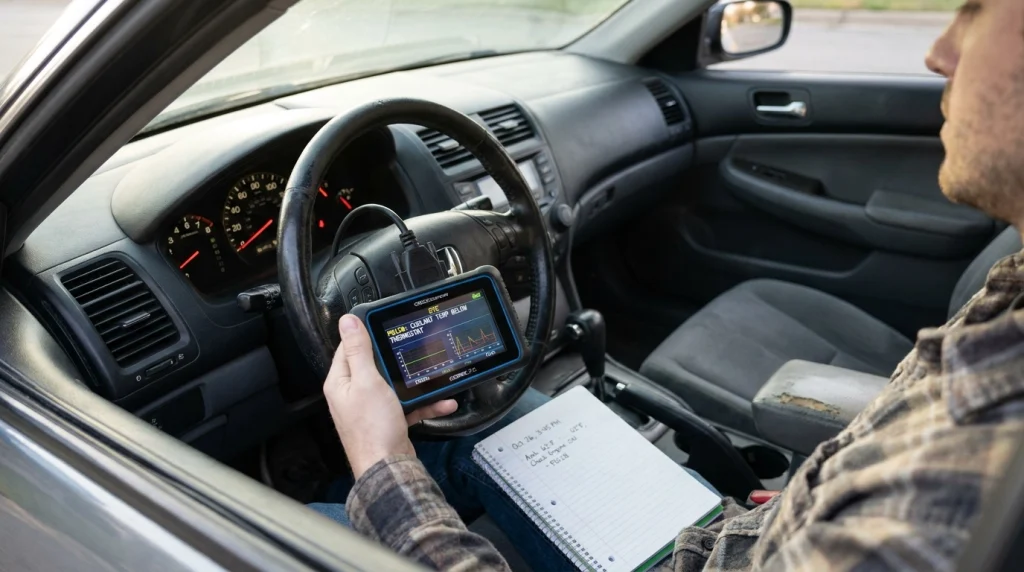
- Record the pattern: Note crank or click, dash lights, temperature, and how long the car sat.
- Check the battery: Look for corrosion, tighten the clamps, and load-test the battery.
- Check the ground: Inspect the ground cable at the battery, body, and engine for rust or looseness.
- Try Neutral and the spare key: This tests the safety switch and the key in one minute.
- Listen for fuel: Turn the key to On and listen for the pump hum before you crank.
- Scan for codes: Use an OBD2 scanner and note every code, even a pending one.
- Test when it fails: Check voltage, fuel hum, and spark signal during a failed start, not after it starts fine.
Section Takeaway: Test during a failed start, in cheap-to-expensive order, and let the pattern and the codes choose the part.
When Should I Stop DIY Testing and See a Mechanic?
Stop when the fault involves fuel pressure, airbags, steering-column wiring, or work under the car. Those jobs need the right tools and safety steps.
Look for an ASE-certified technician if you want a certified check, and keep your notes and codes to share. As of 2026, a clear pattern note still helps a mechanic find a random fault faster than a vague description.
Section Takeaway: DIY the cables, battery, key, and code scan, then hand fuel, starter, and column work to a pro if the fault stays hidden.
Frequently Asked Questions
Why does my car start in the morning but not later in the day?
Heat is the likely trigger. A fuel pump relay, crankshaft sensor, or starter solenoid can fail when hot and work again after it cools. Note the temperature and the time it sat, then test during a hot failed start.
Can a bad battery cause intermittent starting?
Yes, a weak battery or a corroded cable can crank slowly one time and start fine the next. A load test finds this better than a simple voltage check. Clean the terminals, tighten the clamps, and test the battery before you buy parts.
Why does my car start after I wait 10 minutes?
A hot part is cooling down. The fuel pump relay and crankshaft sensor are the two most common parts for this pattern. Listen for the fuel pump hum and scan for codes during the next failed start.
Can heat cause my car not to start sometimes?
Yes, heat expands metal, raises resistance in worn contacts, and can stop a weak relay or sensor. Cold faults point more to the battery, while hot faults point more to fuel and sensors. Your pattern note will show which one fits.
Is it safe to drive if my car starts sometimes?
It is risky, because the fault can turn into a stall or a full no-start away from home. Drive only to a shop if you must, and avoid long trips until you find the cause. A car that stalls while driving needs prompt professional help.
How much does it cost to fix intermittent starting?
It depends on the part, your car, and the shop rate, so no single price fits every case. A relay or battery cable costs far less than a starter or fuel pump in most cases. Get a diagnosis first, then compare OEM, aftermarket, and remanufactured options by warranty and fitment.
Closing Takeaway
Your car starts sometimes but not others because one part is failing only part of the time. Track the sound, the heat, and the codes, then test the battery, cables, starter, fuel relay, and sensors in that order.
Fix the pattern, not the one bad start.

Alex Carter is an automotive content writer at VastAutoParts, focusing on car parts, vehicle troubleshooting, automotive tools, product research, and practical car care guides.