
Why Does My Car Click But Not Start? 7 Causes & Quick Fixes (2026)
Quick Answer
Your car clicks but won’t start most often because the battery can’t send enough power to the starter motor. A weak battery, corroded terminals, or a loose cable is the usual cause. A single loud click points more to the starter or solenoid, while fast repeated clicking points more to low voltage. Check the battery first — it’s the cheapest fix, and AAA car care guidance also starts with the battery and connections before the starter.
Most likely causes, in order
- Weak battery: It has some charge for lights, but not enough cranking power for the starter.
- Corroded terminals: White, green, or blue crust blocks power even when the battery itself is fine.
- Loose cable: A cable that wiggles by hand can’t carry the high current the starter needs.
- Bad starter: One solid click and no crank often means the starter motor or solenoid has failed.
- Bad alternator: It failed to recharge the battery on your last drive, so the battery is flat now.
Try this first
- Turn the headlights on. Dim or fading lights mean low battery power.
- Wiggle each battery cable. If one moves, tighten it and try again.
- Jump-start it with good cables. If it starts and runs, get the battery and charging system tested the same day.
I’ve heard that click in my own driveway on a cold morning, and I know the sinking feeling it brings. You turn the key, you hear the click, and nothing else happens.
This guide goes deeper than a quick guess. I’ll walk you through what each type of click means, how to test the battery and starter yourself, and when it’s time to stop and call a mechanic.
In This Guide
- What Does That Clicking Sound Actually Mean?
- Single Click vs. Rapid Clicking: How to Tell Them Apart
- Is It a Dead or Weak Battery? How to Check in 5 Minutes
- Corroded or Loose Battery Connections: The Cheap Fix Most People Miss
- Bad Starter Motor or Starter Solenoid: Signs, Tests, and Costs
- Could a Bad Alternator Be Behind the Click?
- Other Causes: Ignition Switch, Fuses, Relays, and More
- How to Diagnose a Clicking Car Step by Step
- When to Jump-Start, When to Replace, and When to Call a Mechanic
- Frequently Asked Questions
What Does That Clicking Sound Actually Mean?
The click is the sound of the starter solenoid trying to work. A starter solenoid is a small switch that connects the battery to the starter motor when you turn the key.
It needs a strong burst of power to engage. When that power is weak or blocked, the solenoid clicks in and out, but the starter motor never spins the engine.
Think of it like a door that almost latches. The mechanism moves, but it never gets enough force to finish the job.
That one sound tells you a lot. It tells you the ignition switch is at least sending a signal.
It also tells you the engine itself probably isn’t seized, because the problem is in the starting circuit.
Most clicking no-start problems live in three places: the battery, the cables, or the starter. I’ll start with the battery because it’s the most common cause and the easiest to check.
Section takeaway: The click means the solenoid is trying but the starter isn’t getting enough power, so start your diagnosis at the battery and cables.
Why your lights can still work when the car won’t start
Your lights need far less power than your starter. A battery can run a dome light for hours and still fail to crank an engine.
Starting an engine takes a short, heavy burst of current. Lights and radios take a slow, light draw.
That’s why “the lights work, so the battery must be fine” is a trap.
I’ve fallen for it myself. My old sedan lit up fine one winter morning, then clicked and did nothing.
The battery tested weak under load, even though it looked healthy at rest.
Single Click vs. Rapid Clicking: How to Tell Them Apart
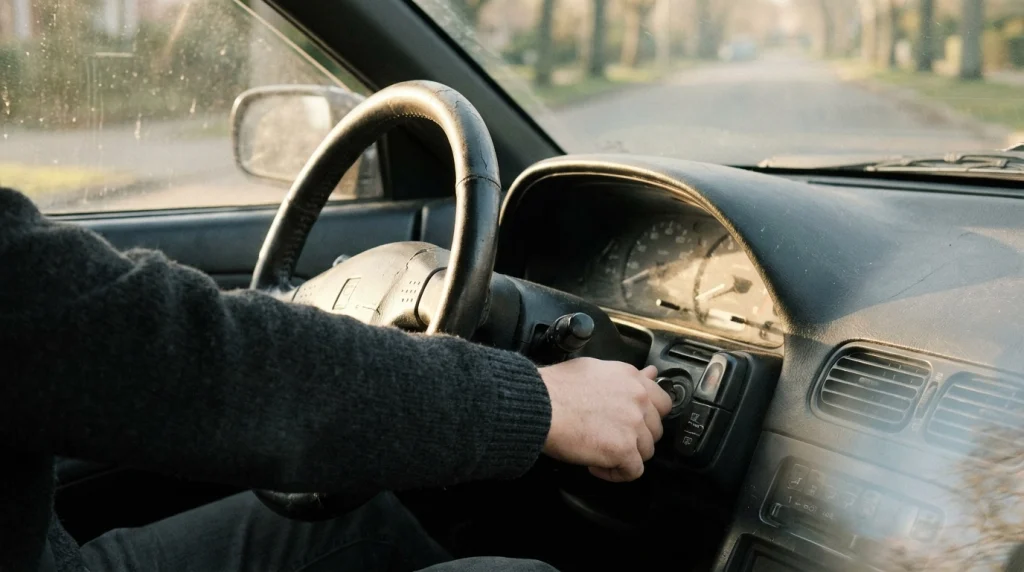
How many clicks do you hear? That count is your best first clue.
Count them carefully the next time you turn the key. One click and silence means something different from a fast machine-gun chatter.
- One loud click, then silence: The solenoid engages once, but the starter motor doesn’t turn. Suspect the starter, solenoid, or a bad connection at the starter itself.
- Fast repeated clicking: The solenoid engages, drops out, and engages again as voltage falls. Suspect a weak battery or a poor battery connection.
- One click, then a slow crank: The starter turns, but slowly and weakly. Suspect a low battery, thick cold oil, or a starter that’s starting to fail.
- No click at all: The signal may never reach the starter. Suspect the ignition switch, a blown fuse, a bad relay, or a dead battery.
Write down what you hear before you start testing. It keeps you from chasing the wrong part.
A push-button start car can sound a little different. You may hear one click from under the hood, or just a faint click behind the dash.
The same logic still applies.
Section takeaway: Fast clicking usually means low voltage, while one solid click usually means the starter or its solenoid, so let the sound guide your next test.
Does the click change when you jump-start it?
A jump-start is a useful test, not just a rescue. If the car cranks normally with a jump, the starter is probably fine and the battery or charging system is the problem.
If it still gives one click with good jumper cables and a running donor car, the starter is more likely at fault. Don’t keep cranking it over and over in that case.
Give it two or three short tries at most. Long cranking heats the starter and drains the donor battery.
Is It a Dead or Weak Battery? How to Check in 5 Minutes
A dead or weak battery is the number one cause of a clicking no-start. Batteries lose strength with age, cold weather, and short trips that never fully recharge them.
Most car batteries last around three to five years, depending on climate and use. Check your owner’s manual and the Car Care Council maintenance guidance for your vehicle’s service interval and the correct battery group size.
You don’t need to be a mechanic to run the first checks. You need your eyes, your hands, and ideally a multimeter.
Safety note: Wear eye protection and gloves when you work around a battery. Keep sparks and flames away, and disconnect the negative cable first if you remove the battery.
Check the age and condition first
Look for a date sticker on the battery case. If it’s more than four years old and the car clicks on a cold morning, treat the battery as a prime suspect.
Look for a swollen case, a cracked case, or a strong sulfur smell. Those are signs the battery has failed inside.
Don’t try to charge a cracked or leaking battery.
Check the electrolyte level only if your battery has removable caps. Many modern batteries are sealed, so don’t force them open.
Use the headlight test
Turn the headlights on and watch them while someone turns the key. If they dim sharply or go out, the battery is too weak to crank.
If the headlights stay bright and the car gives one click, the battery is less likely to be the problem. That points you toward the starter or a connection.
This test isn’t perfect, but it’s fast. I use it every time before I pull out the multimeter.
Test voltage with a multimeter
A multimeter is a small tool that measures electrical voltage. Set it to DC volts, touch red to positive and black to negative, and read the number.
- 12.6 volts or higher: Fully charged at rest. The battery may still fail under load, so don’t stop here.
- 12.4 volts: Partly charged. It may start a warm car but struggle in the cold.
- 12.2 volts or lower: Low charge. Charge it and have it load-tested before you trust it.
- Below 12 volts: Deeply discharged or failed. It may not recover, even after charging.
A parts store can load-test the battery for you. That test puts a real cranking load on it, which a simple voltage reading can’t do.
Section takeaway: A battery can show decent voltage at rest and still fail under load, so use the headlight test and a load test before you rule the battery out.
Corroded or Loose Battery Connections: The Cheap Fix Most People Miss
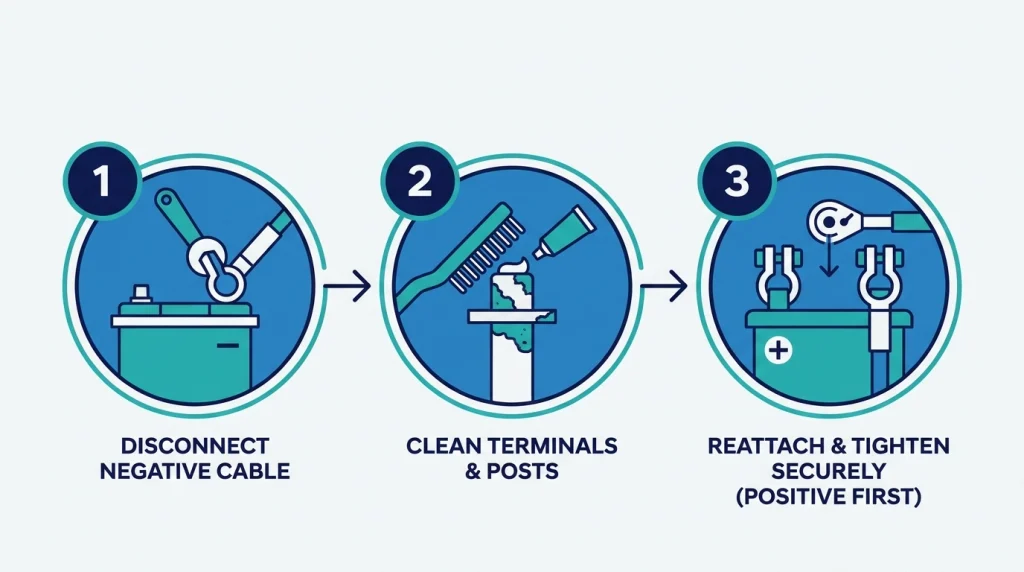
Corrosion is the cheap fix hiding in plain sight. I’ve seen cars towed for a “dead starter” that only needed a terminal cleaning.
Corrosion looks like white, green, or blue crust around the battery terminals. It builds up slowly, so the car starts a little slower each week until one day it just clicks.
Loose cables cause the same symptom. A terminal that moves when you twist it by hand is too loose, even if it looks tight.
How to clean battery terminals safely
Disconnect the negative cable first, then the positive cable. That order reduces the risk of a short circuit.
Scrub the terminals and the inside of the cable ends with a battery brush or an old toothbrush and a mix of baking soda and water. Rinse lightly and dry them fully.
Reconnect positive first, then negative. Tighten each clamp until it doesn’t move, but don’t force it so hard that you crack the terminal.
Safety note: Disconnect the battery before you clean or tighten terminals, and keep metal tools away from both terminals at once.
Check the ground cable too
The ground cable runs from the negative terminal to the body or engine block. If that connection is rusty or loose, power can’t flow back to the battery.
Follow the black cable from the battery and look for rust, fraying, or a loose bolt. Clean the contact point with a wire brush and tighten it.
Also check the positive cable where it meets the starter. That connection lives in a hot, dirty spot and can loosen over time.
Section takeaway: Clean, tight terminals fix more clicking no-starts than most drivers expect, so check connections before you buy any parts.
Bad Starter Motor or Starter Solenoid: Signs, Tests, and Costs
The starter motor is the electric motor that spins your engine to start it. The solenoid sits on or near the starter and acts as its heavy-duty switch.
When the starter fails, you often hear one loud click and nothing else. The lights stay bright, the battery tests fine, and the car still won’t crank.
Starters usually fail slowly. You may notice a slow crank for a few weeks, a grinding noise, or a no-start that fixes itself after a few key turns.
Those are early warnings.
How to tell a starter problem from a battery problem
Jump-start the car with good cables. If it still gives one click, the battery is less likely to be the cause.
Check voltage at the starter if you have a multimeter and can reach the starter safely. Full battery voltage at the starter during cranking, with no crank, points to the starter itself.
Some drivers tap the starter lightly with a hammer while someone turns the key. That can free a stuck starter once, but it’s a short-term trick, not a fix.
Don’t keep tapping it for weeks. A starter that needs a tap is already failing, and it will leave you stranded at the worst time.
Starter vs. solenoid: which one failed?
The solenoid and starter often come as one unit on modern cars. On some older cars, you can replace the solenoid alone.
If you hear the click but the motor never spins, the solenoid may be engaging while the motor is dead. If you hear nothing at all from the starter area, the solenoid may not be getting power.
Your owner’s manual or a repair guide for your make, model, and year will show the layout. Fitment matters here, so confirm the part number and compatibility before you order a replacement, and check NHTSA for any safety recall on your vehicle first.
Starter replacement is one of the pricier fixes in this guide, and shop labour adds to the cost. A remanufactured starter can cost less than a new OEM part, but check the warranty length before you choose.
Safety note: Never work under a car supported only by a jack. Use jack stands, disconnect the battery before starter work, and follow your owner’s manual and torque specs.
Section takeaway: One click with bright lights and a good battery points to the starter, so test with a jump-start before you pay for a replacement.
Could a Bad Alternator Be Behind the Click?
The alternator is the part that recharges your battery while the engine runs. When it fails, the battery slowly drains and the car eventually clicks instead of starting.
This is a sneaky cause. The car starts fine in the morning, then clicks after a few short trips.
Each drive takes more power out of the battery than the alternator puts back.
Watch for warning signs on your last drive. A battery warning light, dimming headlights, or flickering dash lights can mean the alternator isn’t charging.
How to check the charging system
Jump-start the car and let it run. With a multimeter on the battery, you should see a higher reading than the resting voltage, usually in the mid-13 to mid-14 volt range for most cars.
If the reading stays near the resting voltage or keeps falling, the alternator may not be charging. Check your owner’s manual for the expected range for your vehicle.
Also check the serpentine belt that drives the alternator. A loose, cracked, or missing belt can stop the alternator from spinning.
Don’t disconnect the battery while the engine runs to “test” the alternator. That old trick can damage modern electronics.
If the car starts with a jump but dies again soon after, get the battery and alternator tested together. Replacing only the battery when the alternator is bad will leave you with the same click in a few days.
Section takeaway: A bad alternator drains the battery over several drives, so a car that clicks after a jump-start needs a charging system test, not just a new battery.
Other Causes: Ignition Switch, Fuses, Relays, and More
Not every click is a battery or starter problem. Sometimes the signal never reaches the starter at all.
These causes are less common, but they matter when the battery and starter both test fine. Work through them in order, cheapest first.
Ignition switch problems
The ignition switch is the part your key or start button activates. When it wears out, it may send power to the dash but not to the starter.
Signs include a key that feels loose, dash lights that flicker when you turn the key, or a car that starts only if you wiggle the key. Push-button cars can show a similar fault in the start button circuit.
This is a job for a qualified mechanic if you’re not comfortable with steering-column wiring. Airbag wiring lives nearby, so don’t probe it blindly.
Blown fuse or bad starter relay
A starter relay is a small electrical switch that lets a low-power signal control the high-power starter circuit. A fuse is a safety device that breaks the circuit if current gets too high.
Check your owner’s manual for the fuse box location and the starter fuse and relay positions. A blown starter fuse is cheap to replace, but look for the cause if it blows again.
You can often swap the starter relay with an identical relay from a non-essential circuit to test it. Use the exact same part number and rating, and put it back when you’re done.
Other faults to rule out
- Bad ground strap: A corroded engine ground can cause a click even with a good battery.
- Faulty neutral safety switch: An automatic car may not crank unless it knows it’s in Park or Neutral. Try starting in Neutral with your foot on the brake.
- Clutch safety switch: A manual car may not crank unless the clutch pedal is fully pressed.
- Key fob battery: A dead fob battery can stop a push-button car from starting, even when the dash lights up.
- Parasitic drain: Something left on, like a trunk light or an aftermarket accessory, can drain the battery overnight.
- Extreme cold: Cold thickens engine oil and weakens batteries, so a marginal battery fails first on the coldest morning.
Try the Neutral test before you call for a tow. It’s free, it takes ten seconds, and it has saved more than one driver a tow bill.
Section takeaway: When the battery and starter test fine, check the relay, fuse, safety switches, and ground strap before you assume a major repair.
How to Diagnose a Clicking Car Step by Step
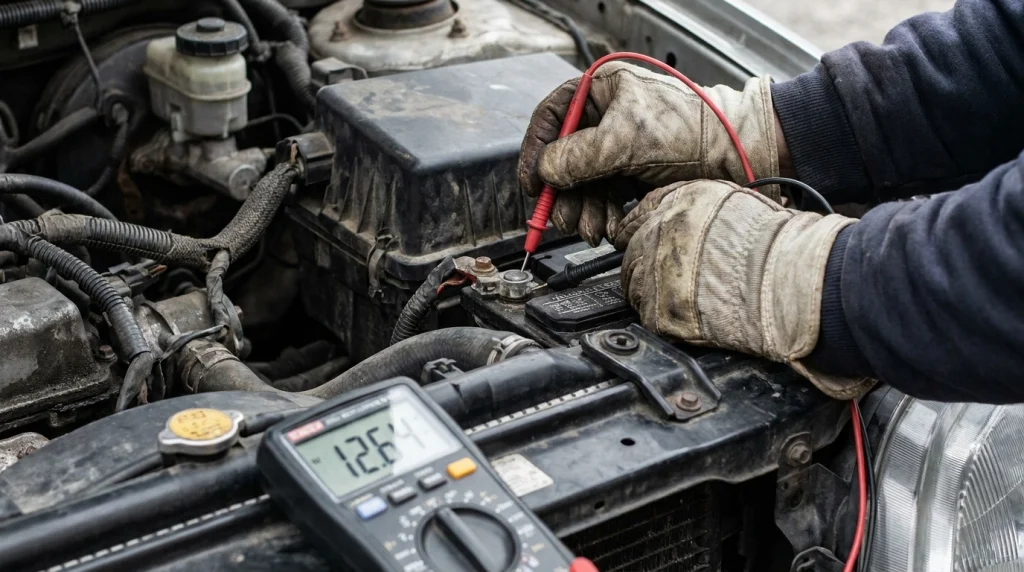
Work in order and don’t skip steps. The cheapest causes come first, and each test narrows the list.
Keep a note of what you find at each step. That note helps a mechanic if you end up calling one, and it stops you from retesting the same thing.
- Listen to the click. Note whether it’s one click, fast clicking, or no click at all.
- Check the lights. Dim or fading lights mean low battery power.
- Inspect the terminals. Look for corrosion, and twist each cable to check for looseness.
- Clean and tighten the connections. Try to start the car again after cleaning.
- Try a jump-start. If it cranks normally, the battery or charging system is the problem.
- Test battery voltage. Use a multimeter, then get a load test at a parts store.
- Try Park or Neutral. For an automatic, try starting in Neutral with your foot on the brake.
- Check fuses and the starter relay. Use your owner’s manual to find the right positions.
- Listen at the starter. One click with a good battery and clean connections points to the starter.
If you get stuck at any step, stop there. Write down where you stopped and what you found, then share that with your mechanic.
| What you hear / see | Most likely cause | First test | Likely fix |
|---|---|---|---|
| Fast repeated clicking | Weak battery or poor connection | Headlight test, voltage test | Charge or replace battery, clean terminals |
| One loud click, lights bright | Bad starter or solenoid | Jump-start test | Replace starter or solenoid |
| One click, slow crank | Low battery or failing starter | Load test the battery | Charge or replace battery, test starter |
| No click, no crank | Ignition switch, fuse, relay, or dead battery | Check fuses, relay, and voltage | Replace fuse or relay, test ignition circuit |
| Clicks, starts with a jump, then dies | Bad alternator | Charging voltage test | Test and replace alternator, check belt |
| Clicks only in cold weather | Weak or ageing battery | Load test, check battery age | Replace battery with correct fitment |
Section takeaway: Follow the steps in order, from the click count to the jump-start test, and the table above will point you to the right cause without guessing.
When to Jump-Start, When to Replace, and When to Call a Mechanic
A jump-start is safe when the battery is simply flat and the cables and terminals are in good shape. Use good-quality jumper cables, connect them in the right order, and follow your owner’s manual.
Don’t jump-start a battery that is cracked, leaking, swollen, or frozen. Don’t jump-start a car with a strong fuel smell or visible damage under the hood.
Call for help instead.
Replace the battery when it fails a load test, when it’s past its expected service life, or when it keeps going flat after a full charge. Match the group size, terminal layout, and cold-cranking rating in your owner’s manual.
Replace the starter when it gives one click with a good battery, when it grinds, or when it only works after a tap. A new starter is a bigger job, and on some cars it sits in a tight spot under the engine.
Call a qualified mechanic when the car still won’t start after the battery, connections, fuses, and relay check out. Call one sooner if you smell burning, see smoke, or find melted wiring.
An ASE-certified technician can test the starter current draw and the charging system properly. That test is worth it before you spend money on a starter you may not need.
As of 2026, the advice hasn’t changed: test before you replace. The click is a clue, not a diagnosis, and a ten-minute check can save you from buying the wrong part.
Section takeaway: Jump-start a healthy-looking flat battery, replace a battery that fails a load test, and get a mechanic to test the starter and charging system before you replace either one.
Frequently Asked Questions
Why does my car click but not start with a new battery?
A new battery can still click if the terminals are loose or corroded, the ground cable is bad, or the starter has failed. Check the connections first, then test the starter.
A new battery can’t fix a bad starter or a poor connection.
Can a bad starter cause rapid clicking?
Rapid clicking usually means low voltage, not a bad starter. A bad starter more often gives one loud click and no crank.
If you hear fast clicking, test the battery and clean the terminals before you suspect the starter.
How do I know if it’s the battery or the starter?
Jump-start the car. If it cranks normally with a jump, the battery or charging system is the problem.
If it still gives one click with a good jump, the starter is more likely at fault. A load test on the battery will confirm it.
Will a jump-start fix a clicking car?
A jump-start can get you moving if the battery is flat, but it won’t fix a bad starter, a bad alternator, or a blown fuse. If the car dies again soon after, get the battery and charging system tested the same day.
Can corroded battery terminals cause a clicking sound?
Yes. Corrosion blocks the high current the starter needs, even when the battery itself is healthy.
Clean the terminals and cable ends, tighten them, and try again. This is one of the cheapest fixes for a clicking no-start.
How long does a car battery last?
Most car batteries last around three to five years, depending on climate, driving habits, and use. Hot climates and frequent short trips shorten battery life.
Check the date sticker and your owner’s manual for your vehicle’s service interval.
Is it safe to drive after a jump-start?
Yes, if the car starts and runs normally with no warning lights, smoke, or strange smells. Drive straight to get the battery and charging system tested.
Don’t turn the engine off for a short stop until you know the battery will restart the car.
If your car clicks but won’t start, start with the battery and the terminals. That simple check solves most cases, and it costs almost nothing.
Work through the steps in order, write down what you find, and don’t guess at parts. If the battery tests fine and you still hear one solid click, get the starter tested by a qualified mechanic before you replace it.

Alex Carter is an automotive content writer at VastAutoParts, focusing on car parts, vehicle troubleshooting, automotive tools, product research, and practical car care guides.