
Why Won’t My Car Start After Replacing the Starter? 7 Causes & Fixes for 2026
Quick Answer
Your car usually won’t start after replacing the starter because the starter was not the real problem, a cable or ground is loose, the battery is weak, or the new starter is faulty. Check the battery, terminals, ground strap, and starter connections first, as AAA car care guidance also stresses, before you buy another part.
Most likely causes
- Weak battery: A new starter still needs full battery power to crank the engine.
- Loose connection: A loose, dirty, or corroded cable can stop power from reaching the starter.
- Bad ground: A poor ground strap breaks the circuit, even with a good battery and starter.
- Faulty new starter: A new or remanufactured starter can arrive defective, especially a cheap one.
- Wrong diagnosis: The original fault may have been the ignition switch, relay, or neutral safety switch.
- Install error: A missed wire, wrong bolt torque, or poor flywheel mesh can cause a no-start or grinding noise.
Do this first
- Turn the headlights on and try to start the car. If they dim badly or go out, test the battery first.
- Wiggle the battery cables gently and check for heat, corrosion, or looseness. Do not force a hot cable.
- Listen for a single click, rapid clicking, or silence. Each sound points to a different fault.
I’ve been there, and it’s a frustrating feeling.
You just spent a Saturday under the car, fitted a new starter, and turned the key with hope. Then nothing happened, or you heard one sad click.
That moment does not always mean you bought a bad starter. In my experience, the starter is often blamed for a fault that lives somewhere else in the starting system.
This guide walks through the real causes, in the order I check them. You’ll learn how to test the battery, cables, ground, relay, and new starter, spot common install mistakes, and decide when a shop should take over.
In This Guide
- Why won’t my car start after replacing the starter?
- Did the new starter fix the original problem?
- How do I know if the new starter is bad?
- What should I check first after a starter replacement?
- What does each no-start sound mean?
- What installation mistakes cause a no-start?
- OEM vs aftermarket vs remanufactured starter: which should I choose?
- When should I call a mechanic instead of trying again?
- Frequently asked questions
Why won’t my car start after replacing the starter?
The short answer is that a starter is only one link in a chain.
That chain starts at the battery, runs through cables, fuses, a relay, the ignition switch, and safety switches, then ends at the starter motor and the flywheel.
If any link fails, the engine will not crank. A brand-new starter cannot fix a dead battery, a broken ground, or a faulty relay.
Most no-starts after a replacement fall into three groups. The first group is power problems, like a weak battery or corroded terminals.
The second group is control problems, like a bad starter relay, ignition switch, or neutral safety switch. The third group is the starter itself, either a defective unit or a poor install.
I learned this the hard way on an old sedan years ago. I replaced the starter in my driveway, then heard the same single click.
The real fault was a ground strap that looked fine but had corroded under its bolt. A ten-minute clean and a new strap fixed what a new starter could not.
Safety note: disconnect the negative battery cable before you touch starter wiring, and use jack stands if you lift the car. Never work under a car held up by a jack alone.
Section takeaway: A new starter only helps if the starter was the fault, so test power and control parts before you blame the new unit.
Did the new starter fix the original problem?
Not always, and that is the first question to ask.
Many drivers replace a starter because the car clicked, cranked slowly, or would not start at all. Those same symptoms can come from a weak battery, a bad cable, or a faulty relay.
Start by asking what changed after the swap. Did the sound change, or is it exactly the same as before?
If nothing changed, the original fault is probably still there. If the sound changed, the new starter may have exposed the next weak link.
What is a starter motor?
A starter motor is a small electric motor that turns the engine over until it can run on its own.
When you turn the key or press the start button, a solenoid pushes a small gear into the flywheel, also called the ring gear. The motor then spins the flywheel, and the engine cranks.
If the solenoid clicks but the motor does not spin, power may not be reaching the motor. If the motor spins but the engine does not, the gear may not be engaging the flywheel.
How to tell if the starter was the wrong guess
- Same symptom, same sound: The fault is likely upstream, in the battery, cables, or control circuit.
- Slow crank before and after: Check battery voltage and cable resistance before you blame the starter.
- Click only, no crank: Test the battery first, then the solenoid signal wire.
- Car starts with a jump: The battery or charging system is the prime suspect, not the starter.
- Car starts in neutral, not park: The neutral safety switch may be worn or out of adjustment.
Write down the symptom before you touch another bolt. That note saves time, and it stops you from chasing the same guess twice.
Section takeaway: If the symptom did not change at all, look past the starter and test the battery, cables, and control circuit first.
How do I know if the new starter is bad?
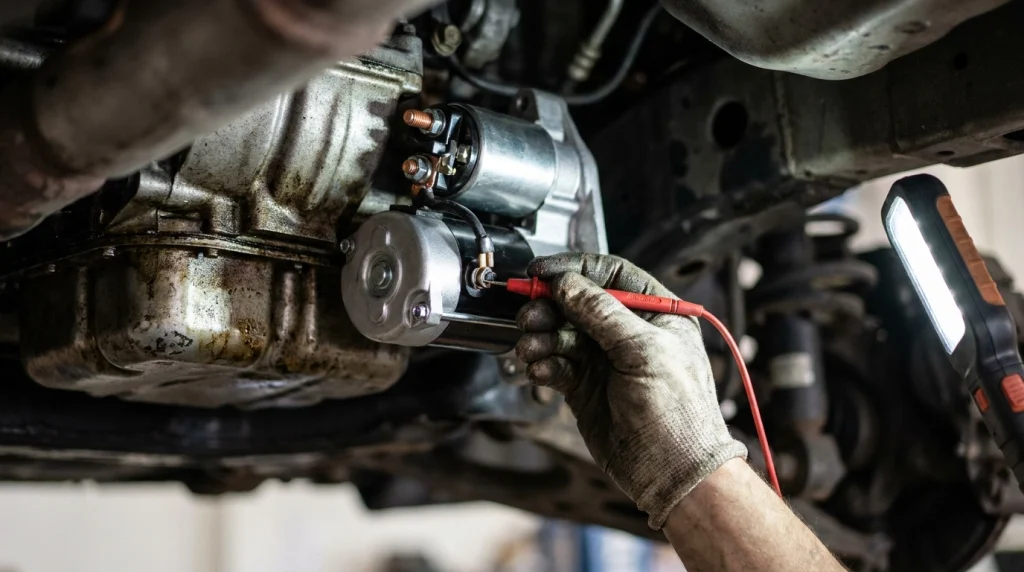
A new starter can be bad straight out of the box.
It happens more with cheap remanufactured units, but even a quality part can fail early. The key is to test it before you remove it again.
Listen first
A single loud click usually means the solenoid is working but the motor is not getting enough power.
Rapid clicking usually means low voltage. Silence usually means no signal is reaching the solenoid at all.
A grinding noise is different. It often means the starter gear is not meshing cleanly with the flywheel, or the flywheel teeth are damaged.
Test the solenoid signal wire
You can test the signal with a multimeter or a test light, with a helper turning the key.
With the key in the start position, the small signal wire at the solenoid should show battery voltage. If it shows no voltage, the fault is upstream.
If it shows full voltage and the starter still does nothing, the starter or its main power feed is the suspect. Check the large cable next.
Safety note: keep hands, tools, and loose clothing away from belts and fans while a helper cranks the engine. Disconnect the battery before you remove starter bolts.
Test the main power feed
- Check voltage at the starter: The large terminal should read close to battery voltage, usually within half a volt.
- Check voltage drop while cranking: A large drop across a cable points to corrosion or a loose connection.
- Check the ground: Test from the starter housing to the negative battery terminal. A high reading means a poor ground.
- Tap test, with care: A light tap on the starter body can free a stuck solenoid, but it is a diagnostic clue, not a fix.
If power and signal are both good and the starter still will not crank, the new starter is likely faulty. Keep your receipt and warranty paperwork before you pull it out.
Section takeaway: Good signal plus good power plus no crank points to the starter itself, while missing signal or low voltage points elsewhere.
What should I check first after a starter replacement?
Work in order, from easy to hard.
That order saves money and keeps you from removing a good starter twice. I check the battery, then cables, then fuses and relays, then safety switches.
1. Battery and terminals
A battery can show 12 volts at rest and still fail under load.
Have it load-tested at a parts store if you can. Many stores test batteries for free, and the test takes only a few minutes.
Clean the terminals until the metal shines. Corrosion hides under the clamp, where you cannot see it at a glance.
Tighten each clamp so it does not move by hand. A clamp that spins is not tight enough, even if it looks seated.
2. Cables and ground straps
Follow the positive cable from the battery to the starter, and the negative cable to the body and engine.
Look for swollen insulation, green or white corrosion, melted spots, and loose bolts. Flex a cable gently and feel for stiffness or cracking inside.
Pay close attention to the engine ground strap. It often bolts to a painted surface or a rusty bracket, and that breaks the connection.
Remove the ground bolt, clean both surfaces to bare metal, and refit it. That simple step has fixed more no-starts for me than any new part.
3. Fuses, relays, and the ignition switch
Find the starter fuse and starter relay in your owner’s manual or fuse-box lid.
A blown fuse is easy to spot, and a relay can be swapped with a matching relay from a non-critical circuit for testing. Do not swap relays with different part numbers.
If the relay clicks but the starter does not, power may be missing on the relay’s output side. If the relay does not click, the ignition switch or safety switch may not be sending a signal.
Try starting in neutral instead of park, with your foot firmly on the brake. If it starts in neutral, the neutral safety switch, also called the transmission range sensor, needs attention.
4. Immobilizer and key issues
Modern cars will not crank if they do not recognize the key.
Look for a flashing security light on the dash. A spare key is a quick test, if you have one.
A weak key fob battery can also cause trouble on push-button cars. Try holding the fob against the start button, as your owner’s manual describes.
If the security light stays on, do not keep cranking. Check your manual for the reset steps, or call a dealer or locksmith.
Safety note: disconnect the battery before electrical work, and follow your owner’s manual and torque specs. If you are unsure about airbag wiring near the steering column, leave the ignition switch to a qualified mechanic.
Section takeaway: Battery, cables, ground, fuse, relay, and safety switch checks take less than an hour, and they solve most post-replacement no-starts.
What does each no-start sound mean?
Sound is your fastest clue.
Listen once, write it down, and match it to the table below. That stops you from guessing at random.
| What you hear | Most likely cause | Check first |
|---|---|---|
| Silence, no click | No signal to solenoid, dead battery, blown fuse, or immobilizer fault | Battery, fuse, relay, neutral safety switch |
| Single loud click | Solenoid works, motor lacks power, or starter is faulty | Battery voltage, main cable, ground, starter |
| Rapid clicking | Low battery voltage or poor connection | Load-test battery, clean terminals |
| Slow, labored crank | Weak battery, corroded cable, or wrong starter fitment | Battery, cables, starter part number |
| Whirring, engine does not turn | Starter gear not engaging flywheel | Starter mounting, flywheel teeth |
| Grinding noise | Gear mesh problem, loose starter, or damaged flywheel | Bolt torque, shims, flywheel inspection |
| Cranks fine, will not fire | Fuel, spark, or sensor fault, not a starter fault | Fuel, ignition, OBD2 codes |
Note the last row carefully.
If the engine cranks at normal speed but will not start, the starter has done its job. The fault is now in fuel delivery, spark, or engine sensors.
That distinction matters, because it stops you from replacing a starter that is already working. A scan with an OBD2 scanner can point to the next step.
Section takeaway: Match the sound to the cause first, and you will test the right part instead of replacing parts at random.
What installation mistakes cause a no-start?
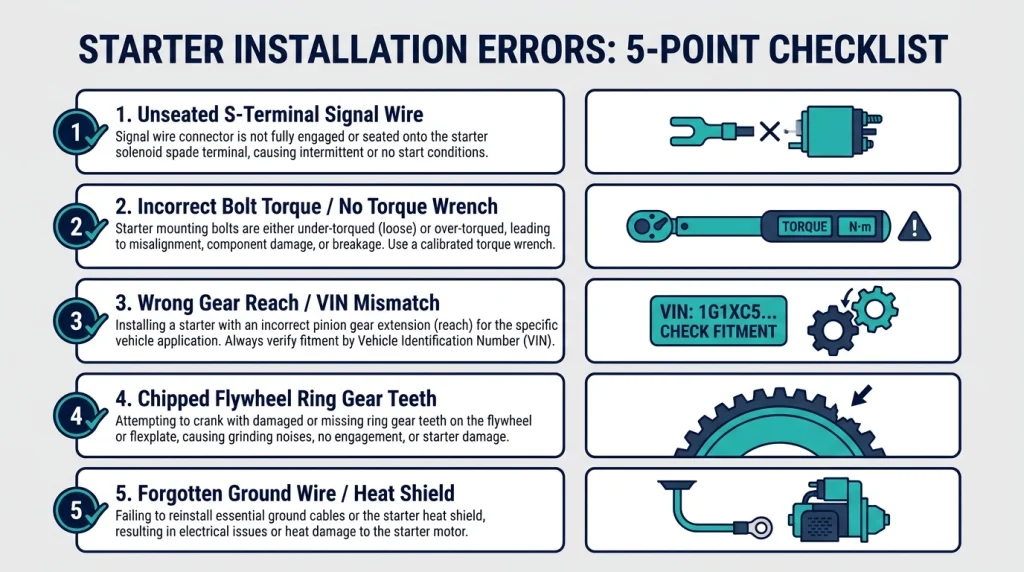
Even a good starter will fail if it is fitted badly.
I have made two of these mistakes myself, and both cost me a second afternoon under the car. Check each one before you order another part.
Missed or swapped wires
Starters usually have one large power cable and one small signal wire.
The signal wire is easy to miss, especially if it fell behind the starter during fitting. A loose signal wire gives you silence when you turn the key.
Take a photo before you remove the old starter. That photo is worth more than any diagram when you are tired and working by feel.
Loose mounting bolts or wrong torque
Starter bolts need the torque spec from your owner’s manual or service guide.
Too loose, and the starter can shift and grind against the flywheel. Too tight, and you can crack the housing or strip the threads.
Use a torque wrench, not guesswork. Clean the mounting surface first, so the starter sits flat.
Wrong starter for your trim or engine
Fitment is more than make and model.
The same car name can use different starters by year, trim, engine, and transmission. A part that looks right can still have the wrong gear, bolt pattern, or power rating.
Confirm fitment with your VIN, or a part-number cross-reference, before you buy. Check the part number on the old starter against the new one.
That check takes five minutes. I once ordered a starter that fit the bolt holes but had the wrong gear depth, and it ground every time I cranked.
Damaged flywheel teeth
A worn flywheel, or ring gear, can stop a new starter from engaging.
Look through the starter opening for chipped or missing teeth. Turn the engine by hand, with the battery disconnected, to check the full ring.
If teeth are damaged in one spot, the car may start sometimes and fail at other times. That pattern is a classic flywheel clue.
Forgotten ground or heat shield
Some cars have a separate ground wire on a starter bolt.
If you leave it off, the starter may click but not crank. Refit every wire you removed, even if it looks minor.
Refit the heat shield too, where fitted. Exhaust heat can shorten a starter’s life fast without it.
Section takeaway: Photos, VIN fitment checks, correct torque, and every wire refitted will prevent most install-related no-starts.
OEM vs aftermarket vs remanufactured starter: which should I choose?
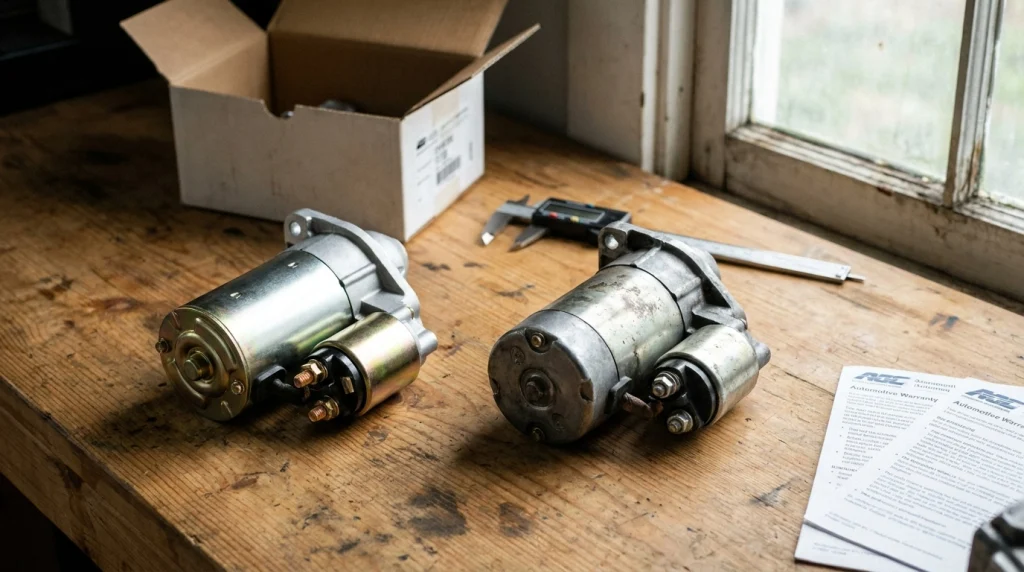
The starter you choose affects both reliability and warranty.
An OEM part is made by the vehicle maker or its original supplier, to the original spec. An aftermarket part is made by another company, often to a similar spec at a lower price.
A remanufactured part is a used starter that has been rebuilt with new wear parts and tested. Quality varies a lot by brand and seller.
| Starter type | Best for | Watch out for |
|---|---|---|
| OEM | Exact fit, long-term ownership, newer cars | Highest cost, dealer-only supply for some models |
| Quality aftermarket | Good value from a known brand, with a solid warranty | Check fitment by VIN and warranty length |
| Remanufactured | Budget repairs on older cars, when tested by a trusted brand | Higher early-failure risk, shorter warranty, core charge |
| Budget no-name | Rarely the best choice, even on a tight budget | Weak solenoids, poor fit, limited support |
For a daily driver, I lean toward OEM or a known aftermarket brand like Bosch, Denso, or ACDelco.
Check the warranty in writing before you buy. A longer warranty often signals better testing, and it protects you if the new starter fails early.
Keep the old starter until the new one proves itself. Many remanufactured sales need the old unit as a core return, and you may need its part number again.
For broader safety and recall checks, see the NHTSA safety and recalls site. For general upkeep, the Car Care Council has plain-language maintenance guides, and Consumer Reports car advice can help you compare long-term reliability.
Section takeaway: Buy the best starter your budget allows, confirm fitment by VIN, and keep the warranty paperwork until the car starts reliably.
When should I call a mechanic instead of trying again?
Some no-starts are simple, and some are not.
Call a shop if you have tested the battery, cables, ground, fuse, and relay, and the car still will not crank. A shop can run a voltage-drop test and check the control circuit in minutes.
Call a shop sooner if you see burnt wiring, a melted connector, or a strong fuel smell. Those signs point to a fault that needs proper diagnosis.
Also call a shop if the starter is hard to reach, or if you need to lift the car high to work safely. A starter buried under an intake manifold is not a good first DIY job.
Ask the shop to show you the test results, not just the new part. A good mechanic will explain the voltage readings and why the old part failed.
As of 2026, a typical DIY starter swap takes two to four hours for an accessible starter. A shop diagnosis usually takes under an hour, and that hour can save you from buying a second starter you do not need.
Section takeaway: If the basic checks are clean and the car still will not crank, pay for a diagnosis before you pay for another part.
Frequently asked questions
Why does my car click once after a new starter?
A single click often means the solenoid is working but the motor is not getting enough power. Check the battery, main cable, and ground first, then test the starter itself.
Can a new starter be bad out of the box?
Yes, it can, especially a cheap remanufactured unit. Test signal voltage and main power at the starter before you remove it, and keep your warranty receipt.
Why won’t my car start with a new starter and a new battery?
The fault is likely in the cables, ground strap, fuse, relay, ignition switch, or neutral safety switch. Test each link in order, and do not assume two new parts mean the circuit is sound.
How do I test a starter without removing it?
Check battery voltage, then check signal voltage at the small solenoid wire while a helper turns the key. If both are good and the starter does nothing, the starter or its main feed is faulty.
Can a bad ground cause a no-start after replacing the starter?
Yes, a bad ground is one of the most common causes. Clean the ground strap bolt and mating surface to bare metal, then refit it tightly and test again.
Should I replace the starter relay too?
Not automatically, but test it. Swap it with a matching relay for a quick test, or test it with a multimeter, and replace it only if the test shows a fault.
Is it safe to jump-start a car after replacing the starter?
A jump can help if the battery is weak, but it will not fix a bad cable, ground, or starter. Use proper jump leads, follow your owner’s manual, and stop if you see sparks, smoke, or a hot cable.
If your car still won’t start after these checks, don’t keep cranking it. A flat battery and a hot starter will only make the next test harder.
Work through the list once more, write down what you tested, and take those notes to a mechanic if you need help. That list will save you time, money, and a second starter you may not need.

Alex Carter is an automotive content writer at VastAutoParts, focusing on car parts, vehicle troubleshooting, automotive tools, product research, and practical car care guides.