
Why Does My Car Only Start After Multiple Attempts? 7 Fixes
Quick Answer
Why does my car only start after multiple attempts? Most often a weak battery, corroded terminals, a failing starter, or low fuel pressure is to blame, and the engine usually catches once the part warms up or finally gets enough power, fuel, or spark. Check the battery terminals and listen for a click first, then work through fuel and ignition causes before you replace any part. AAA car care guidance is a good place to confirm basic battery and starting-system checks.
Most likely causes
- Weak battery: It has just enough charge to crank slowly, then fails on the first try.
- Dirty terminals: Corrosion blocks power, so the starter gets a weak, uneven feed.
- Failing starter: It turns sometimes and sticks other times, often when hot.
- Low fuel pressure: The engine cranks but gets no fuel until pressure builds.
- Worn spark plugs: A weak spark fails to light the fuel mix on early tries.
- Bad crank sensor: The engine computer gets no clear signal to fire the plugs.
Try this first
- Turn the key to ON for three seconds, off, then ON again before you crank.
- Note whether the crank sounds slow, fast, or normal, and whether it is worse cold or warm.
- Stop after three failed tries and let the starter cool for a minute.
I have had this exact morning. You turn the key, the engine coughs, and nothing happens.
You try again, then again, and on the fourth try it fires up like nothing was wrong. This guide walks through why that happens, how to narrow it down in ten minutes, and what to fix first.
In This Guide
- What does it mean when your car only starts after multiple attempts?
- Why does my car only start after multiple attempts? The 7 most common causes
- How can I diagnose it in 10 minutes?
- Why is it worse on cold mornings, or only when the engine is warm?
- Battery vs starter vs fuel vs spark: how do I tell them apart?
- What should I fix first, and what does it usually cost?
- When should I stop trying and call a mechanic?
- How do I stop it from happening again?
- Frequently asked questions
What does it mean when your car only starts after multiple attempts?
A hard start is when the engine needs several cranks before it catches and runs on its own. The starter may turn, the engine may sputter, or you may hear a click and then silence.
A healthy engine needs four things at the same time: enough cranking power, fuel at the right pressure, a strong spark, and clean air. If one of those arrives late, the engine will crank without firing.
Repeated tries can mask the fault. Heat, vibration, or a second fuel-pump prime can push a weak part over the line.
Is it the same as a car that will not start at all?
No, and the difference helps your diagnosis. A car that never starts has a part that has failed outright.
What should I notice before I touch anything?
- Slow crank: The engine turns over lazily, like it is tired.
- Fast crank, no fire: The starter spins well, but the engine never catches.
- Single click: You hear one click and the starter does not turn.
- Rapid clicks: The starter chatters, which often means low voltage.
- Cold only: The fault shows up on the first start of the day.
- Warm only: The fault shows up after a short stop, such as a fuel stop.
Section takeaway: A car that starts after several tries still has a fault, and the crank sound plus the cold-or-warm pattern tells you which system to check first.
Why does my car only start after multiple attempts? The 7 most common causes
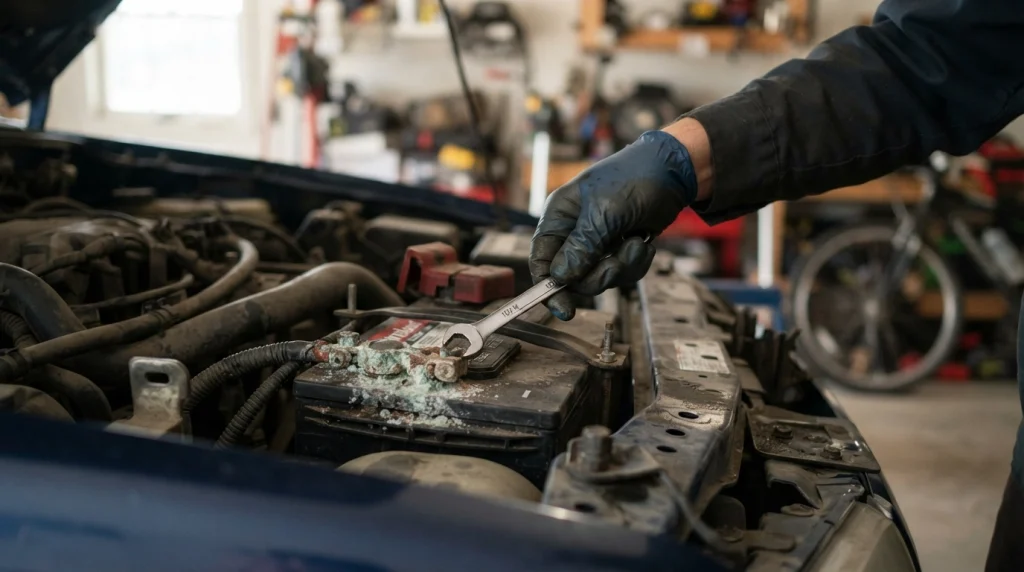
These seven causes cover most cases I see on daily drivers. Start at the top, because the first three are the cheapest to check.
1. A weak or dying battery
A battery is a chemical part, and it loses strength with age and cold. It may still light the dash, yet fail to spin the starter fast enough.
Watch for dim headlights during cranking, a slow turn, and trouble on cold mornings. Most car batteries last around three to five years, so check the date sticker if you are unsure.
2. Corroded or loose battery terminals
Corrosion is the white, blue, or green crust that grows on battery posts. It acts like a bad connection, so power reaches the starter in fits and starts.
Clean the posts and clamps, then tighten them until they do not twist by hand. This ten-minute job fixes more hard starts than most owners expect.
Safety note: Disconnect the battery before you clean or tighten terminals, negative cable first, and keep tools away from both posts at once.
3. A failing starter motor or starter solenoid
The starter is the electric motor that turns the engine over. The solenoid is the small switch that feeds it power and pushes its gear into place.
When either part wears out, it works on some tries and sticks on others. Heat makes it worse, so a warm restart often fails first.
A single loud click with no crank points here. So does a starter that spins but does not engage the engine.
4. Low fuel pressure or a weak fuel pump
The fuel pump must build pressure before the injectors can spray fuel. If the pump is weak, or the pressure leaks back overnight, the first cranks get little fuel.
Turning the key to ON twice before you crank often helps here. That primes the pump and builds pressure before the starter turns.
Safety note: Fuel work needs care, so keep sparks and flames away, work outside, and let a qualified mechanic handle a leaking fuel line.
5. Worn spark plugs or weak ignition coils
Spark plugs light the fuel and air mix in each cylinder. Worn plugs make a weak spark, and the mix may not light until several tries.
Plugs are a wear item with a set service interval in your owner’s manual. If they are past due, replace them before you blame the starter.
6. A bad crankshaft position sensor
The crankshaft position sensor tells the engine computer where the crank is and how fast it turns. Without that signal, the computer does not know when to fire the plugs.
A failing sensor often works when cold and drops out when hot. The engine may crank well, stall after starting, or refuse until it cools down.
7. A faulty ignition switch or a weak key fob battery
The ignition switch sends power to the starter and the fuel system when you turn the key. Worn contacts inside it can drop power on the first try and connect on the next.
On push-button cars, a weak fob battery can cause the same dance. The car may not see the key until you hold the fob close to the button.
Section takeaway: Check the battery, terminals, and fuel prime first, because those three fixes are cheap and they rule out the most common causes in minutes.
How can I diagnose it in 10 minutes?
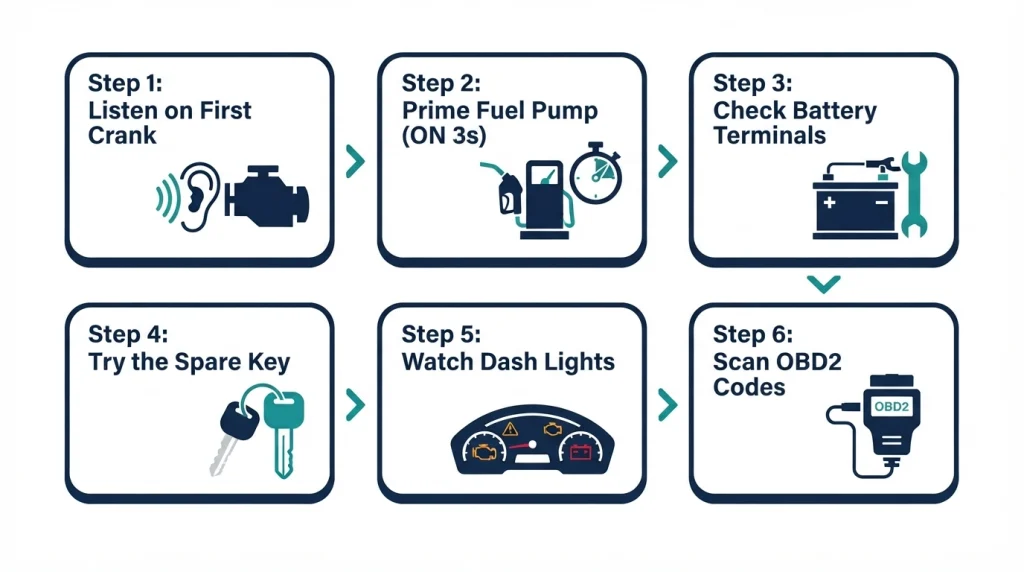
You do not need a full tool kit for the first pass. You need your ears, your eyes, and a note of what changes between tries.
- Listen on the first crank: Slow, fast, click, or chatter tells you which system to check.
- Prime the fuel pump: Turn the key to ON for three seconds, off, then ON again before you crank.
- Check the terminals: Look for crust, loose clamps, or a cable that twists by hand.
- Try the spare key: This rules out a worn key or a weak fob battery in seconds.
- Watch the dash: Dimming lights during crank point to the battery, while steady lights point elsewhere.
- Scan for codes: An OBD2 scan can reveal a crank sensor or misfire code, even with no check engine light.
If priming the pump fixes it, the fault is in fuel pressure. If the crank is slow, the fault is in power.
Safety note: Disconnect the battery before electrical work, and never crank the starter for more than ten seconds at a time.
Section takeaway: Listen first, prime the pump, check the terminals, and scan for codes, because those four steps split the fault into power, fuel, or spark.
Why is it worse on cold mornings, or only when the engine is warm?
Cold and warm faults point at different parts. The pattern is one of the best clues you have, so note it every time.
Why does cold weather make it worse?
Cold thickens engine oil and slows the battery’s chemical reaction. The starter must work harder, and a weak battery has less to give.
If your car starts fine all day but struggles at dawn, test the battery first. A load test, not just a voltage check, shows its real strength.
Why does it fail only when the engine is warm?
Heat expands metal and raises electrical resistance. A worn starter or a failing crank sensor often works cold and fails hot.
This is the classic fuel-stop failure. You drive, you stop for five minutes, and the car will not start until it cools.
Section takeaway: Cold-only trouble points to the battery and fuel pressure, while warm-only trouble points to the starter and crank sensor.
Battery vs starter vs fuel vs spark: how do I tell them apart?
These four systems fail in different ways. Use the table below to match what you hear and see to the likely cause.
| What you notice | Likely system | Quick check | Fix difficulty |
|---|---|---|---|
| Slow crank, dim lights | Battery or terminals | Load test, clean terminals | Easy DIY |
| Single click, no crank | Starter or solenoid | Check voltage at starter | Shop job for most owners |
| Fast crank, no fire | Fuel pressure | Prime key twice, listen for pump | Moderate to shop job |
| Cranks, sputters, then dies | Spark plugs or coils | Check plug age, scan for misfire | Easy to moderate DIY |
| Cranks well, stalls when hot | Crank sensor | OBD2 scan for sensor code | Shop job for most owners |
The Car Care Council lists battery, starting, and charging checks in its regular service guidance. Use it to build a simple seasonal check list.
Section takeaway: Match the crank sound to the table, because slow means power, a click means starter, and a fast crank with no fire means fuel or spark.
What should I fix first, and what does it usually cost?
- Clean terminals: Low cost, ten minutes, and it fixes many hard starts outright.
- Test the battery: A load test is cheap or free at many parts stores, and it ends the guessing.
- Replace worn plugs: A routine service item, with a clear interval in your owner’s manual.
- Check fuel pressure: A gauge test confirms a weak pump before you replace it.
- Replace the starter: A bigger job, so confirm it with a voltage test first.
Section takeaway: Start with terminals, a battery test, and plugs, and only move to a starter or fuel pump once a test points at it.
When should I stop trying and call a mechanic?
Repeated cranking can drain the battery and overheat the starter. Three failed tries is a good place to stop and think.
Call a mechanic sooner if you smell fuel, see smoke, hear grinding, or spot a leak. Those signs mean the fault is no longer a simple hard start.
The NHTSA site is the place to check for safety recalls on your year and model. A recall can explain a starting fault, and it may be fixed at no charge.
Look for an ASE-certified technician when you book the job. ASE is the group that certifies auto technicians, and its directory is a useful starting point, as noted on ASE.
Section takeaway: Stop after three failed tries, and call a mechanic at once for fuel smell, smoke, grinding, leaks, or a flashing check engine light.
How do I stop it from happening again?
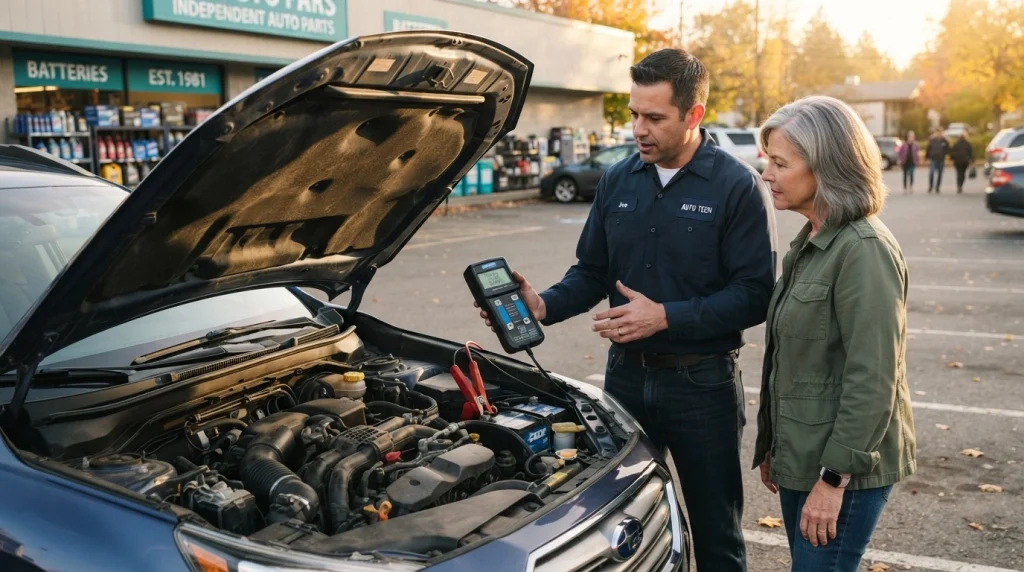
A hard start is a warning, not a quirk. Small habits keep the starting system healthy and catch the next weak part early.
- Clean terminals twice a year: Check them in spring and before winter, when cold exposes weak batteries.
- Test the battery yearly: Test it before winter, and sooner if it is over three years old.
- Follow plug intervals: Replace spark plugs on the schedule in your owner’s manual, not when they fail.
- Keep fuel above a quarter tank: The pump stays cooler when it sits in fuel, and it primes faster.
- Drive it regularly: Short trips alone can leave a battery undercharged, so take a longer drive each week.
Consumer Reports notes that regular maintenance and early battery testing prevent many no-start calls. That matches what I see in the driveway.
Section takeaway: Clean terminals, test the battery before winter, follow plug intervals, and log each hard start so the next fault is easy to trace.
Frequently asked questions
Why does my car start on the second try but not the first?
The first try often primes the fuel pump or warms a weak connection. On the second try, pressure is up or contact is made, so the engine catches.
Can a bad battery cause a car to start after multiple attempts?
Yes, a weak battery is the most common cause. It may spin the starter slowly on the first try, then catch once the engine turns a little faster or the terminals warm up.
Why does my car only start after multiple attempts when it is cold?
Cold slows the battery and thickens oil, so the starter needs more power. A battery near the end of its life often fails on cold mornings first.
Why does my car start fine in the morning but not after a short stop?
Heat is the likely cause, often a worn starter or a failing crank sensor. Both parts can work cold and drop out when hot, then work again after cooling.
Is it safe to keep driving if my car starts after a few tries?
It is risky, because a weak part can fail outright without warning. Get the battery tested and scan for codes soon, and avoid long trips until you know the cause.
How many times should I try to start my car before I stop?
Try three times, with a short pause between each try. If it still will not start, let the starter cool and check the battery, terminals, and fuel prime before you try again.
If your car only starts after multiple attempts, do not treat it as a quirk. Note the crank sound, the cold-or-warm pattern, and how many tries it takes.
Clean the terminals, test the battery, and prime the fuel pump first. Those three checks solve many cases, and they give your mechanic a clear story if the fault runs deeper.

Alex Carter is an automotive content writer at VastAutoParts, focusing on car parts, vehicle troubleshooting, automotive tools, product research, and practical car care guides.