
Why Does My Push Button Car Not Start When Pressing the Brake? 7 Fixes
Quick Answer
Why does my push button car not start when pressing the brake? In most cases the car never sees the brake press, so the start button stays locked out. A failed brake light switch, a weak key fob battery, a low car battery, or a car left in gear is usually behind it, as NHTSA safety guidance also stresses fixing brake faults before driving on.
Most likely causes
- Brake switch failure: The pedal sensor does not send the start signal.
- Weak key fob: The car cannot detect the fob inside the cabin.
- Low car battery: There is not enough power to wake the system.
- Wrong gear position: The car must be in Park or Neutral to start.
Try this first
- Press the pedal firmly, watch for brake lights, then press the start button once.
- Hold the fob against the start button and try again.
I’ve stood in a driveway with a push-button car that just blinked at me. The brake felt firm, the button lit up, and nothing happened.
This guide walks through the start chain in order. You’ll learn which part usually fails, and what to test before you pay for a tow.
In This Guide
- How Does a Push-Button Start System Work?
- Why Isn’t My Car Detecting the Brake Pedal?
- Could a Dead Key Fob Stop the Car From Starting?
- What If the Brake Is Fine but the Car Still Won’t Start?
- Is the Gear, Steering Lock, or Security System Blocking the Start?
- How Do I Diagnose a Push-Button Car That Won’t Start?
- What Does Each Symptom Mean?
- How Can I Prevent This From Happening Again?
- Frequently Asked Questions
How Does a Push-Button Start System Work?
A push-button start system replaces the metal key with a short checklist. The car checks the fob, the brake pedal, and the gear position before it cranks.
An immobilizer is the security system that checks the fob’s signal before it allows the engine to start. A brake light switch is the small sensor on the brake pedal that tells the car you are pressing it.
When you press the brake and the button, the car sends a signal to the starter. If one check fails, the starter never gets that signal.
I learned this on a neighbour’s SUV. The fob was in a bag in the back seat, and the car kept saying it could not find the key.
Here is the normal start sequence, in order:
- Fob detected: The car finds the smart key inside the cabin.
- Brake pressed: The brake light switch sends a clear signal.
- Gear checked: The transmission confirms Park or Neutral.
- Button pressed: The start button sends the crank request.
- Engine cranks: The starter turns the engine over.
Safety note: never bypass the brake interlock as a habit. It exists to stop an unintended start, so fix the fault behind it.
Section takeaway: Your car is not ignoring you. It is waiting for the fob, brake, and gear checks to pass, and one failed check stops the start.
Why Isn’t My Car Detecting the Brake Pedal?
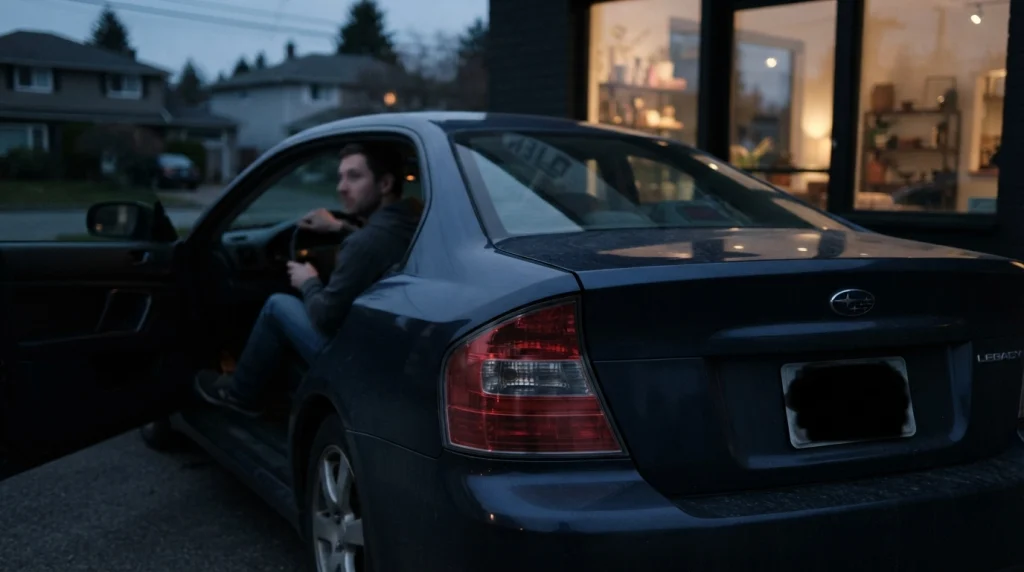
The brake light switch is the most common cause here. It sits above the brake pedal and wears out with every press.
When it fails, the pedal moves but the car sees nothing. The brake lights stay dark, and the start button does nothing.
Check the brake lights first. Ask someone to watch them while you press the pedal, or back up to a shop window at night.
If the lights stay off, the switch is a strong suspect. If they come on, the switch is likely working and the fault sits further along the chain.
A hard pedal can fool you too. After the engine stops, the brake booster loses its stored vacuum after a few presses.
The pedal then feels stiff and barely moves. Press it firmly with steady force, not a light tap.
A blown brake light fuse can cause the same symptom. The switch may work, but the signal never reaches the start system.
Check your owner’s manual for the brake fuse location. A loose plug at the switch or a corroded pin can break the signal in the same way.
Watch for these signs of a brake switch problem:
- No brake lights: The lights stay off when you press the pedal.
- Intermittent starts: The car starts only after several hard presses.
- Cruise control fault: Cruise will not set or drops out on its own.
- Stuck in Park: The shift lever will not move out of Park.
Safety note: do not drive with a faulty brake light switch. Other drivers cannot see you braking, so fix the switch before you drive the car.
Section takeaway: If the brake lights stay dark, suspect the brake light switch, its fuse, or its connector before you blame the starter or the fob.
Could a Dead Key Fob Stop the Car From Starting?
Yes, a weak fob is one of the top causes. The fob uses a small coin battery, and it fades slowly rather than failing all at once.
Early signs are easy to miss. You need to stand closer to unlock the doors, or you press the unlock button twice.
When the battery gets too weak, the car cannot detect the fob inside the cabin. Many cars show “key not detected” or a key warning light on the dash.
Try the backup method first. Hold the fob flat against the start button, then press the button with the fob still touching it.
Most cars have a backup sensor near the button for this exact case. If that works, replace the fob battery soon.
A second fob is a useful test. If the spare starts the car and the main fob does not, the main fob is the problem.
Interference can block the signal too. A phone, a metal case, or another fob in the same pocket can confuse the sensor.
Move the fob away from other electronics and try again.
Section takeaway: A fob that works from a distance may still be too weak for the cabin sensor, so test it against the start button and try the spare fob.
What If the Brake Is Fine but the Car Still Won’t Start?
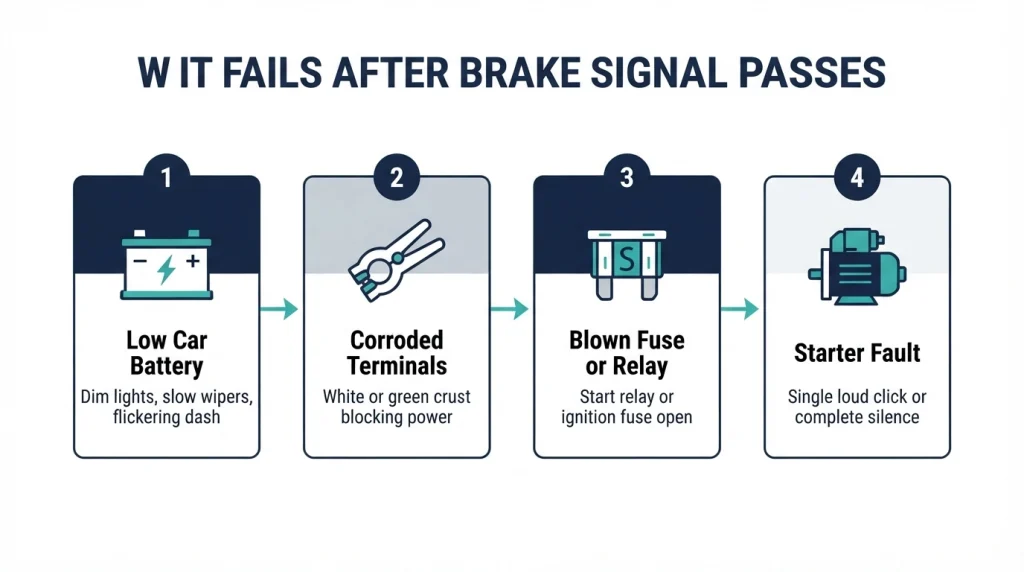
A weak car battery can look like a brake problem. The dash lights up, the button responds, but the starter clicks or does nothing.
Push-button systems need a healthy battery to wake up. The computers, sensors, and starter all draw power at once during a start.
Check the headlights and dash brightness. Dim lights, slow wipers, or a flickering dash point to low battery power.
Corroded battery terminals cause the same fault. A white or green crust on a terminal can block enough power to stop a start.
If you are unsure, follow AAA car care guidance and have a shop test the battery and the charging system.
The starter itself can fail without warning. A single loud click, or no sound at all, can point to a worn starter or a poor connection to it.
Blown fuses and relays sit between the button and the starter. The start relay, ignition fuse, and starter fuse all need to pass power in sequence.
An OBD2 scanner can help here. An OBD2 scanner is a plug-in tool that reads fault codes from the car’s computer.
Codes for the brake switch, immobilizer, or starter circuit narrow the search fast. No code does not mean no fault, but a code gives you a clear next step.
Safety note: disconnect the battery before you work on starter wiring or clean terminals. Wear eye protection, and keep tools clear of the battery posts.
Section takeaway: A car that lights up but will not crank often has a battery, terminal, fuse, or starter fault, even when the brake pedal feels normal.
Is the Gear, Steering Lock, or Security System Blocking the Start?
Push-button cars only start in Park or Neutral. If the shifter reads Drive or Reverse, the start request is blocked.
The shifter may look like it is in Park when it is not. Push it firmly into Park, listen for the click, and check the gear display on the dash.
If Park will not engage, try Neutral. Hold the brake firmly, shift to Neutral, and press the start button again.
A faulty gear position sensor can misread the shifter. The lever sits in Park, but the computer thinks it is still in gear.
The steering lock can block a start too. If the wheel is turned hard against the lock, the system may refuse to release it.
Turn the wheel gently left and right while you press the start button. Do not force it, as steady pressure works better than yanking it.
The immobilizer can also stop a start after a fob battery change or a flat car battery. Try locking and unlocking the car with the fob, then start it again.
If the security light keeps flashing, the system still does not recognise the key. An aftermarket alarm can cut the starter signal in the same way.
Section takeaway: Confirm Park or Neutral on the dash, free a locked steering wheel gently, and check the security light before you assume the starter has failed.
How Do I Diagnose a Push-Button Car That Won’t Start?
Work in order, from the simplest check to the hardest. Guessing at parts wastes money and time.
Follow these steps in order, and stop at the first one that changes the result:
- Check the fob: Hold it against the start button and try again.
- Check the gear: Confirm Park on the dash, then try Neutral.
- Press the brake firmly: Watch for brake lights in a reflection.
- Check the dash: Note any key, brake, or security warning.
- Check the battery: Look for dim lights and corroded terminals.
- Try the spare fob: A working spare points to the main fob.
- Scan for codes: Use an OBD2 scanner if you have one.
- Check fuses: Look at the brake, ignition, and starter fuses.
If the brake lights work and the fob works, the fault is likely deeper. That points to the starter, a relay, or a wiring fault.
If the brake lights stay dark, stay on the brake circuit. Test the switch, its fuse, and its connector before you move on.
Do not keep pressing the button over and over. Three or four calm attempts are enough for a diagnosis.
Safety note: keep the car in Park with the parking brake on while you test. Never work under the bonnet with loose clothing near a running engine.
Section takeaway: Test the fob, gear, brake lights, and battery in order, and let the first failed check guide your next step instead of replacing parts at random.
What Does Each Symptom Mean?
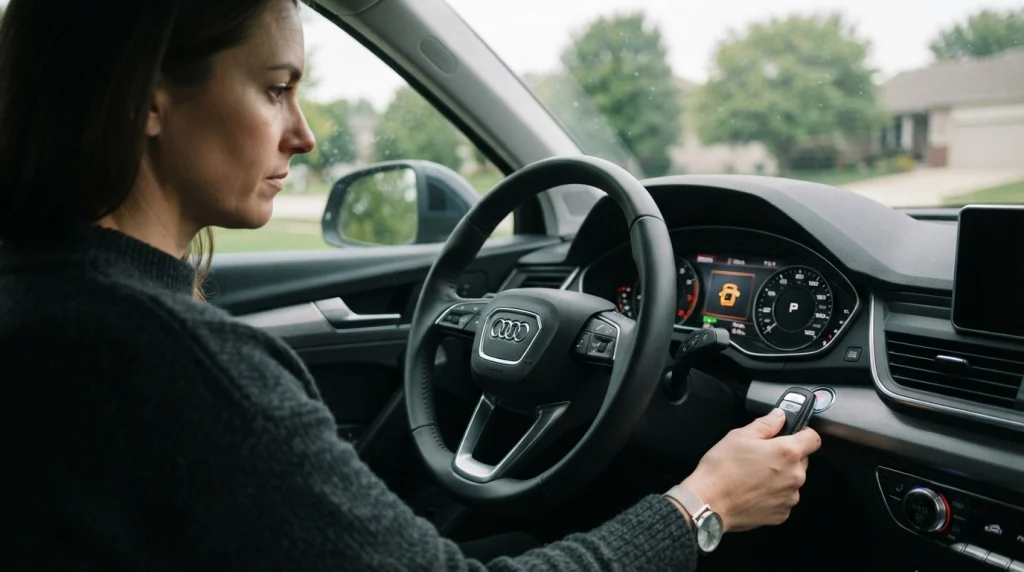
Symptoms narrow the fault fast. Match what you see and hear to the likely cause below, then test that cause first.
| Symptom | Most likely cause | First check |
|---|---|---|
| No brake lights, no crank | Brake light switch or fuse | Brake lights, fuse, connector |
| Key not detected message | Weak fob battery | Fob against button, spare fob |
| Dash lights up, single click | Weak battery or starter | Battery test, terminals |
| Nothing happens at all | Flat battery, fuse, or relay | Battery, fuses, relays |
| Starts in Neutral, not Park | Gear position sensor | Gear display, shifter feel |
| Security light flashing | Immobilizer not recognising fob | Spare fob, lock and unlock cycle |
Use the table as a starting point, not a final diagnosis. Two faults can share one symptom, so confirm with a test before you buy a part.
Fitment matters when you do replace a part. A brake light switch, fob battery, or starter must match your make, model, year, trim, and engine.
Check fitment with your VIN before you order. A VIN is the vehicle identification number, and it pins down the exact parts your car was built with.
An OEM part is made by the vehicle’s maker or its approved supplier. An aftermarket part is made by another company to fit the same car.
Section takeaway: Match the symptom to the table, test that cause first, and confirm fitment with your VIN before you order a replacement.
How Can I Prevent This From Happening Again?
Small habits prevent most push-button no-starts. They cost little and they catch a weak part before it strands you.
Replace the fob battery at the first sign of weak range. Do not wait until the car says the key is not detected, and keep a spare fob battery in the glovebox.
Have the car battery tested before winter. Cold weather exposes a weak battery fast, and a test takes only a few minutes at most shops.
Press the brake firmly every time you start. A light tap can fail to trigger the switch, especially as the switch ages.
Fix an intermittent fault while the car still starts. Car Care Council maintenance guidance also recommends regular inspections to catch worn switches and weak batteries early.
Section takeaway: Replace a fading fob battery early, test the car battery before winter, and fix an intermittent brake switch while the car still starts.
Frequently Asked Questions
Can I start a push-button car without pressing the brake?
No, most push-button cars require a firm brake press to start. The brake signal is a safety interlock, and the starter stays locked out without it.
Why does my brake pedal feel hard when the car won’t start?
The brake booster loses stored vacuum after a few presses with the engine off. The pedal then feels stiff and moves very little.
Press it firmly and steadily.
Why does my push-button car say key not detected?
The fob battery is usually weak, or the fob is too far from the cabin sensor. Hold the fob against the start button and try again.
Can a weak battery cause the brake pedal not to register?
A weak car battery can stop the start system from waking up, which looks like a brake fault. The dash may light up, but the starter will not turn.
How do I start my car if the brake light switch fails?
Some cars have a shift-lock override or a start override listed in the owner’s manual. Use it only as a short-term test, then replace the faulty switch.
Should I jump-start a push-button car that won’t start?
A jump start can help if the car battery is flat, but it will not fix a brake switch, fob, or gear fault. Try the fob and brake checks first.
That hard brake pedal and silent start button usually point to a small, testable fault. Check the brake lights, the fob, and the gear position first.
If the simple checks do not fix it, book a diagnostic with an ASE-certified technician. A proper test will find it faster than replacing parts at random.

Alex Carter is an automotive content writer at VastAutoParts, focusing on car parts, vehicle troubleshooting, automotive tools, product research, and practical car care guides.