
Why Won’t My Car Start Even With a Jump? 7 Causes & Fixes for 2026
Quick Answer
Why won’t my car start even with a jump? A jump only adds power, so it cannot fix a bad connection, a battery with a dead cell, a failed starter, or a fuel or security fault. If the cables are good and the donor car is running, the fault is usually past the battery. Test the terminals, ground, and starter next. AAA car care guidance also stresses clean, tight connections before you blame the battery itself.
Most likely causes, in order
- Bad cable connection: Loose or corroded clamps stop jump power from reaching your starter.
- Dead battery cell: One shorted cell drags voltage down even with a donor car attached.
- Failed starter: A bad starter motor or solenoid clicks, or stays silent, no matter how much power you feed it.
- Bad ground cable: A rusted engine or body ground breaks the circuit back to the battery.
- Blown fuse or relay: A failed starter relay or main fuse cuts power before it reaches the starter.
- Fuel or security fault: The engine may crank fine but never fire if fuel, spark, or the immobilizer is the real fault.
Try this first
- Wiggle and re-seat both clamps, then try again with the donor car running for a few minutes.
- Listen closely: silence, one loud click, and fast clicking each point to a different fault.
- If the dash lights stay dim with good cables, stop cranking and test the battery and ground.
I’ve been there in a cold driveway, cables in hand, watching a car refuse to start even with a good donor car beside it.
That moment is frustrating because a jump feels like it should fix everything. This guide goes deeper than “get a new battery” and walks you through each cause in the order I’d check it myself, as of 2026.
In This Guide
- What Does a Jump Start Actually Do — And What It Can’t Fix?
- Why Won’t My Car Start Even With a Jump? 7 Most Common Causes
- How Do You Tell If It’s the Battery, the Cables, or the Starter?
- What Should You Check First? A 10-Minute Diagnostic in the Right Order
- Bad Connections, Corrosion, and Ground Problems: The Hidden Culprit
- Starter, Alternator, and Ignition: When the Problem Isn’t the Battery
- Fuel, Security, and Other Reasons a Jump Won’t Help
- Can You Fix It Yourself — And How Do You Jump Safely?
- Frequently Asked Questions
What Does a Jump Start Actually Do — And What It Can’t Fix?
A jump start is a temporary power boost from a donor battery that helps your starter motor turn the engine over. It does not repair your battery, starter, cables, or fuel system.
Think of it like a push for the electrical system. It adds voltage and current for a few seconds, just long enough to crank.
That boost only helps when the battery is simply low on charge. A healthy car battery should sit near 12.6 volts with the engine off, and it drops under load when you crank.
A jump can mask a weak battery for one start. It cannot mask a broken part.
What a failed jump proves
If the car starts with a jump and keeps running, your starter, fuel, and spark systems are likely working. The battery was probably drained, or the alternator may not be charging it well.
If it still won’t start with good cables and a running donor car, the fault is usually not low charge alone. Power is either not reaching the starter, or the starter cannot use it.
That narrows your search fast. You can stop guessing about the battery and start checking connections, the starter, and the rest of the starting circuit.
Section Takeaway: A jump adds power, it does not fix parts — a failed jump tells you the fault is past the battery, in the cables, starter, or another system.
Why Won’t My Car Start Even With a Jump? 7 Most Common Causes
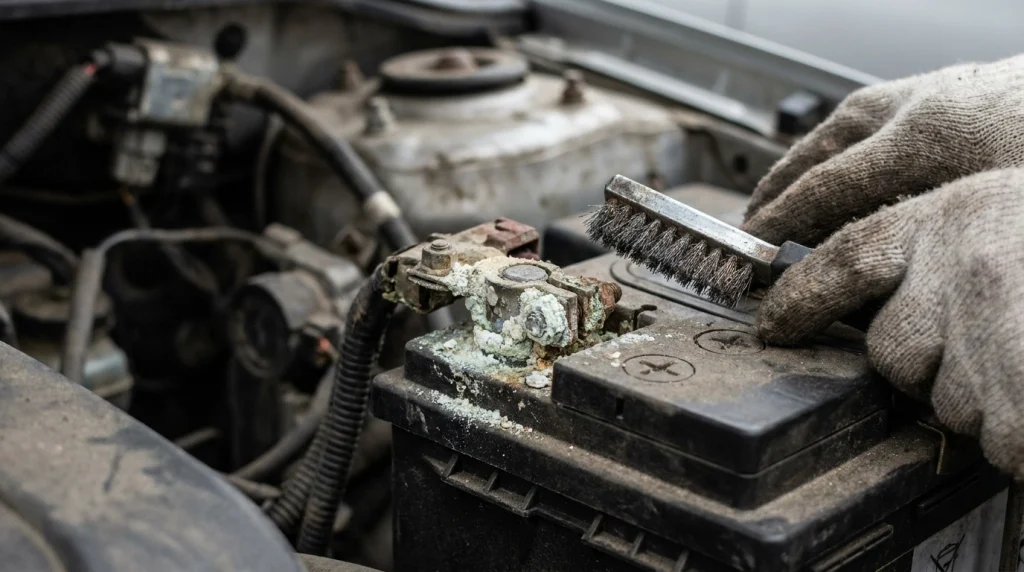
A car that won’t start even with a jump usually has one of seven faults. I check them in this order because it saves time and avoids buying parts I don’t need.
1. Loose or corroded battery terminals
Corrosion looks like white, green, or blue crust around the terminal. It acts like a wall between the cable and the battery post, and jump power hits that wall too.
2. Bad or thin jumper cables
Cheap, thin cables can’t carry enough current for a big engine. They get warm, voltage drops, and the starter turns slowly or not at all.
I learned this with a bargain set on a V6 in winter. A thicker, well-made set started the same car on the first try.
3. A battery with a dead or shorted cell
A battery can have one dead cell and still show some voltage. That bad cell pulls the whole system down when you try to crank, and a jump can’t fix a shorted cell.
4. A failed starter motor or solenoid
The starter motor turns the engine over, and the solenoid is the small switch that feeds it power. When either fails, you may hear one loud click, or nothing at all.
No amount of jump power helps a starter that can’t spin. This often follows weeks of slow cranking.
5. A bad ground connection
The ground cable, also called the earth cable, carries current back from the engine to the battery. Rust, a loose bolt, or a cracked cable breaks that return path, and power has no complete circuit without it.
6. A blown fuse, bad relay, or faulty ignition switch
The starter relay is a small switch that lets a low-power key signal control high-power starter current. A failed relay means the starter never gets the signal to crank.
A blown main fuse, a bad ignition switch, or a faulty neutral safety switch can do the same thing. The dash may light up, but the starter stays silent.
7. Fuel, spark, or security problems
Sometimes the engine cranks fine with a jump but never fires. That points away from the battery entirely, toward fuel, spark, or an immobilizer that doesn’t recognize your key.
Section Takeaway: Check terminals and cables first, then the battery and ground, then the starter and relays — most failed jumps are a connection or starter fault, not a lack of jump power.
How Do You Tell If It’s the Battery, the Cables, or the Starter?
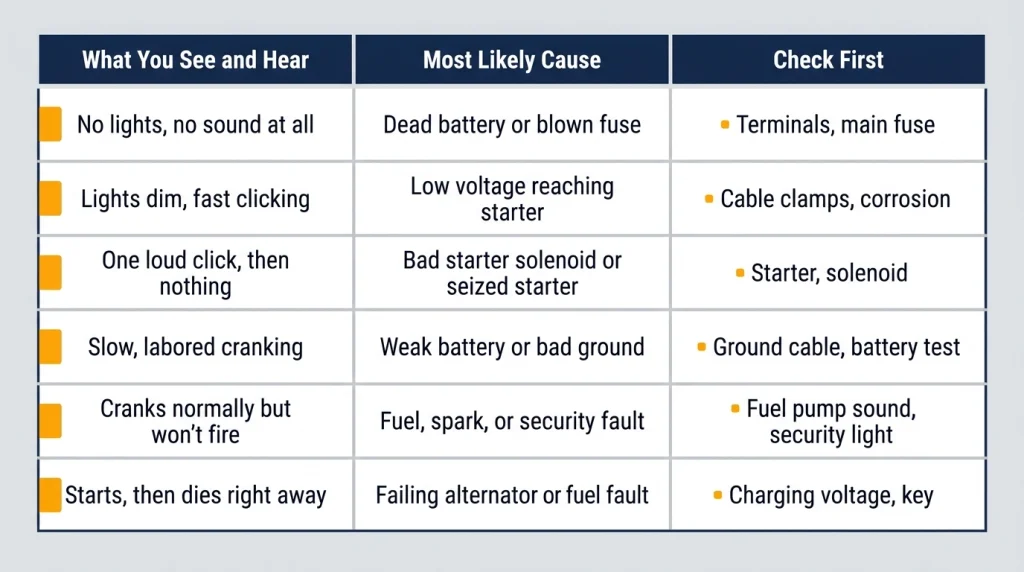
Listen and watch before you buy anything. The sound your car makes, and what the lights do, point to the fault faster than guesswork.
Turn the key once and note exactly what happens. Silence, clicking, and slow cranking each mean something different.
| What you see and hear | Most likely cause | Check first |
|---|---|---|
| No lights, no sound at all | Dead battery, blown main fuse, or broken main cable | Terminals, main fuse, battery voltage |
| Lights dim, fast clicking | Low voltage reaching the starter | Cable clamps, corrosion, donor connection |
| One loud click, then nothing | Bad starter solenoid or seized starter | Starter, solenoid, voltage under load |
| Slow, labored cranking | Weak battery, bad ground, or thin cables | Ground cable, battery test, cable gauge |
| Cranks normally but won’t fire | Fuel, spark, or security fault | Fuel level, fuel pump sound, security light |
| Starts, then dies right away | Failing alternator, fuel fault, or immobilizer | Charging voltage, fuel pressure, key |
Use a multimeter if you have one
A multimeter is a small tool that measures battery voltage. With the engine off, a healthy battery reads about 12.4 to 12.7 volts.
Below 12.0 volts, the battery is low, and below 11 volts under cranking, it is likely failing. Check your owner’s manual for the exact spec for your car.
An OBD2 scanner plugs into the port under your dash and reads fault codes from the car’s computer. It helps when a check engine light is on, or when a sensor fault is stopping the start.
Section Takeaway: Match the sound and lights to the table above before you replace parts — one loud click points to the starter, fast clicking points to low voltage, and normal cranking points to fuel or spark.
What Should You Check First? A 10-Minute Diagnostic in the Right Order
Work in order, from easiest to hardest. This sequence takes about 10 minutes and catches most failed-jump faults.
Stop cranking after a few short tries. Long cranking drains the donor battery and can overheat the starter.
Safety note: Wear eye protection, keep hands clear of belts and fans, and disconnect the battery before you remove electrical parts. Follow your owner’s manual and torque specs, and get help if you’re unsure.
- Check the donor setup: Is the donor car running, and are the cables on the right terminals? Red goes to positive, black to negative or a bare metal ground.
- Re-seat the clamps: Wiggle each clamp and make sure it bites clean metal, not corrosion or paint. Try again.
- Look at the terminals: White or green crust, loose clamps, or swollen cables all point to a bad connection.
- Watch the dash: Do the lights brighten with the jump attached? If not, power isn’t reaching your car.
- Listen to the crank: Note silence, one click, fast clicking, or normal cranking, then match it to the table above.
- Try the other key: A worn key or weak key fob battery can trigger the immobilizer. Try your spare key.
- Check the shifter: Make sure an automatic is fully in Park, or try Neutral. A faulty neutral safety switch can block the start.
- Test voltage if you can: Use a multimeter on the battery posts, then on the cable ends, to find where voltage is lost.
Warm cables mean high resistance or a short. Stop, let them cool, and check for reversed cables or a damaged clamp.
Section Takeaway: Re-seat the clamps, watch the dash, and listen to the crank first — those three checks in 10 minutes will point you to the battery, the cables, or the starter.
Bad Connections, Corrosion, and Ground Problems: The Hidden Culprit
Corrosion is the fault I see most often after a failed jump. It hides under the clamp, where you can’t see it until you take the cable off.
Even a thin layer can block the huge current a starter needs. Lights may work fine, but the starter gets almost nothing.
How to clean battery terminals safely
Disconnect the negative cable first, then the positive. That order reduces the risk of a short if your wrench touches metal.
Scrub the posts and the inside of the clamps with a terminal brush until the metal shines. Rinse with a little water, dry them well, and reconnect positive first, then negative.
Tighten the clamps so they don’t twist by hand. A loose clamp will cause the same fault again within days.
Don’t forget the ground cable
Follow the negative cable from the battery to where it bolts to the body or engine. That bolt must be clean and tight.
Rust, paint, or oil under that bolt breaks the return path. Clean the surface to bare metal and tighten it to the torque spec in your owner’s manual.
Older cars often have a second ground strap from the engine to the body. Check that strap too, especially if the car cranks slowly only when hot.
For cables, fitment matters more than brand. OEM parts are made to the car maker’s original spec, aftermarket parts vary in quality, and remanufactured parts are rebuilt used parts — so check the part number cross-reference, your VIN lookup, and the fitment guide before you order.
Section Takeaway: Clean terminals and a solid ground fix more failed jumps than a new battery does — if the metal isn’t clean and tight, jump power can’t reach the starter.
Starter, Alternator, and Ignition: When the Problem Isn’t the Battery
When the connections test good and the battery holds voltage, the starter is the next suspect. A starter works hard every time you turn the key, and it wears out over time.
How do you know the starter is bad?
One loud click with bright dash lights is the classic sign. The solenoid is engaging, but the motor isn’t spinning.
A grinding noise points to a worn starter gear or flywheel teeth. Sometimes a light tap on the starter body helps it turn once, but that is only a short-term test, not a fix.
What about the alternator?
The alternator charges the battery while the engine runs. It does not start the car, so a bad alternator alone rarely stops a jump from working.
It matters after the jump, though. If the car starts with a jump and dies soon after, or the battery light stays on, the alternator may not be charging. Have the charging voltage tested with the engine running.
Ignition switch, relay, and fuses
If the lights go out completely when you turn the key, or nothing happens in the start position, the ignition switch or starter relay may be at fault.
Check the main fuses too. A blown fuse can cut power to the whole starting circuit, and NHTSA lets you check for safety recalls that may cover a faulty ignition or electrical part on your car.
Safety note: Disconnect the battery before you replace a starter or work near high-current cables. Use jack stands, never a jack alone, if you need to work under the car.
Section Takeaway: Bright lights plus one loud click means starter, not battery — test the starter, solenoid, and relay before you buy another battery.
Fuel, Security, and Other Reasons a Jump Won’t Help
If the engine cranks at normal speed but won’t fire, the battery did its job. The engine is missing fuel, spark, or the signal to run.
This is the most confusing case for drivers. The jump worked, the crank sounds right, yet the car still won’t start.
Fuel and spark problems
Check the fuel gauge first. A faulty gauge can read a quarter tank when the tank is empty, and I have seen that fool even careful owners.
Listen for the fuel pump when you turn the key to On. You should hear a soft hum for a few seconds from the rear of the car, and no hum can mean a failed pump, a blown fuse, or a bad relay.
Worn spark plugs, bad ignition coils, or a failed crank sensor can also stop the engine from firing. The crank sensor tells the computer when to spark, so the engine won’t run without it.
Security and immobilizer faults
Most modern cars have an immobilizer that only lets the engine run with a recognized key. A flashing security light on the dash is the clue.
Try your spare key, replace the key fob battery, and make sure no other keys or metal are blocking the signal. If the light keeps flashing, a dealer or locksmith may need to reprogram the key.
The Car Care Council notes that regular checks of the battery, fuel, and ignition systems help catch these faults before they leave you stranded.
Section Takeaway: Normal cranking with no firing means fuel, spark, or security — check the gauge, listen for the fuel pump, and watch the security light.
Can You Fix It Yourself — And How Do You Jump Safely?
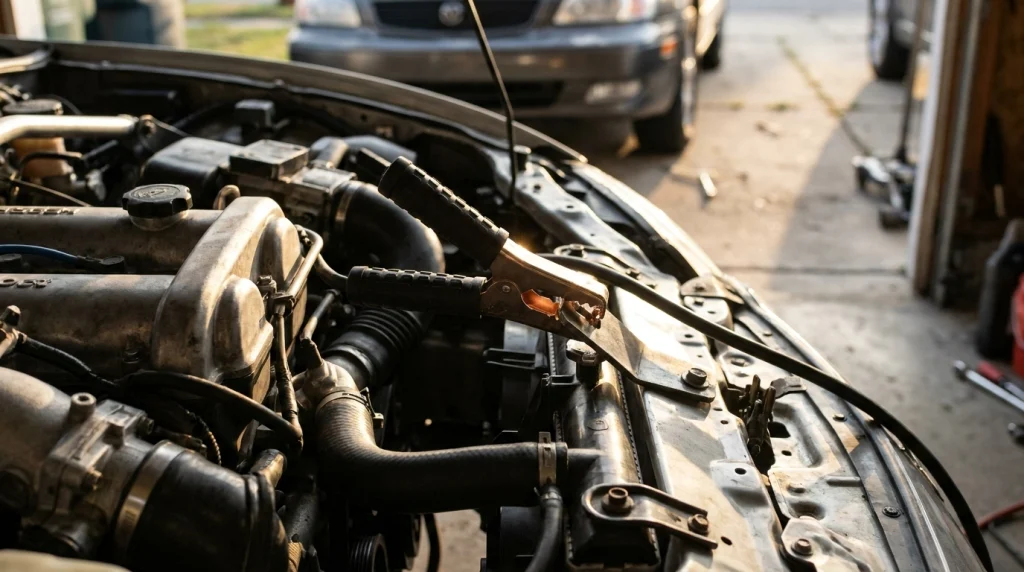
Some failed-jump faults are easy DIY jobs. Others need tools, a lift, or a proper diagnosis, and guessing can cost more than the repair.
Good DIY jobs, and when to call a professional
- Clean terminals: A brush, wrench, and 15 minutes fix most corrosion faults.
- Tighten grounds: Clean and tighten the ground bolt, and check the engine strap.
- Replace the battery: Match the group size, cold cranking amps, and terminal layout to your car, and check fitment by VIN.
- Call a shop for: Starter replacement, fuel pump work, electrical shorts, and immobilizer faults — these need a lift, fuel pressure tools, or key programming.
Ask the shop to test the battery, starter, and alternator before they replace anything. A good shop will show you the test result, not just quote a part.
Look for ASE-certified technicians when you want that test done properly. ASE certification is a useful sign that a technician has passed a set standard for repair work.
Before you buy a battery or starter, compare OEM, aftermarket, and remanufactured options on warranty length, not just price. Consumer Reports testing often finds that warranty and cold-weather performance matter more than a small saving up front.
How to jump-start safely
A good jump should not damage either car. Most damage comes from reversed cables, loose clamps, or cranking for too long.
Safety note: Never lean over the battery while you connect cables, and keep sparks away from the battery. If a battery is cracked, leaking, or smells strongly of sulfur, do not jump it — call for help.
- Park close, engine off: Put both cars in Park, set the brakes, and turn off lights and accessories.
- Red to dead positive: Connect red to the dead car’s positive terminal, then red to the donor’s positive terminal.
- Black to donor negative: Connect black to the donor’s negative terminal, then the other black clamp to bare metal on the dead car’s engine, away from the battery.
- Start the donor: Let it run for a few minutes, then try the dead car once, and remove the cables in reverse order.
Section Takeaway: Clean and tighten what you can reach safely, let a certified shop test and replace the starter or fuel pump, and always connect red to positive and black to bare metal.
Frequently Asked Questions
Why does my car click once with a jump but not start?
One loud click usually means the starter solenoid is engaging but the starter motor isn’t spinning. The battery and cables may be fine, so have the starter and its connections tested before you replace the battery.
Can a battery be too dead to jump-start?
Yes. A battery with a shorted or dead cell can drag voltage down even with a donor car attached. If the dash stays dim with good cables, the battery likely needs a load test and replacement.
How long should I leave jumper cables on before trying?
Let the donor car run for three to five minutes with the cables connected, then try once. If it doesn’t start, re-seat the clamps and check the terminals instead of cranking again and again.
Will a jump start damage my car?
A correct jump rarely causes damage. Reversed cables, loose clamps, or long cranking can harm electronics, the starter, or both batteries, so follow the connection order and stop if the cables get hot.
Why did my car start with a jump yesterday but not today?
The battery may have a bad cell, a drain is emptying it overnight, or the alternator isn’t charging it. A jump only adds charge for one start, so test the battery, charging system, and for a parasitic drain.
Does cold weather make a jump less likely to work?
Yes. Cold thickens engine oil and cuts battery power, so the starter needs more current to turn the engine. Clean terminals, thicker cables, and a fully charged donor battery matter even more in winter.
Should I replace the battery or the starter first?
Test first, then replace. Check the battery voltage and load test, clean the terminals and ground, and note the click pattern. Replace the battery only if it fails a test, and the starter only if it clicks once with good voltage.
If your car still won’t start even with a jump, don’t keep cranking and guessing. Work through the terminals, ground, and starter in order, test the battery before you buy a new one, and get a certified mechanic to check the starter or fuel system if the crank sounds normal but the engine won’t fire.
That method saved me from buying a battery I didn’t need, and it will save you the same money and time. Fix the connection first, test the parts second, and you’ll find the real fault faster.

Alex Carter is an automotive content writer at VastAutoParts, focusing on car parts, vehicle troubleshooting, automotive tools, product research, and practical car care guides.