
Why Does My Car Start With a Jump But Not Normally? 7 Causes & Fixes for 2026
Quick Answer
Your car starts with a jump but not normally because the starter is not getting enough power on its own. A weak battery is the most common cause, but loose or corroded connections, a failing starter, and a weak alternator can cause the same symptom. Check the battery voltage and clean the terminals first, then test the starter and charging system before you replace any part. AAA car care guidance also stresses checking the battery and connections before assuming a bigger repair is needed.
Most likely causes, in order
- Weak battery: It holds some charge, but not enough cranking power to turn the engine over.
- Bad connections: Corrosion or a loose clamp blocks power, even when the battery itself is still good.
- Failing starter: It needs extra voltage from a jump to spin fast enough to start the engine.
- Weak alternator: It does not recharge the battery fully, so the battery runs flat again after every drive.
- Hidden drain: A light, module, or faulty relay drains the battery while the car sits parked.
Try this first
- Turn the key once and listen. A single click points to the battery or starter, while fast clicking usually points to low voltage.
I’ve had this exact problem on a cold morning, and it feels confusing. The car fires up fine with jumper cables, then refuses to start on its own the next day.
This guide walks through the causes in the order I check them, and how to test each part at home.
In This Guide
- What Does It Mean When a Jump Start Works?
- Why Is a Weak Battery the Most Common Cause?
- Could Corroded or Loose Battery Connections Be the Problem?
- Is the Starter Motor or Solenoid Failing?
- Is the Alternator Failing to Recharge the Battery?
- What Else Can Drain a Battery Overnight?
- How Do I Test the Battery, Connections, and Starter at Home?
- Should I Replace the Battery, Starter, or Alternator First?
- Frequently Asked Questions
What Does It Mean When a Jump Start Works?
A jump start works because it adds a second power source to your starting system. The donor battery, or a jump pack, supplies the extra voltage and current your own battery cannot deliver on its own.
A jump start is a temporary power boost from another battery or a jump pack, used to crank an engine when the car’s own battery cannot supply enough power. It does not fix the underlying fault. It only proves the starter can work when it gets enough power.
What a successful jump rules out
- Seized engine: The engine turns over, so it is not locked up.
- No fuel: The engine starts and keeps running, so fuel is reaching it.
- Dead ignition: Spark and fuel delivery work once cranking speed is high enough.
- Broken starter gear: The starter engages and spins the engine, at least with extra power.
That leaves the battery, the cables and connections, the starter, and the charging system.
Safety note: wear eye protection when you work near a battery, keep sparks away from it, and follow your owner’s manual for the correct jump-start order for your vehicle.
Section Takeaway: If a jump start works, the engine is fine and the fault is in the power supply. Focus on the battery, connections, starter, and alternator.
Why Is a Weak Battery the Most Common Cause?
A weak battery is the most common cause of this symptom. It can still power the lights and radio, yet fail to crank the engine, because starting needs a short, heavy burst of power.
Batteries lose capacity with age, heat, and cold. Most car batteries last around three to five years, depending on climate, driving habits, and how often the car sits unused.
Signs your battery is the problem
- Slow crank: The engine turns over slowly, like it is dragging.
- Fast clicking: You hear rapid clicks and the engine does not turn.
- Dim lights while cranking: The headlights dim sharply when you turn the key.
- Old age: The battery is more than four years old and has never been tested.
I once replaced a battery that tested fine at rest, yet failed under load. The voltage looked good with the engine off, but it dropped sharply the moment I turned the key.
A load test is the best check here. It measures how the battery performs while it works, not just while it rests.
Safety note: never jump a battery with a cracked case or leaking fluid. Have it handled by a qualified technician instead.
Section Takeaway: A battery can run the lights and still fail to start the car. Test it under load before you replace anything else.
Could Corroded or Loose Battery Connections Be the Problem?
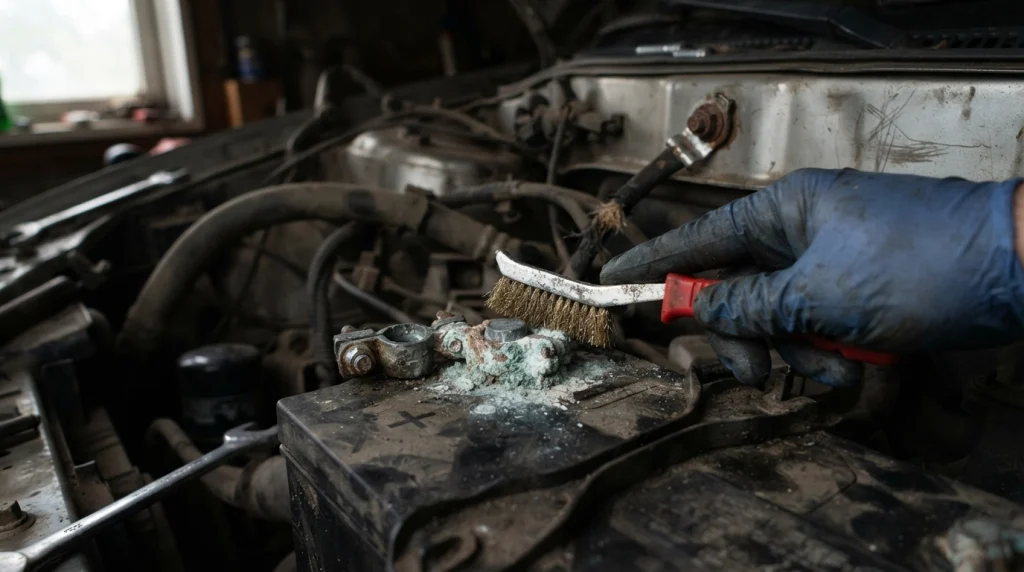
Yes, and this is the cheapest fix on the list. Corrosion and loose clamps can block power just as surely as a dead battery.
Corrosion is the crusty white, green, or blue build-up you see on battery terminals. It acts like a wall between the battery and the cables, so power can trickle through for lights but not push through fast enough for the starter.
How to check the connections
- Look: Check both terminals, both cable ends, and the ground cable where it bolts to the body or engine.
- Wiggle: Try to move each clamp gently. It should not move at all.
- Follow the ground: The negative cable runs to the body or engine block, and that bolt can loosen or corrode too.
Clean the terminals with a wire brush made for battery posts, then refit the clamps snugly. The Car Care Council lists battery terminal cleaning and inspection as a basic part of regular vehicle maintenance.
Safety note: disconnect the negative cable first and reconnect it last. That order reduces the risk of a short circuit while you work.
Section Takeaway: Clean, tight connections cost almost nothing and fix many jump-start-only problems. Check both terminals and the ground cable before you buy a new battery.
Is the Starter Motor or Solenoid Failing?
A failing starter can also cause this exact symptom. It may need the extra voltage from a jump to spin fast enough to start the engine.
The starter motor is the electric motor that cranks the engine. The solenoid is the small switch on the starter that connects it to the battery and pushes the gear into place.
How a weak starter behaves
- Single loud click: The solenoid clicks, but the motor does not spin.
- Slow crank when hot: The engine cranks fine in the morning, then drags after a hot restart.
- Grinding noise: The starter gear does not mesh cleanly with the flywheel.
- Intermittent start: The car starts some days and not others, with no clear battery pattern.
A worn starter draws more current than a healthy one, and heat makes this worse. Tell it apart from a battery fault by the lights: with a starter fault they stay bright, and a jump only helps sometimes.
If you are unsure, ask a shop to test the starter draw. The ASE certification body notes that starter diagnosis should include a proper cranking test, not guesswork based on sound alone.
Safety note: never work under a car supported only by a jack. Use jack stands on a flat surface, and keep hands clear of moving parts while someone else cranks the engine.
Section Takeaway: A starter that drags, clicks once, or fails when hot can mimic a weak battery. Check the battery first, then test the starter before you replace it.
Is the Alternator Failing to Recharge the Battery?
The alternator recharges the battery while you drive. If it charges weakly, the battery starts each trip a little lower than the last one, until it runs too low to start the car alone.
A healthy system usually shows around 13.7 to 14.7 volts at the battery with the engine running. Check your owner’s manual for the exact range for your vehicle, because it can vary by make and model.
Signs the alternator is the problem
- Dimming lights: Headlights brighten when you rev the engine and dim at idle.
- Multiple warnings: Several dash lights come on together while driving.
- Whining noise: A worn alternator bearing can whine or grind, and the sound changes with engine speed.
- Repeated flat battery: A new battery goes flat again within days or weeks.
Test the charging voltage with a multimeter at the battery terminals, engine running, lights off. If the reading stays near the resting battery voltage instead of rising, the alternator is not charging properly.
Section Takeaway: A weak alternator leaves the battery half-charged after every drive. If a jump works but the battery keeps going flat, test the charging voltage before you replace the battery again.
What Else Can Drain a Battery Overnight?
A parasitic drain is power drawn from the battery while the car is off. Every car draws a tiny amount for the clock, alarm, and memory settings, but a fault can draw far more.
This fault is easy to miss. The battery tests fine, the alternator charges fine, yet the car will not start after sitting overnight.
Common sources of a hidden drain
- Interior light: A glovebox, boot, or dome light that stays on will drain a battery overnight.
- Stuck relay: A relay that stays closed can keep a fan, pump, or module powered after shut-off.
- Aftermarket accessory: A poorly wired dash cam, alarm, or stereo can draw power around the clock.
- Faulty module: A control module that fails to sleep can keep drawing current long after you lock the car.
Spot it with an overnight check: charge the battery fully, then note the voltage before bed and again in the morning. A large drop points to a drain, not a weak battery.
Section Takeaway: A battery that goes flat overnight may be drained, not dead. Check lights, relays, and aftermarket accessories before you blame the battery or alternator.
How Do I Test the Battery, Connections, and Starter at Home?
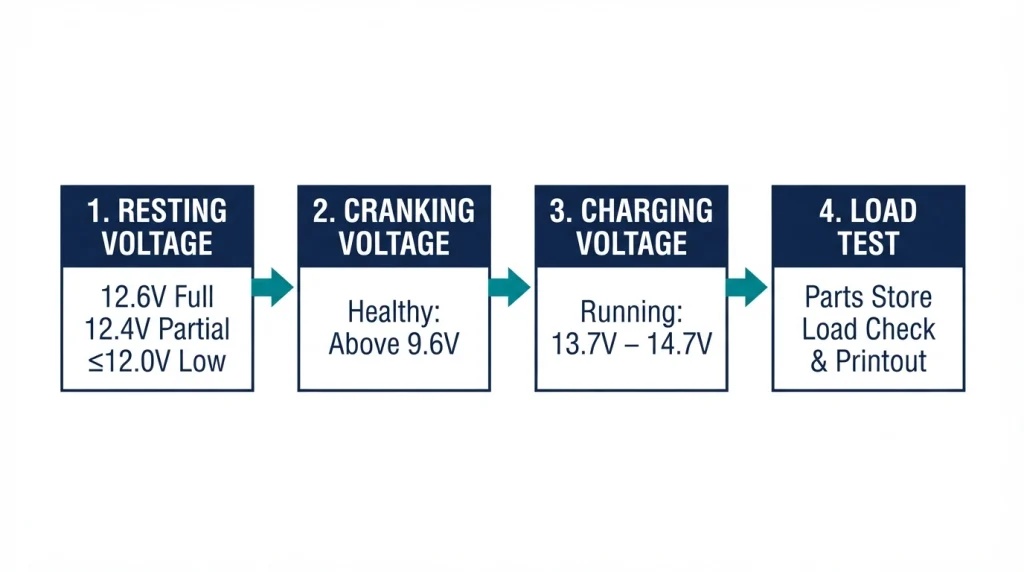
You can narrow this fault down in under 30 minutes with a multimeter and a wire brush. Work in order, and write down each reading as you go.
Four tests, in order
- Resting voltage: Test after the car has sat for a few hours, engine off. Around 12.6 volts means fully charged, 12.4 means partly charged, and 12.0 or lower means low charge.
- Cranking voltage: Have a helper turn the key while you watch the meter. A healthy battery usually stays above 9.6 volts, while a sharp drop points to a weak battery.
- Charging voltage: With the engine running, it should rise to around 13.7 to 14.7 volts. If it stays flat, the alternator, belt, or wiring may be at fault.
- Load test: Take the battery to a parts store for a load test if your home tests are unclear. Ask for a printout and keep it with your service notes.
Voltage alone does not prove a battery is good, because a battery can read 12.6 volts at rest and still fail under load.
The NHTSA recall and safety pages are also worth a quick check if your car has a known starting or electrical fault.
Safety note: keep the multimeter leads clear of belts and fans while the engine runs. If you are unsure at any step, stop and ask a qualified mechanic to run the test.
Section Takeaway: Test in order: resting voltage, cranking voltage, charging voltage, then a load test. Four readings will point to the battery, the cables, the starter, or the alternator.
Should I Replace the Battery, Starter, or Alternator First?
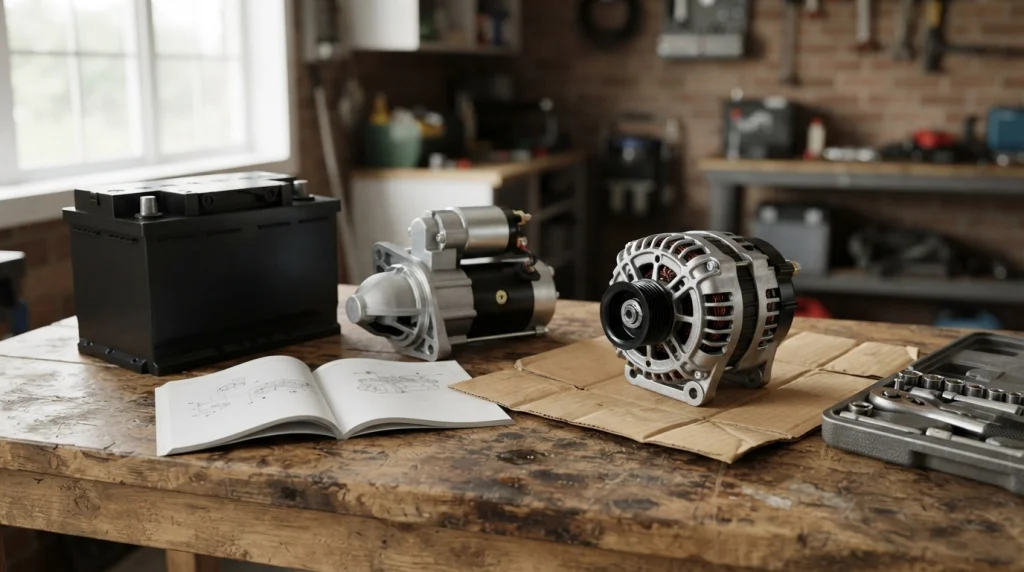
Replace the part your tests point to, not the part you suspect most. Start with the cheapest fix: clean the terminals, charge the battery fully, and retest before you order anything.
| Likely cause | Key symptom | Best test | Usual fix |
|---|---|---|---|
| Weak battery | Slow crank, fast clicking | Load test | Replace the battery |
| Corroded connections | Intermittent no-start, crust on terminals | Visual and wiggle check | Clean and tighten terminals |
| Failing starter | Single click, fails when hot | Starter draw test | Replace the starter |
| Weak alternator | Battery goes flat again after driving | Charging voltage test | Replace the alternator or belt |
| Parasitic drain | Flat overnight, battery tests fine | Overnight voltage and drain test | Find and fix the drain source |
Choose the right replacement part
- OEM parts: Made by the vehicle maker or its supplier, usually the closest match to the original part.
- Aftermarket parts: Made by other brands, often cheaper, with quality that varies by brand and warranty.
- Remanufactured parts: Used cores rebuilt to working order, often with a warranty, and a good budget option for a starter or alternator.
Match the replacement to your exact vehicle, using your VIN, owner’s manual, or a fitment guide to confirm group size, terminal layout, and cold cranking amps.
Check the warranty before you buy. Consumer Reports testing often shows that battery life varies widely by brand and model, so compare warranty terms and test results rather than choosing on brand name alone.
Section Takeaway: Test first, then replace only the failed part. Match fitment by VIN and part number, compare warranties, and get help when the fault repeats or involves warning lights.
Frequently Asked Questions
Why does my car start with a jump but not normally?
Your starter is not getting enough power on its own. A weak battery is the most common cause, followed by corroded connections, a failing starter, and a weak alternator. Test the battery voltage and clean the terminals first.
Can a battery be bad if the lights still work?
Yes, lights need far less power than a starter motor. A battery can run the lights and radio, yet fail to crank the engine. A load test will show whether it can deliver power under real starting demand.
How long should I drive after a jump start?
Drive for at least 20 to 30 minutes at normal road speed if the car runs normally and no warning light is on. That gives the alternator time to recharge the battery, but it will not fix a battery that can no longer hold a charge.
Why does my car need a jump every morning?
A daily jump points to a battery that cannot hold a charge, a hidden drain overnight, or an alternator that is not recharging it fully.
Is it the battery or the alternator?
Test both. If the battery fails a load test, replace it first. If a new or good battery goes flat again after driving, test the charging voltage, because a weak alternator is the likely cause.
If your car starts with a jump but not normally, start with the simple checks. Clean the terminals, test the battery under load, and check the charging voltage.
Fix the part your tests point to, match the replacement by VIN and part number, and keep the test results with your service notes for next time.

Alex Carter is an automotive content writer at VastAutoParts, focusing on car parts, vehicle troubleshooting, automotive tools, product research, and practical car care guides.