
Why Does My Car Have Power But Won’t Start? 7 Causes & Fixes for 2026
Quick Answer
Why does my car have power but won’t start? Your lights and radio need only a small amount of power, so they can work while the starter still lacks the strong current it needs to turn the engine. The most common causes are a weak battery, loose or corroded terminals, a bad starter, or a faulty ignition switch. Check the battery terminals first, then listen for a click or a crank to narrow it down, and follow the AAA car care guidance on battery testing if you are unsure.
Most likely causes
- Weak battery: It holds enough charge for lights but not enough to crank the engine.
- Loose terminals: A poor connection starves the starter even when the battery itself is fine.
- Bad starter: A single loud click, or silence, often points to the starter motor or its solenoid.
- Ignition fault: A worn ignition switch or key fault can cut power to the starter circuit.
- No fuel or spark: If the engine cranks but never fires, fuel delivery or ignition is the next place to look.
Try this first
- Turn the headlights on and watch them while someone turns the key.
- Wiggle the battery cables gently and check that each clamp feels tight.
- Try the spare key, and make sure the car is fully in Park or Neutral.
I’ve stood in a driveway with bright dashboard lights, a working radio, and an engine that refused to do anything at all.
This guide walks through the causes in the order I check them.
In This Guide
- What does “has power but won’t start” actually mean?
- Why does my car have power but won’t crank at all?
- Why does my car have power, crank, but won’t start?
- Could it be the battery even though the lights work?
- How do I check the starter, ignition switch, and fuses myself?
- What about the security system, neutral safety switch, and fuel system?
- When should I call a mechanic instead of fixing it myself?
- Frequently asked questions
What does “has power but won’t start” actually mean?
A car that has power but won’t start is one where the lights, radio, or dashboard turn on, yet the engine either stays silent or cranks without firing.
That detail matters more than it looks. It tells you the battery is not completely dead, and the fault sits further along the starting chain.
Think of starting as three jobs: the battery supplies power, the starter turns the engine, and fuel and ignition keep it running. Your lights prove only the first job is partly working.
Power is not the same as cranking power
A dome light draws a tiny amount of current, while a starter motor draws a huge surge in one short burst. A battery can look healthy at a glance and still fail that one job.
Check your owner’s manual for the right battery size and rating for your make, model, and engine before you buy a replacement.
Section takeaway: Lights on means some power is present, not that the battery can crank the engine. Treat the symptom as a clue about where the chain breaks, not as proof the battery is fine.
Why does my car have power but won’t crank at all?
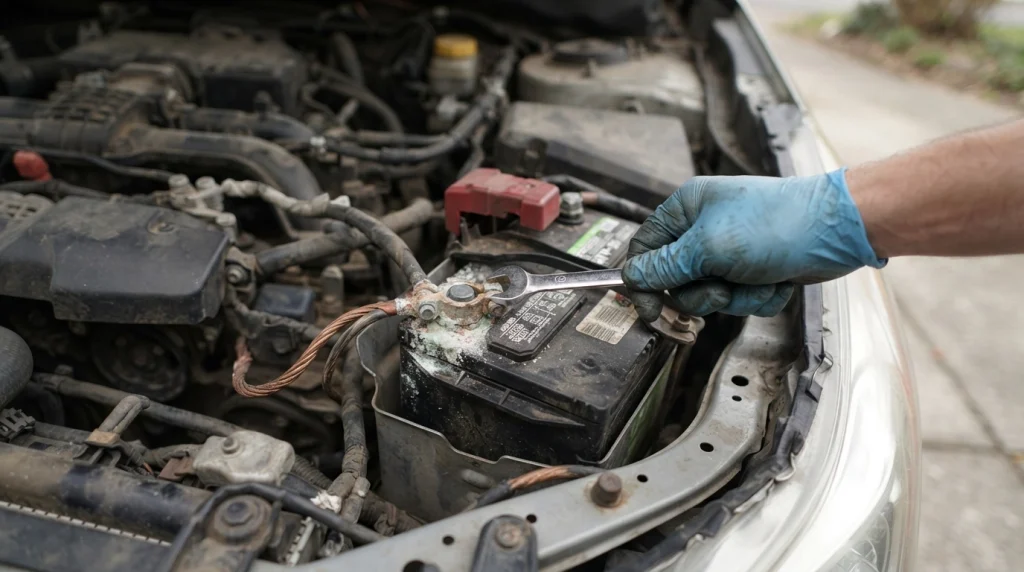
If you turn the key or press the start button and hear nothing, or only a single click, the starter is not turning the engine.
Start with the simplest checks first. I have fixed more no-crank cars with a wrench on a battery clamp than with any new part.
| What you hear or see | Likely cause | First check |
|---|---|---|
| Silence, no click | Dead starter circuit, ignition switch, or safety switch | Shift to Park or Neutral, try the spare key |
| One loud click | Starter solenoid or starter motor | Battery terminals, then starter connections |
| Rapid clicking | Weak battery or poor connection | Clean and tighten terminals, test the battery |
| Lights dim sharply on crank | Low battery charge or high resistance | Charge and load-test the battery |
Is the starter getting the signal to turn?
Your owner’s manual shows the fuse box layout, and a blown starter fuse or failed relay can break that signal without warning.
Could a loose cable be the whole problem?
Corrosion looks like a pale crust on the terminals, and it hides under the clamp where you cannot see it. Twist each clamp by hand, and if it moves at all, it is too loose.
Clean the terminals with a wire brush and tighten them until they do not move.
Safety note: Disconnect the battery before electrical work, and keep tools clear of both terminals at once. A short across the terminals can spark and damage the battery.
Section takeaway: Silence or a single click points to the starter circuit, not the lights. Check the shifter, the key, the fuses, and the terminals before you blame the starter itself.
Why does my car have power, crank, but won’t start?
A car that cranks normally but never fires has a different problem. The starter is doing its job, so the fault sits with fuel, spark, or air.
Listen to the crank first. A steady, even crank with no hint of catching usually means the engine is turning without fuel or without spark.
Is fuel reaching the engine?
Turn the key to the run position and listen for a soft hum from the rear of the car. That hum is the fuel pump priming for a few seconds.
No hum can also mean a blown fuel pump fuse, a failed relay, or a wiring fault. Check the fuel gauge too, since a faulty sender can read a quarter tank when the tank is dry.
Is the engine getting spark?
Spark plugs fire the fuel and air mix in each cylinder, and worn plugs or a failed ignition coil can stop that fire from happening. Check your owner’s manual for the plug replacement interval for your engine.
What does the check engine light tell you?
A solid check engine light often stores a useful code, and an OBD2 scanner reads it in minutes through the port under the dash.
Codes for a crankshaft position sensor or fuel system fault are common here, and a failed crankshaft sensor can stop spark and fuel at the same time. Write the code down before you clear it.
Section takeaway: A normal crank that never fires is a fuel or spark problem, not a starter problem. Listen for the fuel pump, check the gauge, and read the OBD2 code before you replace parts.
Could it be the battery even though the lights work?
Yes, and this is the most common answer I see. A battery can hold enough charge for lights and still fail a load test.
Heat, cold, short trips, and long periods parked all wear a battery down. I once had one die on the first cold morning of the year, with bright lights and one tired click from the starter.
How do I test a battery the right way?
A battery can read near full voltage at rest and still collapse under a starter load, so a load test matters more than a voltmeter reading. Most parts stores offer this test in a few minutes, so ask for the printed result.
What should I check on the terminals and cables?
Follow each cable from the battery to its other end, and do not miss the ground cable to the body or engine block. Swelling, green crust, or a stiff cable means it needs cleaning or replacement.
- Clean the posts: Use a battery terminal brush until the metal looks bright.
- Tighten the clamps: Each clamp should not move when you twist it by hand.
- Check the ground: Make sure the ground bolt is tight and free of rust.
The Car Care Council lists battery inspection among the routine checks that catch a weak battery before it leaves you stranded.
Safety note: Wear eye protection when you clean battery terminals, and wash your hands after handling a battery. Battery acid and corrosion dust irritate skin and eyes.
Section takeaway: Bright lights do not clear the battery. A load test, clean terminals, and a sound ground cable settle the question in minutes.
How do I check the starter, ignition switch, and fuses myself?
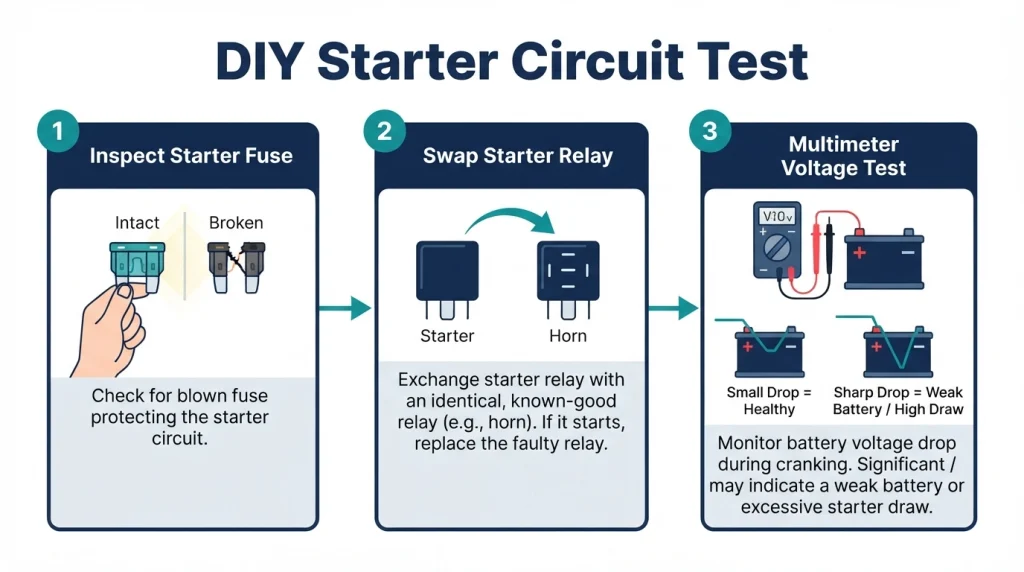
You can check the starter circuit with basic tools and a careful sequence. Work in order, and stop if anything feels beyond your comfort level.
You will need a socket set, a multimeter, and your owner’s manual, plus a helper to turn the key while you watch the meter.
How do I test the starter fuse and relay?
Find the fuse box layout in your owner’s manual, then pull the starter fuse and hold it up to the light. A broken wire inside means it has blown, so fit a fuse of the same rating.
Swap the starter relay with an identical relay from a non-essential circuit, such as the horn. If the car then cranks, the old relay was the fault.
What are the signs of a bad ignition switch?
A worn ignition switch can cut power to the starter while the radio and lights still work, and the dashboard may flicker. Try turning the key slowly and firmly, and if the car cranks only at one exact spot, the switch contacts are likely worn.
Push-button cars show the same fault in a different way. A start button that needs several presses can point to the switch or the fob battery.
How do I test the starter with a multimeter?
Set the multimeter to volts across the battery terminals, and have a helper turn the key while you watch the reading. A healthy battery drops only a little during a crank, while a sharp drop points to a weak battery or a starter drawing too much current.
Safety note: Never work under a car supported only by a jack, and never touch the starter terminals while the key is in the start position. Use jack stands and keep hands clear of moving parts.
Section takeaway: Fuses and relays are cheap checks, and a multimeter reading during a crank tells you more than a new part ever will. Test before you replace.
What about the security system, neutral safety switch, and fuel system?
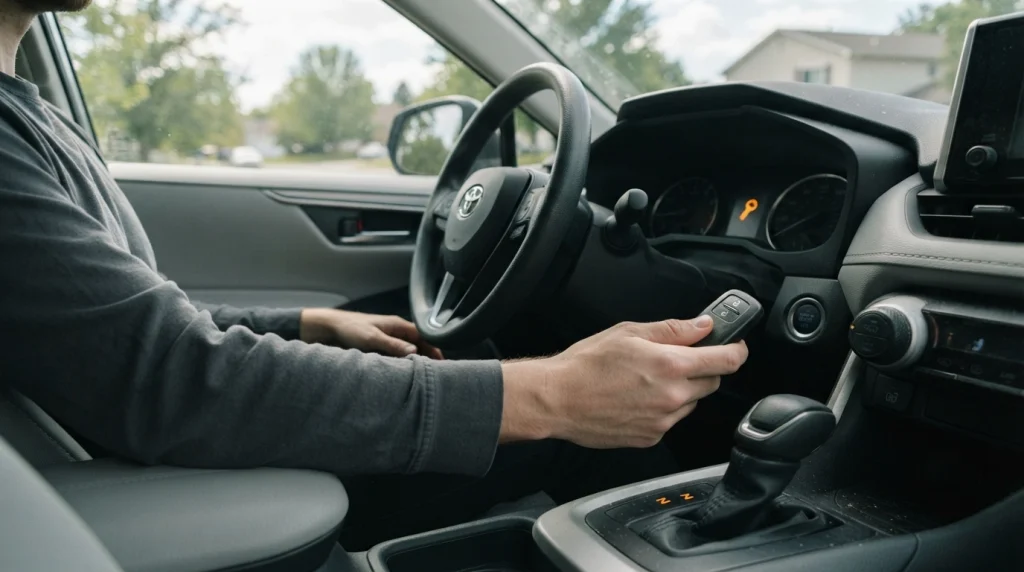
Three quiet parts can stop a car with full power from starting. Each one is easy to miss because none of them affects the lights.
Could the anti-theft system be blocking the start?
Most modern keys carry a chip that the car must recognise before it allows a start, and a damaged key or weak fob battery can block the starter or fuel system. Watch for a security light that stays on or flashes when you turn the key.
Is the neutral safety switch stopping the crank?
An automatic car only cranks in Park or Neutral. The neutral safety switch, also called the range sensor, tells the car which gear it is in.
A worn switch may think the car is in gear even when the shifter reads Park, so you get silence with full power everywhere else. Try shifting firmly into Park, then try Neutral with your foot on the brake.
What if the fuel system is the fault?
A failed fuel pump, a clogged fuel filter, or a faulty fuel pump relay can stop fuel from reaching the engine, while the starter cranks happily. Check your owner’s manual for the fuel filter service interval, and listen for a pump that whines loudly or has gone silent.
Check for recalls that affect the starting or fuel system on your car through the NHTSA recalls service before you pay for a repair. A covered fault costs you nothing to fix at the dealer.
Section takeaway: A flashing security light, a car that cranks only in Neutral, or a silent fuel pump each points to a specific system. Test the spare key and the shifter before you blame the starter.
When should I call a mechanic instead of fixing it myself?
Call a mechanic when the simple checks have not found the fault, or when the next step needs tools you do not have.
A starter buried under the intake manifold, a fuel pump inside the tank, or an intermittent electrical fault all take time and special tools. Stop and get help if you smell fuel, see smoke, or find melted wiring, and do not crank the car again until it is inspected.
Ask the shop what they tested and what the readings were. A clear answer is worth more than a low quote with no diagnosis.
Owner reviews and reliability data can help you judge whether a repeat fault is common on your model, and Consumer Reports publishes reliability findings that help with that call.
Section takeaway: Try the battery, terminals, fuses, key, and shifter first. If those checks pass and the car still will not start, a mechanic with a scan tool and a load tester will find the fault faster than guessing at parts.
Frequently asked questions
Why does my car have power but won’t start with no sound at all?
Silence usually means the starter is not getting a signal or power. Check Park or Neutral, try the spare key, and inspect the battery terminals and starter fuse before you replace any parts.
Can a bad battery still power the lights and radio?
Yes, lights and radio need far less current than a starter motor. A weak battery can run them for hours yet fail a load test, so test it rather than judging by the lights.
Why does my car click once but not start?
A single loud click often points to the starter solenoid or starter motor. Check the battery terminals and starter connections first, since a loose connection can cause the same click.
Why does my car crank but not start after sitting overnight?
Overnight faults often involve fuel pressure loss, a weak battery, or a sensor that fails when cold. Listen for the fuel pump hum, check the battery, and read stored OBD2 codes.
Can a blown fuse stop my car from starting?
Yes, a blown starter, fuel pump, or ignition fuse can stop the car from cranking or firing. Replace it with one of the same rating, and find the cause if it blows again.
Should I jump-start a car that has power but won’t start?
A jump start helps only if the battery is weak, and it will not fix a bad starter, a faulty ignition switch, or a security fault. Try it once, and if the car still will not crank, move on to the checks in this guide.
As of 2026, the checks in this guide still cover the most common causes first. Start with the battery and the terminals, listen to what the car does when you turn the key, and let each answer point you to the next test.

Alex Carter is an automotive content writer at VastAutoParts, focusing on car parts, vehicle troubleshooting, automotive tools, product research, and practical car care guides.