
Why Won’t My Car Start With a Brand New Battery? 7 Causes & Fixes for 2026
Quick Answer
Why won’t my car start with a brand new battery? A new battery only rules out a worn-out battery. The fault is often loose or corroded terminals, a faulty starter, a weak alternator, a blown fuse, or a drain that emptied the battery overnight. Start with the terminals and a voltage check, then test the starter and alternator before you replace anything else, as AAA car care guidance recommends.
Most likely causes, in order
- Loose terminals: A cable that moves by hand cannot carry enough current to crank the engine.
- Corrosion: White, blue, or green crust on a terminal blocks the connection, even on a new battery.
- Faulty starter: One loud click and no crank often points to the starter motor or its solenoid.
- Weak alternator: A bad alternator will not recharge the battery, so the car dies again after a jump.
- Bad new battery: A new battery can arrive discharged, damaged, or in the wrong size for your car.
- Parasitic drain: A light, module, or aftermarket part left on can drain a battery overnight.
Do this first
- Turn the headlights on and try to start the car, then note whether they dim, stay bright, or go out.
- Wiggle each battery cable gently and check that both terminals are tight and clean.
- Check the battery voltage with a multimeter if you have one, and look for a resting reading near 12.6 volts.
I’ve been there. You just paid for a brand new battery, you turn the key, and nothing happens.
That moment is confusing because a new battery should fix a no-start. This guide goes deeper than that first guess.
I’ll walk you through the real causes, the quick tests I use in my own driveway, and when it’s time to call a mechanic.
In This Guide
- What Does a Brand New Battery Actually Rule Out?
- Why Won’t My Car Start With a Brand New Battery? 7 Causes
- Click, Silence, or Crank But No Start — What Is Your Car Telling You?
- How Can I Test a New Battery, Starter, and Alternator at Home?
- Battery vs Starter vs Alternator: What’s the Difference?
- Why Does a New Battery Drain Overnight?
- When Should I Call a Mechanic?
- Frequently Asked Questions
- The Bottom Line
What Does a Brand New Battery Actually Rule Out?
A new battery rules out one thing only: an old, worn-out battery. It does not rule out the parts around it.
A car battery is a storage unit that supplies a short burst of power to crank the engine. Once the engine runs, the alternator takes over and recharges it.
Starting needs a full chain to work. The battery, cables, starter, ignition switch, fuses, and alternator all play a part.
One weak link stops the whole process. That’s why a fresh battery can still leave you stranded.
I learned this on a cold morning in my own driveway. The new battery was fine, but a loose ground cable meant the starter never got the power it needed.
Section takeaway: A new battery proves the battery was replaced, not that the starting system is healthy — check the chain around it next.
Why Won’t My Car Start With a Brand New Battery? 7 Causes
Most no-starts with a new battery come down to seven causes. Work through them from simplest to hardest.
1. Loose or corroded battery terminals
This is the most common cause I see, and the cheapest to fix. A terminal that moves by hand is too loose.
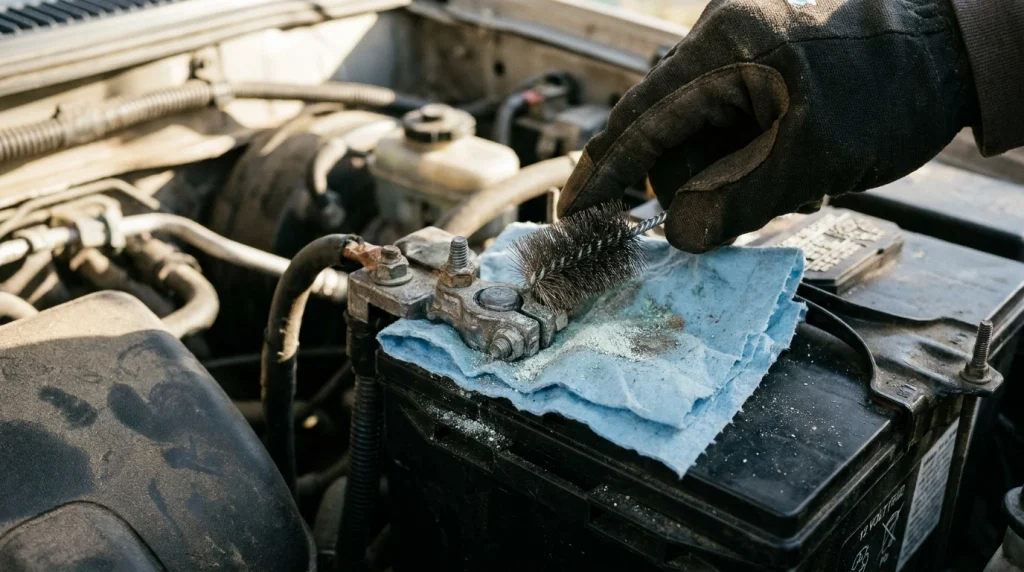
Corrosion looks like white, blue, or green crust around the terminal. It acts like an insulator and blocks current, even when the battery is new.
Clean both terminals with a wire brush, tighten each clamp until it does not move, then try to start the car again.
2. A faulty or discharged new battery
Yes, a new battery can be bad. It may have sat on a shelf for months, arrived partly discharged, or suffered damage in transit.
It may also be the wrong fitment for your car. Fitment means the battery matches your make, model, year, trim, and engine in size, terminal layout, and power rating.
Check the label against your owner’s manual or a VIN lookup. A battery with the wrong group size or cold cranking amps can crank slowly or not at all.
3. A bad starter motor or starter solenoid
The starter motor is the electric motor that turns the engine over. The solenoid is the small switch on the starter that engages it.
When a starter fails, you often hear one loud click and then silence. The lights may stay bright, which tells you the battery still has power.
4. A weak or failed alternator
The alternator recharges the battery while you drive. If it fails, the new battery drains a little more on every trip.
Watch for a battery warning light, dim lights at idle, or a car that starts after a jump and dies again soon after. A charging system test at a parts store or shop can confirm it in minutes.
5. A blown fuse, bad relay, or faulty ignition switch
A fuse is a small safety device that breaks the circuit if current gets too high. A relay is an electric switch that lets a small signal control a larger load, like the starter.
If the starter fuse or relay fails, the starter gets no signal at all. An ignition switch can fail the same way, so try the spare key first and check the fuse box diagram in your owner’s manual.
6. A bad ground connection
A ground is the return path that lets current flow back to the battery. Most cars ground the battery to the body and the engine block.
Rust, paint, or a loose bolt can break that path. Follow the thick black cable from the battery to the body and engine, clean the contact points, and tighten the bolts.
7. A parasitic drain or a part left on
A parasitic drain is a small, constant draw that should shut off after you park. A glove box light, trunk light, or aftermarket alarm can keep drawing power all night.
This cause is easy to miss because the car starts fine during the day. It only fails after sitting overnight or over a weekend.
Safety note: Disconnect the negative battery cable first before you clean terminals or check wiring, and reconnect it last. Wear eye protection, and follow your owner’s manual for fuse and battery work.
Section takeaway: Start with terminals and fitment, then test the starter and alternator — most new-battery no-starts are a connection or charging fault, not a second bad battery.
Click, Silence, or Crank But No Start — What Is Your Car Telling You?
What does it sound like when you turn the key? That sound narrows the fault fast, so listen once before you replace anything.
| Symptom | Most likely cause | Check first |
|---|---|---|
| Rapid clicking | Low voltage or loose terminals | Terminal tightness, corrosion, battery voltage |
| One loud click, no crank | Starter or solenoid fault | Starter signal, solenoid, starter fuse and relay |
| No sound at all | Ignition switch, fuse, relay, or dead connection | Fuses, relay, shifter in Park, spare key |
| Slow, laboured crank | Weak battery, bad ground, or cold weather | Voltage under load, ground cable, battery size |
| Cranks fine, won’t fire | Fuel, spark, or immobiliser fault | Fuel level, check engine light, OBD2 code scan |
Rapid clicking usually means low voltage at the starter. One click usually means the starter got the signal but could not turn.
Silence is different again. Check that the car is fully in Park or Neutral, then try the spare key.
Cranking without firing is not a battery fault in most cases. The battery did its job, but fuel or spark did not follow.
An OBD2 scanner can help here. OBD2 is the diagnostics port under your dash, and a basic scan can reveal a code tied to the immobiliser or fuel system.
Section takeaway: Match the sound to the table first — rapid clicks point to voltage, one click points to the starter, and silence points to the switch, fuse, or connection.
How Can I Test a New Battery, Starter, and Alternator at Home?
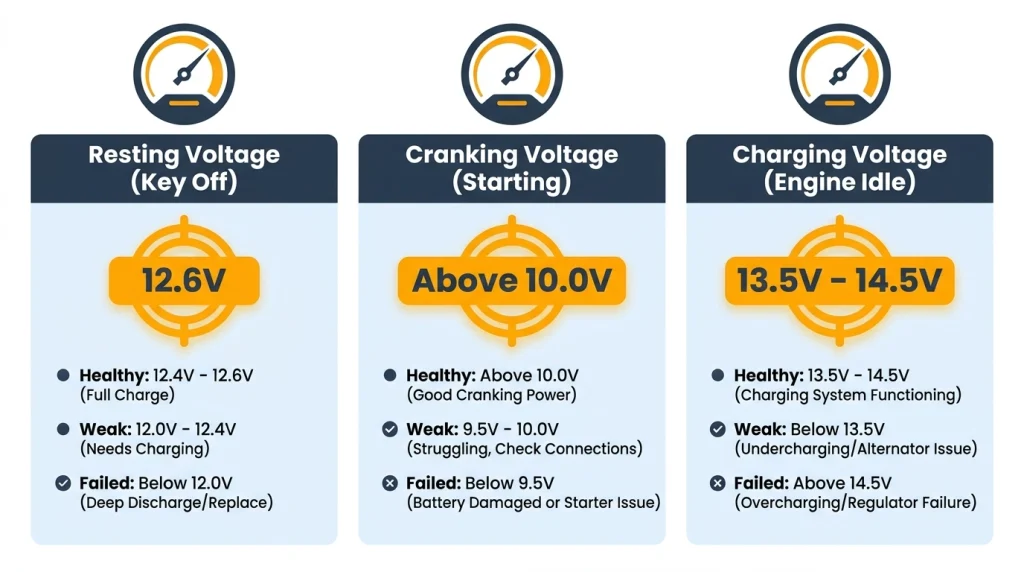
You don’t need a shop to run the first tests. A multimeter is a small tool that measures voltage, and ten minutes will tell you a lot.
Many auto parts stores will also test your battery and alternator for free. Follow these steps in order, and write down each reading as you go.
- Check resting voltage: With the car off for at least an hour, touch the multimeter leads to the terminals. A healthy, charged battery reads near 12.6 volts.
- Check voltage while cranking: Have a helper turn the key while you watch the meter. If voltage drops far below 10 volts, the battery is weak or the connection is poor.
- Check charging voltage: With the engine running, the meter should read roughly 13.5 to 14.5 volts. A lower reading points to the alternator or its belt.
- Check for a voltage drop: Measure from the battery post to the cable clamp while cranking. A large drop means corrosion or a loose clamp.
- Test the starter signal: If voltage is good but you hear one click, check the starter fuse and relay first, then have a shop test the starter itself.
I once tested a “new” battery that read 12.1 volts at rest. It had simply sat discharged on a shelf, and a full charge fixed it.
If you don’t own a multimeter, use a free parts-store test. Ask for a printout of the results, and keep it for warranty.
Safety note: Keep hands, loose clothing, and test leads clear of belts and fans while the engine runs. Never disconnect the battery with the engine running to test the alternator.
Section takeaway: Test resting, cranking, and charging voltage in that order — the three readings together separate a battery fault from a starter or alternator fault.
Battery vs Starter vs Alternator: What’s the Difference?
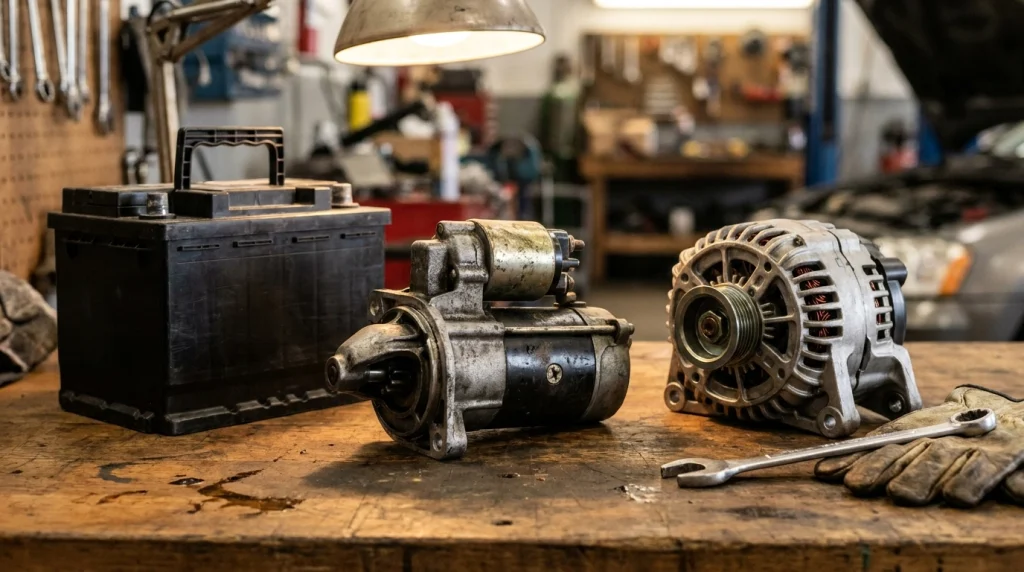
These three parts get blamed for each other all the time. Here’s how they differ in plain terms.
The battery stores power for the first crank. The starter uses that power to turn the engine.
The alternator makes power once the engine runs and refills the battery.
| Part | Job | Fails like this | Key test |
|---|---|---|---|
| Battery | Stores power to crank the engine | Slow crank, rapid clicks, dim lights | Resting voltage near 12.6 volts, load test |
| Starter | Turns the engine over | One click, no crank, bright lights | Starter signal and bench test |
| Alternator | Charges the battery while driving | Car dies after a jump, battery light on | Charging voltage near 13.5 to 14.5 volts |
Use the table before you buy a part. A starter will not fix a charging fault, and an alternator will not fix a dead starter.
Check fitment before you order any of these parts. Use your VIN, the part number from the old part, and your owner’s manual to confirm the match.
OEM parts come from the vehicle maker or its approved supplier. Aftermarket parts come from other makers, and remanufactured parts are used cores rebuilt to a working standard.
Keep your receipt and the old part until the new one is tested, as the Car Care Council advises for routine maintenance and repairs.
Section takeaway: Battery stores, starter turns, alternator charges — name the job that failed before you buy its replacement.
Why Does a New Battery Drain Overnight?
A new battery should hold a charge for weeks, not hours. If it dies overnight, something is drawing power when it should be asleep.
That draw is called a parasitic drain.
Common culprits include a glove box light that stays on, a trunk light, a faulty door switch, or an aftermarket stereo, alarm, or dash camera wired to constant power.
Check the simple things first. Look for a light on after you lock the car, and unplug aftermarket accessories for one night as a test.
As of 2026, many newer cars keep modules awake longer after you park. Give the car time to sleep before you judge the draw.
Section takeaway: An overnight drain is a draw fault, not a battery fault — check lights and aftermarket parts first, then measure the draw properly.
When Should I Call a Mechanic?
Call a mechanic when the simple checks don’t solve it. Get help right away if you smell fuel, see smoke, find melted wiring, or hear grinding from the starter.
Also seek help if the car cranks but won’t start after a fuel or spark check. That fault needs a proper scan.
Before you book, write down what you already tried. Note the sound, the voltage readings, and whether a jump helped.
That note saves diagnostic time and helps the shop test the right part first. Ask for the test results in writing, and keep them with your battery warranty.
For safety recalls, check NHTSA for recall information before you pay for a repair. Consumer Reports also publishes reliability notes that can help you ask sharper questions.
Section takeaway: If terminals, voltage, fuses, and a jump don’t solve it — or you see smoke, fuel, or melted wiring — let a qualified mechanic test the starter and charging system.
Frequently Asked Questions
Can a brand new battery be dead?
Yes, it can arrive partly discharged or damaged. A resting voltage test and a load test will confirm it, and most suppliers will replace it under warranty if it fails.
Why does my car click but not start with a new battery?
Rapid clicking usually means low voltage from a loose or corroded terminal. One loud click with bright lights usually points to the starter or its solenoid instead.
Will a jump start help if I have a new battery?
A jump can help if the new battery is discharged or the connection is weak. If the car dies again soon after, the alternator or a drain is the more likely fault.
How do I know if it’s the starter or the alternator?
Check the sound and the voltage. A starter fault gives one click and no crank with good voltage, while an alternator fault shows low charging voltage.
Can a bad alternator kill a new battery?
Yes, a failed alternator will not recharge the battery while you drive. The battery then drains a little more on every trip.
Should I replace the battery again first?
No, test it first. Check the terminals and voltage before you buy a second battery, or you may repeat the same fault.
The Bottom Line
A brand new battery is a good start, but it is not a full diagnosis. Check the terminals, listen to the sound, and test the voltage before you spend more.
If you’re still stuck, take your notes to a qualified mechanic. You’ll arrive with a clear symptom, a test result, and a much shorter path to a fix.

Alex Carter is an automotive content writer at VastAutoParts, focusing on car parts, vehicle troubleshooting, automotive tools, product research, and practical car care guides.