
Car Won’t Start in the Morning but Starts Later? Causes
Quick Answer
If your car won’t start in the morning but starts later, a weak battery, poor electrical connection, overnight power drain, or cold-start fuel problem may be responsible. The key clue is whether the engine turns slowly, clicks without turning, or cranks normally but fails to fire.
- Slow cranking suggests a battery, cable, or starter problem.
- Normal cranking without ignition points toward fuel, spark, or sensor issues.
- Starting after a jump suggests a power problem, not necessarily a bad battery.
- Record the first failed start before replacing any parts.
You turn the key before work, and the car refuses to start. Later, it starts as though nothing happened. This guide helps you use the sound, weather, and timing of the failure to narrow down the cause safely.
In this article
- Why a car starts later but not in the morning
- What starting sounds reveal
- Common causes of morning starting trouble
- Checks to perform before replacing parts
- How to check battery and charging performance
- What to do if the engine cranks normally
- Mistakes that make diagnosis harder
- When to stop and get professional help
- How to reduce another morning failure
- Frequently asked questions
- Conclusion
Why Does a Car Start Later but Not in the Morning?
A morning-only starting problem often means something changes while the car is parked or as outside temperatures rise. The engine may also restart more easily after it has run and warmed up.
An aging battery can struggle after sitting overnight, especially in cold weather. Once the engine runs, the alternator may replace some lost charge. A warmer engine may also turn more easily on the next attempt.
Fuel pressure can drop while a vehicle sits. A fuel pump may need extra time to rebuild that pressure at the next startup. Some engine sensors and ignition parts also behave differently when cold.
Does a Later Successful Start Mean the Problem Is Gone?
A successful start later in the day does not prove that the fault has disappeared. Intermittent electrical contacts and marginal batteries may work under favorable conditions and fail again.
Compare the first start after a long rest with restarts after driving. That pattern helps separate an overnight battery or fuel issue from a fault that appears at random.
What Do the Starting Sounds Tell You?
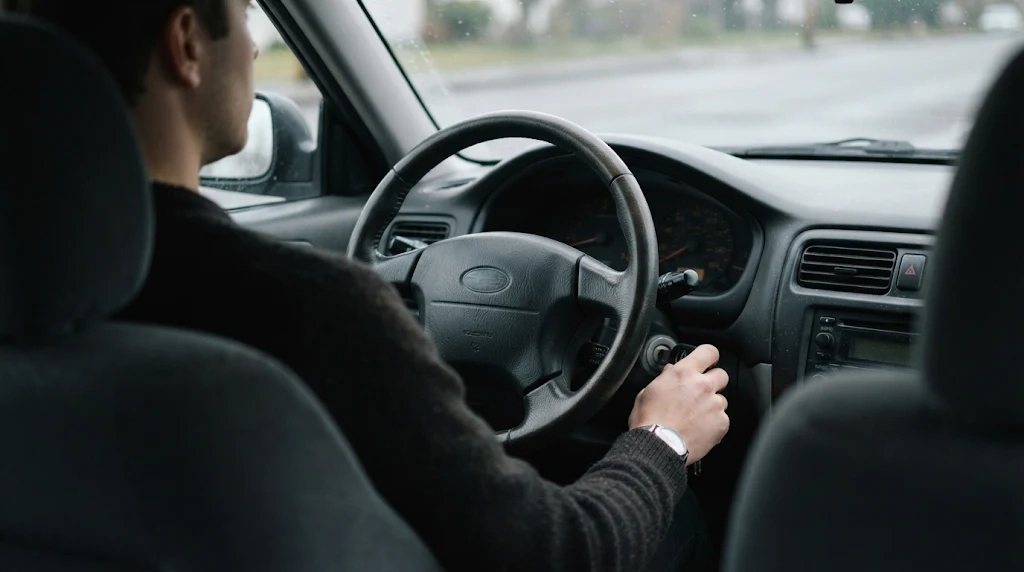
The sound during the failed attempt is the fastest way to sort a no-start problem into useful categories. Listen once carefully instead of repeatedly turning the key.
The following table compares common symptoms with the system worth checking first.
| Morning symptom | Possible cause | First useful check |
|---|---|---|
| Slow, dragging crank | Weak battery, cables, or starter | Battery load test and terminal inspection |
| Rapid clicking | Low available electrical power | Battery charge and cable condition |
| Single click, no crank | Starter circuit or poor connection | Power supply and starter diagnosis |
| Normal crank, no ignition | Fuel, spark, or sensor fault | Fault codes and fuel system checks |
| Starts, then runs roughly | Ignition, mixture, or air intake issue | Scan for codes and check maintenance history |
Slow cranking points first toward the starting circuit. Normal cranking without starting calls for a different diagnosis. A bright dashboard alone cannot confirm that the battery can power the starter.
What Causes Morning-Only Starting Problems?
Morning starting failures can come from the battery, wiring, charging system, starter, fuel delivery, or engine controls. The most likely cause depends on how the engine behaves.
1. Weak Battery or Reduced Cold Cranking Power
A weak battery may have enough power for a warm restart but not for a cold first start. Low temperatures reduce the power a battery can deliver while the engine may demand more.
Look for dim lights, sluggish cranking, or a noticeable improvement after a jump-start. AAA explains these effects in its guide to battery failure.
2. Loose or Corroded Battery Connections
Loose battery terminals or a damaged ground cable can restrict the current reaching the starter. A battery may test charged while a poor connection prevents reliable cranking.
Look for powdery corrosion, damaged cable insulation, or a terminal that appears loose. Have a technician service unsafe or heavily corroded connections instead of forcing them.
3. Overnight Electrical Drain or Poor Charging
An electrical drain can leave a battery weak after the car sits overnight. A stuck interior light, accessory, or faulty electrical component may keep drawing power after shutdown.
A weak alternator can cause similar symptoms by failing to recharge the battery while driving. Short journeys may also leave a low battery without enough time to recover.
If the battery passes its health test but keeps losing charge, request a charging-system and parasitic-draw test. Replacing a healthy battery will not repair the underlying fault.
4. Intermittent Starter Motor or Starter Circuit
A worn starter or faulty starter circuit may fail to turn the engine even when the battery has power. A single click or silence with bright lights can point in this direction.
The ignition switch, starter relay, wiring, and ground connections can produce similar symptoms. AAA covers these possibilities in its starting-problem guide.
Do not replace the starter based on clicking alone. A technician should confirm that the starter receives proper voltage and its control signal.
5. Fuel Pressure Loss While the Car Sits
Fuel pressure can drop after shutdown and delay the first start. A weak pump, leaking check valve, regulator problem, or injector issue may be involved.
The engine often cranks at normal speed but takes longer to fire. AutoZone explains how a pump can struggle to build pressure after the vehicle rests in its fuel pump diagnosis guide.
A mechanic can check pressure buildup and pressure retention against the vehicle’s specifications. A long crank alone does not prove the fuel pump needs replacing.
6. Cold-Start Sensor or Ignition Fault
An incorrect engine temperature signal can cause the computer to choose the wrong fuel mixture during a cold start. Worn spark plugs or ignition coils may also cause rough firing.
Watch for sputtering, uneven idle, or a check engine light after startup. A scan tool can help identify stored codes and compare sensor readings with actual conditions.
7. Diesel Cold-Start Components
A diesel engine may struggle on cold mornings when its glow-plug or intake-heating system does not work properly. Diesel starting problems require checks suited to that engine.
Follow the vehicle’s cold-start procedure and warning lights. Avoid using starting fluid unless the manufacturer specifically permits it, because some diesel intake-heating systems make that unsafe.
What Should You Check Before Replacing Parts?
Start with observations and simple checks before buying a battery, starter, or fuel pump. These steps help preserve clues from the failed first start.
- Listen to the engine. Decide whether it cranks slowly, clicks without turning, or turns normally without firing.
- Check the dashboard. Note any battery, security, or check engine warning. Record whether lights dim during cranking.
- Look at the battery. Inspect from a safe distance for loose connections, corrosion, leaks, cracks, or swelling.
- Check for overnight loads. Look for lights left on, plugged-in accessories, or doors that were not fully closed.
- Record the circumstances. Note the outside temperature, parking duration, and whether a jump-start changed the result.
- Arrange testing. Ask for battery and charging tests first if cranking is weak. Ask about fuel or ignition diagnosis if cranking is normal.
These checks are useful because a battery problem and a fuel problem can feel alike from the driver’s seat. Their starting sounds and test results are different.
Warning
A swollen, cracked, leaking, or frozen battery can be dangerous. Do not jump-start it; get professional assistance instead.
How Can You Check the Battery and Charging System?
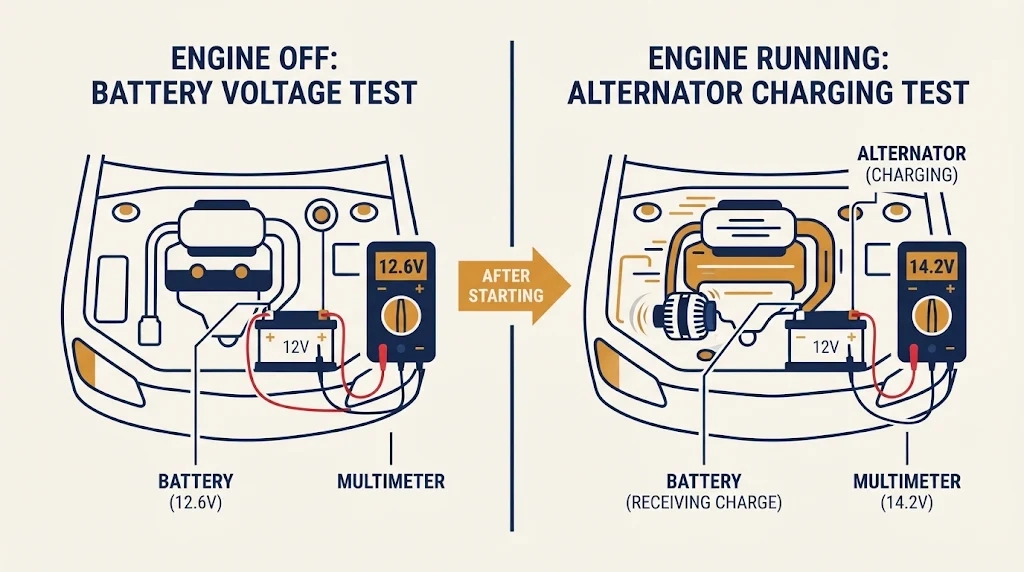
A battery test checks whether the battery can deliver starting power, while a charging test checks whether the vehicle can replenish it. Both may be needed.
Check the Battery Before the First Start
A car battery tester that performs a load test is more useful than judging battery condition from working lights alone. Ask for a test when the battery is cold or after the car has been parked overnight.
A digital multimeter can measure voltage, but resting voltage alone cannot establish battery health. For a conventional 12-volt system, AAA describes about 12.6 volts with the engine off as a common reference.
Use the vehicle manual and the tester’s instructions when interpreting readings. Battery chemistry, state of charge, and vehicle design can change the expected results.
Check Whether the Alternator Charges Properly
A charging-system check helps explain why a battery becomes weak again after driving. It should include the alternator, wiring, and related controls.
AAA lists about 13.8 to 14.2 volts as a common running reference for conventional systems. Some computer-controlled charging systems vary their output, so a single reading is not conclusive.
If the battery warning light stays on while driving, stop safely and arrange assistance. A charging failure can leave the vehicle unable to keep running.
What Does a Successful Jump-Start Prove?
A successful jump-start suggests that extra electrical power helped the engine turn or start. It does not identify why the original battery lacked enough usable power.
The battery may be discharged, worn, undercharged, or affected by poor connections. Have it and the charging system tested rather than treating a jump-start as a repair.
What If the Engine Cranks Normally but Will Not Start?
Normal cranking without ignition shifts attention toward fuel delivery, spark, air, and engine-control signals. The starter is turning the engine, so a basic cranking failure is less likely.
Notice whether the car starts after sitting with the ignition switched on, where the owner’s manual permits that procedure. Some vehicles prime the fuel system before cranking.
An improvement may suggest a pressure-building problem, but it is not proof of pump failure. A pressure test is needed to separate a pump, regulator, injector, and other fuel faults.
A diagnostic scan may reveal ignition misfires or sensor faults. Even without a warning light, a technician can check temperature data and live engine readings during the cold start.
If the engine starts and immediately shakes or stalls, record that behavior too. The fault may involve fuel mixture, ignition, intake air, or another engine-control issue.
Which Mistakes Can Make a Morning No-Start Worse?
Repeated cranking and random parts replacement can turn a manageable diagnosis into a larger problem. Protect the starter and preserve evidence of the original fault.
- Avoid repeated long start attempts when the engine does not fire.
- Do not assume a working radio proves the battery is strong.
- Do not replace the alternator simply because a jump-start worked.
- Do not buy a fuel pump based only on a long morning crank.
- Do not bypass safety switches or connect jumper cables without following the vehicle instructions.
- Do not ignore a strong fuel smell, smoke, or a burning odor.
Start with the failed-start symptom and follow a test result to the next step. That approach avoids paying for parts that were working properly.
When Should You Stop Trying and Call a Mechanic?
Stop attempting to start the vehicle when there are signs of fire risk, battery damage, or a serious mechanical problem. Roadside assistance may be safer than more attempts.
Seek prompt help if the battery is damaged, the engine makes harsh grinding sounds, or you smell strong fuel or burning material. A flashing check engine light or repeated stalling also needs professional attention.
If the car starts later but the problem keeps returning, book a diagnosis before relying on it for a long trip. Ask the shop to reproduce the failure after an overnight park if possible.
Tell the mechanic whether the engine cranked, what the lights did, and whether a jump helped. A short phone recording of the sound can be more useful than saying it did not start.
How Can You Reduce Another Morning Starting Failure?
Routine battery care and timely testing can reduce many preventable morning starting failures. Prevention depends on fixing the actual fault, not merely getting the engine running once.
- Have an aging or slow-cranking battery tested before cold weather.
- Keep battery connections secure and free of heavy corrosion.
- Unplug accessories that draw power while the vehicle is parked.
- Use the oil grade and maintenance schedule specified in the owner’s manual.
- Check charging performance when the battery repeatedly loses power.
- Investigate recurring hard starts before they become a complete no-start.
When the problem continues despite a healthy battery, ask for targeted electrical or fuel-system testing. A complete diagnosis is more useful than repeated jump-starts.
Car Battery Tester
A car battery tester can help check starting-system performance when morning cranking is weak.
Frequently Asked Questions
Can a key fob battery stop my car starting?
A weak key fob battery can prevent some push-button-start vehicles from recognizing the key and allowing the engine to start. Look for a key warning on the dashboard. Check the owner’s manual for the backup key-detection location, which varies by vehicle.
Does parking in a garage make morning starts easier?
Parking in a garage can help when lower outdoor temperatures reduce available battery power or make an engine harder to turn. The benefit depends on how much warmer the garage stays. Indoor parking will not repair a weak battery, damaged cable, or failing starter.
Can the wrong engine oil cause hard cold starting?
Oil that is too thick for the conditions can make a cold engine harder to turn during startup. Use the viscosity grade approved in your vehicle’s manual. If you suspect an oil problem, check the oil level and service history before blaming the battery.
Can an automatic car start in Neutral instead of Park?
Many automatic cars permit starting in Neutral as well as Park, provided the brake and other required conditions are met. If it starts in Neutral but not Park, the gear-position switch or adjustment may need checking. Use only the procedure in your manual and keep the vehicle secured.
Why does a new battery still fail overnight?
A new battery can still be discharged by a parasitic electrical load or a charging-system fault. Loose terminals can also prevent reliable starting. Confirm the battery is the correct type, then request electrical and charging tests instead of immediately replacing it again.
What should I tell a mechanic about this problem?
A mechanic needs the failed-start sound, whether the engine turned, warning lights, and how long the car had been parked. Mention outside temperature, recent repairs, and whether a jump-start helped. A recording of the first attempt can help reproduce an intermittent fault.
Conclusion
If your car won’t start in the morning but starts later, use its first-start sound to separate electrical trouble from fuel or ignition trouble. If cranking is slow, test the battery and connections first; if it cranks normally, request targeted fuel and engine-control checks.

Alex Carter is an automotive content writer at VastAutoParts, focusing on car parts, vehicle troubleshooting, automotive tools, product research, and practical car care guides.