
Why Is My Car Cranking Slowly Even With a Good Battery?
Quick Answer
Your car can crank slowly even with a good battery because the starter motor may not receive enough electrical power, or the engine may resist turning. Loose battery cables, corroded connections, weak ground straps, and a worn starter are common causes. Testing the starting circuit helps identify the problem before you replace parts.
- Check battery terminals and cable connections for corrosion or looseness.
- Inspect the engine ground strap and negative battery cable.
- Test voltage loss between the battery and starter motor.
- Check the starter motor if the battery and wiring pass their tests.
- Consider thick engine oil or mechanical resistance if electrical tests are normal.
You turn the key, and your engine struggles to spin, even though the battery appears healthy. Slow cranking with a good battery can leave you unsure whether the starter, wiring, or engine needs attention.
This guide explains the likely causes, how to separate them, and which checks to perform before spending money on repairs.
In this article
- What Does Slow Cranking Mean?
- Why Can a Good Battery Still Crank Slowly?
- What Causes Slow Engine Cranking?
- Which Symptoms Point to Each Problem?
- How to Diagnose Slow Cranking
- How to Check Starter Voltage Drop
- Cold Starts and Hot Starts
- Which Repairs Should You Consider?
- When Should You Stop Trying to Start?
- Frequently Asked Questions
- Conclusion
What Does Slow Cranking Mean?
Slow cranking means the starter motor turns the engine more slowly than expected when you try to start your car. Instead of a quick, steady turning sound, you hear a labored or uneven rotation.
The starter motor is an electric motor that briefly rotates the engine until combustion can begin. It draws substantial electrical power from the battery during this process.
Slow cranking is different from an engine that spins normally but takes a long time to start. That second problem usually calls for checks involving fuel delivery, ignition, or engine management.
How Is Slow Cranking Different From No Cranking?
Slow cranking means the engine rotates with difficulty, while no cranking means the engine does not turn when you request a start.
A single click without rotation can indicate a starter engagement or power delivery problem. Rapid clicking may suggest inadequate electrical supply or excessive resistance in the starting circuit.
These sounds provide clues, but they cannot confirm the failed component without testing.
Why Can a Good Battery Still Crank Slowly?
A good battery can produce slow cranking when its available power cannot reach the starter efficiently. Excessive electrical resistance reduces the voltage delivered to the motor during starting.
Electrical resistance opposes current flow through wires and connections. A damaged cable or loose terminal can create enough resistance to affect starter performance under heavy load.
The starter might also receive adequate electrical power but struggle because of internal wear or excessive engine resistance.
Does a Good Battery Test Rule Out Battery Problems?
A good battery test reduces the chance of battery failure, but the type of test matters. A resting voltage measurement cannot prove that the battery delivers enough current during cranking.
A battery may show acceptable voltage without a heavy load and perform poorly when the starter operates. A proper battery load or conductance test gives more useful information about its condition.
Battery charge level also matters. A healthy battery that is not fully charged may still struggle to start the engine.
Why Does the Starter Need Strong Connections?
The starter needs a low-resistance path from the battery’s positive terminal and back through the ground circuit. A restriction anywhere along that path can reduce the power available.
The negative side often includes an engine ground strap, which connects engine metal to the vehicle’s electrical ground. A damaged strap can affect cranking even when other electrical accessories work.
What Causes Slow Engine Cranking With a Good Battery?
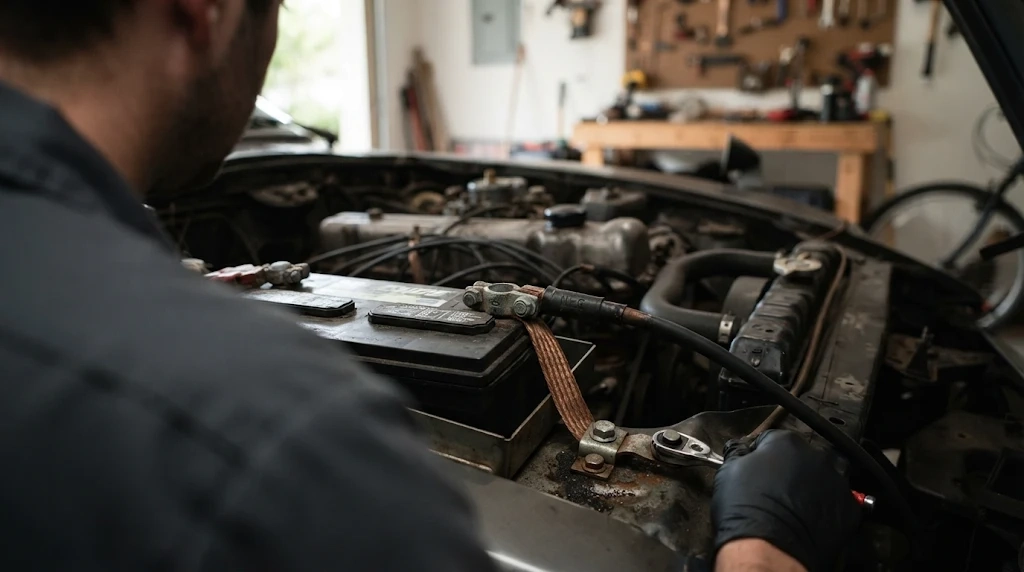
Slow engine cranking with a good battery often comes from cable resistance, weak ground connections, starter wear, or increased engine drag. Each cause requires a different check.
1. Loose or Corroded Battery Terminals
Loose or corroded battery terminals can restrict the high current needed by the starter motor. This can happen even when the battery itself passes a health test.
Look for loose clamps, corrosion, damaged terminal surfaces, and cables that do not sit securely. Corrosion may appear around the clamps or where a cable enters its terminal end.
Connection problems can also be hidden beneath insulation or inside cable ends. A cable that looks clean from the outside is not necessarily electrically sound.
2. Damaged Positive Battery Cable
A damaged positive cable can prevent enough battery power from reaching the starter. Internal corrosion, broken wire strands, and loose cable connections can increase resistance.
The cable may still conduct enough electricity for smaller accessories. However, the much heavier starter load can expose the fault.
A voltage drop test can identify excessive resistance along this path without relying on appearance alone.
3. Poor Engine Ground Connection
A poor engine ground can make a healthy starter crank slowly because the return path to the battery has excessive resistance.
The engine ground strap may become loose, corroded, or damaged. Connection points can also develop resistance where the strap attaches to the engine or body.
Check for damaged braided straps, loose fasteners, and corrosion around ground mounting points. A voltage drop test is needed to confirm whether the ground circuit is restricting current.
4. Worn or Failing Starter Motor
A worn starter motor can turn the engine slowly even when the battery and external wiring are working properly.
Internal parts such as brushes, bushings, bearings, and electrical windings can deteriorate. The motor may then struggle to produce enough turning force.
Some starter faults appear intermittently, making diagnosis harder. A faulty starter can also draw abnormal current while cranking.
Starter current testing and electrical circuit checks help separate internal starter problems from poor power delivery.
5. Faulty Starter Solenoid Connections
Bad solenoid contacts can restrict the electrical supply to the starter motor. The solenoid is a switch that helps connect battery power to the starter and engage its drive gear.
Worn contacts may prevent normal engagement or create resistance inside the starter assembly. Depending on the design, the solenoid may be part of the starter unit.
A clicking sound can accompany solenoid problems, but clicking alone does not prove the solenoid has failed.
6. Thick Engine Oil in Cold Weather
Thick engine oil can increase the effort required to turn a cold engine. This adds mechanical load to the starter.
Oil viscosity describes how easily oil flows at different temperatures. Using oil that is too thick for the vehicle’s conditions can make cold cranking harder.
Check the oil grade recommended in your owner’s manual rather than choosing a thinner oil without guidance.
7. Excessive Engine Mechanical Resistance
Excessive mechanical resistance can slow cranking even when the electrical system works correctly. The starter must overcome the resistance of the engine’s moving parts.
Possible causes include internal engine damage, a binding accessory, or an abnormal mechanical load.
Mechanical causes become more important when battery, cable, ground, and starter tests do not explain the problem.
A qualified technician can check whether the engine rotates normally and identify components that may be binding.
Which Symptoms Point to Each Starting Problem?
Starting sounds, temperature, and electrical behavior can help narrow the cause, but symptoms are not a substitute for testing.
The following table compares common patterns with the most useful next check.
| Symptom | Possible Cause | Next Check |
|---|---|---|
| Slow, steady cranking | Cable resistance or starter wear | Battery load and voltage drop tests |
| Cranking improves after cleaning terminals | Poor terminal contact | Confirm connection voltage drop |
| Slow cranking when cold | Oil drag, battery output, or wiring resistance | Oil specification and cold-load testing |
| Slow cranking when hot | Heat-sensitive starter or connections | Starter current and voltage drop |
| Single click without rotation | Starter engagement or supply problem | Starter circuit and solenoid tests |
| Cranking slows on repeated attempts | Falling battery charge or increased resistance | Battery under-load test and wiring inspection |
The strongest clue is a repeatable test result, not a particular sound. Similar symptoms can come from different faults.
How to Diagnose Slow Cranking Step by Step
Diagnose slow cranking by testing the battery first, inspecting the power and ground paths, and checking starter performance afterward.
For the safest and most reliable result, use the vehicle’s service procedures. A digital multimeter can assist with voltage checks, while starter current measurements require suitable equipment.
- Confirm battery condition. Check whether the battery is fully charged and has passed a proper load test. If it has not, correct that issue before testing other components.
- Inspect the battery terminals. With the vehicle switched off, look for looseness, corrosion, and damaged cables. Repair any visible problems using the manufacturer’s instructions.
- Inspect the ground connections. Check the negative cable and visible engine ground straps for damage. Pay attention to loose mounting points and corroded connections.
- Measure battery voltage during cranking. Use an appropriate meter and compare the reading against the vehicle’s service specifications. A resting battery reading alone is not enough.
- Check voltage drop through the starter circuit. Test the positive and ground paths under load. Excessive voltage loss indicates resistance somewhere in the circuit.
- Test the starter and engine load. If the electrical supply tests normally, have the starter current draw and mechanical resistance checked.
This order helps prevent unnecessary starter replacement. DENSO’s starting system troubleshooting guide also recommends checking battery condition, cable connections, and voltage drop before deciding which part needs repair.
Warning
Starter wiring carries high current. Keep hands and tools away from moving parts, and leave exposed starter-terminal testing to a trained technician.
How Do You Check Starter Voltage Drop?
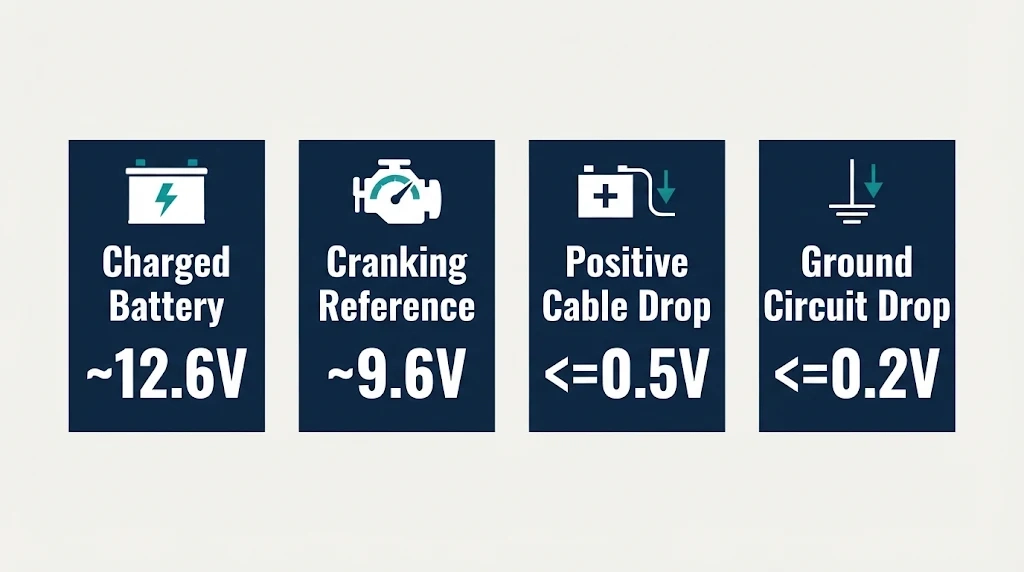
A starter voltage drop test measures how much voltage is lost as electricity travels through the starting circuit under load.
A digital multimeter measures the difference in voltage between two points. Excessive voltage loss can indicate damaged wiring, corrosion, loose connections, or faulty electrical contacts.
What Does Battery Voltage Tell You?
Battery voltage helps show whether the battery is charged and how it responds during starting. However, the voltage reading must be interpreted under the correct test conditions.
According to DENSO’s starter troubleshooting guidance, a fully charged conventional battery is about 12.6 volts.
DENSO also identifies approximately 9.6 volts as a common cranking-voltage reference under specified temperature conditions. Your vehicle’s service manual should take priority over a general reference value.
A low reading during cranking can indicate battery weakness, insufficient charge, or excessive electrical demand. More tests are needed to separate these possibilities.
What Is the Positive Cable Voltage Drop Test?
The positive-side test measures voltage loss between the battery’s positive post and the starter’s main power connection during cranking.
DENSO’s guidance identifies 0.5 volts or less as an acceptable positive-side drop for its described test. Higher readings may indicate unwanted resistance in the positive cable path.
The connection location matters because testing the battery clamp instead of the actual battery post can hide a poor connection.
The starter’s main power terminal may remain live with the ignition switched off. Accessing it can cause a serious short if a probe touches nearby metal.
How Do You Check the Ground Circuit?
The ground-side test measures voltage loss between the starter housing and the battery’s negative post while the starter is operating.
DENSO gives 0.2 volts or less as an acceptable negative-side reading in its diagnostic procedure. A higher result suggests excessive resistance through the engine ground path.
Possible problem areas include the battery ground cable, engine ground strap, and starter mounting connections.
Use the vehicle manufacturer’s exact test method and limits. Have a technician perform the procedure if starter access is unsafe.
What If Both Voltage Drop Tests Pass?
Normal voltage drop readings shift attention toward the starter motor and mechanical engine load. They do not automatically prove that the starter is defective.
A starter current draw test can help reveal whether the motor is working harder than expected. Excessive engine resistance can also raise current demand.
Delco Remy’s starter cranking diagnostic guidance recommends confirming battery and cable performance before identifying the starter as the failed component.
Why Does My Car Crank Slowly When Cold or Hot?
Temperature can change how the battery, starter, wiring, and engine behave. Cold and hot starting problems may therefore point toward different conditions.
Slow Cranking on Cold Mornings
Cold-weather slow cranking can result from increased engine oil resistance and reduced battery performance. Marginal cable connections or starter wear can make the symptoms more noticeable.
Compare cold starts with starts after the engine reaches normal operating temperature. If cranking improves substantially when warm, include oil viscosity and cold battery performance in the diagnosis.
Follow the manufacturer’s engine oil recommendations for the climate. Using the wrong viscosity can increase the load on the starting system.
Slow Cranking After the Engine Gets Hot
Hot-engine slow cranking can occur when starter components or electrical connections become more sensitive to heat.
A starter may work normally when cool and struggle after the engine has been running. Temperature-related resistance changes and internal starter faults are possible causes.
Ask a technician to test the starting circuit while the symptom is present. Testing only after everything cools may miss an intermittent problem.
Which Repairs Can Fix Slow Cranking?
The correct repair depends on which part fails testing. Replacing the battery or starter without confirming the cause can leave the original problem unresolved.
Repair Poor Battery Cable Connections
Cleaning and securing damaged terminal connections can restore normal current flow when connection resistance causes the problem.
Check whether the cable itself is still sound. Cleaning a terminal will not fix a cable that has internal corrosion or broken strands.
Repair or Replace a Damaged Ground Strap
A damaged engine ground strap should be repaired or replaced with a suitable connection that meets the vehicle’s requirements.
The ground path must provide a reliable return circuit for the starter. Confirm the repair with a voltage drop test instead of relying on appearance alone.
Replace a Starter Only After Testing
Starter replacement makes sense when testing confirms an internal motor or solenoid problem and other causes have been ruled out.
Ask for the battery, cable resistance, and starter current results before approving replacement. A high current reading can also reflect mechanical engine resistance.
Correct Engine Oil or Mechanical Problems
Engine-related cranking problems require repairs that address the source of mechanical resistance. Replacing a starter will not fix an engine that is unusually difficult to rotate.
Use the correct engine oil grade and investigate unusual resistance, noises, or signs of internal damage.
When Should You Stop Trying to Start the Car?
Stop repeated starting attempts when cranking produces unusual heat, burning smells, smoke, grinding noises, or signs of electrical damage.
Repeated cranking can overheat the starter and further discharge the battery. Continuing to force a reluctant engine to turn can also make some mechanical problems worse.
DENSO’s service instructions limit individual cranking tests to 10 seconds and specify at least 60 seconds of cooling before another attempt. Follow vehicle-specific requirements where they differ.
Arrange professional inspection if you notice:
- Smoke or a burning smell near the engine or battery.
- A battery cable or terminal becoming abnormally hot.
- Grinding or harsh mechanical sounds during cranking.
- Repeated starting failure after the battery passes its tests.
- Cranking that becomes progressively weaker despite corrective checks.
A car that starts after several difficult attempts may still have a developing electrical or mechanical fault. Fixing the cause before complete failure can prevent an unexpected no-start situation.
Digital Multimeter
A digital multimeter helps measure battery voltage and supports safe, appropriate starting-circuit checks.
Frequently Asked Questions
Can a new battery still cause slow cranking?
A new battery can cause slow cranking if it is undercharged, defective, incorrectly specified, or unable to deliver enough current. Battery age alone does not guarantee performance. Check the battery’s charge and test it under load before ruling it out.
Can a bad alternator cause slow cranking?
A faulty alternator can indirectly cause slow cranking by failing to recharge the battery properly while the engine runs. The starter then receives less available power at the next start. If the battery is fully charged and load-tested, investigate the starting circuit separately.
Why does my car crank slowly after sitting overnight?
Slow cranking after overnight parking may result from reduced battery charge, cold temperatures, or increased engine resistance during a cold start. Check battery condition and compare the symptom in different temperatures. If the battery loses charge while parked, investigate an electrical drain.
Can a bad ground cause intermittent starting problems?
A weak ground connection can cause intermittent slow cranking when vibration, temperature, or contact changes affect electrical resistance. Visual inspection may not expose the issue. A ground-side voltage drop test while the fault occurs can help identify the problem.
Will jump-starting help if the starter is bad?
Jump-starting may help when inadequate battery power is the main problem, but it cannot repair a mechanically damaged starter motor. Extra available power may temporarily change some symptoms. If a confirmed healthy battery cannot turn the engine normally, further diagnosis is necessary.
Can spark plugs make the engine crank slowly?
Worn spark plugs generally affect ignition and combustion rather than the physical speed of engine cranking. An engine may spin normally but fail to start because the spark is inadequate. Distinguish slow rotation from normal rotation without ignition before replacing spark plugs.
Should I replace the starter if the battery tests good?
A good battery test alone is not enough reason to replace the starter motor. Check cable resistance, grounds, starter current, and possible engine drag first. Replace the starter only when the diagnostic results support an internal starter fault.
Conclusion
If you are asking why your car is cranking slowly even with a good battery, the likely causes include poor electrical connections, starter wear, and increased engine resistance.
Start with battery load and cable checks, then test voltage drop before considering starter replacement. If the electrical tests pass but cranking remains slow, have the starter and engine load inspected.

Alex Carter is an automotive content writer at VastAutoParts, focusing on car parts, vehicle troubleshooting, automotive tools, product research, and practical car care guides.