
Why Does My Car Lose All Power When I Try to Start It? 7 Causes & Fixes for 2026
Quick Answer
Why does my car lose all power when I try to start it? In most cases, a loose or corroded battery connection breaks under the starter’s heavy load, so the dash, lights, and radio all go dark at the exact moment you turn the key. A weak battery, a bad ground cable, or a blown main fuse can do the same thing. Start by checking the battery terminals for white or green crust, as AAA car care guidance also points owners toward the battery and its connections first when a car goes dead on cranking.
Most likely causes, in order
- Loose or corroded terminals: The connection looks fine at rest, then fails when the starter draws heavy current.
- Weak or dead battery: It holds enough charge for the dash, but not enough to crank the engine.
- Bad ground cable: Power cannot complete its circuit back to the battery, so everything cuts out.
- Blown main fuse: A main fuse or fusible link cuts power to protect the wiring after a short or surge.
- Failing starter or switch: A stuck starter or a worn ignition switch can pull power down or break the circuit.
Try this first
- Turn the headlights on, then try to start the car and watch them. If they go out completely, suspect the battery connections first.
- Do not keep cranking over and over. It drains the battery fast and can overheat the starter.
I’ve had this happen in my own driveway on a cold morning. The dash lit up fine, I turned the key, and the whole car went black in half a second.
That sudden blackout feels worse than a normal no-start. It makes you think something big just died, but the cause is often small and cheap to fix.
In This Guide
- What Does “Lose All Power” Actually Mean?
- Why Do Loose or Corroded Battery Terminals Kill All Power?
- Is It the Battery Itself?
- Could a Bad Ground Cable or Blown Main Fuse Cause Total Power Loss?
- What About the Starter, Ignition Switch, and Main Relay?
- How Do I Diagnose It in 10 Minutes?
- How Do I Stop It Happening Again?
- Frequently Asked Questions
What Does “Lose All Power” Actually Mean?
A total power loss means every electrical item dies at once. The dash goes dark, the radio stops, and the dome light fades out.
Here, the key clue is the timing. Power is fine until you ask the starter to work, then it vanishes in an instant.
The starter is the hungriest part in your car. It needs a huge rush of current for a few seconds to turn the engine over.
A weak link anywhere in that main circuit can handle a radio or a dash light. It cannot handle the starter, so it fails right at that moment.
What is a voltage drop?
A voltage drop is a loss of electrical pressure along a wire or connection. Corrosion, looseness, or damage creates resistance, and resistance eats voltage.
Your battery may read fine when nothing is running. Under load, that hidden resistance drops the voltage so low that nothing works.
Does power coming back mean the problem fixed itself?
No, and this pattern is actually a useful clue. If the lights return a few seconds after you release the key, a connection likely broke and then settled back.
Why Do Loose or Corroded Battery Terminals Kill All Power?
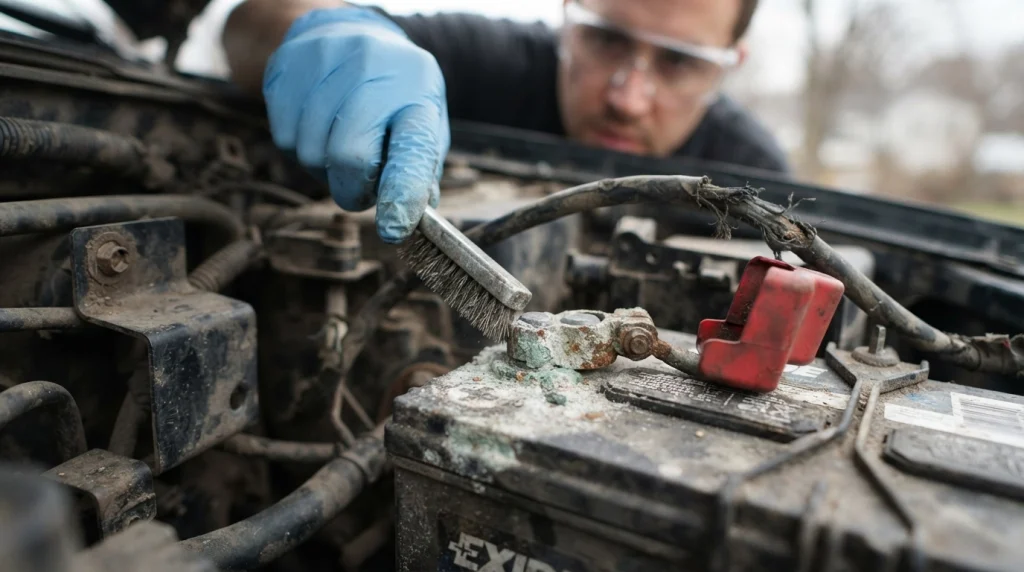
This is the most common cause I see, and the cheapest to fix. A terminal can look tight and still be loose enough to fail under load.
Corrosion builds up slowly between the terminal and the battery post. It forms a crusty white, green, or blue layer that blocks current.
How do I check the battery terminals?
Open the hood and look at both battery posts. Check for crust, swelling, or a clamp that moves when you twist it by hand.
A terminal should not move at all. If you can rock it with your fingers, it is too loose, even if it looks tight.
- Positive terminal: Usually marked with a plus sign and a red cover, and often the first to corrode.
- Negative terminal: Usually marked with a minus sign and a black cover, and just as able to break the whole circuit.
- Cable ends: Green or white fuzz creeping up the wire means corrosion has spread inside the cable.
How do I clean and tighten them safely?
Wear eye protection and gloves before you touch the battery. Disconnect the negative cable first, then the positive.
Clean the posts and the inside of the clamps with a battery terminal brush. Scrub until the metal looks bright, not dull grey.
Refit the clamps, tighten them until they do not move, then reconnect positive first and negative last.
Safety note: Disconnect the battery before electrical work, keep sparks and flames away from it, and follow your owner’s manual for your exact battery location and terminal layout.
Is It the Battery Itself?
Yes, a weak battery is the second most likely cause. It can light the dash and still fail the moment the starter loads it.
Batteries age from the inside out. Plates sulfate, cells weaken, and the battery loses its ability to deliver a big burst of current.
How can a battery show power and still be dead?
A battery at rest can show a normal voltage and still fail under load. Voltage at rest is only half the story.
What are the signs of a failing battery?
- Slow or labored crank: The engine turns over sluggishly before it catches, especially when cold.
- Dimming lights on crank: Headlights fade hard or go out as you turn the key.
- Swollen case: A bulging battery case often means heat or internal damage, and it needs checking soon.
- Age: Most car batteries last around three to five years, so check the date label on the case.
- Repeated jump starts: Needing a jump more than once in a short period points to the battery or the charging system.
How do I test a battery without guessing?
A load test is the honest check. Many auto parts stores offer a free battery test, and it measures the battery under load, not just at rest.
If the voltage falls sharply and stays low, the battery is suspect. If it stays steady while the car still goes black, look at the cables instead.
Safety note: Never jump start a battery that is cracked, leaking, or frozen, and follow your owner’s manual jump start steps exactly.
Could a Bad Ground Cable or Blown Main Fuse Cause Total Power Loss?
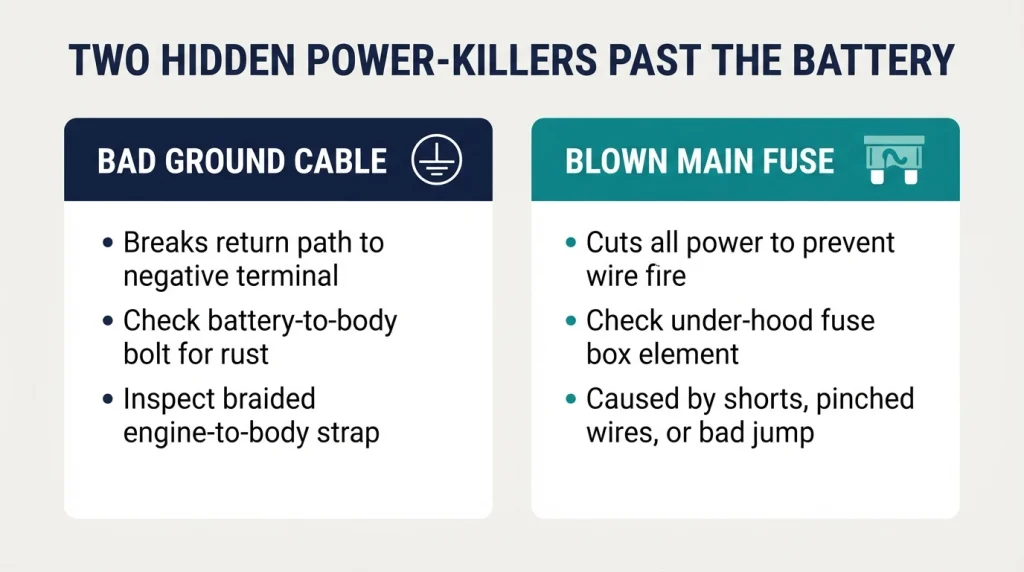
Yes, and these two causes are easy to miss. They sit just past the battery, so a clean battery can still leave the whole car dead.
The ground cable is the return path for all that current. Power flows out of the positive terminal, through the starter, and back through the ground to the battery.
What is a ground cable, and where does it fail?
A ground cable is a thick black cable from the battery’s negative terminal to the car’s body or engine block. It is the main return wire for the whole electrical system.
- Battery-to-body ground: Check the bolt for rust, looseness, and corrosion under the lug.
- Engine ground strap: Look for a braided strap from the engine to the body, and check both ends.
What is a main fuse or fusible link?
A main fuse is a large fuse that protects the whole electrical system. A fusible link is a short length of special wire that melts to break the circuit in the same way.
When one blows, power stops dead. That is the point, since it stops a short from melting wires or starting a fire.
A blown main fuse rarely blows for no reason. Look for a recent short, a pinched wire, a jump start done backwards, or an accessory wired badly.
Safety note: If a main fuse blows again right after you replace it, stop and get help, since a live short is still in the circuit.
What About the Starter, Ignition Switch, and Main Relay?
These parts sit further down the chain, but they can still kill all power. They are less common than a bad connection, so check them after the battery and cables.
A starter that has seized inside can draw far more current than normal. That huge draw pulls the voltage down so low that the dash goes black.
How do I tell a starter fault from a battery fault?
Listen and watch closely on the first try. A bad battery usually gives a slow crank or a rapid click before it dies.
A seized starter often gives a single heavy clunk, then darkness. The lights may stay out until you release the key.
Try a jump start from a known good battery. If the car still goes black with strong jump power, the starter or its cable is more suspect than the battery.
What does a bad ignition switch look like?
The key feels loose, or you have to wiggle it to get the dash lights on. Accessories may flicker when you turn the key slowly.
Power may cut out only in the start position, then return when you let the key spring back. That on-off pattern is a strong clue.
Could a parasitic drain be the real cause?
A parasitic drain is a small current draw that continues after you switch the car off. It drains the battery overnight, so the car is dead in the morning.
Safety note: Starter and ignition work involves heavy current, so disconnect the battery first and follow your owner’s manual and torque specs when you refit cables.
How Do I Diagnose It in 10 Minutes?
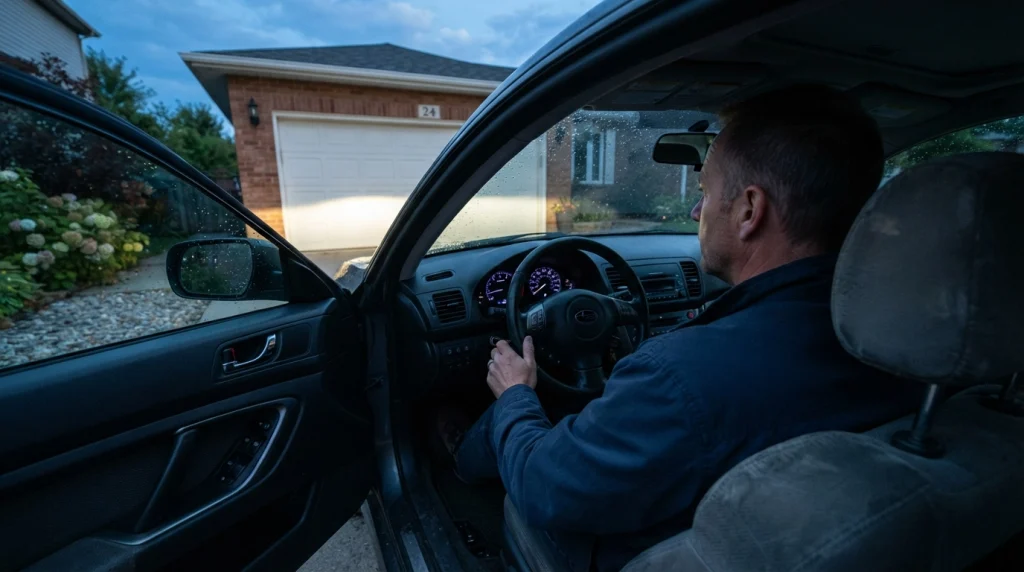
You do not need a full tool kit for the first pass. A pair of eyes, a wiggle test, and a headlight check will narrow it down fast.
Step-by-step check
- Watch the headlights: Turn them on, then try to start the car and watch them closely.
- Note the pattern: Lights go out completely points to the battery circuit, while lights stay bright points to the starter or switch.
- Wiggle the terminals: With the key off, try to move each battery terminal by hand and look for looseness or crust.
- Check the ground: Follow the negative cable to the body and engine, and look for rust or a loose bolt.
- Inspect the main fuse: Open the under-hood fuse box, find the main fuse, and look for a broken element or a burnt smell.
- Try a jump start: If a jump brings the car back to life, the battery or charging system is the prime suspect.
- Listen for a clunk: A single heavy clunk with no crank points to the starter, while rapid clicking points to low battery power.
Symptom-to-cause table
| What you see | Most likely cause | Quick check | Fix difficulty |
|---|---|---|---|
| All power dies on crank, returns later | Loose or corroded battery terminal | Wiggle terminals, look for crust | Easy DIY |
| Lights dim hard, slow crank, then black | Weak or dead battery | Load test at a parts store | Easy DIY |
| Power dies, battery tests fine | Bad ground cable or strap | Check ground bolts for rust | Easy to moderate DIY |
| No power at all, even with key off | Blown main fuse or fusible link | Inspect main fuse in fuse box | Moderate, find the short first |
| Single clunk, then darkness | Seized or failing starter | Jump test, check starter cable | Shop job for most owners |
| Power cuts only in start position | Worn ignition switch or relay | Wiggle key, test relay swap | Moderate to shop job |
| Battery flat every morning | Parasitic drain or weak alternator | Check charging, test for drain | Shop job for most owners |
How Do I Stop It Happening Again?
Prevention is mostly boring maintenance, and that is the point. A clean connection and a tested battery rarely leave you stranded.
Check the terminals every few months, especially before winter. A quick look takes a minute and catches corrosion early.
What should I check at each service?
- Terminal condition: Clean off any crust and check that both clamps still grip firmly.
- Cable condition: Look for swelling, cracking, or green corrosion creeping up the wire.
- Ground bolts: Check the body and engine ground bolts for rust and tightness.
- Battery age and test: Ask for a load test once a year, and sooner if cranking feels slow.
The Car Care Council offers plain maintenance checklists that cover battery and starting system checks, and they are a useful reminder to test before winter rather than after a failure.
If your car has a recall or a known starting system issue, check it with your maker. The NHTSA site lists safety recalls by vehicle, and a recall check takes only a few minutes with your VIN.
For work beyond a terminal clean or a battery swap, use a qualified shop. The ASE site explains technician certification, and it helps you find a shop with certified staff for starter, ignition, and wiring work.
Frequently Asked Questions
Why does my car lose all power when I try to start it, but the lights work before I turn the key?
The lights need only a small current, while the starter needs a huge burst. A loose terminal, corroded cable, or weak battery can feed the lights, then collapse under the starter load and cut all power at once.
Can a bad battery cause the whole car to go dead?
Yes. A battery with a weak or shorted cell can hold voltage at rest, then fall sharply when you crank and kill the dash, lights, and radio until you release the key.
Why does power come back after a few seconds?
A loose connection often settles back into place once the load stops. That recovery points to a terminal, cable, or ground fault rather than a fully dead battery.
Is it safe to jump start a car that loses all power?
A jump start is usually safe if the battery is not cracked, leaking, or frozen. Follow your owner’s manual steps exactly, and do not keep cranking if the car still goes black.
How do I know if it is the starter or the battery?
Try a jump from a known good battery. If the car still goes black with strong jump power, suspect the starter or its cable, and if it starts cleanly but dies again overnight, suspect the battery or charging system.
When should I call a mechanic instead of fixing it myself?
Call a pro if a main fuse blows twice, if you smell burning, or if the fault returns after you clean the terminals and test the battery. Starter, ignition switch, and wiring faults need proper testing.
If your car loses all power when you try to start it, start with the battery terminals. Clean them, tighten them, and test the battery under load before you buy anything else.

Alex Carter is an automotive content writer at VastAutoParts, focusing on car parts, vehicle troubleshooting, automotive tools, product research, and practical car care guides.