
Can a Bad Starter Drain a Battery? 5 Proven Tests to Try
Quick Answer
Yes, a bad starter can drain a battery. A healthy starter draws power only for a few seconds while you crank the engine. A faulty starter can keep drawing power after you switch the engine off. A faulty starter can also pull too much power at each start. Both faults leave the battery flat, often overnight.
- A stuck solenoid can keep the starter circuit closed after the key is off.
- An internal short can leak power to ground while the car sits parked.
- A worn starter can pull excess power during long or repeated cranking.
- A battery that dies overnight after a normal drive points to a drain.
You turn the key in the morning and hear a click, or nothing at all. The battery worked fine the day before, so a hidden drain is a fair suspect. This guide explains the drain, the signs to watch for, and the tests that pin down the fault.
In this article
- How Does a Bad Starter Drain a Battery?
- What Are the Signs of a Starter Draining Your Battery?
- Is It the Starter, the Battery, or the Alternator?
- How Do You Test If a Starter Is Draining the Battery?
- What Should You Do If the Starter Is Draining the Battery?
- Can a Bad Starter Damage a Battery for Good?
- Frequently Asked Questions
- Conclusion
How Does a Bad Starter Drain a Battery?
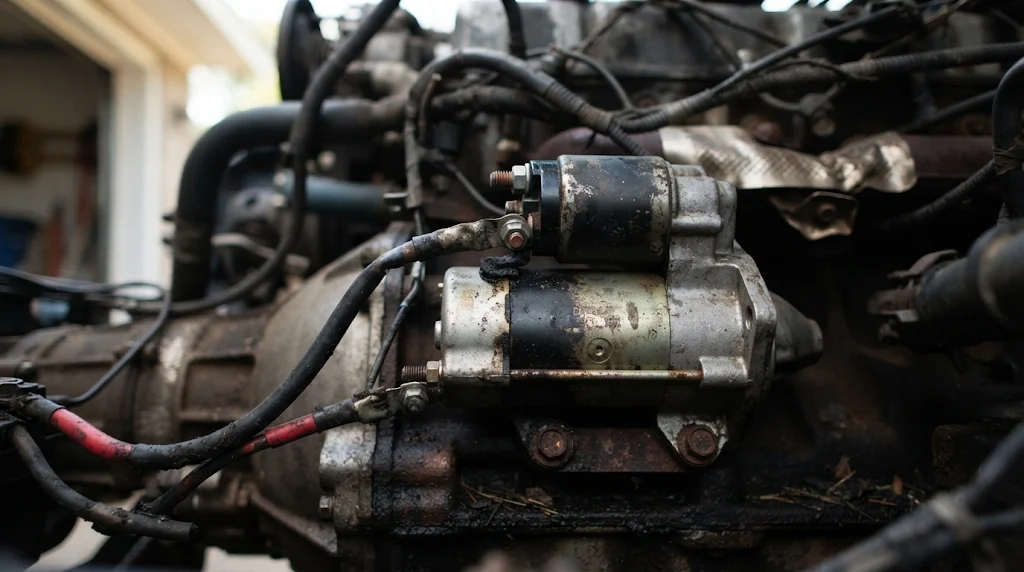
A bad starter drains a battery by drawing power when it should draw none, or by drawing far more power than a normal start needs. A starter motor turns the engine over for a few seconds, then it should rest until the next start. A fault in the starter, the solenoid, or the wiring breaks that pattern.
The starter is the largest electrical load in most cars. Engineer Fix describes a typical cranking draw of about 100 to 300 amps for a few seconds while the engine turns over.
That burst is normal, and the alternator tops up the battery once the engine runs. A healthy starter draws no power with the key off, so any flow at rest is a fault.
A starter fault is only one cause of battery drain when parked, and lights, relays, and accessories can leak power too. The starter deserves a close look when the drain is large and the battery dies fast. Three failure modes explain most starter drains.
A Stuck Solenoid Keeps the Circuit Closed
A stuck solenoid keeps battery power flowing to the starter after you release the key. The solenoid is an electromagnetic switch that closes the high current circuit to the motor and pushes the starter gear into the flywheel. Its contacts should open as soon as the engine starts or the key returns from the start position.
Heat, wear, or arcing can weld those contacts shut or leave them stuck partway closed. Power then flows without pause, and the starter may keep spinning or hum with the engine off. This fault drains a battery fast, sometimes in minutes or hours, and it can heat the starter and its cables.
An Internal Short Leaks Power to Ground
An internal short gives battery current a path to ground inside the starter motor. The motor holds copper windings with insulation that can wear thin, crack, or soak up moisture over time. A damaged spot lets current leak past the normal circuit, even when the solenoid opens as it should.
This leak is a parasitic draw, which means current flows with the ignition off and the car parked. Engineer Fix puts normal key-off draw at typically 50 to 85 milliamps for modern vehicles. A starter short draws far more, so the battery can go flat overnight.
A Worn Starter Pulls Too Much Power to Crank
A worn starter needs more power than a healthy starter to turn the engine. Seized bearings, worn brushes, and damaged windings raise resistance inside the motor and slow the crank. Each start attempt then pulls a heavy load for longer than it should.
Repeated tries make the problem worse, since every failed crank takes another bite from the battery. The engine may turn slowly or fail to turn at all while the lights dim. This pattern drains the battery during starting, rather than while the car sits parked.
What Are the Signs of a Starter Draining Your Battery?
A starter drain shows up as a battery that loses charge while the car sits, plus starting trouble that does not match a simple old battery. Timing is the clearest clue, since a drain strikes after parking and a worn battery fades bit by bit. Watch for this set of signs together, not one sign alone.
- Battery dead in the morning after a normal drive the day before.
- Slow or labored cranking even after a full charge.
- A single loud click, or no sound, when you turn the key.
- Dashboard lights stay bright while the starter fails to turn.
- Starter area feels warm after the car has sat with the engine off.
- Burning smell, smoke, or heat near the starter after a start attempt.
- Repeated jump starts with the same dead battery the next day.
Bright lights with no crank point toward the starter, since the battery still has power to run the lights. Dim lights with slow cranking can mean a weak battery, a poor connection, or a starter pulling too much current. A warm starter after parking is a strong hint, since a resting starter should feel cool to the touch.
The AAA guide to dead batteries lists slow cranking, clicking, dim lights, and repeated jump starts as signs that the battery or charging system needs attention.
The full set of failing starter motor symptoms can help you match what you see and hear to the part at fault.
Is It the Starter, the Battery, or the Alternator?
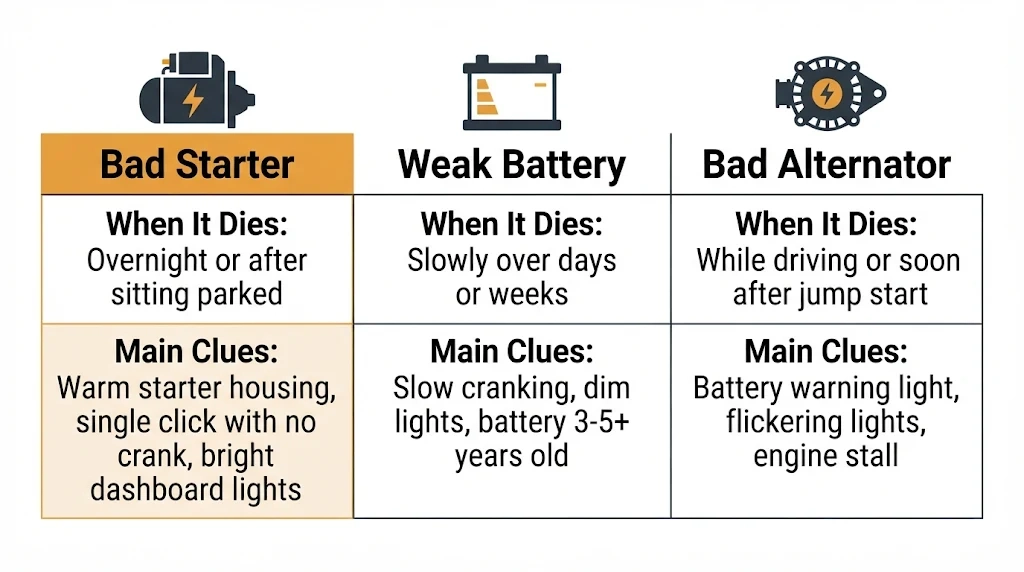
The timing of the failure separates these three causes. A starter drain kills the battery while parked, a weak battery fades over time, and a bad alternator leaves the battery undercharged while driving. Each cause leaves a different pattern, and the table below compares the three side by side.
| Cause | When the battery dies | Main clue |
|---|---|---|
| Bad starter | Overnight or after sitting parked | Warm starter, click with no crank, bright lights |
| Weak battery | Slowly, with weaker starts over days or weeks | Slow cranking, dim lights, old battery |
| Bad alternator | While driving or soon after a jump start | Warning light, flickering lights, stall after jump |
The table shows why timing matters more than any single symptom. A battery that dies overnight after a good drive points to a drain, while a battery that dies on the road points to charging.
Age still matters, since AAA gives a typical battery life of 3 to 5 years, with heat and driving habits changing that span. An old battery can fail on its own, and it can also hide a starter drain by dying first.
Connections can fool you too. Loose or corroded terminals cut power to the starter and mimic a weak battery or a bad starter.
If the symptoms still overlap, work through the checks for a starter or battery fault before you buy parts.
How Do You Test If a Starter Is Draining the Battery?
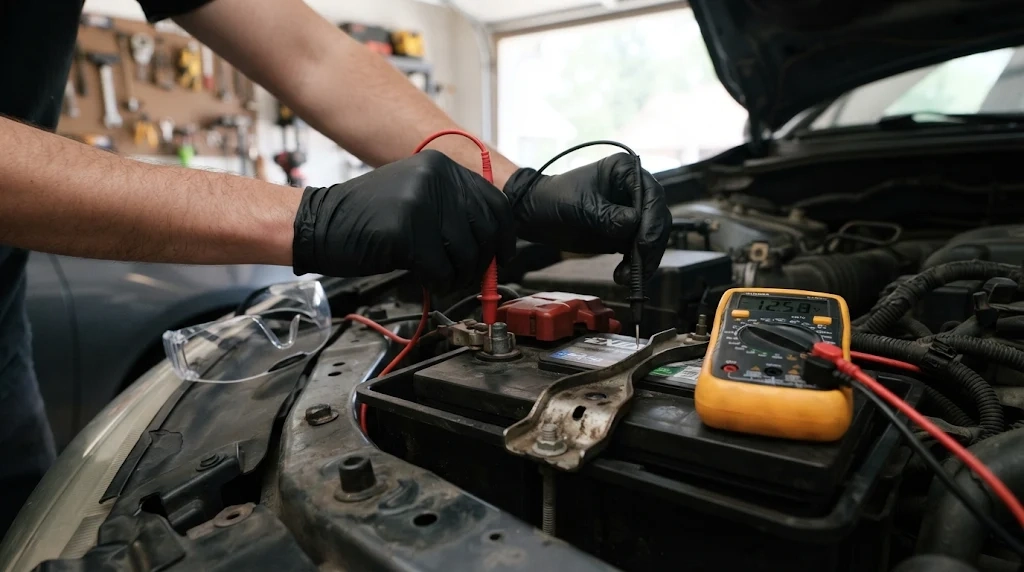
A starter drain test starts with simple voltage and heat checks, then measures key-off current draw to confirm the starter circuit is the source. Work in order, from the easy checks to the meter tests, and stop when a check points to the fault. A technician can run the later steps if you lack a meter.
Charge the battery fully before you test, since a flat battery gives false readings on every check. Inspect the terminals for corrosion, cracks, or loose cables, and clean and tighten them first. A warm starter housing after the car has sat points to current flow.
Warning
A starter circuit carries high current and a battery can give off flammable gas. Disconnect the negative cable first, wear eye protection, and stop if you see smoke or smell burning.
Voltage checks come next and need only a digital multimeter. Goodyear states that fully charged batteries should measure at 12.6 volts or above. The reading with the engine running should be 13.7 to 14.7 volts.
A rested reading below 12.4 volts means the battery needs a charge before further tests. The guide on how to check a bad starter covers safe at-home checks that do not need the starter removed.
Family Handyman describes a systematic parasitic draw diagnosis that starts by ruling out lights and clock memory, then tests circuits one at a time. The steps below follow the same order and end with the starter circuit isolated.
Step 1
Check resting voltage with a multimeter
Set the meter to DC volts and read the battery with the engine off. A full battery reads 12.6 volts or above, so a lower reading means charge it first.
Step 2
Look, listen, and feel for starter activity
Check for a warm starter, a hum or click with the key off, and any burning smell. Any of these signs points to current flow with the engine off.
Step 3
Measure key-off current draw
Connect the meter in series on the negative cable and wait for the modules to sleep. A reading far above the normal milliamp range confirms a drain.
Step 4
Isolate the starter circuit
With the meter still in place, disconnect the main starter cable and watch the reading. A sharp drop points to the starter or its solenoid as the source.
Step 5
Test the battery and charging system
Load test the battery and check running voltage, which Goodyear gives as 13.7 to 14.7 volts. These checks show whether the battery and alternator are still sound.
Step 4 needs care, since the main starter cable is not fused and carries high current. Leave that step to a technician if you have not worked on starter wiring before.
What Should You Do If the Starter Is Draining the Battery?
A confirmed starter drain calls for repair or replacement of the starter assembly, not another battery or another jump start. A new battery will drain again if the starter fault stays in place. Fix the source first, then test the battery to see what the drain left behind.
Stop repeated jump starts and long cranking attempts once you suspect a starter drain. Each attempt heats the starter and pulls the battery lower. If the starter hums, smokes, or smells of burning, stop at once and call for help rather than trying again.
Most shops replace the full starter assembly, since the motor and solenoid wear together and share one housing. Ask for a starter draw test and a battery load test after the repair, so you leave with both parts proven sound.
Check the cables and grounds while the starter is out. Corroded cables and loose grounds raise resistance and can mimic a starter fault.
If you
Battery dies overnight and the starter feels warm after parking
Choose a starter test first, because a warm starter points to current flow with the key off.
If you
Car cranks slowly but the battery tests well
Choose a starter draw test, because excess cranking load drains a good battery fast.
If you
You smell burning or see smoke near the starter
Choose to stop and call for help, because heat signals a short that can damage wiring.
Can a Bad Starter Damage a Battery for Good?
A bad starter can shorten battery life, and repeated deep discharges can leave a battery unable to hold a full charge. A lead-acid battery is built for short, strong bursts, not for slow drains to flat.
One overnight drain often ends well, with a full recharge and a passing load test. Several flat cycles are a different story, since the battery may show fair voltage at rest and still fail under load. A load test is the fair check after a drain, since voltage alone can hide lost capacity.
Digital Multimeter
A digital multimeter lets you check resting voltage and key-off current draw, the two readings this guide uses to test for a starter drain.
Frequently Asked Questions
Can a bad starter drain a new battery?
A bad starter can drain a new battery because the fault draws power without regard to battery age or condition. A stuck solenoid or an internal short pulls current while the car sits parked. If a new battery dies overnight, test for a drain before you blame the battery.
Can you jump start a car with a starter drain?
A jump start can work once with a starter drain if the starter still turns and the battery takes a charge. The car may start, but the drain stays in place and the battery dies again after parking. Fix the starter fault before you rely on jump starts.
Can a loose starter wire drain a battery?
A loose starter wire can drain a battery when it rubs through and touches metal, which creates a short to ground. The short pulls current with the key off, much like an internal starter short. A technician should inspect the starter cables and grounds for damage.
Will disconnecting the battery stop a starter drain?
Disconnecting the battery stops a starter drain because the starter loses its power source with the cable removed. This step protects the battery during storage, but it does not fix the starter fault. Reconnecting the cable lets the drain start again.
Can a bad starter cause a battery warning light?
A bad starter rarely causes a battery warning light because that light tracks the charging system, not the starter. The light points more often to the alternator, the drive belt, or the battery cables. A starter fault shows up as a click or slow crank instead.
Should you replace the battery and starter together?
You should replace the battery and starter together only when tests show that both parts have failed. A good battery can stay in service after a starter replacement. Test the battery after the repair, then replace it only if it fails the test.
Conclusion
Can a bad starter drain a battery? Yes, a stuck solenoid, an internal short, or a worn motor can pull power while the car sits or during cranking. If your battery dies overnight, test the key-off draw and the starter circuit before you buy another battery.

Alex Carter is an automotive content writer at VastAutoParts, focusing on car parts, vehicle troubleshooting, automotive tools, product research, and practical car care guides.