
How Long Does It Take to Replace a Starter? Time by Car
Quick Answer
How long does it take a mechanic to replace a starter? A mechanic needs 1 to 2 hours when the part is easy to reach, and AAA gives that range for accessible starters. Meineke puts the wider range at 1 to 4 hours, while buried starters can take up to 6 hours, so engine layout decides the time.
- Easy access means a short job: many four-cylinder cars need about 1 to 2 hours of labor.
- A starter under the intake manifold can push the job to 3 to 6 hours.
- Diagnosis, parts, and shop scheduling add clock time beyond the labor hours.
- Ask for the labor time on your written estimate before you approve the work.
Your car will not start, and the shop says the starter must come out. This guide explains the labor time for most cars, what stretches it, and how the shop day differs from the wrench time.
In this article
- How Long Does a Starter Replacement Take on Most Cars?
- What Makes a Starter Replacement Take Longer?
- What Steps Does a Mechanic Follow to Replace a Starter?
- Mechanic or DIY: How Does the Time Compare?
- How Does Vehicle Type Change the Replacement Time?
- Does Booked Labor Time Match Your Time at the Shop?
- How Can You Get an Accurate Time Estimate?
- What Should You Check Before You Approve the Job?
- How Does Replacement Time Affect the Cost?
- Frequently Asked Questions
- Conclusion
How Long Does a Starter Replacement Take on Most Cars?
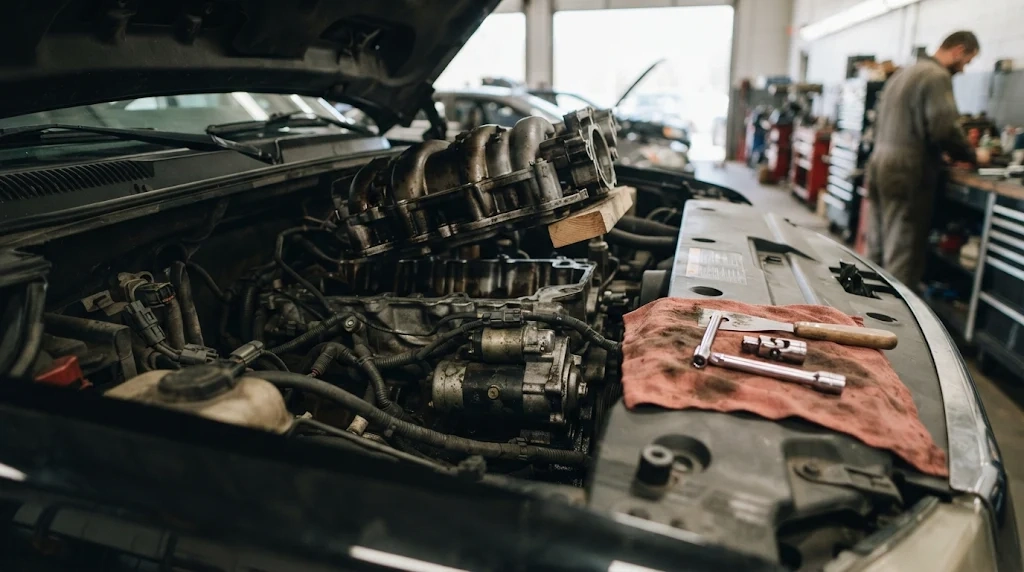
A starter replacement takes 1 to 2 hours of labor on most cars with easy access. AAA states that range for accessible starters, and Meineke puts the wider range at 1 to 4 hours.
The AAA starter replacement guide adds that a unit buried under other engine parts can take up to 6 hours.
Book time is the standard labor time a repair guide lists for one job on one vehicle. A shop bills that time even when a skilled technician finishes sooner.
Your quote should name the labor hours, not just the total price. If the hours look high, ask which parts must come off to reach the starter. That answer tells you whether the time is honest or padded.
The table below compares labor time by starter access, using the ranges published by AAA and Meineke.
| Starter access | Typical labor time | What the job involves |
|---|---|---|
| Easy access, top or side of engine | 1 to 2 hours | Remove a few parts, swap the starter, test the start |
| Tight access, behind other parts | 2 to 4 hours | Remove air parts, shields, or brackets first |
| Buried, under the intake manifold | 3 to 6 hours | Remove the manifold and refit it with new gaskets |
Access decides the hours, so two cars with the same fault can still have different bills.
What Makes a Starter Replacement Take Longer?
Starter location decides most of the extra time, because the mechanic must clear a path before the swap can start. Corrosion, stuck bolts, and added repairs stretch the job further.
Starter location and engine layout
A starter bolted to the side of the engine block is the fastest job, since the mechanic can reach it from below with few parts removed. A starter under the intake manifold is the slowest common layout, because the manifold must come off first.
Front-wheel drive cars often pack the starter into a tight space, while many trucks leave more room. Engine size alone does not predict the time. A small engine in a crowded bay can take longer than a large engine with open access.
Before you book the job, confirm the starter is the failed part. A weak battery or a bad cable can copy starter trouble, so check the failing starter motor symptoms against what your car does.
Corrosion and stuck fasteners
Rust and heat can turn a short job into a long one, because seized bolts need penetrating oil, heat, or special tools before they move. Older cars with road salt exposure suffer most from this delay.
Corroded cables add time too. The mechanic should clean the terminals and check the wiring before fitting the new starter.
Parts and extra repairs
A starter swap can grow when the mechanic finds a related fault, such as a damaged cable, an oil leak, or worn flywheel teeth. Each added repair needs its own parts and labor time.
A common starter may sit on the shelf, while a rare one may need ordering. Ask whether the part is in stock when you book.
What Steps Does a Mechanic Follow to Replace a Starter?
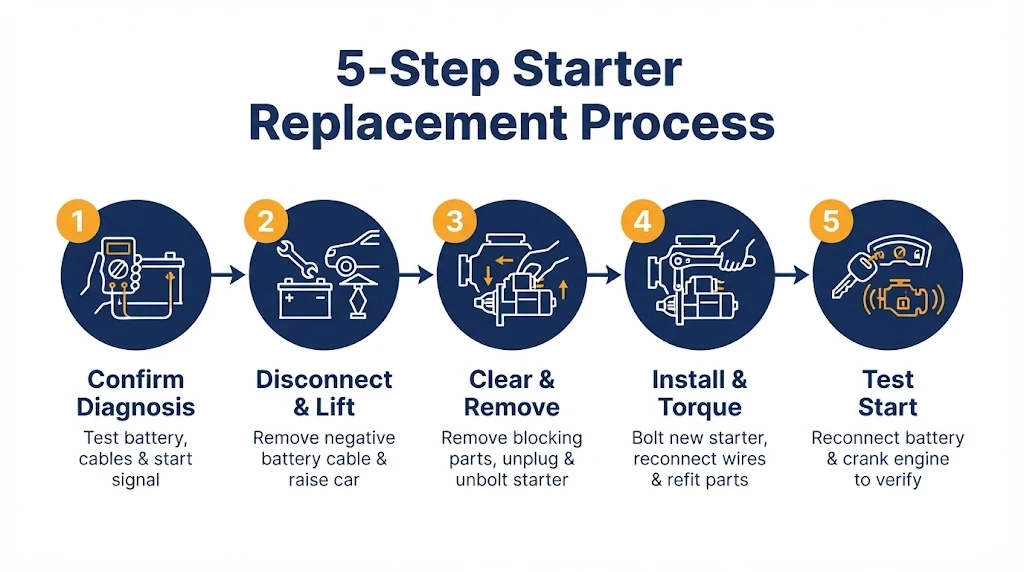
A mechanic follows a set order: confirm the fault, reach the starter, swap it, and test the result. The swap itself is often the shortest part of the job.
Step 1
Confirm the diagnosis
The mechanic tests the battery, cables, and start signal to prove the starter has failed. Testing first stops an expensive swap on a car with a weak battery.
Step 2
Disconnect the battery and raise the car
The negative cable comes off first to cut power to the starter circuit. The car goes on a lift or stands when the starter sits underneath.
Step 3
Clear access and remove the old starter
Air parts, shields, or the intake manifold come off as needed. The mechanic then unplugs the wiring and unbolts the starter.
Step 4
Fit the new starter and refit parts
The new starter bolts in place, the wiring goes back, and each removed part returns. Bolts get tightened to the manufacturer torque specification.
Step 5
Test the start and check the work
The mechanic reconnects the battery and cranks the engine several times. A clean start, with no grinding or delay, closes the job.
Testing matters because a new starter does not cure every failure to start. If the engine still refuses to crank, the fault may sit in the battery, cables, or ground. Read the guide to a no start after replacement before you approve more parts.
Mechanic or DIY: How Does the Time Compare?
A mechanic finishes faster than a home repair, because a shop has a lift, air tools, and long practice. A home repair can still work well when the starter is easy to reach.
Engineer Fix reports a DIY range of 1 hour to 5 hours or more, based on skill and access.
Professional mechanic
Best for: tight access and daily drivers
- Time: about 1 to 4 hours of labor
- Tools: lift, air tools, and torque gear
- Cover: shop warranty on parts and labor
DIY at home
Best for: easy access and a second car
- Time: about 1 to 5 hours or more
- Tools: sockets, jack stands, and a multimeter
- Risk: you carry the cost of a mistake
A home repair saves labor cost, but it costs your time and carries risk. The starter circuit moves heavy current, so a short can damage wiring or cause injury.
Warning
Starter cables carry heavy current, and a short can burn wiring or injure you. Disconnect the negative battery cable first, and never work under a car held up by a jack alone.
Choose the shop when access is tight or you lack tools. Choose DIY only when the starter is easy to reach and you have sound repair instructions for your exact model.
How Does Vehicle Type Change the Replacement Time?
Vehicle type changes the time through access, not through size alone. VehicleFreak reports 1 to 2 hours for many four-cylinder cars, while some European models can need up to 5 hours.
Japanese and domestic four-cylinder cars often leave the starter in open view. European cars often bury it behind more parts, which adds labor. Trucks and large SUVs can go either way: open bays help, but drivetrain parts in the way can slow the job.
The table below compares typical labor time by engine layout, using ranges from published repair guides.
| Engine layout | Typical labor time | Why the time varies |
|---|---|---|
| Four-cylinder, easy access | 1 to 2 hours | Starter sits in open view on many models |
| V6, transverse or longitudinal | 1 to 3 hours | Starter position varies widely by model |
| V8, truck or large car | 1 to 3 hours | Open bays help, but some layouts hide the starter |
| Any engine, starter under manifold | 3 to 6 hours | Manifold removal adds hours to the job |
Judge by your exact model, since two cars with the same engine size can differ by hours. Meineke puts the general range at 1 to 4 hours in its starter replacement FAQ.
Does Booked Labor Time Match Your Time at the Shop?
Booked labor time and shop time are two different clocks. Labor time counts the wrench work, while shop time adds diagnosis, waiting, parts, and paperwork.
A 2-hour job can mean a half day without your car. The shop may need to confirm the fault, order the part, or finish cars ahead of yours. Ask for a pickup time, not just labor hours.
If you
Need the car back fast
Choose a morning appointment with the part in stock, because diagnosis and fitting can share one visit.
If you
Can leave the car all day
Choose a drop-off booking, because the shop can fit the job around other work.
If you
Cannot start the car at all
Choose a tow to the shop, because a no-start car cannot reach the bay on its own.
A written estimate should list diagnosis, labor hours, and parts separately. That split makes quotes easy to compare.
How Can You Get an Accurate Time Estimate?
An accurate estimate starts with your exact vehicle, because labor time comes from a guide entry for one year, model, and engine. Give the shop your VIN or full model details when you ask.
- How many labor hours does the guide list for my model?
- Is the starter part in stock, or must it be ordered?
- What parts must come off to reach the starter?
- Does the quote include diagnosis and testing?
- When can I collect the car?
Compare two quotes when the hours differ by more than an hour. Ask each shop to explain the access steps behind its hours.
Tip
Ask the shop to write the labor hours and the pickup time on the estimate. That note stops a 2-hour job from turning into a day without your car.
What Should You Check Before You Approve the Job?
Check the battery and wiring before you approve a starter swap, because those parts cause many failures to start. A short test can save you the cost of a part you do not need.
Ask the shop to load-test the battery and check the cable connections. A battery can show voltage at rest yet fail under load. If the tests pass, the starter becomes the prime suspect.
Some faults need only a small repair, not a new motor. A loose ground, a bad relay, or a blown fuse can stop the start signal, and the guide to starter repairs without replacement covers those checks.
Approve the swap only after the shop names the failed part and the test behind it. Confirm the warranty on parts and labor.
How Does Replacement Time Affect the Cost?
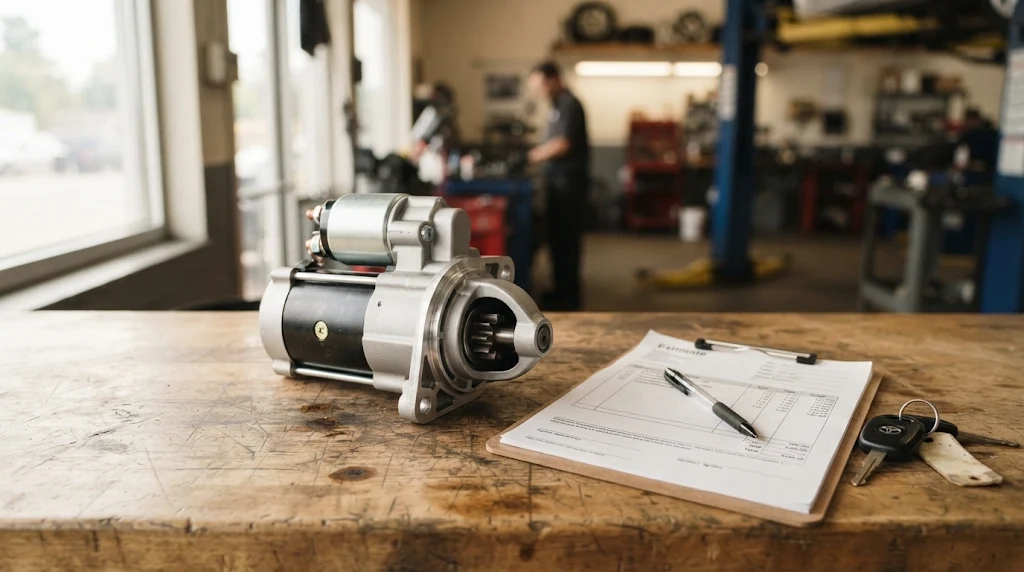
Labor time drives the labor bill, because the shop multiplies the hours by its hourly rate. A buried starter costs more because it takes longer, not because the part costs more.
RepairPal estimates the average starter replacement at $565 to $796, with labor at $191 to $280 and parts at $375 to $516. See the RepairPal starter replacement estimate for the full breakdown by vehicle.
AAA reports labor rates of $150 to $300 per hour in its Approved Auto Repair network. At those rates, each extra hour of access work adds real money to the bill. That is why the time estimate matters as much as the part price.
For a full breakdown of parts, labor, and ways to control the bill, see the guide to starter repair costs.
Starter Motor
A starter motor is the part your mechanic installs during this job, so check the fitment for your exact model before you order one.
Frequently Asked Questions
Can a mechanic replace a starter in under an hour?
A mechanic can replace a starter in under an hour when it sits in open view on an older truck or a simple four-cylinder car. The job needs only a few bolts and two wiring connections in those cases. Most cars still need more time, because access parts must come off first.
Can a starter be replaced the same day?
A starter replacement is often a same-day job when the shop has the part in stock and a free bay. Accessible starters take 1 to 2 hours of labor, so a morning booking can end with an afternoon pickup. A rare part or a buried starter can push the pickup to the next day.
How long does a starter last before it needs replacement?
A starter motor typically lasts 100,000 to 150,000 miles on most cars, according to AAA. Heat, oil leaks, and frequent short trips can shorten that life. A starter near that mileage with slow cranking is a fair candidate for replacement rather than repair.
Is it faster to repair a starter than to replace it?
Repairing a starter is faster only when the fault sits outside the motor, such as a bad relay, a loose cable, or a blown fuse. Those fixes can take minutes, while a full swap takes hours. Internal motor damage usually makes replacement the quicker and more reliable choice.
Can a mobile mechanic replace a starter at your home?
A mobile mechanic can replace a starter at your home when the starter is easy to reach and the workspace is flat and safe. The visit saves a tow when the car will not start. Tight access, a lift job, or bad weather can make a shop visit the better option.
Can you drive to the shop with a bad starter?
You can drive to the shop with a bad starter only if the engine still cranks and starts reliably. A starter that works once may fail at the next stop, so the trip carries real risk. AAA warns that a failing starter can strand you without warning and strain the battery.
Conclusion
How long it takes a mechanic to replace a starter depends on access: most cars need 1 to 2 hours of labor, while buried starters need more. If your shop quotes over 3 hours, ask what must come off to reach the starter before you approve the work.

Alex Carter is an automotive content writer at VastAutoParts, focusing on car parts, vehicle troubleshooting, automotive tools, product research, and practical car care guides.