
How to Start a Car With a Bad Starter: Simple Steps
Quick Answer
You can start a car with a bad starter by tapping the starter, cleaning a loose or corroded connection, or push starting a manual car. A jump start can help when the battery is also weak. Each method is a short term workaround, not a repair. Drive to a repair shop right after the engine starts.
- Check the battery and connections first, since a weak battery can sound like a starter fault.
- Tap the starter body with a hammer handle while a helper turns the key.
- Push start a manual car in second gear at about 5 to 10 miles per hour.
- Jump start the car only when the battery is weak or the cables may help.
- Stop and call for help if you smell burning, see smoke, or hear grinding.
You are likely stuck in a parking lot or driveway with a car that clicks once and stays silent. This guide is for a driver who needs one more start to reach a repair shop. You will learn how to check the simple causes first, then try the methods that fit your car.
In this article
- How do you know the starter is the problem?
- What should you check before you try a workaround?
- How to start a car with a bad starter by tapping it
- How to push start a manual car
- Can a jump start help a bad starter?
- Which method fits your car?
- What should you do after the car starts?
- When should you stop and call for help?
- Frequently Asked Questions
How do you know the starter is the problem?
The starter is the likely problem when the battery has power but the engine does not turn over. A single loud click, a single clunk, or silence after a key turn points toward the starter or its solenoid. The solenoid is an electric switch that sends a large current to the starter motor.
Bright headlights and a strong dashboard point away from a dead battery. If the car starts after several tries, the fault may sit inside the starter.
What sound points to a bad starter?
A single click or clunk points to a starter or solenoid fault. Rapid clicking points to a weak battery or a poor connection instead. A grinding noise can mean the starter gear is not meshing with the engine flywheel, the toothed wheel the starter turns.
Listen for the sound on one careful try, then stop. Repeated long cranks drain the battery and heat the starter.
What else can look like a bad starter?
A weak battery, corroded terminals, a loose cable, a blown fuse, or a faulty ignition switch can look like a bad starter. A car that cranks at normal speed but does not fire has a different fault, such as fuel or spark trouble. The starter did its job in that case, since the engine turned over.
Check the simple causes before you tap or push anything. A guide to a starter or battery fault can help you sort the two causes by sound and by test. You can also check the starter without taking it out, using basic tests at home.
What should you check before you try a workaround?
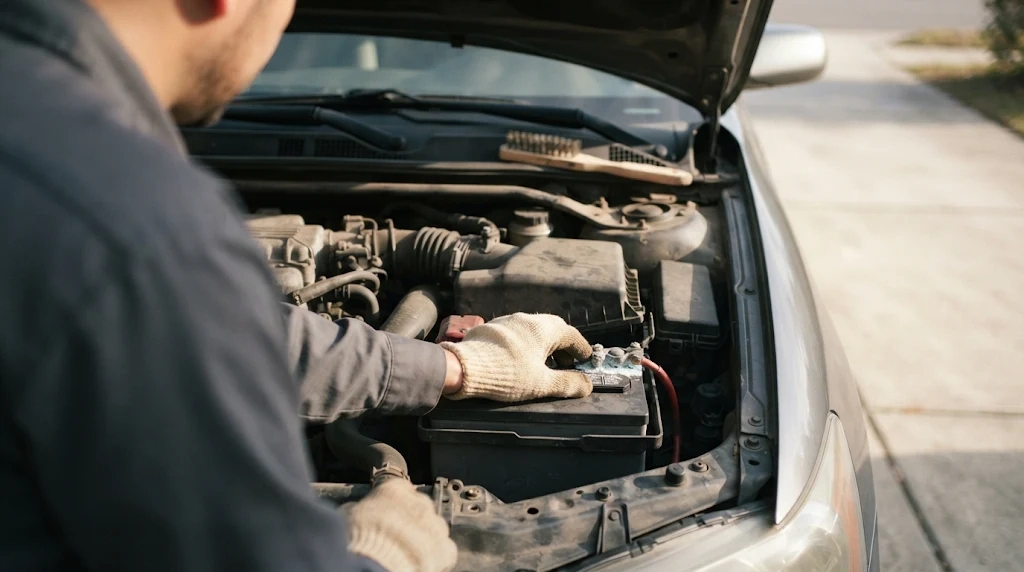
Check the battery, the cable ends, the gear selector, and the area around the car before any workaround. These checks take a few minutes and can save a tow. They also keep you from trying a method that cannot help.
Set the parking brake and put an automatic car in Park or a manual car in Neutral. Turn off the lights, heater, and radio to save battery power. Make sure the car is on flat ground and clear of traffic.
- Look at the battery terminals for white or bluish green buildup.
- Wiggle each cable end gently to feel for a loose fit.
- Check that the gear selector is fully in Park or Neutral.
If the terminals look dirty, clean them with a wire brush after you disconnect the cables. Remove the negative cable first, then the positive cable. Reconnect the positive cable first, then the negative cable, and tighten each clamp until it does not move.
Family Handyman notes that a healthy battery should show at least 12.5 volts, while a reading below 12 volts points to a weak battery. If a jump starts the car, the battery was the likely cause.
How to start a car with a bad starter by tapping it
Tapping the starter can free a stuck part inside it for one more start. The tap can reseat worn brushes, the small carbon blocks that pass current to the spinning part of the motor. It can also free a stuck solenoid plunger, the small rod that moves when the solenoid switches on.
Find the starter before you tap it. The starter is a round metal part, often low on the engine where the engine meets the transmission. Some cars hide it under other parts, so use a flashlight and check the manual for its spot.
Use a hammer handle, a wrench, or a short piece of wood. Tap the starter body or the solenoid housing with firm, short taps. Do not strike hard, since a hard hit can crack the housing or damage the magnets inside.
Ask a helper to turn the key while you tap, or tap first and then try the key at once. The contact may last only a short time, so try the key right after the taps. If the car starts, drive it to a repair shop without turning the engine off.
Warning
Keep hands, tools, and clothing clear of belts and fans, since a running engine can catch them. Set the parking brake and keep the car in Park or Neutral before you tap the starter.
Tapping helps only when worn brushes or a stuck plunger cause the fault. It will not help a burned motor, a broken gear, or a dead battery.
How to push start a manual car
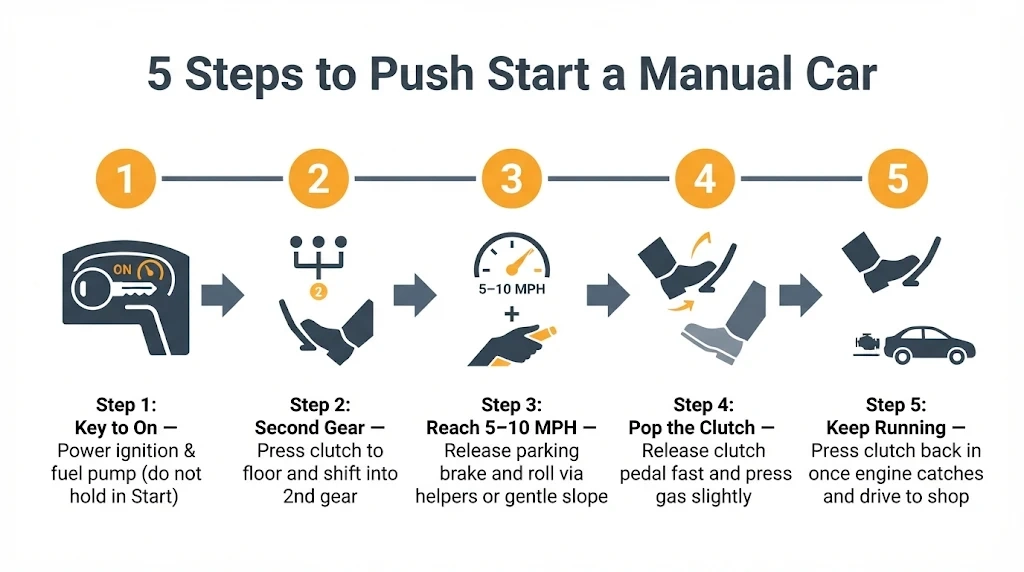
Push starting uses the rolling wheels to turn the engine, so it bypasses the starter motor. This method works only on a manual transmission car. An automatic car cannot be push started, since its gearbox needs the engine running to select gears.
You need a helper or a gentle slope, plus a clear stretch of road. Do not try this in traffic or on a steep hill.
Step 1
Turn the key to On
Turn the ignition to On so the fuel pump and ignition have power. Do not hold the key in the Start spot.
Step 2
Press the clutch and pick second gear
Press the clutch pedal to the floor and shift into second gear. Second gear gives a smoother start than first gear.
Step 3
Roll to about 5 to 10 miles per hour
Release the parking brake and let helpers push, or roll down a gentle slope. Keep the clutch pressed until the car reaches speed.
Step 4
Release the clutch fast
Let the clutch pedal up fast so the wheels turn the engine. Press the gas pedal a small amount as the engine catches.
Step 5
Press the clutch again and keep driving
Press the clutch back in as soon as the engine starts. Keep the engine running and drive to a repair shop.
If the engine does not catch, press the clutch in and stop in a safe spot. A failed push start can mean the battery is too weak to run the fuel pump and ignition.
Do not push start a car alone by running beside it. The car can roll away, and you can fall under a wheel.
Can a jump start help a bad starter?
A jump start can help when a weak battery sits behind the starter fault, but it cannot fix a dead starter motor. Extra current from a donor battery or a portable pack may push a weak starter past a dead spot. If the starter motor itself has failed, the car will still click or stay silent.
Try a jump when the lights look dim or the crank sounds slow. Skip it when the battery is cracked, leaking, swollen, or frozen.
Follow the cable order in the AAA jump-start guide. Connect red to the dead positive post, then red to the donor positive post.
Connect black to the donor negative post, then the last black clamp to bare metal on the dead car, away from the battery. That last clamp stays off the dead negative post to keep sparks away from battery gas.
Start the donor car and let it run for a minute or two, then try the dead car. If the car starts, remove the cables in reverse order and keep the engine running. The AAA jump-start safety steps add that you should check the manual first, since some makers warn against jump starting to protect car electronics.
If the jump fails, the starter or a cable may be at fault. A guide on a jump start fails case lists the faults to check next. Do not keep cranking, since long cranks can overheat the starter and drain both batteries.
Tip
Carry jumper cables and a portable jump starter pack in the trunk, and charge the pack every few months so it works when you need it.
Which method fits your car?
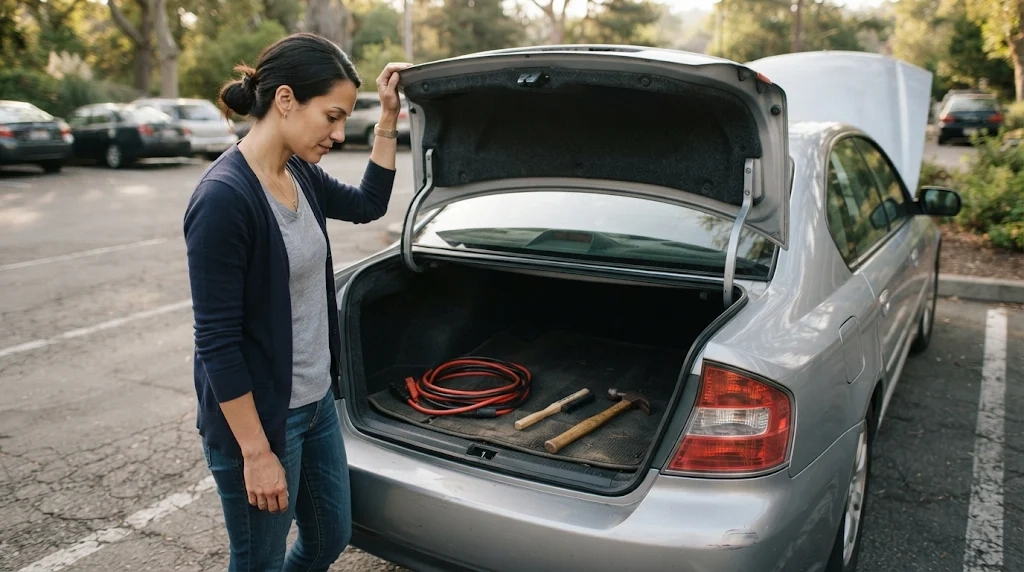
The right method depends on your transmission, your helpers, and the sound the car makes. A manual car gives you the most options, while an automatic car leaves tapping and cleaning as the main roadside options.
The table below compares the four main methods by transmission type, helpers needed, and the fault each one suits.
| Method | Transmission | Suits this fault |
|---|---|---|
| Tap the starter | Manual or automatic | Worn brushes or stuck solenoid |
| Clean connections | Manual or automatic | Corroded or loose cables |
| Push start | Manual only | Starter motor will not turn |
| Jump start | Manual or automatic | Weak battery with a weak starter |
Tapping and cleaning fit almost any car, while push starting fits only a manual car with helpers or a slope. A jump start fits a weak battery, not a dead starter motor.
If you
Drive an automatic and hear one click
Choose tapping and cleaning, because push starting cannot work on your car.
If you
Drive a manual and have helpers nearby
Choose a push start, because it bypasses the starter motor.
If you
See dim lights and hear slow cranking
Choose a jump start, because the battery may be the real fault.
What should you do after the car starts?
Drive to a repair shop right away and keep the engine running until you arrive. A starter that worked once may fail on the next try, so do not stop for errands. Tell the shop what sound you heard and which method worked.
Keep the trip short and stay off fast roads when you can. If the car stalls, you may not get a second start.
Ask the shop whether a repair can fix a starter in your case, or whether a new starter is the safer choice. Some faults sit in a cable, a relay, or the solenoid, while others sit inside the motor itself. The right fix depends on the test result, not on the workaround that worked.
When should you stop and call for help?
Stop and call for help when the car shows smoke, a burning smell, a grinding noise, or fluid under the car. These signs point to damage that a workaround can make worse. A tow costs less than a burned starter, a damaged flywheel, or an injury.
Stop also when you feel unsure about any step, or when the car sits in a risky spot. Roadside help can test the battery and starter on the spot.
Do not bypass the solenoid with a wire or a screwdriver unless you have training for that job. That trick sends a large current through a tool by hand, and it can spark, burn skin, or make the car lurch. Leave high current work to a technician.
Jumper Cables
Jumper cables let you test a weak battery and give a weak starter extra current, which is the first check in this guide.
Frequently Asked Questions
Can you start an automatic car with a bad starter?
An automatic car can start after tapping the starter or cleaning a bad connection, but it cannot be push started. The gearbox in an automatic car needs the engine running to select gears, so rolling the car will not turn the engine. Try the tap method first, then call for a tow if it fails.
Does tapping a starter work?
Tapping a starter can work when worn brushes or a stuck solenoid plunger cause the fault. The tap shakes the part back into contact for one start, but the fault stays inside the starter. Plan on a repair right after the car starts, since the trick may fail next time.
Will a jump start work with a bad starter?
A jump start will work only when a weak battery sits behind the starter fault. Extra current can push a weak starter past a dead spot, yet a failed starter motor will still click or stay silent. If a jump starts the car, the battery was the likely cause.
How many times can you tap a starter?
A starter can be tapped a few times, but each tap buys one start at most, not a fix. Tapping works less often as the brushes wear down, and hard hits can crack the housing. Stop after three or four rounds and get the starter tested.
Can you push start a car alone?
A car can be push started alone only on a gentle slope with a clear run ahead. Pushing a car alone on flat ground is unsafe, since the car can roll away while you try to climb in. Use helpers on flat ground, or call for roadside help instead.
What should you do if the car starts then stalls?
A car that starts then stalls may have a fault beyond the starter, such as a fuel or ignition fault. Keep the car in a safe spot and do not keep cranking, since that drains the battery. Call a mechanic and note how long the engine ran before it stalled.
Conclusion
Learning how to start a car with a bad starter buys you one trip to a shop, not a lasting fix. Tap the starter, clean the connections, push start a manual car, or jump a weak battery, then drive to a shop without turning the engine off. If you drive an automatic and tapping fails, call for a tow.

Alex Carter is an automotive content writer at VastAutoParts, focusing on car parts, vehicle troubleshooting, automotive tools, product research, and practical car care guides.