
What Are the Signs of a Bad Alternator? Causes and Tests
Quick Answer
The signs of a bad alternator are a battery warning light, dim or flickering headlights, a dead battery that keeps coming back, and slow or glitchy accessories. A whining or grinding noise, a burning smell, and stalling or hard starting can follow. Two or more signs together point to the charging system, not the battery alone.
- The battery light means the charging system is at fault, not the battery itself.
- Lights that dim at idle and brighten with revs point to weak alternator output.
- A jump start that ends in a stall within minutes is a strong alternator clue.
- A multimeter test at the battery confirms it in minutes.
Your car runs on two power sources: the battery starts the engine, and the alternator keeps it running and recharges the battery. When the alternator weakens, the signs show up across the whole car, from the lights to the radio to the engine itself. This guide walks through each sign, shows how to tell an alternator fault from a weak battery, and explains a simple voltage test.
In this article
- What Does the Alternator Do?
- The 7 Signs of a Bad Alternator
- Is It the Alternator or the Battery?
- How to Test an Alternator With a Multimeter
- What Else Can Look Like a Bad Alternator?
- Can You Drive With a Bad Alternator?
- What to Do Next
- Frequently Asked Questions
- Conclusion
What Does the Alternator Do?
The alternator is the part that makes electricity while the engine runs. A belt spins it, and it turns that motion into electrical power. That power runs the lights, the ignition, the fuel system, and every accessory, and it recharges the battery.
The battery and the alternator split the work. The battery supplies the big burst of power that cranks the engine, and once the engine runs, the alternator takes over while the battery rests. When the alternator fails, the battery must carry the full load alone, and a healthy battery can do that for a short time before it runs flat.
The 7 Signs of a Bad Alternator

A failing alternator rarely fails without warning. The signs below often appear one at a time, then pile up, so watch for the pattern.
The Battery Warning Light Comes On
The battery warning light is the clearest early sign of a bad alternator. The light is shaped like a battery, but it watches the charging system and comes on when voltage falls below the level the alternator should hold.
The light may glow steady, or it may flicker on and off. A flicker often means the alternator works at times and drops out at others. Either way, get the charging system checked soon, since the icon shape does not mean the battery is at fault.
Headlights Dim or Flicker
Headlights that dim at idle and brighten when you press the gas point to weak alternator output. The alternator spins slower at idle, so a weak unit falls behind there first, and revving the engine lifts the voltage for a moment.
Flickering lights point to unstable output. The voltage may swing up and down as the alternator struggles, and dash lights and interior lights can flicker the same way. Lights that grow too bright can also signal trouble, since a failed regulator can push voltage high.
The Battery Keeps Going Dead
A battery that dies again and again often means the alternator is not recharging it. The car starts after a jump, runs for a while, then needs another jump. A new battery that goes flat within days points the same way.
AAA notes that a car that stalls within 10 to 15 minutes after a jump start has an alternator that can no longer keep the system charged. The battery carries the load for a short time, then runs out of power. If the battery dies while the car sits parked, check for battery drain while parked before blaming the alternator.
Electrical Accessories Act Up
Slow power windows, a radio that resets, and gauges that jump around all point to unstable voltage. Accessories need steady power, and a failing alternator cannot hold voltage steady under load.
Heated seats may stop warming, and the blower fan may run weak. Several small glitches at once mean more than one alone. One faulty window is likely a window fault, but slow windows plus dim lights point to the charging system.
The Engine Makes a Whining or Grinding Noise
A whining or growling noise from the front of the engine often means worn alternator bearings. The sound usually rises and falls with engine speed and may grow louder with the headlights or heater on, since that loads the alternator.
A loud squeal often points to the serpentine belt instead. The belt drives the alternator, and a loose or worn belt slips on the pulley, so it cannot spin the alternator fast enough. Either sound deserves a look under the hood.
You Smell Burning Rubber or Hot Wire
A burning rubber smell often comes from a slipping serpentine belt. The belt rubs against the pulley and heats up. A hot wire smell is more serious, since it can mean parts inside the alternator are overheating.
AAA notes that an alternator that overcharges the battery can also produce a burning rubber or hot wire smell. Its guide to bad alternators and batteries covers both faults. If the smell grows strong, pull over in a safe place and switch the engine off.
The Engine Stalls or Struggles to Start
An engine that stalls while you drive may have lost the voltage it needs to run. Spark plugs and fuel injectors need steady power, and low voltage can cut the engine out.
Hard starting can also trace back to the alternator. A battery that never gets recharged cannot crank the engine well, so the car may crank slowly or click and fail to start. If the engine turns over but never fires, the cause may sit elsewhere, as in a car that cranks but won’t start.
Is It the Alternator or the Battery?
The battery and the alternator share symptoms, so telling them apart takes a clear test. The pattern below gives a fast first read. A voltage test gives the firm answer.
The table compares the same symptom under each fault, so you can see which part the pattern favors.
| Symptom | Points to the alternator | Points to the battery |
|---|---|---|
| Battery warning light on | Likely, it signals a charging fault | Unlikely, the light does not test the battery |
| Car dies while driving | Likely, voltage has fallen too low | Rare, a running car needs little from the battery |
| Slow crank after sitting | Possible, if the battery never recharged | Likely, age and cold weaken batteries |
| Runs fine after a jump | Unlikely, a bad alternator stalls the car again | Likely, the battery just needed a boost |
| New battery goes flat fast | Likely, nothing is recharging it | Unlikely, unless the new battery is faulty |
The pattern matters more than any single row. Two or more alternator signs together make a strong case for a charging test.
Age helps too: a battery past its normal life is a fair suspect on its own. Learn the signs of a weak battery before you buy parts, since a weak battery and a weak alternator can look alike.
How to Test an Alternator With a Multimeter
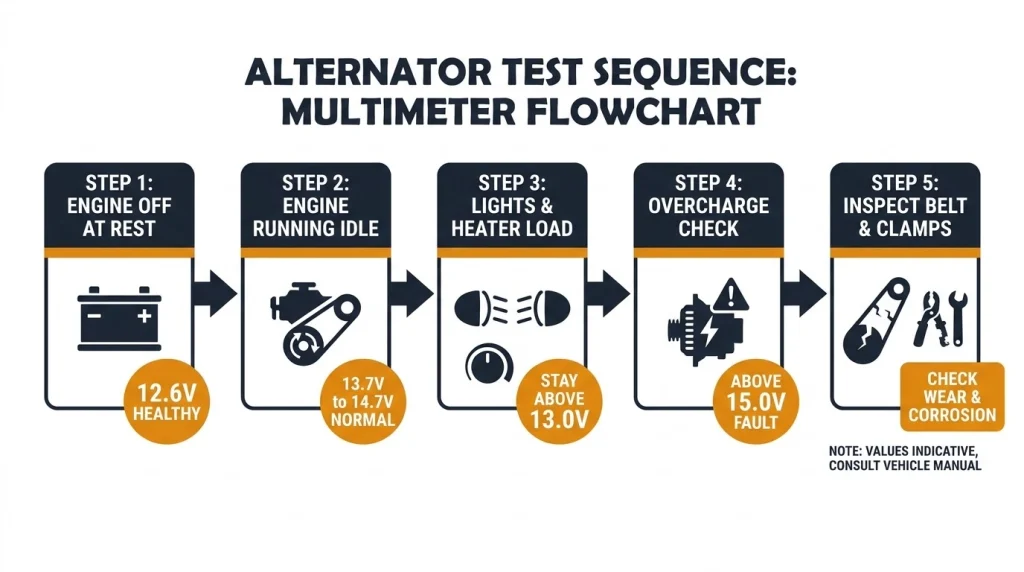
A multimeter gives a firm answer in a few minutes. The test reads voltage at the battery terminals with the engine off and then running.
Step 1
Check the battery at rest
Switch the engine off and close the doors so the lights go out. Set the meter to DC volts and touch the red probe to the positive terminal and the black probe to the negative terminal. A healthy battery reads about 12.6 volts.
Step 2
Start the engine and read again
Start the car and let it idle. Read the voltage at the same terminals. A charging system should read 13.7 to 14.7 volts with the engine running, per AutoZone. A reading near the resting voltage means the alternator is not charging.
Step 3
Add load and watch the reading
Switch on the headlights, the heater fan, and the rear defroster. The voltage should stay above 13 volts under load. A reading that sags toward 12 volts means the alternator cannot keep up.
Step 4
Check for overcharging
A reading above 15 volts means the voltage regulator may be failing. High voltage can cook the battery and blow bulbs. Switch the engine off and book a repair if you see this.
Step 5
Inspect the belt and connections
With the engine off, look at the serpentine belt for cracks, fraying, or missing ribs. Check that the battery terminals are tight and free of white or blue buildup. A loose cable or a worn belt can mimic a bad alternator.
If your readings sit in the normal range but the symptoms stay, the fault may be intermittent. A failing alternator can charge well at times and drop out at others, so a shop load test can catch a fault that a driveway reading misses. See AutoZone’s battery and alternator test guide for the full method.
Warning
Never disconnect a battery cable while the engine runs to test the alternator. That old trick can spike voltage and damage the computer and other electronics. Use a multimeter instead.
What Else Can Look Like a Bad Alternator?
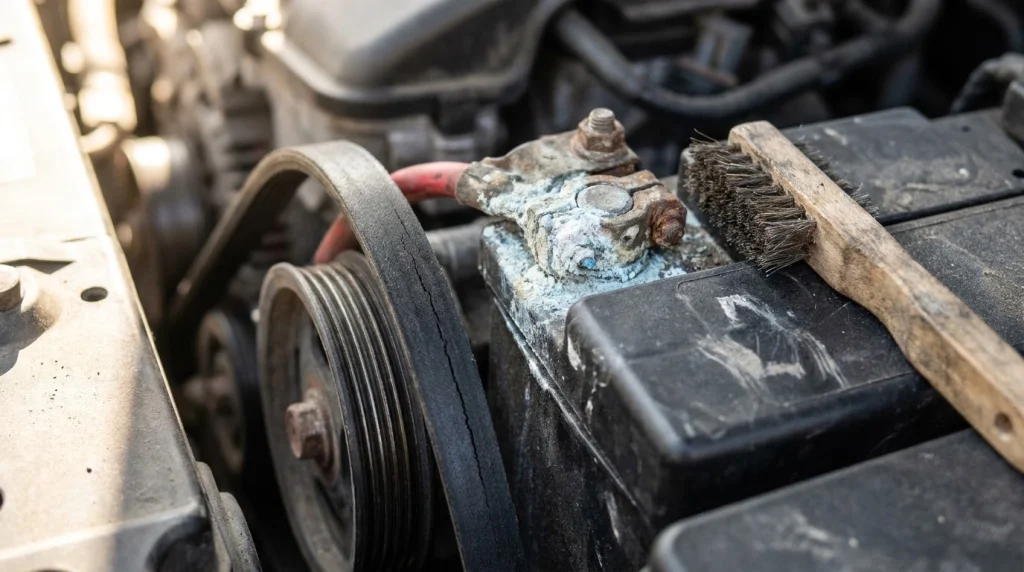
Not every charging symptom means the alternator has failed. Several cheaper faults copy the same signs, so check these first.
Loose or corroded battery connections. Corrosion on the terminals blocks current in both directions, so the battery cannot charge and the starter cannot draw power. Clean white or blue buildup with a wire brush and tighten the clamps.
A worn serpentine belt. The belt spins the alternator, and a cracked, glazed, or loose belt slips so the alternator slows down. Look for cracks, missing ribs, and frayed edges with the engine off.
A blown fusible link or fuse. A fusible link is a short wire that melts to protect the circuit. If it blows, the alternator cannot send power to the battery, and a mechanic can test it in minutes.
A drain while the car sits parked. Some faults pull power while the car sits. A light left on or a faulty module can empty the battery overnight, and that fault looks like a charging failure at the next start.
A failing starter. A dead battery from a weak alternator can sound like a starter fault. Slow cranking or a click with no start often gets blamed on the starter, so test the charging system before you condemn the starter.
Can You Drive With a Bad Alternator?
You can drive a short distance with a bad alternator, but the car runs on battery power alone. The battery drains as you drive, and the engine stalls once voltage falls too low. The distance depends on the battery’s charge and the power you use.
Switch off the heater, the radio, and the rear defroster, and drive straight to a repair shop or a safe place to park. Do not start a long trip or drive at night with a failing alternator.
Stop at once if you smell burning wire, see smoke, or hear a loud squeal followed by silence. A snapped belt can also drive the water pump, so the engine can overheat fast. Call for a tow rather than risk the drive.
What to Do Next
Start with the cheap checks, then confirm with a test. The right next step depends on what you found.
If you
See one mild sign, such as dim lights at idle
Choose a voltage test first, because a reading settles the question in minutes.
If you
See several signs at once, or the battery light stays on
Choose a shop visit soon, because the car can stall without warning.
If you
Smell burning wire or the engine stalls while driving
Choose a tow, because driving further risks damage or a breakdown in traffic.
Tip
Ask a parts store for a free charging system test before you buy parts. The test checks the battery, the starter draw, and the alternator output in one visit.
If the car will not start at all, try diagnosing a no-start car step by step before you call for help.
Digital Multimeter
A digital multimeter lets you test battery and alternator voltage at home in a few minutes.
Frequently Asked Questions
How long does an alternator last?
A typical car alternator lasts 7 to 10 years under normal driving conditions before it needs replacement, according to AAA. Heat, heavy loads, and oil or coolant leaks can shorten that span. A unit near the end of that range with early symptoms deserves a charging test.
Will a bad alternator trigger a check engine light?
A bad alternator can trigger a check engine light when system voltage falls outside the normal range. The engine computer watches voltage, and a low reading can set a low voltage code such as P0562. A scan tool at a parts store or a repair shop can read the code for you.
Can a bad alternator cause rough idling?
A bad alternator can cause rough idling when voltage falls too low to run the engine well. Spark plugs and fuel injectors need steady power, and weak voltage makes the engine stumble or shake at idle. The roughness often clears when you rev the engine, since the alternator spins faster.
Can cold weather damage an alternator?
Cold weather rarely damages a healthy alternator on its own, since low temperatures do not wear its internal parts. Cold thickens engine oil and weakens the battery, so the alternator works harder at startup and may show a fault heat and age already caused. Heat is the bigger enemy of alternator life.
How much does it cost to replace an alternator?
Alternator replacement typically costs 500 to 2,500 dollars, including parts and labor, according to AAA. The price varies with the car model, the part, and how hard the alternator is to reach. Ask for a written quote that splits parts and labor before you agree to the work.
Can you replace an alternator yourself?
You can replace an alternator yourself on some cars using basic hand tools and a repair manual. Access varies widely, and on many cars the unit sits low in the engine bay or needs other parts removed first. If the job needs a lift or special tools, a repair shop is the safer choice.
Conclusion
The signs of a bad alternator follow a clear pattern: a warning light, dim or flickering lights, and a battery that keeps dying. Strange noises or smells can point the same way. If you see two or more of these signs, test the charging voltage before you buy any parts.

Alex Carter is an automotive content writer at VastAutoParts, focusing on car parts, vehicle troubleshooting, automotive tools, product research, and practical car care guides.