
How to Diagnose a Car That Won’t Start: First Checks
Quick Answer
To diagnose a car that won’t start, first determine whether the engine cranks. Check the battery, electrical connections, and starter if it does not crank. If it cranks normally but will not run, investigate fuel delivery, ignition, sensors, and engine compression. Follow the symptoms rather than replacing parts based on guesses.
- Listen for clicking, silence, slow cranking, or normal cranking.
- Inspect battery terminals and check battery voltage.
- Verify the gear position, brake input, and key recognition.
- Test the starter circuit or engine systems based on the symptoms.
- Stop testing if you notice smoke, fuel leaks, or mechanical damage.
A car that refuses to start can leave you stranded without showing an obvious cause. The good news is that its sounds, dashboard lights, and cranking behavior provide useful clues.
This guide explains how to diagnose a car that won’t start using simple observations and targeted tests. It covers common gasoline-powered vehicles and shows when a professional diagnosis becomes necessary.
In this article
- Identify the type of starting problem
- Follow the diagnostic steps
- Test the battery and connections
- Diagnose clicking and no-crank problems
- Diagnose an engine that cranks without starting
- Investigate starting and stalling
- Compare battery, starter, and alternator symptoms
- Avoid common diagnostic mistakes
- Know when professional help is needed
- Frequently asked questions
- Conclusion
What Kind of Starting Problem Does Your Car Have?
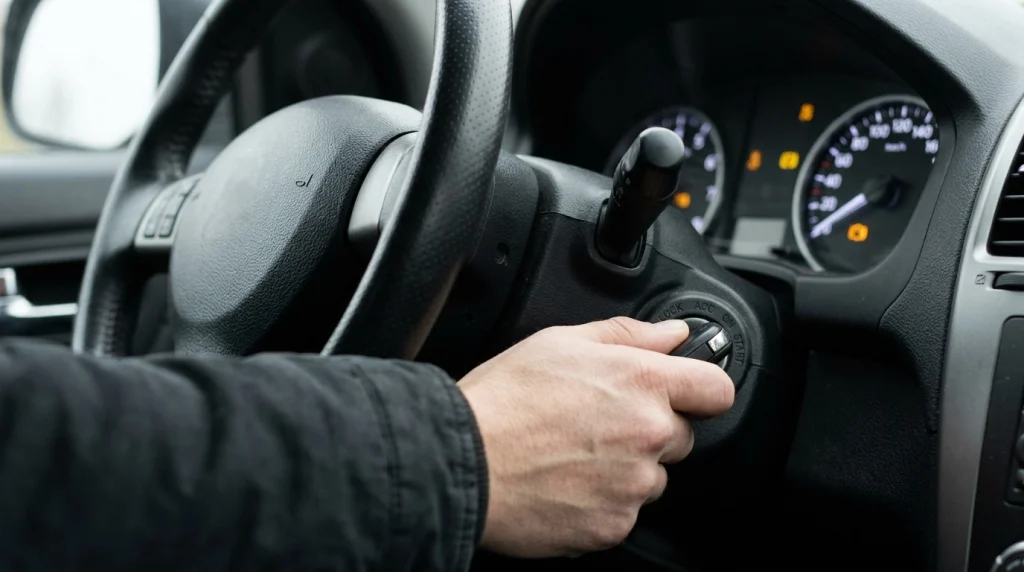
The first step in car starting problem diagnosis is identifying exactly what happens when you attempt to start the engine. Different symptoms point toward different systems.
Cranking means the starter motor turns the engine before it begins running independently. Hearing the starter is not always proof that the engine itself is turning.
The following table compares common starting symptoms and the first checks worth making.
| Starting symptom | Possible cause | First check |
|---|---|---|
| No lights or sound | Discharged battery or disconnected power | Battery voltage and terminals |
| Rapid clicking | Weak battery or poor connection | Battery condition and cables |
| Single click, no crank | Starter or electrical supply fault | Battery load and starter circuit |
| Slow cranking | Low power or excessive resistance | Battery and cable condition |
| Normal crank, no start | Fuel, spark, sensors, or compression | Fuel level and diagnostic codes |
| Starts then stalls | Fuel supply, air control, or immobilizer | Security light and fault codes |
The most useful distinction is no-crank versus crank-no-start. A starter that cannot turn the engine requires different testing from an engine that turns normally but fails to fire.
How Do You Diagnose a Car That Won’t Start Step by Step?
A reliable diagnosis follows the starting sequence and tests the most likely system first. Begin with safe observations before touching electrical or mechanical components.
- Make the vehicle safe. Park on level ground, apply the parking brake, and select Park or Neutral as appropriate. Keep the area around the vehicle clear.
- Observe one starting attempt. Watch the dashboard and listen carefully. Record whether the engine is silent, clicks, cranks slowly, or turns at its normal speed.
- Inspect the battery. Look for loose cables, corrosion, damage, and obvious electrical problems. A weak battery can prevent the starter from operating properly.
- Check starting permissions. Confirm the transmission position and required pedal input. For push-button vehicles, check whether the electronic key is recognized.
- Test the starting circuit. If the engine does not crank, investigate battery power, grounds, relays, control signals, and the starter motor.
- Investigate engine operation. If the engine cranks normally, check fuel availability, ignition operation, sensor information, and relevant diagnostic trouble codes.
- Confirm the cause. Match each test result to the suspected fault before replacing a component. Recheck starting operation after the repair.
This order reduces unnecessary parts replacement. It also helps you identify which checks are practical at home and which require professional equipment.
What should you notice during the first starting attempt?
The most helpful observations are the starting sound, dashboard behavior, warning messages, and engine speed. These clues establish the direction of further testing.
- Do the dashboard lights illuminate normally?
- Do the lights become dim when starting?
- Does the engine make one click or repeated clicks?
- Does the engine turn at its usual speed?
- Does the engine briefly run before stopping?
- Does a security or key warning appear?
Also note whether the vehicle failed after sitting, refueling, driving, or undergoing repair. Such details can reveal patterns that a single test misses.
How Do You Test the Battery and Power Connections?
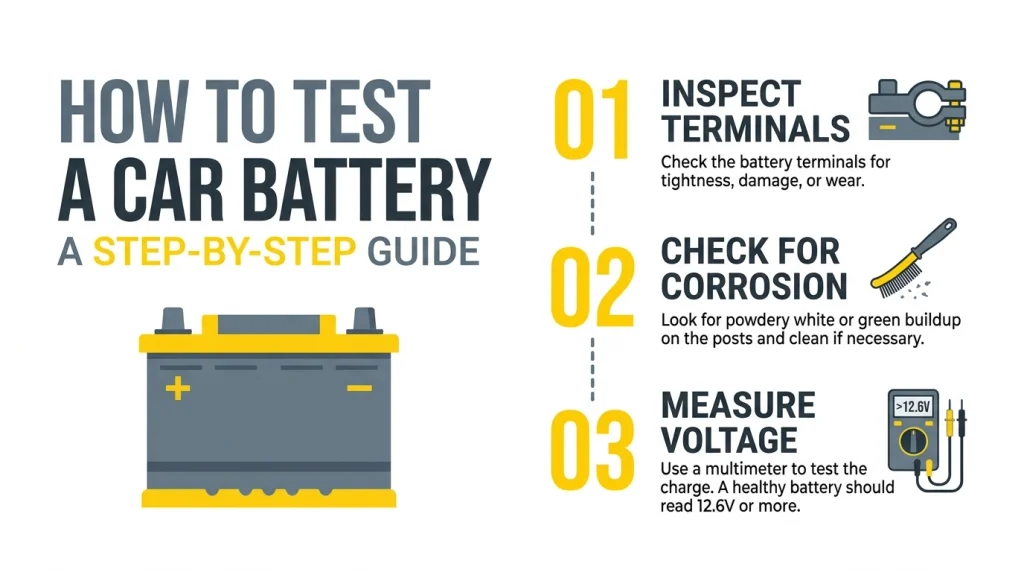
Battery testing is a practical first check when the engine cranks slowly, clicks, or does not crank. Inspect the battery condition before assuming it needs replacement.
How do you inspect battery terminals?
Battery terminals should be secure, clean, and free from obvious damage. Loose connections or corrosion can restrict the high electrical current needed for starting.
With the ignition off, inspect the battery posts and cable ends without touching exposed conductors with metal tools. Look for white or blue deposits, damaged insulation, and loose connections.
Corrosion or damaged cables may require cleaning or replacement using the vehicle manufacturer’s procedure. If the battery or wiring appears unsafe, leave the work to a qualified technician.
How do you check battery voltage?
A digital multimeter can measure battery voltage and reveal whether the battery may be discharged. Set the meter to DC voltage and follow its instructions.
According to Interstate Batteries’ battery guidance, a charged conventional 12-volt car battery normally measures about 12.6 volts or higher at rest.
A lower reading can indicate insufficient charge. However, voltage alone does not prove the battery can supply enough current during cranking.
A battery load test checks its ability to deliver electrical power under demand. A repair shop or battery service provider can perform this test when the resting reading is inconclusive.
What does a successful jump-start tell you?
A successful jump-start suggests that the starting problem involves available electrical power. It does not automatically prove the battery is defective.
The original battery may be discharged because of a charging problem, an electrical drain, or poor connections. Have the battery and charging system checked before deciding which component needs repair.
Follow the vehicle manufacturer’s instructions or AAA’s jump-start safety guide when using jumper cables or a portable jump starter.
Warning
A cracked, swollen, leaking, or unusually hot battery can cause burns or an explosion. Do not jump-start it. Keep clear and request professional assistance.
Hybrid and electric vehicles may use different jump-start procedures and designated connection points. Always consult the owner’s manual before attempting electrical assistance.
What If the Car Clicks or Does Not Crank?
A car that clicks or remains silent during starting may have a power supply or starter-control problem. The exact sound helps narrow the possibilities.
What does rapid clicking mean?
Rapid clicking often means the starter solenoid repeatedly engages and releases because available voltage drops under load. A weak battery is a common cause.
Poor connections can produce similar symptoms, even with a charged battery. Test both the battery and its power connections before replacing the starter.
What does a single click mean?
A single click without engine rotation may point toward a starter motor, solenoid, cable, or power supply problem. The click alone cannot identify the failed component.
If the battery passes testing, a technician can check whether sufficient power reaches the starter during an attempted start. This separates electrical supply faults from starter faults.
What if the dashboard lights work but nothing happens?
Working dashboard lights do not guarantee that the battery has enough current to operate the starter. Lighting and starting require different electrical loads.
Other possibilities include a faulty starter relay, ignition switch, transmission range switch, brake switch, or immobilizer. Check the starting conditions required by your vehicle.
For an automatic transmission, confirm Park is selected. With the brake pressed and the vehicle secured, a manufacturer-permitted start attempt in Neutral may help identify a range-switch problem.
Can a key fob prevent the engine from starting?
A vehicle may refuse to start when its electronic security system cannot recognize the key fob. A weak fob battery is one possible reason.
Look for a key warning or security message on the dashboard. Try a working spare key or the backup starting procedure described in the owner’s manual.
Do not assume that changing the key fob battery will solve every security-related starting problem. Antenna faults, immobilizer issues, and control-module problems may require diagnosis.
What If the Engine Cranks but Will Not Start?
An engine that cranks normally but will not start needs checks beyond the starter motor. Fuel delivery, ignition, engine timing, and compression must work together.
Start with safe, accessible checks. Advanced fuel and ignition tests should follow the vehicle’s service information.
How can you check for a fuel delivery problem?
A fuel delivery problem can prevent a cranking engine from running. Begin by checking the fuel gauge and considering whether the vehicle has enough fuel.
A faulty fuel pump, relay, fuse, injector circuit, or pressure-control component may interrupt fuel delivery. Some vehicles briefly operate the fuel pump when the ignition turns on.
However, hearing a pump does not prove that adequate fuel pressure reaches the engine. A technician may need a fuel pressure test and electrical measurements.
Fuel systems can remain pressurized after the engine stops. Avoid opening fuel lines or loosening fittings without the manufacturer’s safety procedure.
Can faulty spark plugs or ignition coils cause no-start?
Faulty ignition components can prevent a gasoline engine from producing the spark needed for combustion. Spark plugs, ignition coils, and their control circuits are possible causes.
Engine sensors also provide timing information that helps the computer control ignition and fuel injection. A failed crankshaft or camshaft position sensor can interrupt starting.
Do not hold a disconnected spark plug wire or coil near exposed metal to test ignition. High-voltage ignition circuits can cause injury and damage electronics.
How do diagnostic trouble codes help?
Diagnostic trouble codes can identify systems that need investigation. An OBD-II scanner reads stored fault information from compatible vehicle control modules.
Relevant codes may point toward crankshaft sensors, camshaft sensors, ignition circuits, or other engine-control faults. Record the exact codes before clearing anything.
A code identifies a detected condition, not necessarily the defective part. Wiring faults and related components can trigger similar warnings.
A scanner that shows no fault codes does not prove that fuel, spark, timing, and compression are correct. Mechanical problems may not produce a stored code.
When should you suspect a mechanical engine problem?
Mechanical problems become more concerning when cranking sounds unusually fast, uneven, or accompanied by grinding or other abnormal noises. Stop repeated starting attempts in these situations.
A timing belt or chain problem can disrupt valve timing. Low compression can also prevent the engine from starting, even when fuel and ignition are present.
Compression and mechanical timing tests require suitable tools and vehicle-specific specifications. A technician should perform these checks when severe mechanical damage is possible.
Why Does a Car Start and Then Stall?
A car that starts briefly and then stalls may be losing fuel delivery, ignition operation, air control, or permission to keep running. The timing and warning lights provide useful clues.
If a security warning appears as the engine stops, the immobilizer system deserves attention. If the engine runs poorly before stopping, fuel or air-control problems may be involved.
A vehicle that starts with a jump but later loses power may also have a charging-system fault. Repeated battery discharge warrants battery and alternator testing.
Look for changes in dashboard brightness, warning lights, and engine behavior. A technician can use scan data to determine which system stops operating during the stall.
A vehicle that repeatedly stalls should not be driven until the cause is identified. Unexpected engine shutdown can create a traffic hazard.
How Can You Tell the Battery, Starter, and Alternator Apart?
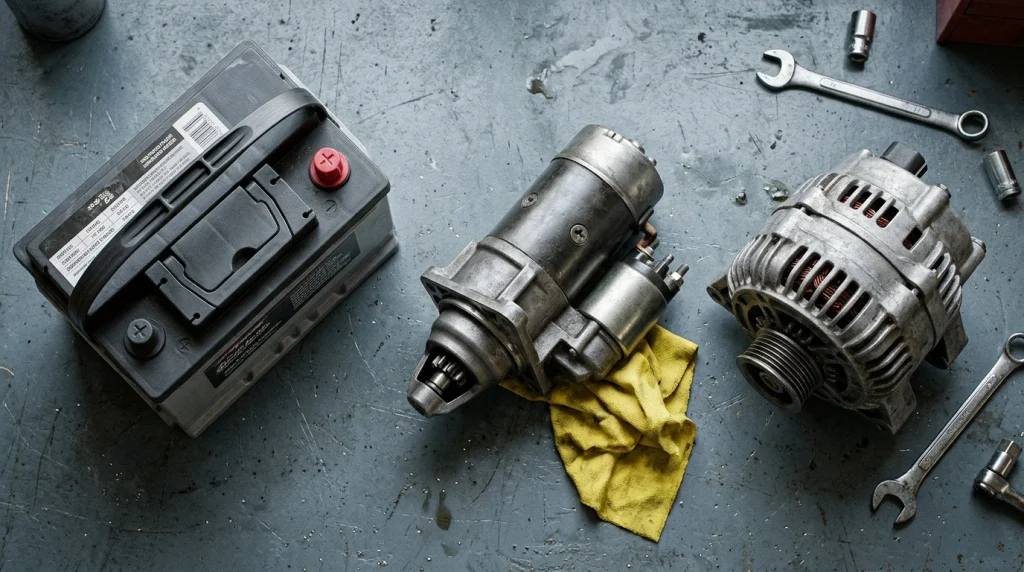
Battery, starter, and alternator problems can produce overlapping symptoms, but each component serves a different purpose. Testing the correct function helps avoid unnecessary replacement.
Battery
Suspect when: Starting power is weak
- Common clue: Slow crank or rapid clicking
- Function: Supplies electrical starting power
- Test: Voltage and battery load test
Starter Motor
Suspect when: Engine will not crank
- Common clue: Single click or no engine rotation
- Function: Turns the engine for starting
- Test: Power, ground, and control circuit
Alternator
Suspect when: Battery repeatedly loses charge
- Common clue: Charging warning or repeated discharge
- Function: Supplies electrical power while running
- Test: Charging-system performance
A weak battery may be the result of a faulty alternator rather than the original problem. Likewise, poor cables can mimic a defective starter.
The AAA guide to no-start causes explains how battery, charging, starting, and other faults can prevent an engine from starting.
Use these patterns to select a test, not as proof that any individual component has failed.
What Mistakes Should You Avoid During Diagnosis?
The most common diagnostic mistake is replacing a suspected component without confirming the fault. A consistent testing process is safer and often more effective.
Good diagnostic habits separate observations from conclusions. The following practices help keep the investigation focused.
Do
- Identify the exact starting symptom.
- Test power and connections first.
- Record diagnostic codes and observations.
Avoid
- Replacing parts based on sound alone.
- Cranking repeatedly after abnormal noises.
- Bypassing safety switches or fuel protections.
Another mistake is assuming a jump-start always confirms a failed battery. Jump-starting may temporarily overcome insufficient electrical power without revealing its original cause.
Similarly, a working radio does not establish that the battery can operate the starter. The starter requires a much greater electrical load.
A final mistake is clearing diagnostic codes before recording them. Stored information may help explain an intermittent fault that disappears during inspection.
When Should You Get Professional Diagnostic Help?
Professional diagnosis is appropriate when basic checks do not identify the cause or when testing involves unsafe electrical, fuel, or mechanical systems.
Arrange roadside assistance or towing if you notice smoke, fuel leakage, severe electrical damage, grinding, or unusually fast engine cranking.
Advanced repairs may require starter-circuit voltage-drop tests, fuel pressure measurement, sensor waveform analysis, or compression testing. These procedures depend on the vehicle’s specifications.
Before contacting a mechanic, prepare a short description of the failure.
- Explain whether the engine cranks or remains silent.
- Describe clicking, grinding, or unusual cranking sounds.
- Report dashboard warnings and diagnostic codes.
- Explain whether a jump-start changed the symptoms.
- Mention any repairs or electrical work before the failure.
- Describe whether the problem occurs occasionally or consistently.
These observations help a technician reproduce the problem and choose useful tests. They may also prevent replacing parts that are operating normally.
Digital Multimeter
A digital multimeter can help measure battery voltage and support basic electrical checks when used according to the vehicle and meter instructions.
Frequently Asked Questions
Can a car battery show good voltage but still fail?
A car battery can display normal resting voltage yet fail to supply enough current to crank the engine. Internal deterioration or poor connections may cause voltage to drop under heavy load. A proper battery load test helps determine whether the battery can perform its starting function.
Why does my car start after the engine cools?
A car that starts after cooling may have a temperature-sensitive electrical or mechanical fault. Heat can affect failing sensors, wiring connections, relays, and other components. Record the conditions when the failure occurs, since testing only after the vehicle starts normally may miss the problem.
Can a blocked air filter stop a car from starting?
A severely restricted air intake can interfere with engine operation, although a mildly dirty air filter rarely prevents starting by itself. Other air-control or intake problems may also affect the air entering the engine. Inspect the intake for obvious blockages before assuming the air filter caused the failure.
Can a car have starting problems without fault codes?
A car can fail to start without storing a diagnostic trouble code because some electrical or mechanical faults escape electronic monitoring. A discharged battery, poor connection, or mechanical failure may not create a useful code. Physical tests remain necessary even when a scanner reports no faults.
Should you press the gas pedal when starting a car?
Most modern fuel-injected gasoline cars do not need accelerator pedal input during normal starting. The engine control system manages fuel delivery and starting airflow automatically. Some vehicles have special procedures for flooding or other conditions, so follow the owner’s manual instead of repeatedly pressing the pedal.
Can disconnecting the battery fix a starting problem?
Disconnecting the battery does not repair a defective starter, weak battery, fuel system fault, or damaged electrical connection. It may reset some electronic modules while also erasing useful diagnostic information. Diagnose the underlying failure before considering any manufacturer-approved reset procedure.
Conclusion
To answer how do you diagnose a car that won’t start, begin by separating no-crank symptoms from an engine that cranks without starting. Check battery power and starter operation first, then investigate fuel, ignition, and mechanical systems as the evidence requires.
If simple checks do not identify the fault, arrange a professional diagnosis before replacing parts.

Alex Carter is an automotive content writer at VastAutoParts, focusing on car parts, vehicle troubleshooting, automotive tools, product research, and practical car care guides.