
How to Check for a Bad Ignition Switch: Tests That Work
Quick Answer
You check for a bad ignition switch by testing whether it sends power in each key position. Start with the battery and fuses, then use a multimeter to test voltage and continuity at the switch connector. A good switch shows battery voltage and near-zero ohms. A bad switch shows no voltage, no continuity, or flickering readings.
- Rule out a weak battery, corroded terminals, and blown fuses first.
- Watch the dashboard and accessories in each key position for dead or flickering circuits.
- Test voltage at the switch connector with a multimeter set to 20 DC volts.
- Test continuity between the battery terminal and each output terminal.
- Replace the switch if a circuit stays open where it should close.
Your key turns, but the engine stays silent. That fault could sit in the battery, the starter, or the ignition switch itself. This guide shows you how to test the switch step by step with simple tools, read the results, and know when the job belongs to a mechanic.
In this article
- What Does the Ignition Switch Do?
- Signs That Point to a Bad Ignition Switch
- What to Rule Out Before You Test the Switch
- How to Check for a Bad Ignition Switch With a Multimeter
- How to Read Your Test Results
- Quick Checks Without a Multimeter
- Ignition Switch, Lock Cylinder, or Starter?
- When to Stop and Call a Mechanic
- Frequently Asked Questions
- Conclusion
What Does the Ignition Switch Do?
The ignition switch routes power from the battery to the circuits your car needs. It sits behind the lock cylinder, where you insert the key. Turning the key moves internal contacts that close one circuit at a time.
Most keyed switches have four positions: Off, Accessory, Run, and Start. Accessory powers the radio and windows. Run powers the fuel pump, ignition coils, and engine computer.
Start sends a signal to the starter solenoid, which cranks the engine. Two parts often get mixed up here. The lock cylinder is the mechanical slot the key turns.
The ignition switch is the electrical part behind it. A fault in either part can stop the car from starting, so testing must tell them apart.
Signs That Point to a Bad Ignition Switch
A bad ignition switch shows clear signs before it fails outright. Its contacts wear, pit, or loosen over time, and each worn circuit shows a distinct fault. Watch for these signs before you pick up a tool.
- The engine does not crank when you turn the key, even with a charged battery.
- Dashboard lights flicker or die when you move the key or hit a bump.
- The radio, heater fan, or windows cut out while you drive.
- The engine starts, then stalls the moment you release the key from Start.
- The key feels stiff, sticks, or needs a jiggle before the car starts.
- Accessories stay dead in the Accessory position but work in Run, or the reverse.
If the engine starts and then dies as the key springs back to Run, the Run circuit may have lost contact. That stall pattern has several causes, so compare it with the signs when a car starts and then dies for another reason.
What to Rule Out Before You Test the Switch
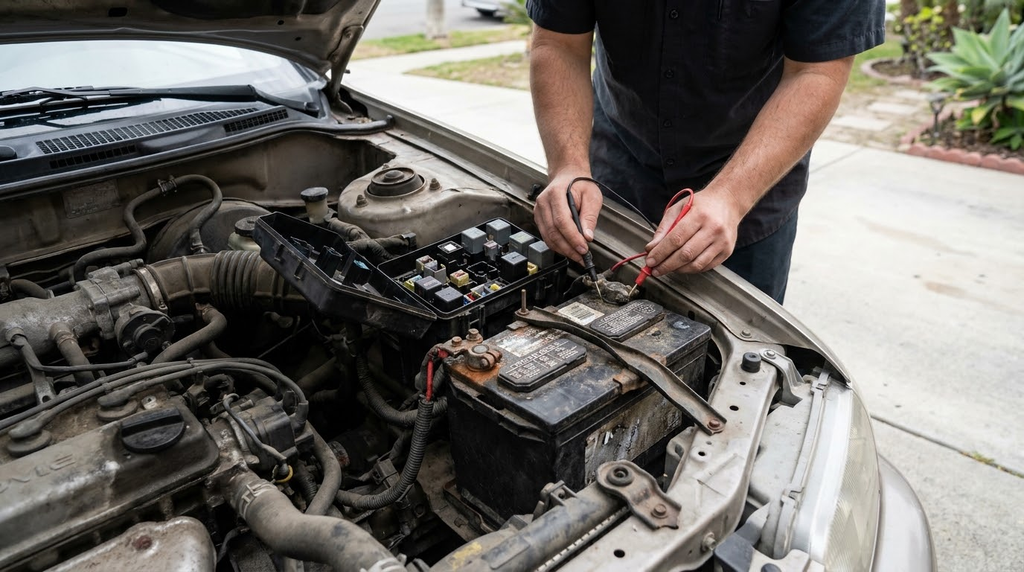
A weak battery or a blown fuse can copy every ignition switch fault. Testing the switch first wastes time when a simpler part is at fault. Rule out these causes first.
Test the battery with a multimeter across its terminals. A healthy battery reads about 12.6 volts with the engine off. Clean any corrosion from the terminals and tighten loose clamps before you test again.
If the reading stays low, a weak battery is the likely fault, so deal with that before you blame the switch.
Check the fuses and relays for the ignition and starter circuits in the under-hood fuse box. A blown fuse breaks the same power path as a failed switch. Swap a suspect relay with an identical one from a non-essential circuit and try again.
Listen for a single click or rapid clicking when you turn the key. Rapid clicking usually means a weak battery, while one firm click points at the starter solenoid. Many faults mimic a bad starter at this stage, so rule them out before you open the steering column.
Try starting the car in Neutral if you have an automatic transmission. A worn neutral safety switch can block the start signal just like a bad ignition switch. If the car starts in Neutral but not in Park, the safety switch is the fault.
How to Check for a Bad Ignition Switch With a Multimeter
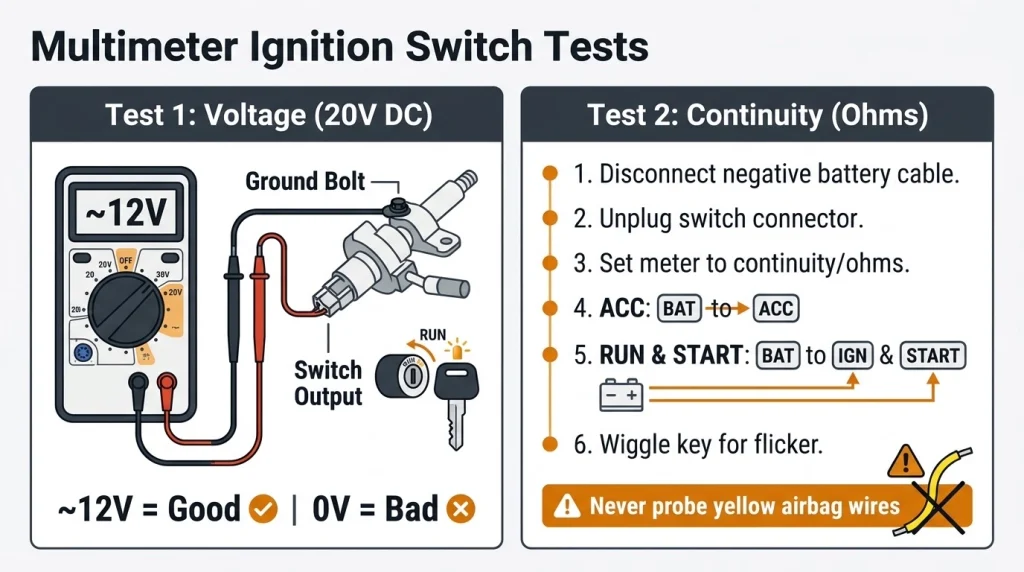
You check the switch with a multimeter by testing voltage and continuity at its connector. The switch either passes power in each key position or it does not. Two tests cover it: a voltage test and a continuity test.
Warning
Disconnect the negative battery cable before you touch the switch connector. Never probe yellow connectors or airbag wires inside the steering column. Stop and get help if you cannot find the switch connector.
Test the Voltage at the Switch
A voltage test shows whether power reaches the switch and leaves it. Set your multimeter to the 20 DC volt range. Ground the black probe on bare metal, such as a bolt on the steering column.
Remove the plastic covers under the steering wheel to reach the switch connector. Touch the red probe to the output terminal on the switch side of the connector. Turn the key to Run without cranking the engine.
A good switch shows a reading close to battery voltage, about 12 volts. A reading of zero, or one far below battery voltage, means the switch is not passing power. This voltage test with a multimeter is the fastest way to confirm a dead switch.
Test Continuity in Each Key Position
A continuity test checks each circuit inside the switch one position at a time. It finds faults the voltage test can miss, such as a circuit that closes in one position but not another. Keep the battery disconnected for this test.
Set the multimeter to continuity or ohms mode. Find the terminals on the switch, usually marked BAT, ACC, IGN, and START. Your vehicle wiring diagram names each terminal if the marks are unclear.
Step 1
Disconnect the battery
Remove the negative cable and set it aside so it cannot touch the terminal.
Step 2
Expose the switch connector
Remove the steering column covers and unplug the switch connector.
Step 3
Set the meter to continuity
Choose continuity or ohms mode and touch the probes together to check for a beep or a near-zero reading.
Step 4
Test the Accessory position
Turn the key to ACC and check for continuity between BAT and ACC only.
Step 5
Test the Run and Start positions
Turn the key to Run and check BAT to IGN, then hold it in Start and check BAT to START.
Step 6
Wiggle the key gently
Hold each position and move the key slightly to catch intermittent contact.
A healthy switch beeps or reads near zero ohms where continuity belongs. An open circuit, or a reading that flickers as you wiggle the key, means worn contacts inside the switch. This step-by-step continuity test is the most reliable way to confirm the fault before you buy parts.
How to Read Your Test Results
Match each key position to the reading a healthy switch gives.
| Key Position | Healthy Reading | Failed Reading Means |
|---|---|---|
| Off | No continuity on any output | Switch stuck closed, battery drain risk |
| Accessory | Continuity between BAT and ACC only | Dead accessories, worn ACC contacts |
| Run | Continuity between BAT and IGN | Engine stalls, no power to fuel and spark |
| Start | Continuity between BAT and START, IGN stays live | No crank, silent key turn |
One failed position is enough to condemn the switch. Contacts do not heal, and a switch that fails one circuit will soon fail another.
Intermittent readings deserve care. A switch that passes on a cold morning can fail once the cabin warms up, because heat expands worn contacts. Repeat the test after a short drive if the fault only shows up warm.
Quick Checks Without a Multimeter
You can gather strong clues without any tools. These checks point at the switch, but they cannot prove it. Use them to decide whether a multimeter test is worth the effort.
- Turn the key to Run and watch the dashboard. Dark gauges with a charged battery point at the switch.
- Turn the key to Accessory and try the radio and windows. Dead accessories in one position only suggest worn contacts.
- Jiggle the key gently in Run. Lights that flicker with the movement mean loose internal contacts.
- Note whether bumps or turns cut power while you drive. Vibration breaks weak contact inside a worn switch.
- Check whether the engine dies the instant you release the key from Start. That pattern implicates the Run circuit.
Tip
Try your spare key before you test the switch. A worn key can fail to turn the cylinder fully into Start, and a fresh key rules out that cause in seconds.
Ignition Switch, Lock Cylinder, or Starter?
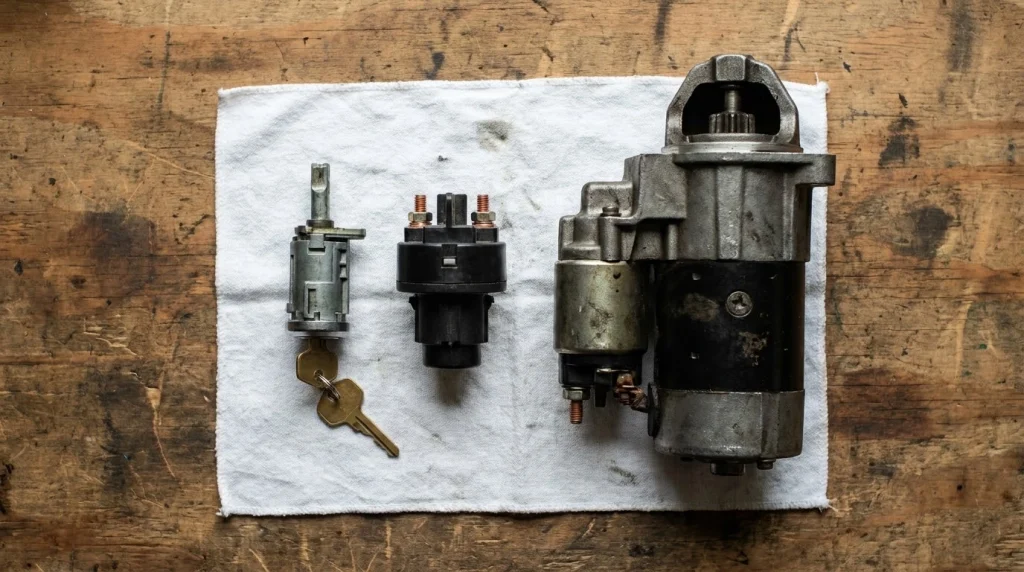
Three parts cause the same no-start, and each needs a different fix. Match your symptoms to the part below before you order anything.
If you
Key turns hard, sticks, or will not turn at all, but the dashboard lights work
Choose the lock cylinder, because the mechanical slot fails while the electrical switch still passes power.
If you
Dashboard lights and accessories flicker or die as you move the key
Choose the ignition switch, because worn contacts break power to whole circuits at once.
If you
Dashboard lights stay bright and you hear a single click or grinding noise
Choose the starter, because the switch delivers power but the starter cannot use it.
A car with power but no start can still fool you. Bright lights with a silent starter may mean the switch, the starter, or a safety switch in between. Work through the checks in order and let the multimeter settle it.
When to Stop and Call a Mechanic
Some ignition switch jobs need tools and access a home mechanic lacks. Stop testing and call a mechanic if the switch sits deep in the column, the airbag must move, or the new switch needs pairing with the immobilizer. A shop can also test the switch with the wiring diagram for your exact model.
Check for open recalls before you pay for parts. Some vehicles had ignition switches that could slip out of Run while driving, cutting the engine and airbags. You can check for open recalls with NHTSA using your VIN.
If your car stalls while driving, treat it as a safety fault. Stop driving it until a mechanic checks the switch.
Digital Multimeter
A digital multimeter is the tool this guide uses for both tests, and it also checks batteries, fuses, and charging faults around the car.
Frequently Asked Questions
Can a bad ignition switch drain your battery?
A bad ignition switch can drain your battery when it fails to cut power after you turn the key off. Stuck contacts may keep the radio, lights, or fuel pump circuit live overnight. Repeated failed start attempts also drain the battery while you chase the fault.
Can you start a car with a bad ignition switch?
You can sometimes start a car with a bad ignition switch by jiggling the key or trying a spare key. Gentle movement can close worn contacts long enough for one start. This trick is a short term workaround only, and the switch still needs replacement.
Can a heavy keychain damage an ignition switch?
A heavy keychain can wear an ignition switch over time by pulling on the key while you drive. The extra weight stresses the lock cylinder and the contacts behind it. Keep the ring light and remove bulky items from the ignition key.
Can a locksmith replace an ignition switch?
A locksmith can replace the lock cylinder and often the ignition switch on many cars. Some vehicles need the new switch paired with the immobilizer, which needs dealer or shop tools. Ask whether your model needs programming before you book the job.
How do you test an ignition switch on a push-button car?
A push-button car has no keyed ignition switch, so you test the start button circuit and its inputs instead. Check the key fob battery, the brake pedal switch, and the fuses for the starting system. A scan tool can read codes from the body control module if those checks pass.
Does a bad ignition switch set a check engine light?
A bad ignition switch often sets no check engine light because the switch is a simple electrical part. A scan tool may still show codes for circuits that lost power, such as the fuel pump or engine computer. Treat stored codes as clues, not proof, and test the switch directly.
Conclusion
How do you check for a bad ignition switch? Test whether power reaches the right circuit in each key position, starting with the battery and fuses. If the switch fails a test or the car stalls while driving, book a mechanic and stop driving until it is fixed.

Alex Carter is an automotive content writer at VastAutoParts, focusing on car parts, vehicle troubleshooting, automotive tools, product research, and practical car care guides.