
Bad Starter Solenoid Signs: Symptoms and Simple Tests
Quick Answer
The most common signs of a bad starter solenoid are a single click without engine cranking, intermittent starting, complete silence when starting, and grinding noises. A faulty solenoid may also keep the starter engaged after you release the key. However, a weak battery or damaged cable can cause similar problems, so testing matters.
- A single loud click without cranking may indicate failed solenoid contacts.
- Intermittent starting can indicate worn or sticking internal connections.
- Grinding or continued starter operation may indicate an engagement problem.
- Rapid clicking usually suggests low battery power or poor electrical connections.
- Confirm battery condition before replacing the solenoid.
You turn the ignition key or press the start button, but your engine refuses to crank. A faulty starter solenoid could be responsible, although other electrical problems can look almost identical.
Understanding the warning signs helps you avoid replacing a working starter or battery. This guide explains the symptoms, what the sounds mean, and how to narrow down the cause safely.
In this article
- What a starter solenoid does
- Signs of a bad starter solenoid
- What different starting noises mean
- Starter solenoid versus battery problems
- Other electrical faults
- Safe checks before replacement
- Professional solenoid testing
- Common causes of failure
- Repair or replacement decisions
- When to stop trying to start
- Frequently asked questions
- Conclusion
What Does a Starter Solenoid Do?

A starter solenoid is an electromagnetic switch that helps connect battery power to the starter motor. In many vehicles, it also moves the starter gear into position so the motor can turn the engine.
When you turn the ignition key, the starting system sends an electrical signal to the solenoid. The solenoid moves an internal plunger and closes heavy electrical contacts.
These contacts allow battery current to reach the starter motor. The motor then turns the engine until it can run on its own.
When you release the key, the solenoid should open its contacts and disengage the starter drive. A problem with either action can prevent normal starting or damage nearby components.
Where is the starter solenoid located?
Most modern vehicles have a starter solenoid attached directly to the starter motor. The assembly is generally mounted near the engine and transmission connection.
Some older vehicles use a separate solenoid mounted on the firewall or another location in the engine compartment. The arrangement matters because replacement procedures differ between designs.
The solenoid’s location also affects how easily you can inspect its wiring. Some vehicles require component removal to reach the starter safely.
What Are the Signs of a Bad Starter Solenoid?
Bad starter solenoid symptoms usually involve the engine failing to crank, unusual starter noises, or inconsistent operation. The same symptoms can have other causes, so no single sound proves the solenoid has failed.
1. A single click but the engine does not crank
A single loud click without engine movement is a common warning sign of a starter solenoid or starter motor problem. The click may mean the solenoid has moved, but the motor has not received usable power.
Internal solenoid contacts can wear or burn, preventing sufficient current from reaching the motor. However, a faulty starter motor, weak battery, or poor main cable connection can produce the same result.
If the battery tests healthy, the next step is checking power delivery to the starter assembly. The AutoZone solenoid symptoms guide describes this clicking condition as a possible indication of internal connection trouble.
2. No clicking sound and no engine cranking
Complete silence when you try to start the engine can occur when the solenoid fails to activate. An open solenoid winding or damaged internal connection may prevent normal movement.
However, silence can also mean the solenoid never received the start command. A blown fuse, failed starter relay, ignition switch problem, or safety interlock can interrupt that signal.
Check whether dashboard lights and other electrical accessories work. Their operation provides clues, but working lights alone do not prove the battery can supply starting current.
3. The car starts sometimes but not others
Intermittent starting can indicate worn solenoid contacts or an internal mechanism that occasionally sticks. Your vehicle might start normally several times before refusing to crank.
Temperature changes and vibration may affect a failing electrical connection. A similar pattern can develop from loose battery terminals, damaged wiring, or a defective starter relay.
Record whether the problem happens with a hot engine, a cold engine, or after several starting attempts. These details help a technician reproduce the fault.
4. Grinding noises during starting
Grinding during starting can indicate that the starter gear is not engaging the engine’s ring gear correctly. A sticking or damaged solenoid mechanism is one possible cause.
The starter drive, damaged gear teeth, and mounting problems can also create grinding sounds. Continued grinding may damage the starter pinion or ring gear.
Stop attempting to start the engine if grinding continues. The gear engagement system should be inspected before further use.
5. The starter spins without turning the engine
A whirring starter without engine movement may indicate that the starter drive is spinning but not engaging the ring gear. Some solenoid faults can interfere with this engagement.
However, a defective starter drive or damaged ring gear can cause the same symptom. A spinning sound alone cannot identify the failed component.
A technician should inspect the starter engagement mechanism rather than replacing the solenoid based only on the noise.
6. The starter keeps running after the key is released
A starter that remains energized after the start command ends may have stuck solenoid contacts. A faulty relay or control circuit can also keep supplying power.
Continued starter operation is more serious than an occasional missed start. The motor can overheat, and the drive components may suffer damage.
If you hear continued starter operation or grinding after the engine starts, stop using the vehicle and arrange professional inspection. Do not continue driving while the starter remains engaged.
7. Slow cranking despite a charged battery
Slow cranking can result from excessive resistance in the starting circuit, including damaged connections associated with the solenoid. However, slow cranking is not a specific solenoid diagnosis.
A weak battery, corroded cables, poor engine ground, or worn starter motor can limit cranking speed. Cold conditions and engine mechanical resistance can also affect starter performance.
A battery load test and voltage-drop testing help separate these possibilities.
What Do Different Starting Noises Mean?
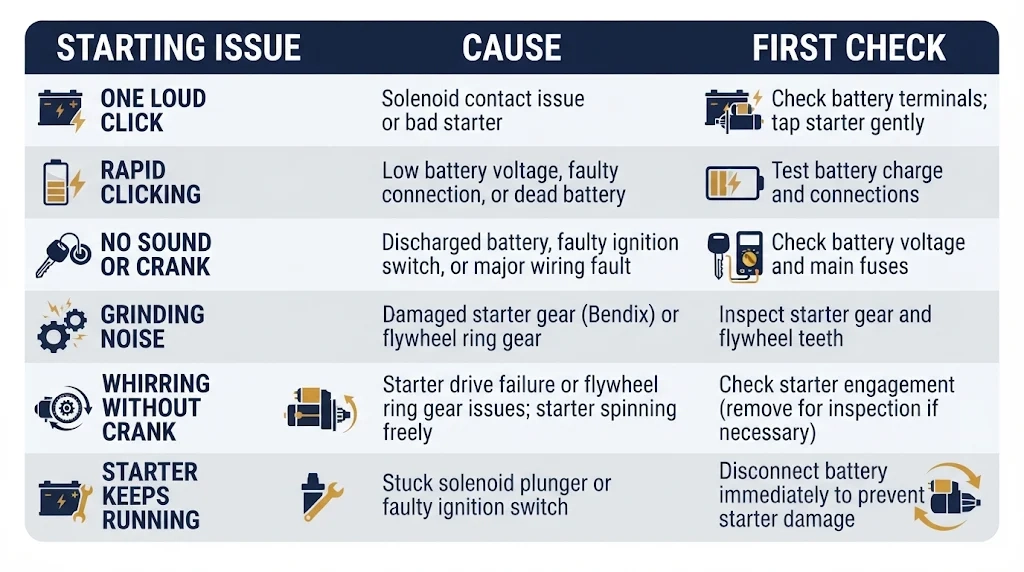
Starting noises provide useful clues about which part of the electrical system deserves attention first. The following table compares common symptoms and possible causes.
| What You Notice | Possible Cause | First Check |
|---|---|---|
| One loud click | Solenoid contacts, starter motor, or power cable | Battery load and starter power supply |
| Rapid clicking | Weak battery or high-resistance connection | Battery condition and terminals |
| No sound or crank | Control circuit, relay, solenoid, or battery | Battery and start-command circuit |
| Grinding noise | Starter drive or ring gear engagement | Starter engagement components |
| Whirring without crank | Starter drive not engaging | Drive mechanism and ring gear |
| Starter keeps running | Stuck solenoid contacts or control fault | Stop operation and inspect professionally |
The main distinction is between a single click, rapid clicking, and complete silence. Each symptom leads to a different starting point for testing, not an automatic replacement decision.
Is It the Starter Solenoid or a Weak Battery?
A weak battery usually causes low electrical power, while a faulty solenoid can prevent available power from reaching the starter motor. Both problems may leave the engine unable to crank.
Rapid clicking commonly points toward a discharged battery or poor connections. A single click with a battery that passes proper testing makes the starter assembly more suspicious.
Headlights and dashboard lights provide limited diagnostic information. They require less current than the starter, so normal lighting does not guarantee a healthy battery.
A jump start can also offer clues. If additional battery power restores normal cranking, investigate battery condition and charging performance.
If a correctly performed jump start makes no difference, the starter assembly and electrical connections deserve closer testing. However, jump-start results alone cannot prove a failed solenoid.
For a comparison of these symptoms, see AutoZone’s starter versus battery diagnosis.
What Else Can Look Like a Bad Starter Solenoid?
Several electrical and mechanical faults can imitate a failed solenoid. Checking these possibilities reduces unnecessary repairs.
- Starter relay: A failed relay may prevent the solenoid from receiving the start signal.
- Ignition switch: A faulty switch may interrupt the command to crank the engine.
- Neutral safety switch: An automatic transmission interlock may prevent starting outside permitted gear positions.
- Clutch safety switch: A manual transmission vehicle may not crank if the switch does not recognize clutch operation.
- Battery cables: Loose, corroded, or damaged connections can block sufficient current.
- Engine ground: A poor ground connection can interrupt the starter’s return current path.
- Starter motor: Worn brushes or internal electrical faults can cause clicking without cranking.
Security systems can also prevent starting in some vehicles. Consult the owner’s manual when a security warning appears alongside a no-crank condition.
How Can You Check a Bad Starter Solenoid Safely?
Start with basic observations and battery checks before working near the starter. These steps can identify common causes without bypassing the solenoid or touching exposed high-current terminals.
- Park safely. Use a level surface, apply the parking brake, and select Park or Neutral as appropriate. Keep people clear of the vehicle.
- Listen to the starting attempt. Note whether you hear one click, rapid clicking, grinding, whirring, or silence. Avoid repeated attempts when unusual mechanical noises occur.
- Inspect visible battery connections. With the engine off, look for loose clamps, corrosion, or damaged cables. Follow the vehicle manufacturer’s instructions before disconnecting or cleaning anything.
- Check the battery. Use a suitable battery tester or have the battery load-tested. A voltage reading alone cannot establish how much current it can deliver.
- Review dashboard warnings. Look for security, transmission, or other starting-related messages. Follow the owner’s manual for vehicle-specific checks.
- Request starter circuit testing. If battery condition and connections are satisfactory, have the solenoid control and power circuits tested.
A digital multimeter can help check battery voltage at accessible battery terminals. However, testing the live starter circuit is more hazardous because it carries high current and may be difficult to reach.
Warning
Shorting starter terminals can produce sparks, burns, or sudden vehicle movement. Do not bypass the solenoid or probe exposed starter connections without proper training.
Never work beneath a vehicle supported only by a jack. If accessing the starter requires raising the vehicle, leave that work to a properly equipped technician.
How Does a Mechanic Confirm Solenoid Failure?
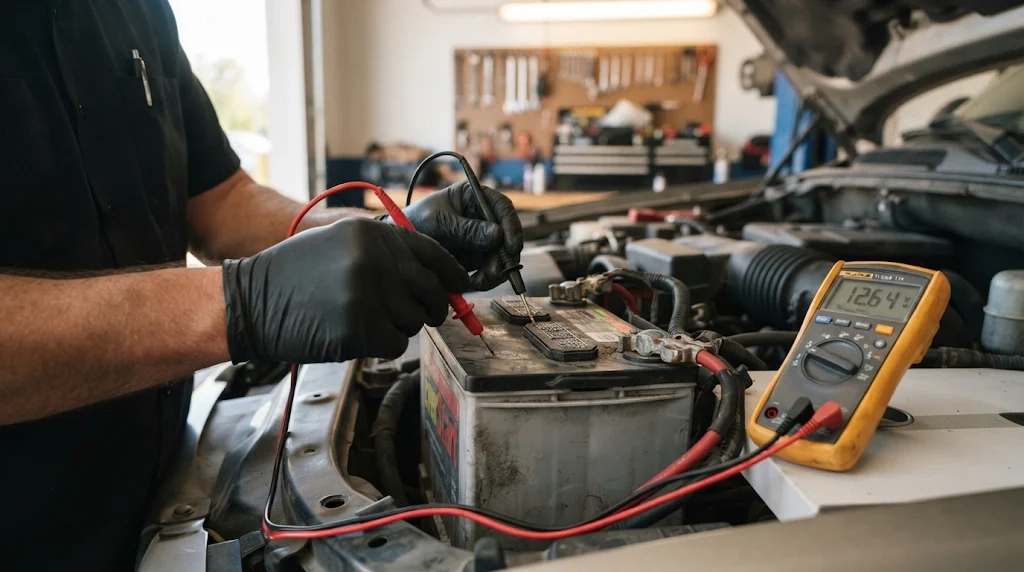
A mechanic confirms solenoid failure by testing battery power, the start command, electrical resistance, and starter operation. The goal is to identify where the starting circuit stops working.
Battery and cable testing
The technician checks whether the battery can deliver starting current under load. They also inspect the positive cable and ground connections for excessive resistance.
A voltage-drop test measures how much voltage is lost as electricity travels through a connection or cable. Excessive voltage loss can make a healthy starter behave like a failed one.
Delco Remy’s starter cranking diagnostic guidance recommends checking batteries and cable voltage drop before moving to specific starter faults.
Solenoid control signal testing
The technician checks whether the solenoid receives the correct signal when starting is requested. If the signal is missing, the control circuit must be investigated first.
A missing signal may indicate a relay, switch, fuse, wiring, or control-system problem. Replacing the solenoid cannot repair an upstream electrical interruption.
Starter power delivery testing
If the solenoid receives the proper command, the technician evaluates whether electrical power passes through its contacts. Poor output with adequate input can indicate defective contacts.
Additional starter motor testing may be required to distinguish solenoid failure from motor failure. The results determine whether replacing the solenoid or complete starter assembly is appropriate.
What Causes a Starter Solenoid to Fail?
Starter solenoids can fail through wear, corrosion, heat exposure, damaged connections, or mechanical binding. The exact cause depends on the component and operating conditions.
Worn electrical contacts
Electrical contacts experience wear as the solenoid repeatedly switches the starter motor’s heavy current. Damaged contacts may stop conducting properly even when the solenoid clicks.
Corrosion and moisture
Moisture can contribute to corrosion around terminals and electrical connections. Increased resistance may prevent the starter from receiving sufficient power.
Heat and electrical stress
Excessive heat can damage electrical components and insulation. Repeated unsuccessful cranking attempts may also place unnecessary stress on the starting system.
Mechanical sticking or damage
A damaged plunger, spring, or engagement mechanism may prevent the solenoid from moving normally. This can lead to incomplete starter engagement or failure to disengage.
Inspecting the complete starting circuit helps identify contributing problems before fitting replacement parts.
Should You Repair the Solenoid or Replace the Starter?
Repairing or replacing the solenoid depends on whether it is separately serviceable and whether the starter motor remains healthy. Many vehicles use a starter assembly with an attached solenoid.
Some designs allow a technician to replace the solenoid independently. Other designs are more practical to service as a complete starter assembly.
Replacing only the solenoid may be reasonable when testing identifies a solenoid fault and the motor passes inspection. A damaged starter motor may require a more complete repair.
Part compatibility and manufacturer service instructions should guide the final decision. Avoid buying parts until the failed component has been identified.
When Should You Stop Trying to Start the Engine?
Stop repeated starting attempts when you hear grinding, notice smoke, smell overheated electrical insulation, or find that the starter will not disengage. These symptoms can indicate damage or an immediate electrical hazard.
Repeated cranking also creates heat in the starter and electrical connections. Continuing after a serious warning sign may make the underlying problem worse.
If the vehicle will not crank after basic battery checks, arrange professional diagnosis or roadside assistance. A no-crank problem is safer to investigate than a starter that continues operating unexpectedly.
Frequently Asked Questions
Can a bad starter solenoid drain my battery?
A faulty starter solenoid can contribute to battery drain if an electrical fault keeps the starter circuit energized when it should be off. However, an ordinary open-circuit solenoid failure does not automatically drain the battery. Battery drain may also come from unrelated electrical equipment, so the cause needs testing.
Can a starter solenoid fail without making noise?
A starter solenoid can fail silently when its internal winding or connection prevents the mechanism from activating. However, an absent start signal can produce identical silence. A technician should confirm that the solenoid receives the required command before deciding it has failed.
Will a bad starter solenoid cause engine stalling?
A typical starter solenoid failure does not cause the engine to stall after normal starting because the starter is no longer needed. Stalling usually points toward fuel, ignition, charging, or engine-control problems. An unusual starter engagement fault can create additional mechanical trouble and requires prompt inspection.
Can cold weather make a starter solenoid problem worse?
Cold weather can make a starting problem more noticeable by reducing battery performance and increasing engine cranking demands. A marginal solenoid or electrical connection may also behave inconsistently under changing conditions. Battery condition should be checked before blaming the solenoid for cold-weather starting trouble.
Can a solenoid problem trigger the check engine light?
A faulty starter solenoid does not necessarily trigger the check engine light because it is primarily part of the starting circuit. Some vehicles may record related electrical or starting-system faults. A diagnostic scan and vehicle-specific service information help establish whether warning codes are connected to the complaint.
Can I replace a starter solenoid myself?
A starter solenoid may be replaceable at home when the component is accessible and the manufacturer provides a suitable service procedure. However, starter wiring carries significant electrical current, and access may require working beneath the vehicle. Professional service is preferable without the necessary equipment and training.
Conclusion
The main signs of a bad starter solenoid include a single click without cranking, intermittent starting, unusual engagement noises, and a starter that stays energized. These symptoms are warning signs, not proof of failure. Test the battery and connections first, then have the starter circuit checked before replacing parts.

Alex Carter is an automotive content writer at VastAutoParts, focusing on car parts, vehicle troubleshooting, automotive tools, product research, and practical car care guides.