
Which Sensor Can Stop a Car From Starting? Key Clues
Quick Answer
The crankshaft position sensor is one of the main sensors that can stop a car from starting. A failed camshaft position sensor can also prevent startup on some engines. Faults involving the immobilizer, transmission range sensor, or clutch safety switch may block starting, depending on the vehicle and its control system.
- A faulty crankshaft position sensor can cause the engine to crank without starting.
- A bad camshaft position sensor may cause long cranking or a complete no-start condition.
- A transmission range sensor or clutch safety switch can prevent starter operation.
- An immobilizer recognition problem may block cranking, fuel delivery, or ignition.
- A diagnostic scan and basic electrical checks help identify the actual cause.
Which sensor can stop a car from starting? The answer depends on whether the starter turns the engine and whether the engine attempts to fire.
Several electronic sensors affect starting, but not every sensor failure causes a complete no-start. Understanding the symptoms can help you avoid replacing working parts.
In this article
- Sensors that can prevent starting
- Crankshaft position sensor problems
- Camshaft position sensor problems
- Sensors that block engine cranking
- Other engine sensors
- Sensor problems versus battery problems
- How to diagnose a sensor-related no-start
- Starting problems when the engine is hot
- When to repair or replace a sensor
- Frequently asked questions
Which Sensors Can Prevent a Car From Starting?

Crankshaft, camshaft, and transmission position sensors are among the components that can directly affect engine starting. Security and clutch safety systems can also prevent startup.
Modern vehicles use an engine control unit, or ECU, to manage fuel delivery and ignition timing. The ECU relies on sensor signals to determine when the engine can operate.
If an essential signal is missing, the engine may not start. The exact response depends on the engine design and its backup operating strategy.
The following table compares the main sensors and related starting-control components.
| Sensor or System | Main Function | Possible Starting Problem |
|---|---|---|
| Crankshaft position sensor | Tracks crankshaft position and engine speed. | May cause cranking without starting. |
| Camshaft position sensor | Reports camshaft position for engine timing. | May cause extended cranking or no-start. |
| Transmission range sensor | Reports the selected transmission position. | May prevent starter engagement. |
| Clutch safety switch | Detects clutch pedal operation. | May block cranking in manual vehicles. |
| Immobilizer system | Checks whether the vehicle recognizes its key. | May block cranking or engine operation. |
| Engine coolant temperature sensor | Reports engine temperature. | May contribute to difficult starting. |
| Mass airflow sensor | Measures air entering the engine. | May cause poor starting or stalling. |
The crankshaft position sensor deserves special attention when the starter turns normally but the engine never runs. A no-crank problem points toward a different set of causes.
How Can a Crankshaft Position Sensor Stop a Car From Starting?
A faulty crankshaft position sensor can stop an engine from starting because the ECU may lose the timing information needed for combustion.
The crankshaft position sensor, often called the CKP sensor, monitors crankshaft rotation. Its signal helps the ECU determine engine speed and position.
On many engines, this information supports ignition timing and fuel injection. When the signal disappears, the ECU may be unable to control those events correctly.
What Happens When the Crankshaft Sensor Fails?
A failed crankshaft sensor may cause the starter to turn the engine without producing a successful start. Some engines also stall or operate poorly when the signal becomes unreliable.
Common symptoms include:
- Engine cranks but does not start.
- Engine stalls unexpectedly.
- Vehicle starts intermittently.
- Starting becomes difficult after the engine warms up.
- Engine misfires or runs unevenly.
- Check engine light appears.
These symptoms do not prove that the sensor has failed. Ignition, fuel delivery, wiring, and mechanical timing faults can create similar problems.
Delphi explains the sensor’s role and possible failure symptoms in its crankshaft sensor troubleshooting guide.
Why Can a Crankshaft Sensor Fail?
Crankshaft sensors can fail because of internal electrical damage, wiring faults, contamination, or problems with the component they monitor.
A loose connector may interrupt the signal even when the sensor itself works. Damaged wiring can cause an intermittent fault that appears only during vibration or temperature changes.
Some sensor designs use magnetic components that can collect metallic debris. Physical damage or an incorrect sensor gap may also affect signal quality.
Replacing the sensor without checking its connector and wiring can leave the original fault unresolved.
Can a Bad Camshaft Position Sensor Prevent Starting?
A bad camshaft position sensor can prevent starting on some vehicles, although other engines may still start using backup timing information.
The camshaft position sensor, or CMP sensor, helps the ECU identify the engine’s operating cycle. This information supports proper fuel injection and ignition control.
When the CMP signal is missing or incorrect, the ECU may struggle to synchronize engine operation. The result can range from a longer starting attempt to a complete no-start.
What Are the Signs of a Faulty Camshaft Sensor?
A faulty camshaft sensor may cause extended cranking, rough running, stalling, or reduced performance. The symptoms depend on how the ECU responds to missing information.
Watch for these signs:
- The engine takes longer than normal to start.
- The engine starts inconsistently.
- The vehicle stalls or hesitates.
- The engine runs roughly.
- A camshaft-related trouble code appears.
Some vehicles can substitute other timing information when a camshaft signal is unavailable. Others need reliable camshaft synchronization before normal starting can occur.
How Is a Camshaft Sensor Different From a Crankshaft Sensor?
The crankshaft sensor measures crankshaft position and speed, while the camshaft sensor helps identify camshaft position within the engine cycle.
Both help the ECU coordinate engine operation, but they provide different information. Their failure symptoms can overlap.
A scan tool may report a synchronization problem even when neither sensor is defective. Incorrect mechanical timing or damaged wiring can also disrupt synchronization.
Which Sensor Can Stop the Engine From Cranking?
A transmission range sensor or clutch safety switch can prevent the starter from operating. An immobilizer problem can also block cranking on certain vehicles.
This differs from a crankshaft sensor fault, which often allows the starter to turn the engine.
Transmission Range Sensor
The transmission range sensor tells the vehicle which gear position is selected. In automatic vehicles, the starting system normally requires Park or Neutral.
If the vehicle cannot confirm an allowed gear position, it may refuse to engage the starter. A damaged sensor, misadjusted linkage, or wiring problem could cause this condition.
With the parking brake engaged and the vehicle secured, follow the owner’s manual to check whether starting behavior differs between Park and Neutral. A difference may suggest a range-sensor or adjustment issue.
Clutch Safety Switch
A clutch safety switch can prevent starting when a manual-transmission vehicle does not detect the required clutch pedal position.
The switch forms part of the starter permission circuit on vehicles equipped with this feature. A defective switch or related wiring can prevent starter engagement.
Keep the vehicle secured and follow the normal starting procedure. Do not bypass the clutch switch because the vehicle could move unexpectedly.
Immobilizer and Key Recognition
An immobilizer problem may prevent a vehicle from starting when its security system does not recognize an authorized key.
Depending on the design, the system may disable starter operation or prevent the engine from continuing to run. The immobilizer is a security system rather than a single engine sensor.
Check for a security warning on the dashboard. If available, try the manufacturer’s approved spare-key procedure.
Warning
Do not bypass starter safety switches or immobilizer wiring. Unexpected vehicle movement, electrical damage, or loss of security protection may result.
Can Other Engine Sensors Cause a No-Start?
Other sensors can contribute to starting problems, but their failure does not always prevent an engine from starting.
The ECU may compensate for an incorrect signal using backup calculations. However, severe faults or multiple related problems can exceed that ability.
Engine Coolant Temperature Sensor
A faulty engine coolant temperature sensor can make starting difficult by giving the ECU incorrect temperature information.
The ECU uses engine temperature to help determine fuel delivery. Incorrect readings may lead to an unsuitable fuel mixture during startup.
A sensor reporting an unrealistic temperature may contribute to poor cold starts or hot restarts. Compare live temperature readings with the actual engine condition before replacing it.
Mass Airflow Sensor
A faulty mass airflow sensor can contribute to difficult starting when its readings cause incorrect fuel calculations.
The mass airflow sensor, or MAF sensor, measures incoming air. The ECU uses that information to help control the air-fuel mixture.
Many vehicles can operate with substitute airflow calculations when the MAF signal fails. Therefore, a MAF fault does not automatically explain a complete no-start.
Manifold Absolute Pressure Sensor
A manifold absolute pressure sensor can affect starting when its readings cause the ECU to calculate engine load incorrectly.
The MAP sensor measures intake manifold pressure. That information helps the ECU estimate the air entering the engine.
A bad reading may cause poor performance or an unsuitable fuel mixture. Complete starting failure is possible under certain conditions but is not the normal result of every MAP fault.
Throttle Position Sensor
A throttle position sensor fault may contribute to starting or idle problems when the ECU receives inaccurate throttle information.
Some electronic throttle systems use multiple position signals and protective operating modes. A throttle fault may trigger a warning or limit engine operation instead of preventing startup.
Check for throttle-related trouble codes and unusual live readings before treating this sensor as the main cause.
How Can You Tell a Bad Sensor From a Dead Battery?
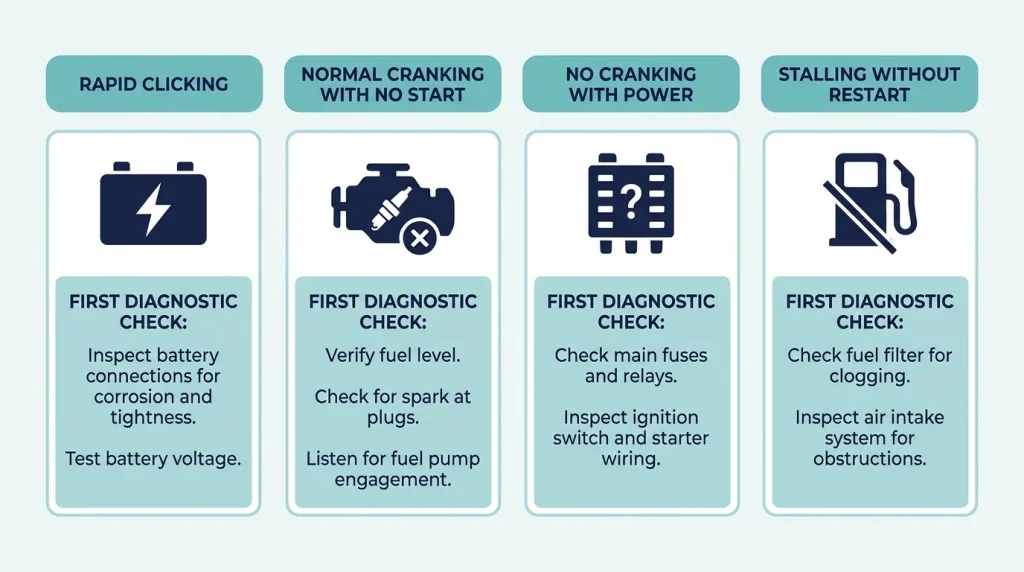
A bad sensor often causes the engine to crank without running, while a weak battery commonly causes slow cranking, clicking, or no starter movement.
This distinction helps narrow the problem, but it is not a complete diagnosis. Battery voltage, wiring, fuel delivery, and starter operation must still be considered.
The table compares common symptoms and the first area worth checking.
| Symptom | Possible Cause | Useful First Check |
|---|---|---|
| Rapid clicking | Weak battery or poor connection | Battery condition and terminals |
| Engine cranks normally but will not start | Fuel, ignition, timing, or sensor fault | Trouble codes and live engine data |
| No cranking with normal electrical power | Starter, relay, or start-permission fault | Starting circuit and safety inputs |
| Engine stalls and will not restart | Sensor, fuel, ignition, or electrical fault | Stored codes and sensor signals |
Start with the basic electrical system when the engine does not crank normally. When it cranks at normal speed, investigate fuel, ignition, and engine-management inputs.
Lights that still work do not guarantee that the battery can supply enough starting current. A proper battery and cable test may still be necessary.
How Do You Diagnose a Sensor That Stops a Car From Starting?
Diagnosing a sensor-related no-start begins with identifying the starting symptom, checking basic electrical conditions, and examining relevant engine data.
Replacing sensors based only on symptoms can waste money. A damaged connector or wiring harness may create the same fault as a defective sensor.
- Identify the starting condition. Determine whether the engine cranks normally, cranks slowly, or does not crank. This separates engine-operation faults from starter-permission problems.
- Check the battery and visible connections. Inspect accessible battery terminals for corrosion or looseness. Arrange a battery test if power delivery is uncertain.
- Look for dashboard warnings. Note the check engine light, security indicator, and any starting-related messages. A warning identifies a system to investigate, not necessarily a failed component.
- Scan for diagnostic trouble codes. Use a compatible OBD2 scanner to check engine fault codes. Vehicles with security or transmission faults may require a scanner that accesses additional control modules.
- Review live engine data. Check whether the scanner reports engine speed during cranking. Missing or implausible speed data can suggest a crankshaft signal problem, but wiring and scanner limitations must also be considered.
- Confirm the suspected fault. Compare sensor signals and electrical measurements with the vehicle manufacturer’s procedure. Test wiring, connectors, power supply, and grounding where applicable.
Can an OBD2 Scanner Find a Bad Sensor?
An OBD2 scanner can help identify a sensor-related fault, but a trouble code does not prove that the sensor itself needs replacement.
A code may identify a circuit problem, missing signal, or disagreement between sensor readings. The cause may be damaged wiring, a faulty connector, or incorrect mechanical timing.
Some faults also occur without storing a code. Reviewing live data and performing the correct electrical tests helps narrow the diagnosis.
Can You Test a Crankshaft Sensor With a Multimeter?
A crankshaft sensor can sometimes be checked with a multimeter, but the appropriate test depends on the sensor’s electrical design.
Inductive sensors and Hall-effect sensors operate differently. Applying an unsuitable resistance or voltage test can give misleading results or risk damage.
Delphi’s crankshaft sensor testing guide explains the sensor types and professional test equipment.
An oscilloscope, which displays electrical signals over time, can help a technician inspect the actual sensor waveform. Always follow the specific vehicle service information.
Why Does a Car Refuse to Start When the Engine Is Hot?
A car that starts cold but refuses to restart when hot may have a temperature-sensitive electrical fault. A crankshaft or camshaft sensor is one possible cause.
Heat can expose weaknesses in electronic components and electrical connections. The fault may disappear after cooling, making the vehicle seem normal during a later inspection.
Other possible causes include ignition components, the fuel pump, relays, and wiring connections. A heat-related no-start does not automatically identify the crankshaft sensor.
For additional background, see TotalEnergies’ guide to electrical faults that prevent starting.
What Should You Record During an Intermittent Failure?
Record the conditions under which the engine fails because intermittent electrical faults can be difficult to reproduce.
Useful details include:
- Whether the engine was cold or warm.
- Whether the starter turned at normal speed.
- Any warning lights or messages.
- Whether the engine stalled before the no-start.
- Whether the problem disappeared after cooling.
- Any fault codes recorded during the failure.
These observations can help a technician test the vehicle under the same conditions. The goal is to capture the fault rather than guess which component is responsible.
When Should You Replace a Sensor or Call a Mechanic?
Replace a sensor when testing confirms that the sensor itself is faulty. Symptoms or a stored trouble code alone may not provide enough evidence.
If the engine cranks without starting, confirm battery condition, sensor signals, fuel delivery, and ignition operation before buying parts.
A technician may need to inspect the wiring harness, connectors, related timing components, and ECU data. Some repairs also require calibration or a manufacturer-specific procedure.
When Is Professional Diagnosis the Safer Choice?
Professional diagnosis is appropriate when the vehicle stalls unexpectedly, repeatedly refuses to start, or requires advanced electrical testing.
Stop driving if the engine stalls unpredictably or shows signs of overheating. Arrange safe recovery rather than repeatedly attempting to restart an unsafe vehicle.
Once the fault has been confirmed, use a replacement component that matches the vehicle’s specifications. Verify the repair by checking normal starting operation and confirming that the fault does not return.
OBD2 Scanner
An OBD2 scanner can help you read engine trouble codes and, on compatible models, view live sensor data during diagnosis.
Frequently Asked Questions
Can a bad oxygen sensor stop a car from starting?
A faulty oxygen sensor usually does not directly prevent an engine from starting because normal startup does not depend on closed-loop exhaust oxygen feedback. The sensor primarily helps correct the air-fuel mixture after suitable operating conditions are reached. Severe related electrical faults may still affect other circuits.
Will a bad sensor always trigger the check engine light?
A bad sensor does not always turn on the check engine light because the ECU may not detect or record every failure. Intermittent faults can disappear before an indicator appears. Some vehicles also need specific operating conditions before a diagnostic fault is confirmed.
Can a loose sensor connector prevent a car from starting?
A loose sensor connector can prevent starting when it interrupts a signal the engine control system needs during startup. A crankshaft sensor connection is one example. Inspect the connector for damage, poor contact, moisture, or loose wiring before replacing the sensor.
Will disconnecting the battery fix a faulty crankshaft sensor?
Disconnecting the battery does not repair a physically defective crankshaft sensor or restore damaged wiring. Battery disconnection may clear certain stored information, depending on the vehicle. The underlying fault can remain and reappear when the engine is started or monitored again.
Can a knock sensor cause a complete no-start?
A failed knock sensor does not normally cause a complete no-start because its main role is detecting abnormal combustion. The ECU generally uses its signal to adjust ignition behavior during engine operation. Separate electrical or engine-management faults may produce similar symptoms.
Can a scan tool confirm which sensor needs replacing?
A scan tool can narrow down a starting problem, but it cannot always confirm which physical component needs replacement. Trouble codes describe detected faults, while live data shows operating information. Electrical testing and vehicle-specific diagnostic procedures may still be necessary.
Conclusion
The crankshaft position sensor is a leading possibility when asking which sensor can stop a car from starting, especially if the engine cranks normally. Camshaft, transmission range, clutch safety, and immobilizer faults can also prevent startup. Check the cranking symptom and verify sensor signals before replacing parts.

Alex Carter is an automotive content writer at VastAutoParts, focusing on car parts, vehicle troubleshooting, automotive tools, product research, and practical car care guides.