
How to Test if a Starter Solenoid Is Working: Steps
Quick Answer
To test if a starter solenoid is working, check the battery first, then measure the solenoid’s start signal and motor-side output with a multimeter. A good solenoid receives a start command and connects battery power to the starter motor. A click alone does not prove its internal contacts work.
- Confirm the battery is charged and its connections are clean.
- Check the small start terminal while a helper requests a start.
- Measure the large input and motor-side terminals.
- Use a voltage-drop test to check the contacts under load.
Your engine will not crank, and you suspect the starter solenoid. The right electrical checks can show whether the solenoid is faulty or another part is stopping the starter. This guide explains the checks for conventional starter systems, what the readings mean, and when to stop for safety.
In this article
- What Does a Starter Solenoid Do?
- What Symptoms Suggest a Faulty Starter Solenoid?
- How Should You Prepare for Safe Testing?
- How to Test if a Starter Solenoid Is Working
- What Do the Multimeter Results Mean?
- How Do You Test Voltage Drop Across the Solenoid?
- Can You Check a Solenoid Without a Multimeter?
- How Can You Tell the Solenoid From Other Faults?
- What Testing Mistakes Should You Avoid?
- When Should You Bench-Test or Replace the Solenoid?
- What Should You Do After the Test?
- Frequently Asked Questions
- Conclusion
What Does a Starter Solenoid Do?
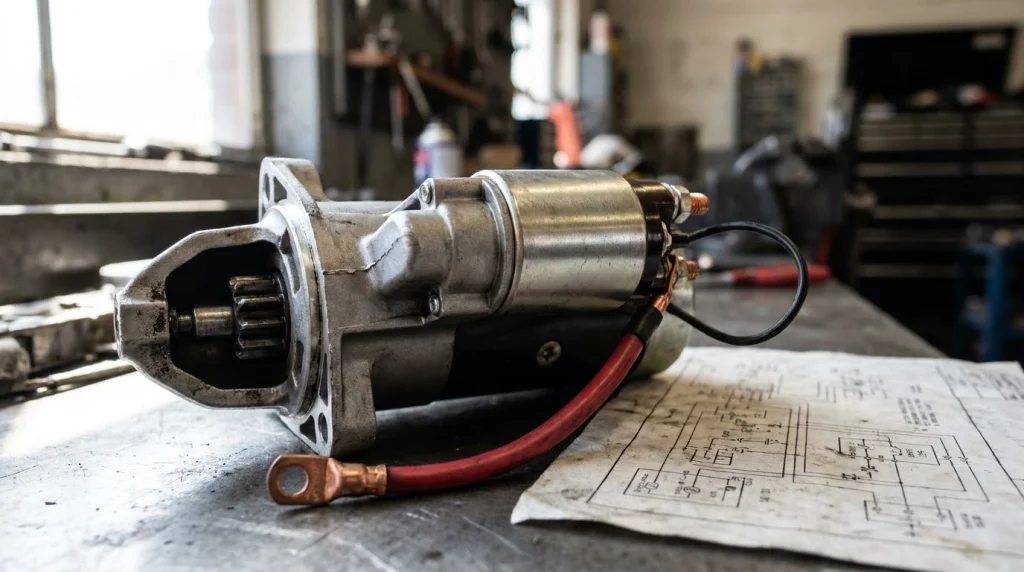
A starter solenoid is an electric switch that connects the battery to the starter motor when you request a start. On many cars, its moving plunger also pushes the starter gear into engagement with the engine.
The main battery terminal receives power through a thick cable. A smaller control terminal receives a start command from the ignition circuit, often through a starter relay. The solenoid then closes heavy internal contacts to feed the starter motor.
Many vehicles use a solenoid mounted on the starter. Other designs have a remote switching device or added control electronics. Use the vehicle’s wiring diagram to identify the terminals before touching a meter probe to them.
What Symptoms Suggest a Faulty Starter Solenoid?
A bad solenoid can cause silence, clicking, or a starter that fails to turn the engine. None of these sounds proves the solenoid is at fault without testing.
The table shows what common symptoms suggest and what to inspect first.
| Symptom | Possible cause | First check |
|---|---|---|
| Rapid clicking | Weak battery or poor connections | Battery condition and cable clamps |
| One click, no crank | Poor solenoid contacts or starter fault | Solenoid output under start command |
| No click, no crank | Missing signal or failed solenoid coil | Voltage at the small control terminal |
| Slow cranking | Battery, cable, engine, or starter resistance | Battery load and cable voltage drop |
Start with battery and connection checks, even if the solenoid clicks. A noise can tell you that something moved, not that enough current reached the starter.
How Should You Prepare for Safe Testing?
Safe solenoid testing begins with securing the vehicle and locating the correct terminals. The starter circuit can carry enough current to cause severe burns, sparks, or unexpected cranking.
- Park on level ground, set the parking brake, and select Park or neutral.
- Keep people clear of the vehicle’s path and all moving engine parts.
- Wear eye protection and use a digital multimeter with insulated probes.
- Find the vehicle-specific starter wiring diagram and terminal labels.
- Arrange for a helper to operate the start control briefly.
- Keep meter leads away from exhaust heat, belts, and rotating fans.
- Use proper vehicle supports if access requires work underneath.
Switch off the ignition before moving a probe to another terminal. Disconnect the negative battery cable before cleaning connections, removing wires, or taking off the starter. Live voltage tests require the battery connected, so only perform them where you can reach terminals safely.
DENSO advises limiting cranking attempts to 10 seconds and waiting at least 60 seconds before another attempt.
Warning
Bridging starter terminals can cause sparks and sudden vehicle movement. Do not bypass the solenoid with a screwdriver or loose jumper wire.
How to Test if a Starter Solenoid Is Working
The most useful test checks whether the solenoid receives a start signal and passes power to the starter motor. Work through these checks in order instead of replacing parts based on sound.
The steps below assume a conventional battery-powered starter with accessible terminals. Check your service manual before testing a start-stop, hybrid, or electronically controlled system.
Step 1
Check battery condition
Measure voltage across the battery posts with the engine off. Charge and load-test a weak battery before judging the solenoid.
Step 2
Identify the input and control terminals
Locate the thick battery cable and the smaller start-control connection. Confirm their functions from the vehicle diagram, not their position alone.
Step 3
Check power at the battery input
Set the meter to DC volts. Carefully compare voltage at the large input terminal and a verified ground with voltage at the battery.
Step 4
Measure the start signal
Measure from the small control terminal to the specified ground while your helper requests a start. Compare the reading with the service manual.
Step 5
Check the motor-side output
If accessible, measure the output that feeds the starter motor while a start is requested. Compare it with the input voltage at the same moment.
Step 6
Confirm the result under load
If the motor turns, use a voltage-drop test to check power loss across the contacts. Investigate cables and grounds before condemning the solenoid.
For a conventional charged battery, an open-circuit reading near 12.6 volts is a useful starting reference. DENSO advises checking the start terminal against the vehicle’s specified minimum, rather than trusting a universal reading. See its starter troubleshooting procedure for the testing sequence.
What Do the Multimeter Results Mean?
Multimeter readings help separate a missing command from a solenoid that cannot pass power. Compare readings during the same start request because battery voltage can change under load.
The table connects each reading pattern to a useful next test.
| Finding | What it suggests | Next step |
|---|---|---|
| No battery input | Power is not reaching the solenoid | Inspect the positive cable and connections |
| No start signal | Fault may be upstream | Test relay, switches, fuses, and wiring |
| Good signal, no engagement | Solenoid coil, ground, or plunger issue | Confirm ground path and assembly test |
| Good signal, poor output | Internal contacts may be worn | Check contact voltage drop under load |
| Good motor output, no crank | Starter motor or mechanical fault | Test starter current and engine movement |
One voltage reading is not proof of a good solenoid. A corroded connection may show battery voltage with almost no current flowing, then fail during cranking.
How Do You Test Voltage Drop Across the Solenoid?
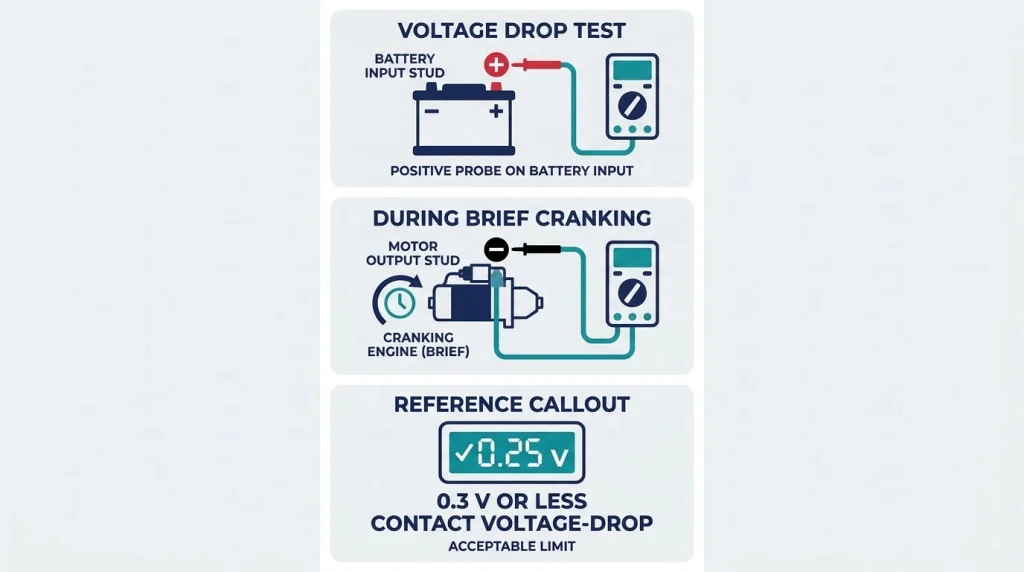
A voltage-drop test measures power lost through the solenoid’s closed contacts while they carry starter current. It is more useful than a simple continuity check when diagnosing high resistance.
On a starter that is cranking, place the meter’s positive probe on the solenoid battery-input stud. Put the negative probe on the motor-output stud. Have a helper crank briefly, then compare the displayed loss with the vehicle specification.
DENSO describes a contact voltage drop of 0.3 volts or less in its starter electrical testing guidance. Treat that as a reference for the described test, not a limit for every vehicle.
If the reading is too high, check that the probes contact the correct metal terminals. Burned or worn solenoid contacts may create resistance. If the starter does not draw current, a high reading across open contacts does not measure their loaded resistance.
Can You Check a Solenoid Without a Multimeter?
You can gather clues without a multimeter, but sound alone cannot confirm a healthy solenoid. A click suggests movement inside the switching mechanism, while silence leaves several possible causes.
Look for loose battery clamps, damaged cables, and corrosion with the ignition off. A properly used automotive test light can indicate a start command, but it cannot show how much voltage is lost during cranking.
A screwdriver bridge test can damage electrical parts or move the vehicle unexpectedly. If you lack safe access or suitable equipment, request a technician’s starting-system test instead.
How Can You Tell the Solenoid From Other Faults?
A solenoid fault becomes more likely only after the battery, cables, grounds, and start command pass their checks. Similar symptoms appear in several different starting-system failures.
- Battery: Weak charge or poor load performance can make the solenoid chatter.
- Battery cables: Corroded terminals and damaged ground straps can restrict current.
- Starter relay: A failed relay may prevent the start signal from reaching the solenoid.
- Safety switches: Park, neutral, or clutch switches may block a start request.
- Starter motor: The solenoid may supply power while the motor fails to turn.
- Engine or drive gear: Mechanical binding can prevent normal cranking.
Do not confuse a no-crank condition with an engine that cranks normally but will not fire. If the engine turns at normal speed, the solenoid has already completed the basic cranking task.
What Testing Mistakes Should You Avoid?
The most common testing mistake is blaming the solenoid before measuring battery and cable performance. A few simple checks prevent false results and unnecessary replacement.
- Do not assume one click means the internal contacts are healthy.
- Do not measure resistance on a circuit that is still powered.
- Do not confuse the battery input stud with the motor output stud.
- Do not judge a high-current path from an unloaded voltage reading alone.
- Do not use a body panel as ground without confirming its ground path.
- Do not keep cranking repeatedly while the starter struggles.
If you must test beneath the car, never rely on a jack alone. Stop if the terminals are hidden behind moving components or unsafe to reach.
When Should You Bench-Test or Replace the Solenoid?
Bench testing is appropriate when in-vehicle measurements point toward a faulty starter assembly but cannot confirm the internal failure. A secured test bench can evaluate engagement and motor performance with proper equipment.
Removed starter assemblies can move with force when energized. Follow the service manual or use a repair shop’s bench tester instead of improvising battery cable connections.
Some starter solenoids can be replaced separately, while others require starter assembly replacement. AutoZone’s solenoid replacement overview explains why vehicle design affects the repair.
Record your battery voltage, start signal, motor output, and voltage-drop findings before ordering parts. Those results help a technician confirm the fault and identify any related wiring issue.
What Should You Do After the Test?

After testing, repair the part or connection supported by your readings rather than replacing the entire starter immediately. Clean and secure faulty connections only after disconnecting the battery.
If the start signal is absent, trace the relay and switch circuit. If the solenoid receives a proper command but cannot transfer power, arrange an assembly test or replacement. Retest the starting system after repairs to confirm consistent cranking.
Digital Multimeter
A digital multimeter helps check the starter solenoid’s control voltage, battery input, and voltage loss.
Frequently Asked Questions
Can a starter solenoid fail only when hot?
A starter solenoid may work when cold and fail after heat affects worn contacts or an internal connection. Heat can also worsen cable resistance and starter faults. Repeat the same voltage checks during the failure, if safe, rather than deciding from temperature alone.
Will a bad starter solenoid cause a trouble code?
A faulty starter solenoid does not always produce a diagnostic trouble code because many vehicles cannot directly monitor its internal contacts. Some electronically controlled starting systems may record related circuit faults. Electrical measurements are still needed to identify the failed part.
Can a car keep running with a bad solenoid?
A conventional car can keep running after its engine starts even if its starter solenoid fails afterward. The solenoid is mainly involved in cranking, not maintaining combustion. However, a starter that remains engaged presents a different risk and needs immediate attention.
Is the starter relay the same as the solenoid?
A starter relay is not always the same component as the starter solenoid. The relay normally switches the control signal, while the solenoid handles high starter current and often moves the drive gear. Some systems combine or relocate these functions, so identify the circuit first.
Does a working solenoid guarantee the engine will start?
A functioning starter solenoid does not guarantee that the engine will start because cranking is only one part of the starting process. The engine still needs suitable fuel delivery, ignition, compression, and control inputs. Diagnose those systems if cranking sounds normal.
Should hybrid cars use the same solenoid test?
Hybrid vehicles should not be tested with a generic starter-solenoid procedure unless the manufacturer confirms a conventional starter circuit. Some use different starting hardware and high-voltage components. Consult the vehicle’s service instructions and leave high-voltage work to trained technicians, especially near high-voltage cables.
Conclusion
To test if a starter solenoid is working, verify battery power, confirm the start signal, and check whether current reaches the starter motor. A click is only a clue. If the signal is correct but output fails, have the solenoid or starter assembly tested before replacement.

Alex Carter is an automotive content writer at VastAutoParts, focusing on car parts, vehicle troubleshooting, automotive tools, product research, and practical car care guides.