
Car Starter Electrical Problems: Causes, Tests and Fixes
Quick Answer
Car starter electrical problems happen when the starter motor cannot receive, switch, or return enough electrical power to crank the engine. Common causes include a weak battery, corroded cables, poor engine grounds, a faulty relay, and damaged solenoid contacts. Check the battery and connections before assuming the starter motor needs replacement.
- Rapid clicks often suggest low voltage or a poor connection.
- One click can point to the solenoid, motor, or high-current cables.
- Silence may indicate a missing start command or control-circuit fault.
- Electrical tests can separate a failed starter from its wiring.
Your car refuses to crank, yet the dashboard may still light up. If you suspect car starter electrical problems, the goal is to find where power stops flowing. These checks help you narrow the fault before buying parts or calling a mechanic.
In this article
- What starter electrical problems mean
- Symptoms of starter circuit trouble
- Common electrical causes
- Safe troubleshooting steps
- Testing voltage and ground
- Battery versus starter diagnosis
- Intermittent starting faults
- Repairs for starter circuit faults
- When to seek professional help
- Preventing electrical starting issues
- Frequently asked questions
- Conclusion
What Are Car Starter Electrical Problems?
Starter electrical problems are faults in the circuit that powers and controls the starter motor. A working starter needs sufficient battery power, a start command, and a reliable path back to the battery.
When you turn the key or press Start, a control circuit activates the starter relay or solenoid. The solenoid closes heavy contacts, and the motor turns the engine through a small drive gear.
Think of the system as three connected paths:
- Power path: Battery positive terminal, large cables, solenoid contacts, and starter motor.
- Control path: Start button or ignition switch, safety controls, relay, and solenoid trigger.
- Ground path: Starter housing, engine, ground straps, and battery negative terminal.
A fault anywhere along these paths can stop cranking. A normal-sounding engine that turns but will not fire usually needs a different diagnosis, such as fuel or ignition testing.
Which Symptoms Suggest Starter Circuit Trouble?

Starter circuit trouble often produces clicking, silence, slow cranking, or a sudden loss of electrical power. The sound is a clue, not proof that a specific part has failed.
The table connects common symptoms with likely electrical causes and sensible first checks.
| What you notice | Possible fault | First check |
|---|---|---|
| Fast repeated clicks | Weak battery or high-resistance connection | Battery charge and terminal condition |
| Single click, no crank | Solenoid contacts, motor, or heavy cables | Battery load and starter connections |
| No click or crank | Fuse, relay, start switch, or safety interlock | Gear selection and relevant fuse |
| Slow engine cranking | Low charge, cable loss, or motor wear | Battery test and cable inspection |
| Lights disappear during Start | Severe voltage drop or loose main connection | Battery clamps and main grounds |
Rapid clicking points toward power delivery, while silence directs attention to the control path. Neither symptom should trigger a starter replacement without testing.
Why do the dashboard lights work but the starter does not?
Dashboard lights can work because they need less power than a starter motor. A battery may run accessories yet fail under the much heavier cranking load.
A poor cable connection can create the same effect. Firestone’s starter symptom guide explains why lit dashboard lamps do not confirm a healthy starter circuit.
What if the starter whirs or makes a grinding sound?
Whirring or grinding can indicate a drive engagement problem rather than an electrical supply fault. Damaged pinion teeth or flywheel teeth can prevent proper engine rotation.
Stop repeated attempts if grinding continues. An inspection is needed before a damaged drive gear harms other parts.
What Causes Electrical Problems in a Car Starter?
Electrical starting failures come from insufficient power, unwanted resistance, failed switching, or an internal motor fault. The correct repair depends on which part of the circuit is affected.
Weak or discharged battery
A weak battery may energize a relay but fail to turn the starter motor. Low battery charge can cause rapid clicking, slow cranking, or silence.
Battery condition matters as much as the voltage measured with the engine off. A battery load test checks whether it can supply power during a demanding start.
Corroded terminals and damaged battery cables
Corrosion and loose terminals increase resistance between the battery and starter. The connection may look attached but still lose substantial voltage when current flows.
Inspect the battery posts, cable clamps, and visible cable insulation. Look for swelling, green deposits, broken strands, or a clamp that moves by hand.
Loose engine grounds and broken ground straps
A weak ground connection blocks the return path that the starter needs. Engine movement, corrosion, and loose attachment bolts can make this fault intermittent.
Inspect the negative cable and engine-to-body ground straps where visible. Rust beneath an attachment point can interfere with electrical contact even when the strap looks intact.
Faulty starter relay or blown control fuse
A failed starter relay may not pass the start signal to the solenoid. A blown fuse can interrupt the control circuit before the starter receives a command.
Find the correct fuse and relay using your vehicle’s manual. Replace a blown fuse only with the specified type and rating, and investigate repeated failures.
Worn solenoid contacts or an internal starter fault
Burned solenoid contacts may click without sending enough current to the motor. Worn brushes, damaged windings, or internal connections can also prevent rotation.
These faults require testing after the battery and external wiring pass inspection. Replacing a starter without those checks can leave the original problem untouched.
Ignition switch, safety switch, or electronic start permission
The starter may be healthy but never receive permission to operate. An ignition switch, clutch switch, park-neutral switch, brake input, or immobilizer can interrupt the command.
A key warning or unusual gear indicator can help identify this branch. On newer vehicles, a technician may need a scan tool to confirm why the start request was blocked.
How Do You Troubleshoot Starter Electrical Problems Safely?
Starter troubleshooting should move from simple checks to tests that require tools and training. Begin outside the engine bay before attempting any electrical measurement.
Park on level ground, apply the parking brake, and select Park or Neutral as required. Keep clothing and tools away from moving parts when anyone attempts to crank the engine.
Warning
Starter cables carry high current and can cause burns or accidental cranking. Never bridge starter terminals or bypass safety switches to test the circuit.
These steps help identify which part of the system needs closer attention.
Step 1
Identify the exact no-start symptom
Listen for clicks, slow rotation, silence, or normal cranking. Note whether the lights dim during the attempt.
Step 2
Check battery condition
Look for damage, swelling, and corrosion. Arrange a proper charge and load test if the battery seems weak.
Step 3
Inspect visible cables and grounds
Look for loose clamps, damaged insulation, or disconnected straps. Do not touch exposed conductors or damaged battery parts.
Step 4
Check start permissions
Confirm the selected gear and required pedal position. Check for security or key-recognition messages.
Step 5
Inspect the correct fuse and relay
Use the vehicle manual to find starter-related components. Never bridge relay terminals or install a higher-rated fuse.
Step 6
Request circuit tests before replacement
If basic checks do not help, request battery load, voltage-drop, and starter-command testing. The results should identify the failed circuit.
If the battery case is swollen, leaking, or unusually hot, stop and seek roadside assistance. AAA’s no-start guidance explains why battery damage and electrical symptoms need careful handling.
How Are Starter Voltage and Ground Problems Tested?
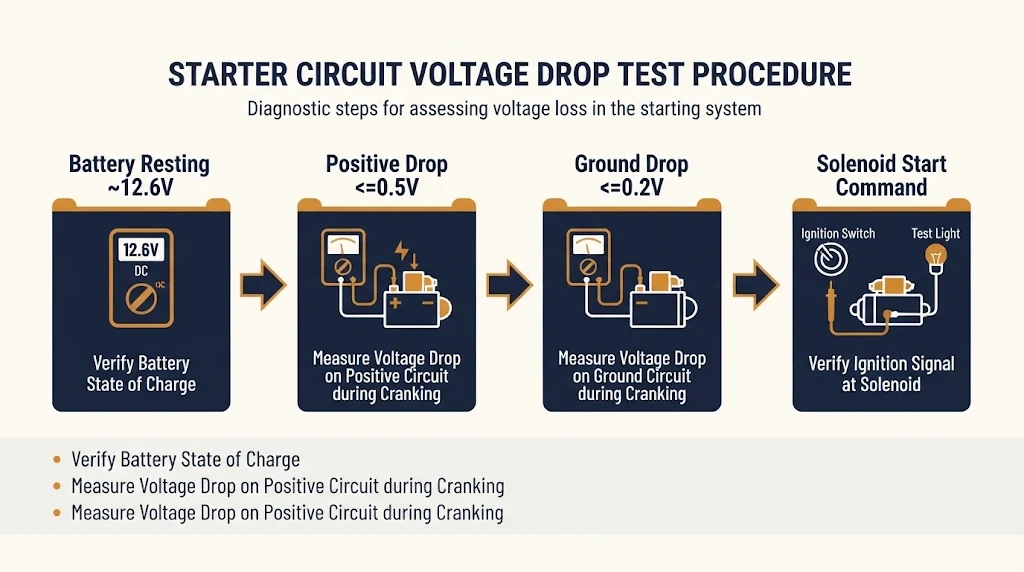
A technician separates power loss from starter failure by measuring the circuit during a starting attempt. A digital multimeter can help, but testing live starter connections carries short-circuit and movement risks.
What does battery voltage tell you?
Battery voltage offers a starting clue, but resting voltage alone cannot prove the battery is healthy. A load test reveals whether voltage collapses when the starter draws current.
According to DENSO, a fully charged automotive battery should measure about 12.6 volts. The battery must be charged and tested before further starter diagnosis.
What is a starter voltage-drop test?
A voltage-drop test measures how much electrical pressure is lost along a cable or connection during cranking. High loss suggests resistance in the tested path.
DENSO’s starter troubleshooting guidance uses 0.5 volts or less for the positive path and 0.2 volts or less for the ground path. Those figures are reference values; the vehicle manufacturer’s procedure takes priority.
Unlike a simple continuity check, a voltage-drop test measures the circuit while it carries a load. This helps reveal corroded connections that appear fine when the system is idle.
How do technicians test the starter command?
Technicians check whether the solenoid trigger receives the correct start signal. A missing signal redirects diagnosis toward switches, relays, wiring, or electronic start permission.
A valid command with good power and ground raises suspicion of the solenoid or starter assembly. Current-draw testing and manufacturer procedures help confirm the failure.
How Can You Separate Battery Trouble From Starter Failure?
Battery trouble and starter failure can look similar, so testing must decide between them. Clicking, dashboard lights, or one successful jump-start cannot confirm a failed part.
A battery that fails a load test needs attention before you judge the starter. If the battery passes and the starter receives proper voltage and ground, internal starter failure becomes more likely.
- Starts after a correct jump: Investigate battery charge, battery condition, cable connections, and the charging system.
- Still clicks with a healthy battery: Test the cables, grounds, solenoid, and starter motor.
- Cranks normally but will not run: Look beyond the starting circuit toward engine management and fuel or ignition problems.
- Does nothing with a healthy battery: Check the start command, safety inputs, fuse, and relay.
The alternator usually does not power the starter directly while the engine is stopped. A charging-system failure can still leave the battery too weak for the next start.
Why Does a Starter Work Sometimes but Not Others?
Intermittent starting faults often involve an unstable connection, heat-sensitive component, or inconsistent start command. Replacing parts without capturing the failure can make diagnosis harder.
A loose terminal may contact well in one position and poorly after vibration. A worn solenoid or starter motor may also stop working when hot, then operate after cooling.
Record whether the fault appears after a long drive, after rain, or after the engine has been off. Tell the technician exactly what sounds and lights appear during the failure.
If electrical tests pass while the car starts normally, request testing when the symptom returns. A repeatable condition is more useful than guessing from a single successful start.
Which Repairs Fix Starter Electrical Problems?
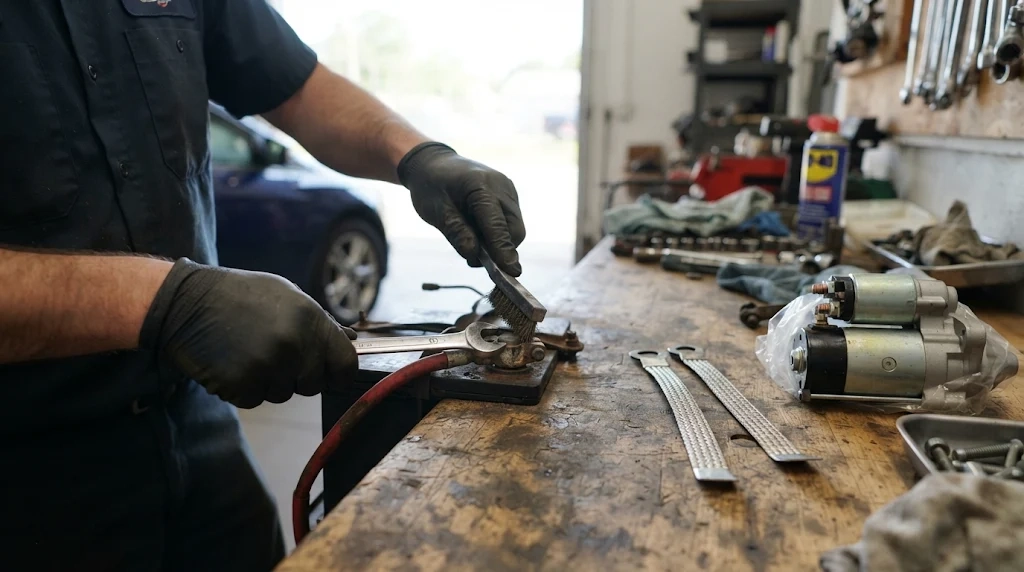
The right repair targets the failed electrical path rather than the sound the car makes. Correcting a weak connection may restore starting without replacing the motor.
- Discharged battery: Charge and load-test it, then check the charging system or unexpected battery drain.
- Corroded or loose terminals: Clean and secure connections using approved battery service procedures.
- Damaged cables or ground straps: Replace failed parts and restore clean, secure attachment points.
- Failed relay or fuse: Confirm the fault and replace with the correct specification.
- Faulty safety input or start command: Diagnose the switch, wiring, or control module before replacement.
- Internal starter or solenoid failure: Repair or replace the verified faulty assembly using vehicle-specific parts.
A new starter cannot compensate for a corroded ground strap. Likewise, a new battery cannot repair a missing signal from the ignition circuit.
Ask the repair shop to explain the failed test and the repair that addresses it. A clear diagnosis can prevent repeat visits and unnecessary parts purchases.
When Should a Mechanic Handle the Starter Problem?
Professional help is appropriate when diagnosis requires live starter-circuit testing, access underneath the vehicle, or electronic control checks. High-current wiring is not a safe place for trial and error.
Stop cranking if you notice smoke, burning insulation, severe grinding, or a starter that continues operating after the engine runs. Arrange a tow rather than continuing to test.
Ask the shop to check battery health, cable voltage loss, engine grounds, solenoid command, and starter operation. Request the results before authorizing a replacement.
How Can You Reduce Future Starter Electrical Issues?
Starter electrical problems are less likely when the battery and cable connections remain clean and secure. Basic checks also make developing faults easier to spot.
- Inspect visible battery terminals during routine under-hood checks.
- Address a weak battery or charging warning before another no-start event.
- Repair oil leaks or damaged wiring near the starter.
- Have loose grounds or repeated fuse failures diagnosed promptly.
- Avoid repeated long cranking attempts when the engine refuses to start.
Prevention does not eliminate normal starter wear. It does help keep external electrical faults from being mistaken for a failed motor.
Digital Multimeter
A digital multimeter helps check battery voltage and supports electrical diagnosis when used with the vehicle’s service procedure.
Frequently Asked Questions
Can rain make a car starter stop working?
Rain can expose a damaged connector or wiring seal and cause intermittent starting trouble. Moisture can increase corrosion or disrupt an already weak connection. If the fault appears mainly after wet weather, have the affected wiring inspected rather than assuming the motor has failed.
Can a new battery still leave the starter powerless?
A new battery can leave the starter powerless when cables, grounds, or control wiring are faulty. Battery replacement does not repair a loose clamp or failed relay. Verify the battery was charged and installed correctly, then test the circuit under load.
Will a starter problem always trigger a dashboard warning?
A starter circuit fault does not always trigger a dashboard warning light or diagnostic code. Some failures involve only a cable or motor connection. An absence of warnings should not replace battery, voltage-drop, and command testing when the engine refuses to crank.
Can the starter keep running after the engine starts?
A starter can continue operating if a solenoid contact sticks or a control fault keeps it energized. Continued engagement can damage the starter drive or engine ring gear. Shut the engine off safely and arrange professional diagnosis before attempting another start.
Could an engine repair cause a new starter fault?
Engine repair can lead to starting trouble if a ground strap or starter wire was left loose. A disturbed connector may also fail to carry the required current. Ask the repair shop to inspect connections touched during the work before replacing the starter.
Can an alternator fault look like a bad starter?
An alternator fault can mimic starter trouble by leaving the battery undercharged after driving. The starter may then click or crank slowly even if its motor works. Test battery condition and charging output before blaming the starter for repeated no-start events.
Conclusion
Car starter electrical problems usually require checking power delivery, ground connections, and start commands before replacing the starter. If the battery and visible connections check out but the engine still will not crank, request a professional voltage-drop and starter-command test.

Alex Carter is an automotive content writer at VastAutoParts, focusing on car parts, vehicle troubleshooting, automotive tools, product research, and practical car care guides.