
Starter or Starter Solenoid? Symptoms and Tests Explained
Quick Answer
To know if it is your starter or starter solenoid, first check the battery and cables rather than judging by sound alone. A single click without cranking can indicate either part, while silence may indicate a missing control signal. Battery, cable, and voltage tests separate these faults more reliably than a click.
- Rapid clicking often means low battery power or a poor connection.
- One click without cranking leaves both the solenoid and motor suspect.
- Grinding or free spinning suggests a starter drive or ring gear issue.
- Testing power at the starter helps identify which part is failing.
Your car will not crank, and you want to avoid buying the wrong part. The starter motor and its solenoid work together, so their symptoms often overlap. This guide explains what each does, what the sounds mean, and how to narrow down the fault safely.
In this article
- What the starter and solenoid do
- Signs that distinguish each fault
- What clicking and other sounds mean
- First checks before buying parts
- How electrical tests isolate the problem
- Other causes of a no-crank condition
- When to replace the solenoid or starter
- When to stop troubleshooting
- Frequently asked questions
- Conclusion
What Do the Starter and Starter Solenoid Do?
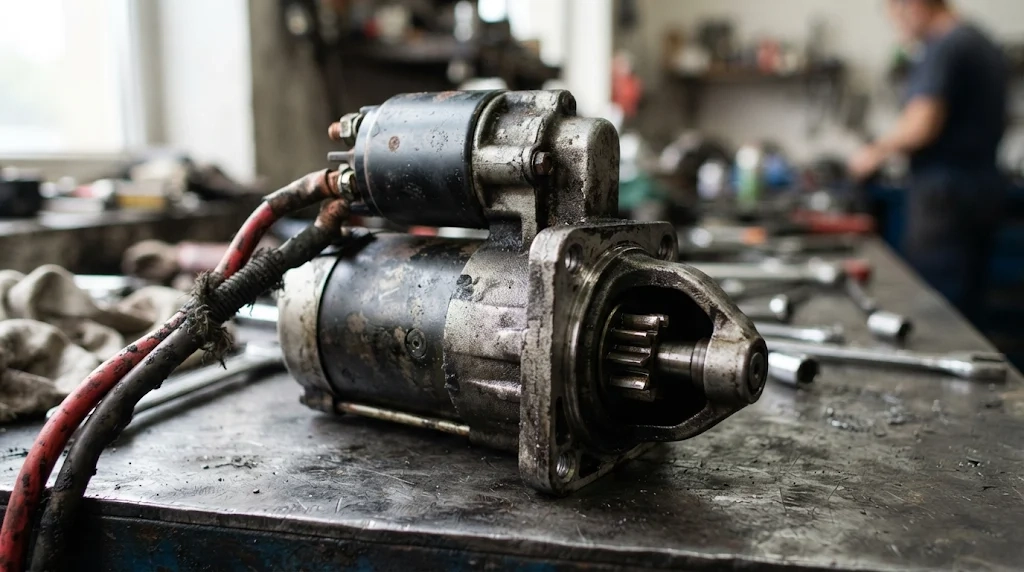
The starter motor turns the engine, while the starter solenoid switches power to the motor and usually moves its drive gear. Both are needed for normal engine cranking.
What does the starter motor do?
The starter motor is a powerful electric motor that rotates the engine until it can run on its own. It uses a small pinion gear to turn the engine’s flywheel or flexplate ring gear.
If the motor cannot spin with proper power supplied, the engine may remain still. Worn internal parts, mechanical damage, or excessive resistance can prevent normal cranking.
What does the starter solenoid do?
The starter solenoid is an electrically operated switch that connects battery power to the motor during a start request. On many vehicles, it also pushes the starter gear into engagement.
A solenoid can click even when its internal contacts fail to deliver enough power. Some vehicles have a separate remote solenoid, while many mount it directly on the starter assembly.
Is a starter relay the same as a solenoid?
A starter relay and a starter solenoid are different parts, although both use electrical control to switch a circuit. A relay commonly controls the signal sent to the solenoid.
The solenoid handles the starter’s heavy electrical connection and, on common designs, gear engagement. A failed relay can prevent the solenoid from operating, which may sound like a starter failure.
Starter vs. Starter Solenoid: Which Signs Matter?
Symptoms suggest where to look, but they rarely prove which component is defective. Comparing the sound with battery condition and electrical tests gives a stronger answer.
The table shows what each symptom suggests and what to check before replacing parts.
| Starting symptom | Possible explanation | First useful check |
|---|---|---|
| Single solid click | Solenoid contacts, starter motor, or power cable | Check battery and voltage reaching the starter |
| Repeated fast clicks | Weak battery or high-resistance connection | Test battery under load and inspect terminals |
| No click and no crank | Missing start signal, failed solenoid, or power fault | Check relay, interlocks, and solenoid control signal |
| Slow engine cranking | Battery, cables, starter motor, or engine drag | Battery load test and cable voltage-drop test |
| Whirring without cranking | Starter drive not engaging the engine | Inspect drive and ring gear |
| Grinding during start | Gear engagement or damaged teeth | Stop attempts and inspect mechanical parts |
The most useful distinction is not simply whether you hear a click. It is whether the control signal, battery supply, and motor output agree.
Why Does the Car Click but Not Crank?
Clicking means a part of the starting circuit is trying to work, but the engine is not turning. The number and character of clicks help narrow the possibilities.
What does one loud click mean?
One solid click often means the solenoid has moved, but the starter motor has not turned. The solenoid contacts may be worn, the motor may be faulty, or the cables may restrict current.
A click does not prove the solenoid is healthy. Its moving plunger can still produce a sound even if the high-current contact inside fails.
What do repeated fast clicks mean?
Rapid clicking usually suggests that available voltage drops too far when the start circuit draws power. A weak battery or poor battery connection is a common reason.
The solenoid may pull in, lose voltage, release, and then try again. Check battery condition and cable connections before condemning the starter assembly.
What if there is no click at all?
Silence can mean the solenoid never received a start signal, or it could mean the solenoid itself cannot respond. An open fuse, faulty relay, or safety interlock can interrupt the command.
A no-click condition is not enough to blame the starter motor. It is especially important to inspect the low-current control side first.
What if you hear grinding or whirring?
Grinding or free spinning suggests a problem with starter gear engagement rather than a simple failure to receive power. Worn gear teeth or a damaged starter drive may be involved.
Repeated attempts can make mechanical damage worse. A technician may need to inspect the starter pinion and engine ring gear.
How Do You Tell if the Starter or Solenoid Is Bad?
Start with checks that rule out battery and connection problems before testing the starter assembly. These steps reduce the chance of replacing a working component.
- Confirm the problem is no-crank. Listen for whether the engine actually turns. If it cranks normally but does not fire, the issue likely lies elsewhere.
- Observe the electrical signs. Check whether the dash lights dim sharply or disappear during a start request. Record whether you hear silence, one click, rapid clicks, or grinding.
- Inspect the battery. Look for loose clamps, corrosion, damaged wiring, or a discharged battery. Arrange a battery load test if its condition is uncertain.
- Check the simple controls. Make sure an automatic transmission is fully in Park. If the owner’s manual allows, try starting in Neutral while holding the brake.
- Test the starting circuit. If battery and connections pass, use the vehicle wiring diagram to check the starter control signal and power path. Have a technician perform live tests if access is unsafe.
Write down the exact symptom and whether it happens every time. Intermittent faults are easier to diagnose when the conditions are clear.
Warning
Starter terminals carry high current and can cause sparks, burns, or unexpected vehicle movement. Do not bridge terminals or crawl under an unsupported vehicle.
Why should you test the battery first?
A weak battery can imitate both a bad starter motor and a failed solenoid. Lights may still work because they need much less power than engine cranking.
Clean terminals and a battery that passes a proper load test make later results more meaningful. A voltage reading alone cannot show whether a battery can supply adequate starting current.
For a systematic sequence, see DENSO’s starter troubleshooting guide, which begins with battery and connection checks.
Can a Multimeter Separate a Bad Solenoid From a Starter?
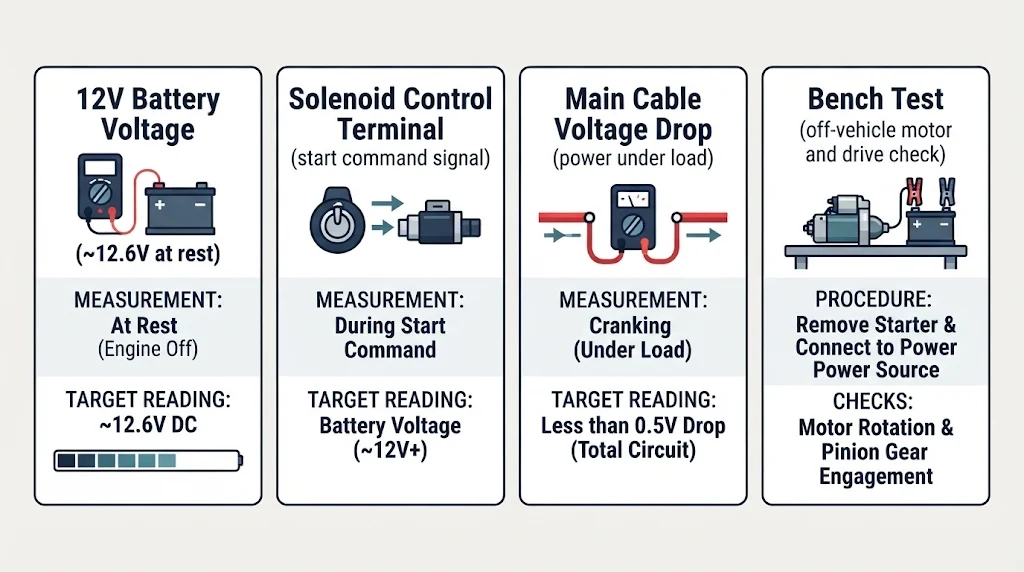
A multimeter can help isolate a missing command, poor battery supply, or motor-side failure. It cannot always distinguish internal solenoid damage from motor failure without further testing.
What does a battery voltage reading tell you?
A fully charged conventional 12-volt battery is around 12.6 volts at rest, according to DENSO’s starter system diagnosis guidance. The exact reading varies with battery condition and testing circumstances.
Low resting voltage suggests the battery needs attention before starter testing. Even a normal resting reading does not replace a load test.
What is the starter solenoid control terminal test?
The control terminal is the smaller connection that receives the start command. During a valid start request, a technician checks whether the specified voltage reaches that terminal.
If the signal is absent, the trouble may be upstream in the switch, relay, safety interlock, or wiring. If the correct signal arrives but the solenoid does not act, the solenoid becomes more suspect.
The correct test point and expected reading vary by vehicle. Use the manufacturer’s wiring diagram rather than assuming every starter has the same terminals.
What does the main power cable test reveal?
The main cable should deliver adequate battery power to the starter while cranking is requested. Corroded connections can show voltage at rest yet lose too much under load.
A voltage-drop test checks how much voltage the cables and connections lose while current flows. It can reveal resistance that a simple visual inspection misses.
If power reaches the motor correctly but it still cannot turn, the motor or an internal mechanical fault becomes more likely. A technician can then test the starter assembly directly.
Can a bench test confirm the failed part?
A bench test can check starter operation after the unit is removed from the vehicle. It helps show whether the motor spins and whether the drive mechanism engages.
A passing bench test does not prove the vehicle’s wiring is healthy. A failing result may identify the assembly as faulty, but solenoid-only repair depends on the design.
What Else Can Look Like a Bad Starter or Solenoid?
Several electrical and mechanical faults cause the same no-crank symptoms. Checking them matters because replacing the starter will not fix a missing start command.
- Bad ground strap: A loose or corroded return path can prevent proper starter current flow.
- Starter relay or fuse: A failed control component can keep the solenoid from receiving its command.
- Park or Neutral switch: An automatic vehicle may block cranking if it does not recognize an allowed gear position.
- Clutch safety switch: A manual vehicle may require the clutch pedal to be fully pressed before starting.
- Ignition or start switch: A worn switch may fail to send a start request.
- Engine mechanical resistance: An engine that cannot rotate normally may make a good starter appear weak.
Modern vehicles can also block starting through security or electronic control systems. The relevant warning lights and fault codes should be checked using the vehicle’s service information.
If the engine turns at normal speed but never runs, stop focusing on the starter. Fuel, spark, compression, and engine control faults belong to a different diagnosis.
Should You Replace the Starter or Only the Solenoid?
Replace only the solenoid when testing identifies that part as faulty and your starter design supports a separate repair. Otherwise, replacing the complete assembly may be the practical option.
Many passenger vehicles have a solenoid mounted on the starter itself. Its serviceability varies by model, supplier, and available replacement parts.
For a failed starter motor, replacing the solenoid alone will not restore the motor. The same is true when the starter drive or housing is mechanically damaged.
For a separate remote solenoid, a confirmed solenoid failure may not require changing the motor. Ask the technician to show the test result that identifies the failed component.
What should you ask the repair shop to test?
Ask for the battery load test, cable voltage-drop results, and the starter control-signal check. Those findings explain whether the fault lies before or inside the starter assembly.
Also ask whether the pinion and ring gear show wear. If the starter passes testing, the shop should investigate the wiring and control circuit instead of guessing.
When Should You Stop Trying to Start the Car?
Stop repeated start attempts if you hear grinding, smell overheating, see smoke, or notice the starter continues running after release. These conditions can cause damage and require prompt inspection.
If the starter remains engaged, switch the ignition off and avoid another attempt. Seek professional help if the engine keeps cranking or the electrical system behaves abnormally.
Do not strike the starter, bridge its terminals, or work near moving parts during a start attempt. Testing near the starter is especially risky when access is underneath the vehicle.
O’Reilly Auto Parts also explains how starter noises and cable faults can overlap. Identifying the cause before a repair protects both the vehicle and your budget.
Automotive Multimeter
An automotive multimeter helps check battery voltage and supports electrical diagnosis when used with the correct service procedure.
Frequently Asked Questions
Can a bad starter solenoid drain the battery?
A faulty solenoid can drain a battery if its contacts remain stuck and keep the starter circuit energized. However, ordinary battery drain has many other causes. If the starter continues operating after release, stop trying to start the car and arrange an inspection.
Can the solenoid fail only when the engine is hot?
A starter solenoid can fail intermittently when heat affects worn contacts, internal parts, or nearby electrical connections. Heat can also expose problems within the starter motor. Compare the battery and starter circuit readings during the actual failure rather than replacing parts based on temperature alone.
Will a jump-start fix a bad starter solenoid?
A jump-start will not repair a defective solenoid, although extra battery power may briefly overcome a weak supply problem. If the car starts with added power, test the battery and connections first. A successful jump does not prove the starter assembly is healthy.
Can a starter work even when its solenoid is failing?
A starter assembly may work intermittently when solenoid contacts make electrical contact only during some start attempts. That pattern can also arise from wiring or relay faults. Testing while the fault is present gives better evidence than testing only after the car starts.
Is the solenoid always attached to the starter motor?
The solenoid is attached to the starter on many vehicles, but some designs use a separate remote unit. This difference changes testing access and repair options. Check the wiring diagram and part layout for your exact vehicle before ordering a replacement.
Could a damaged flywheel sound like a starter problem?
A damaged flywheel or flexplate ring gear can create grinding or poor engagement that resembles starter drive failure. The starter gear must mesh with those teeth to crank the engine. A shop may need to inspect both components before choosing which part to replace.
Conclusion
To know if it is your starter or your starter solenoid, test the battery, cables, and start signal before trusting a clicking sound. If those checks pass but the engine still will not crank, have the starter assembly tested to identify the faulty part.

Alex Carter is an automotive content writer at VastAutoParts, focusing on car parts, vehicle troubleshooting, automotive tools, product research, and practical car care guides.