
How Much Will It Cost to Fix a Car Starter? Cost Guide
Quick Answer
Fixing a car starter usually means replacing the starter assembly. RepairPal estimates the average replacement cost at $565 to $796, including parts and labor. AAA gives a broader shop range of $400 to $1,200. The actual bill depends on your vehicle, starter condition, replacement part, and labor required.
- Average starter replacement: $565 to $796, according to RepairPal.
- Parts: approximately $375 to $516 in RepairPal’s estimate.
- Labor: approximately $191 to $280 in RepairPal’s estimate.
- Testing the battery and starting circuit first can prevent unnecessary replacement.
Your car refuses to start, and a mechanic suspects the starter motor. Before approving the repair, you need to know what a reasonable bill looks like.
Understanding how much it will cost to fix a car starter can help you compare estimates and avoid paying for the wrong repair. This guide explains replacement prices, possible repairs, diagnostic checks, and ways to control the cost.
In this article
- How much does it cost to fix a car starter?
- Starter replacement parts and labor
- Factors that affect the repair cost
- Repairing versus replacing a starter
- How to confirm a starter problem
- What happens during replacement?
- DIY versus professional replacement
- Problems that resemble starter failure
- Getting an accurate repair estimate
- Can you drive with a bad starter?
- How to reduce starter repair expenses
- Frequently Asked Questions
- Conclusion
How Much Does It Cost to Fix a Car Starter?
A car starter replacement typically costs several hundred dollars, although the total varies substantially between vehicles. RepairPal estimates an average of $565 to $796, while AAA describes a broader range of $400 to $1,200.
These are US repair estimates, not guaranteed quotes for every car. Your final bill may include diagnostic work, taxes, additional repairs, and other charges.
The following table compares the published replacement estimates.
| Estimate source | Replacement cost | What it represents |
|---|---|---|
| RepairPal | $565 to $796 | National average estimate including parts and labor |
| AAA | $400 to $1,200 | Broader typical mechanic replacement range |
RepairPal provides a useful national benchmark, while AAA’s broader range reflects how much individual repair bills can vary. Neither replaces a vehicle-specific written estimate.
You can review the RepairPal starter replacement estimate for additional details about parts, labor, and vehicle differences.
How Much Are Starter Parts and Labor?
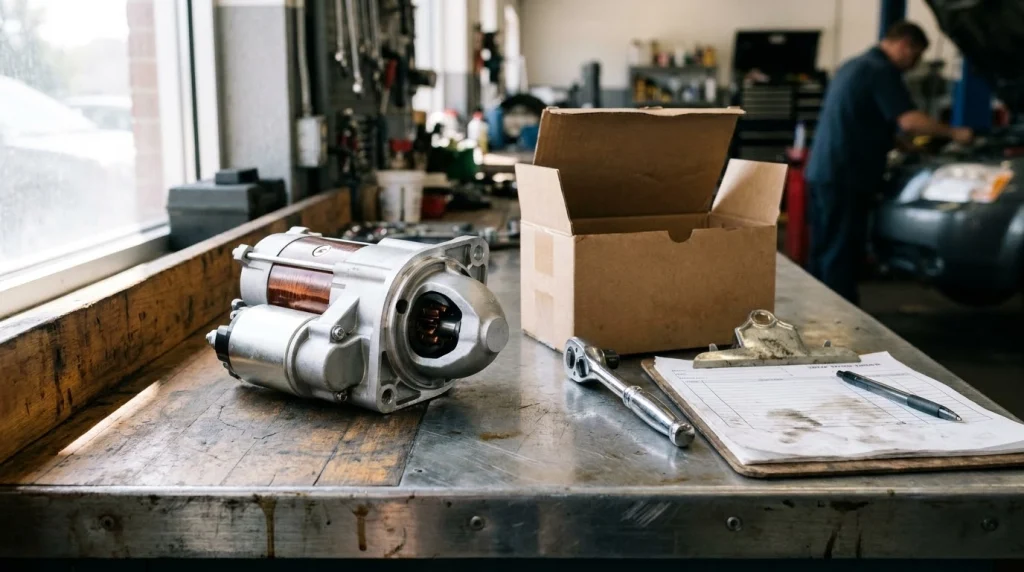
Starter replacement costs have two main components: the replacement assembly and the work needed to install it. Some repair shops also charge separately for diagnostic testing.
How much does the starter motor itself cost?
The replacement starter is often a significant part of the total bill. RepairPal estimates average starter parts costs at $375 to $516.
AAA also reports that some standalone replacement starters cost under $80, while others exceed $400. The correct part depends on the vehicle’s engine, electrical system, and original starter design.
Replacement starters are generally available in these categories:
- OEM starter: A component supplied to meet the vehicle manufacturer’s specifications.
- New aftermarket starter: A newly manufactured alternative to the factory-supplied component.
- Remanufactured starter: A previously used assembly rebuilt and tested for reuse.
An OEM replacement may cost more than an aftermarket alternative. A remanufactured assembly may offer a lower-cost option, but its warranty and quality still matter.
How much does a mechanic charge for labor?
Starter replacement labor depends on the shop’s rate and the time required to reach the component. RepairPal estimates labor at $191 to $280 on average.
AAA reports mechanic labor rates of $150 to $300 per hour within its Approved Auto Repair network. These are not universal rates for every repair shop.
A starter mounted in an accessible location usually requires less work than one hidden beneath other engine components. Complicated access can make labor the biggest reason for a high estimate.
What other charges might appear?
Your repair invoice may include charges beyond the starter and installation. Ask the shop to identify each charge before approving the repair.
- Diagnostic testing of the starting and charging system.
- Taxes and applicable shop fees.
- Replacement of damaged electrical connections or cables.
- A refundable core charge on an exchange starter.
- Towing or roadside assistance when the vehicle cannot start.
A core charge is a deposit sometimes added when purchasing a rebuildable replacement part. The seller may refund it when you return an eligible old starter.
What Factors Affect Car Starter Repair Costs?
Vehicle design, component choice, and local labor rates are the main factors affecting starter replacement prices. The same repair can cost different amounts at different shops.
Vehicle make, model, and engine layout
Some engines place the starter near the outside of the engine, where a technician can reach it easily. Others position it beneath an intake manifold or near tightly packed components.
Removing surrounding parts adds labor time. The AAA starter replacement guide explains how starter location and vehicle design influence the final repair bill.
Replacement part quality
OEM, aftermarket, and remanufactured starters can have different prices and warranty coverage. The least expensive option does not always provide the lowest long-term ownership cost.
Compare the correct fitment, warranty terms, and supplier reputation. Ask whether the shop will install a part you supply yourself, since some shops restrict customer-provided components.
Repair shop and local labor rates
Independent repair shops and dealership service departments may use different labor rates. Their diagnostic equipment, parts policies, and warranty terms can also differ.
Compare the complete written estimate rather than the hourly rate alone. A lower labor rate does not always mean a lower total bill.
Additional damage or electrical problems
A failed starter may not be the only problem. Corroded cables, damaged terminals, or a related engine oil leak may require attention.
Replacing the starter without addressing the underlying cause can lead to repeated trouble. Ask the technician to explain any additional work and show the supporting diagnosis.
Is It Cheaper to Repair or Replace a Car Starter?
Repairing an isolated starter-system fault can cost less than replacing the complete motor. However, replacement is often more practical when the starter assembly itself has failed.
The correct decision depends on which component is defective, whether it can be serviced separately, and the total repair labor.
When does repairing the starter make sense?
A targeted repair can make sense when testing identifies a separate, serviceable component. Examples include a damaged cable connection or an independently replaceable solenoid.
The solenoid is an electrical switch that helps activate the starter motor and engage its drive gear. Some vehicles use integrated designs where servicing the solenoid separately is not practical.
Repairing a small electrical fault may avoid purchasing a complete starter assembly. However, a mechanic should confirm that the motor itself remains functional.
When is full starter replacement better?
Replacing the complete starter is generally more practical when the motor has significant internal wear or repeated electrical failure.
Internal problems can involve worn brushes, damaged windings, bearings, or drive components. Rebuilding the assembly may require specialized equipment and additional labor.
Replacement also offers a clearer path when the shop can supply a tested assembly with warranty coverage.
The following situations help explain which repair approach may be appropriate.
If you
Have a confirmed failed starter motor with internal damage.
Choose complete replacement, because rebuilding may involve more labor and uncertain remaining wear.
If you
Have a loose or corroded connection and a working starter.
Choose connection repair, because a functional starter does not need replacement.
If you
Have an isolated solenoid fault on a serviceable design.
Choose targeted repair if the mechanic confirms it is economical and reliable.
The least expensive repair is the one that fixes the confirmed problem without unnecessary parts. Compare both options when your starter can be serviced separately.
How Do You Know Your Car Starter Is Bad?
A bad starter may cause clicking, grinding, slow cranking, or no engine movement when you try to start the car. However, these symptoms do not prove the starter has failed.
A weak battery, poor electrical connection, or faulty relay can produce similar behavior. Testing is necessary before replacing expensive components.
What are the common signs of starter failure?
Starter problems commonly affect the engine’s ability to crank. Cranking means the starter is physically turning the engine before it begins running.
- A single click occurs without the engine turning.
- The starter makes a grinding or unusual whirring sound.
- The engine sometimes cranks normally and sometimes does not.
- The starter turns the engine slowly despite a verified healthy battery.
- Dashboard lights work, but the engine refuses to crank.
- The starter remains engaged after the engine begins running.
These symptoms can narrow the possible causes. A professional electrical test helps identify the actual failure.
What should you check before replacing a starter?
Check the battery and basic electrical connections before assuming the starter motor needs replacement. A no-start condition can have several causes.
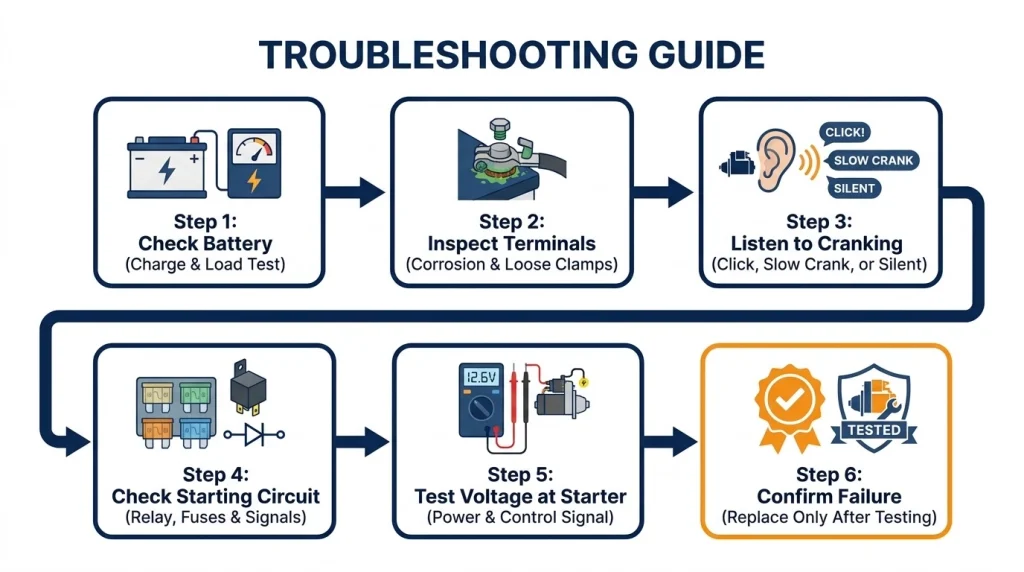
Use this diagnostic sequence to decide what needs further testing.
- Check the battery: Have its charge and load performance tested.
- Inspect the terminals: Look for loose clamps, corrosion, or damaged cables.
- Listen to the cranking sound: Notice whether the car clicks, cranks slowly, or remains silent.
- Check the starting circuit: Ask a technician to inspect the starter relay, relevant fuses, and control signals.
- Test voltage at the starter: A qualified technician can check whether adequate power and control signals reach the assembly.
- Confirm the failure: Replace the starter only after testing supports that decision.
AutoZone’s starter troubleshooting guide also explains battery, connection, relay, and wiring checks.
Tip
Request a battery load test and starting-circuit diagnosis before approving starter replacement. Ask the shop to record the test results.
What Happens During a Car Starter Replacement?
A mechanic confirms the failure, removes the defective starter, installs the correct replacement, and checks the starting system afterward.
The exact procedure depends on the vehicle. Some starters are accessible from above the engine, while others require access from underneath.
How does a repair shop replace the starter?
A professional replacement generally follows a structured process. The technician also checks nearby connections that could affect the new component.
- Confirm the diagnosis and identify the correct replacement part.
- Disconnect the battery according to the vehicle’s service procedure.
- Remove components needed to access the starter.
- Disconnect the starter wiring and remove its mounting hardware.
- Install the replacement assembly and reconnect the wiring.
- Reassemble removed components and restore the battery connection.
- Test engine cranking and check for unusual sounds or related faults.
A proper installation should also address damaged wiring or mounting problems identified during removal. The technician should use vehicle-specific procedures and tightening specifications.
How long does starter replacement take?
Starter replacement often takes about one to two labor hours when access is straightforward, according to AAA. Difficult engine layouts can require substantially more time.
The shop’s labor estimate may differ from the time your vehicle spends at the facility. Diagnosis, parts availability, and scheduling can affect when the repair is completed.
Ask for the estimated labor time before approving the work. A detailed quote should explain unusual access requirements.
Can You Replace a Car Starter Yourself?
Replacing a starter yourself is possible on some vehicles if you have mechanical experience, proper tools, and reliable service instructions.
DIY replacement avoids professional installation labor, but it does not remove the cost of parts or any special equipment. Incorrect installation can create electrical problems or damage nearby components.
What tools might you need?
The required tools depend on how the manufacturer mounts the starter. Common equipment for an accessible replacement includes:
- Socket and wrench set.
- Ratchet with suitable extensions.
- Torque wrench.
- Vehicle-specific repair information.
- Protective gloves and eye protection.
- Multimeter for appropriate electrical testing.
- Approved lifting and support equipment if underbody access is needed.
Some vehicles require additional tools or removal procedures. Compare the job with your experience before attempting it.
Is DIY starter replacement safe?
DIY starter replacement involves electrical and mechanical hazards. The starter circuit carries substantial current, and accidental short circuits can damage components or cause injury.
Disconnecting the battery correctly is an essential part of many replacement procedures. Vehicles with complex electrical systems or difficult starter access require extra care.
Warning
Working beneath an unsupported vehicle can cause serious injury. Use manufacturer-approved support procedures, and never rely on a hydraulic jack alone.
For hybrid or high-voltage vehicles, follow the manufacturer’s safety requirements and use a qualified technician when necessary. Their starting systems may differ from conventional starter-motor designs.
What Problems Can Look Like a Bad Starter?
Several electrical and engine faults can imitate a failed starter. Identifying these problems before replacement may prevent an unnecessary repair bill.
The following table compares common symptoms and the areas a technician should investigate.
| Symptom | Possible cause | Recommended check |
|---|---|---|
| Rapid clicking | Weak battery or high-resistance connection | Battery and cable testing |
| Single click, no crank | Starter, solenoid, or electrical connection | Starting-circuit diagnosis |
| No sound when starting | Relay, ignition control, switch, wiring, or starter | Power and control-signal testing |
| Engine cranks but will not run | Fuel, ignition, sensor, or other engine-management fault | Engine no-start diagnosis |
| Starts after a jump | Discharged battery or power-delivery issue | Battery and charging-system testing |
Symptoms offer clues, but no single sound identifies every fault. Test results should determine which component actually needs attention.
Can a bad battery be mistaken for a starter problem?
A weak battery can prevent a healthy starter from turning the engine. The starter requires substantially more electrical power than many dashboard accessories.
Working headlights or interior lights therefore do not prove the battery is healthy. A proper battery test can distinguish a power-supply problem from a defective starter.
Could a relay or ignition switch be responsible?
A faulty starter relay or ignition control circuit can prevent the starter from receiving its activation signal. The motor may remain silent even when the battery is charged.
These faults require different repairs from a failed starter assembly. A technician should confirm whether the starter receives the correct command and electrical supply.
How Can You Get an Accurate Starter Repair Estimate?
An accurate starter repair estimate should identify your vehicle, the confirmed failure, the replacement part, and the labor required.
Request a written quote before authorizing the work. This makes it easier to compare repair shops and recognize unexpected charges.
What information should the quote include?
A useful estimate explains the actual work rather than giving only a single total. Ask the shop to provide the following details:
- Confirmed starter-system fault and diagnostic findings.
- Replacement part description and part number.
- Whether the starter is OEM, aftermarket, or remanufactured.
- Labor hours and the applied labor rate.
- Separate diagnostic charges, taxes, and shop fees.
- Parts and workmanship warranty terms.
- Any additional work needed and its reason.
For a high estimate, ask what makes the vehicle difficult to repair. A shop should be able to explain special access requirements or related damage.
Should you get multiple repair quotes?
Comparing quotes can help you identify differences in parts, labor, and warranty coverage. However, compare similar repairs rather than assuming every quote covers identical work.
One shop may quote a remanufactured starter, while another includes a new factory-specification assembly. Diagnostic fees and related repairs may also change the total.
A cheaper estimate is useful only when it addresses the same confirmed failure. Ask both shops to explain their recommended parts and workmanship guarantees.
Can You Drive With a Bad Car Starter?
A vehicle with a failing starter may continue running after the engine has started. However, the starter may fail to crank the engine again after you switch it off.
This creates a risk of being stranded. If the starter works intermittently, arrange diagnosis before relying on the vehicle for another trip.
Grinding sounds can also indicate trouble with the starter drive gear or flywheel teeth. Repeated cranking may worsen that damage.
If you notice smoke, burning smells, or a starter that remains engaged, stop attempting to start the vehicle. Seek professional assistance rather than continuing to operate it.
How Can You Reduce Car Starter Repair Costs?
The most effective way to control starter repair costs is to confirm the fault before buying parts. Choosing appropriate components and comparing complete quotes can also help.
Test the starting system first
A battery or cable problem can make a healthy starter appear defective. Proper electrical diagnosis helps prevent unnecessary replacement.
Ask what tests support the mechanic’s conclusion. If the diagnosis remains uncertain, request a clearer explanation before authorizing major work.
Compare replacement part options
A remanufactured or aftermarket starter may cost less than an OEM replacement. However, the correct fit, supplier quality, and warranty coverage are important.
Request the price difference between available options. Avoid selecting an unfamiliar part solely because it has the lowest purchase price.
Check warranty and repair coverage
Existing factory, extended-service, or replacement-part warranties may affect your out-of-pocket costs. Coverage depends on the specific contract and the cause of failure.
Ask the repair shop to check applicable coverage before ordering parts. Also confirm whether the quote includes a labor warranty.
Resolve related problems during the repair
Damaged cables or oil leaks may contribute to starter trouble. Leaving an underlying fault unresolved can create additional costs later.
Have the shop distinguish necessary repairs from optional maintenance. Authorize extra work only after understanding the reason and price.
Starter Motor
A replacement starter motor can restore engine cranking when testing confirms the original assembly has failed. Verify compatibility with your vehicle before purchasing.
Frequently Asked Questions
Does car insurance cover a failed starter motor?
Standard auto insurance generally does not pay for starter failure caused by ordinary wear and tear. Some mechanical protection plans or vehicle service contracts may cover eligible failures. Review your policy and any service agreement before assuming the replacement is covered.
Can a new starter fail because of an oil leak?
An unresolved engine oil leak can contribute to premature starter problems if oil reaches sensitive starter components. Replacing the assembly alone may not solve the underlying issue. Ask the mechanic to inspect nearby leaks when the old starter shows signs of oil contamination.
Does every starter motor include a solenoid?
Many automotive starter assemblies have an integrated solenoid, but component arrangements depend on the vehicle’s design. Some systems use separately mounted starter control components. Check the correct replacement part and service documentation before ordering an individual solenoid or a complete assembly.
Can a car starter fail without warning?
A car starter can fail suddenly, although some units show intermittent problems before stopping completely. A starter may work during one attempt and refuse to crank during another. Unexplained starting problems deserve testing even when the vehicle later starts normally.
Why will my car not start after replacing the starter?
A car may still refuse to start after starter replacement when another electrical or engine problem remains unresolved. Incorrect wiring, weak battery power, faulty control signals, or an unsuitable replacement part can also cause trouble. Have the installation and original diagnosis checked before replacing more components.
Do all new starters come with a warranty?
Starter warranty coverage depends on the manufacturer, seller, and repair shop rather than being identical for every replacement. Parts warranties and labor warranties may have different conditions. Ask for written coverage details, including any exclusions and the process for obtaining a replacement.
Conclusion
The answer to how much it will cost to fix a car starter depends on whether the problem needs a minor electrical repair or complete replacement. RepairPal estimates average replacement costs at $565 to $796.
Before approving the work, confirm the diagnosis and request an itemized quote that separates parts, labor, and additional charges.

Alex Carter is an automotive content writer at VastAutoParts, focusing on car parts, vehicle troubleshooting, automotive tools, product research, and practical car care guides.