
White Smoke When Starting Car Engine: Causes and Fixes
Quick Answer
White smoke when starting a car engine is often harmless water vapor from condensation inside a cold exhaust. It should fade as the exhaust warms. Thick white smoke that continues, especially with coolant loss, a sweet smell, rough running, or overheating, can indicate an internal coolant leak and needs prompt attention.
- Thin vapor that clears after startup often comes from condensation.
- Persistent white exhaust can indicate coolant entering a cylinder.
- Diesel engines can also produce white smoke from incomplete fuel combustion.
- Overheating or heavy smoke means stop safely and get help.
Seeing white smoke when starting a car engine can be alarming, especially when the car has been parked overnight. The key is to watch where the cloud comes from, how long it lasts, and whether the engine behaves normally.
This guide explains the main causes, safe checks, warning signs, and what a mechanic may test. You can use those clues without guessing that every white cloud means a blown head gasket.
In this article
- Why White Smoke Appears When Starting a Car
- Condensation Versus a Coolant Leak
- Causes of Thick White Exhaust Smoke
- White Smoke Only on a Cold Start
- White Smoke From a Diesel Engine
- Safe Checks You Can Make
- What a Mechanic Will Test
- When to Stop Driving
- White, Blue, and Black Exhaust
- Preventing Repeat Problems
- Frequently Asked Questions
- Conclusion
Why Does White Smoke Appear When Starting a Car?
White clouds at startup usually come from water vapor or something entering the engine’s combustion process. The timing, density, odor, and location help narrow down the cause.
A running engine creates water as a normal result of burning fuel. Some moisture collects inside the exhaust system while the vehicle is parked.
When the engine starts, warm exhaust meets cooler metal and outside air. The moisture becomes visible as a light white cloud that often fades after warming.
Steam from under the hood has a different meaning. It may come from coolant contacting hot engine parts, rather than moisture inside the tailpipe.
According to RAC guidance on engine smoke, brief white exhaust after startup commonly reflects condensation. Smoke that persists after warming may indicate coolant entering a combustion chamber.
How Can You Tell Condensation From a Coolant Leak?
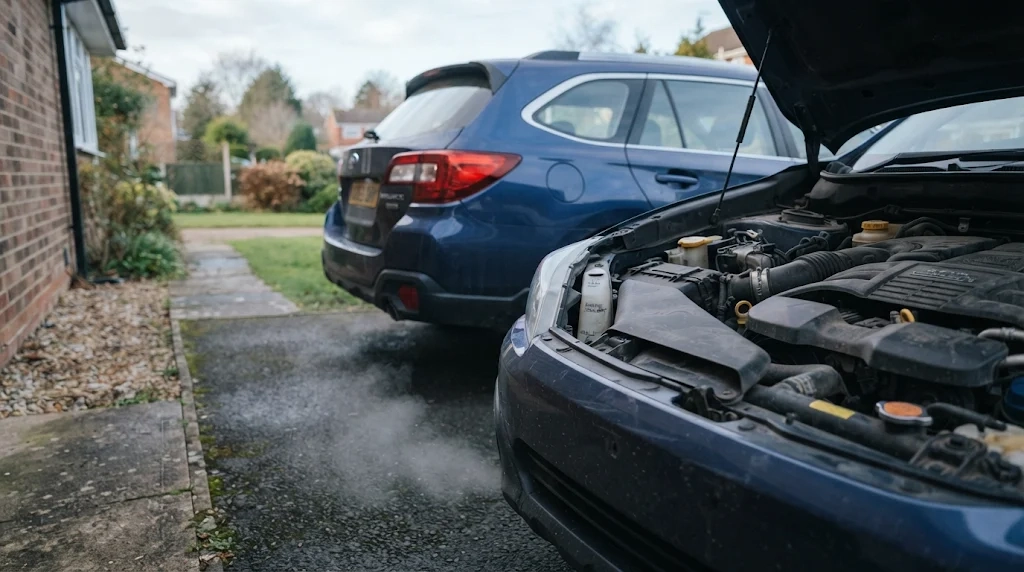
Condensation usually produces a light cloud that disappears as the exhaust warms. A coolant leak is more concerning when the cloud remains thick or the car loses coolant.
These signs help you compare the possibilities without touching any hot components.
| Clue | Likely condensation | Possible coolant leak |
|---|---|---|
| When visible | Mainly during cold startup | May continue after warm-up |
| Appearance | Light vapor that disperses | Often thick or persistent |
| Coolant level | Normally stays stable | May fall between checks |
| Other symptoms | Normal idle and temperature | Possible sweet odor or rough idle |
No single clue proves the cause. Repeated coolant loss, persistent smoke, and rough running together deserve professional inspection.
Does the smell help identify the problem?
A sweet smell can suggest engine coolant, while a strong fuel odor may indicate unburned fuel. Neither smell identifies the exact failed part.
Never place your face near a running tailpipe to check the odor. Exhaust gases can be dangerous even when the visible cloud looks harmless.
What Causes Thick White Smoke From the Exhaust?
Thick white exhaust that continues after warm-up can result from coolant entering a cylinder. Several different engine faults can create that path.
Failed head gasket
A head gasket seals the joint between the engine block and cylinder head. It helps keep combustion gases, engine oil, and coolant in their intended passages.
If the seal fails between a coolant passage and a cylinder, coolant can enter the combustion chamber. The heated coolant may appear as white exhaust vapor.
Other warning signs include overheating, rough running, coolant loss, or oil contaminated with coolant. A head gasket failure is possible, but white smoke alone does not confirm it.
Cracked or warped cylinder head
A damaged cylinder head can also let coolant reach a combustion chamber. Severe overheating can contribute to cracks or distortion that prevent proper sealing.
This problem may resemble a leaking head gasket from the driver’s seat. A repair shop must inspect or test the engine before identifying which part has failed.
Engine block damage
A damaged engine block can sometimes create an internal coolant leak. This is a serious possibility, but it should not be assumed from a cloud of steam.
A technician will usually rule out easier explanations before recommending major engine repairs. Confirming the leak matters more than choosing a part based on smoke color.
Other engine-specific coolant leaks
Some engines have additional passages or heat exchangers that can leak coolant into the intake or exhaust stream. The possible failure points depend on engine design.
For that reason, a vehicle-specific diagnosis is safer than assuming every persistent white cloud means a head gasket. Tell the technician whether coolant loss is also present.
Why Does White Smoke Appear Only on a Cold Start?
White exhaust that appears only while the car is cold often comes from stored moisture. However, an intermittent mechanical leak can also be more noticeable after parking.
The difference is what happens next. Harmless vapor fades, while a mechanical fault may bring a rough start, fluid loss, or repeated heavy smoke.
Why cold or damp weather makes it more visible
Cool air helps exhaust moisture condense into tiny visible droplets. Damp conditions can also leave more water inside the exhaust system while the car sits.
A thin cloud can therefore look more dramatic on a chilly morning than on a warm afternoon. Normal running and stable fluid levels make condensation more likely.
Why a brief puff can still need attention
A brief puff is not automatically harmless if other symptoms appear. Coolant may enter a cylinder while the engine sits, then leave as vapor after the next start.
Watch for repeated rough starts, unexplained coolant loss, or a lingering sweet smell. Those clues justify inspection even if the visible cloud eventually stops.
Why Do Diesel Engines Produce White Smoke at Startup?
Diesel startup smoke can come from poor fuel combustion as well as condensation or coolant. A diesel engine uses compression heat to ignite its fuel.
During a cold start, low temperatures can make combustion less complete. Unburned fuel may leave through the exhaust as a white cloud with a fuel-like smell.
Faulty glow plugs or cold-start controls
Glow plugs help some diesel engines reach suitable temperatures for starting. A faulty plug or control system can contribute to hard starting, rough idling, and white smoke.
DENSO’s glow plug guidance identifies those symptoms and explains that injector faults can also produce persistent white diesel exhaust.
Fuel injection or compression problems
Fuel injectors must deliver diesel at the right time and in the right amount. Poor injection, low compression, or inadequate cranking speed can disrupt cold combustion.
These issues can create smoke alongside a shaky idle or difficult start. Diesel smoke cannot be diagnosed from color alone because coolant leaks may look similar.
Do not spray starting fluid into a diesel intake unless the engine manufacturer specifically permits its use. Improper use can cause ignition and injury risks.
How Can You Check White Startup Smoke Safely?
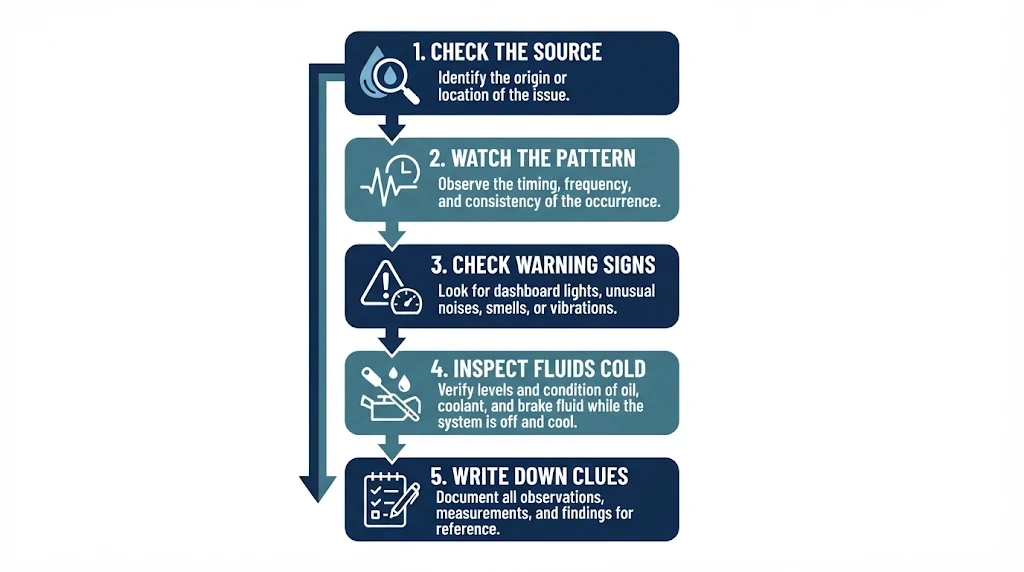
Start with observations you can make without opening a hot cooling system or touching a running engine. Record whether the symptoms change after warm-up.
The following sequence helps separate a likely condensation cloud from a problem needing service.
Step 1
Check the source
Observe from a safe distance whether the cloud leaves the tailpipe or rises from the engine compartment.
Step 2
Watch the pattern
Note whether the vapor fades during normal warm-up or stays thick after the engine warms.
Step 3
Check warning signs
Look for temperature warnings, a flashing check engine light, misfiring, loss of power, or unusual smells.
Step 4
Inspect fluids only when cold
With the engine fully cool, check the coolant reservoir against the owner’s manual and inspect engine oil if accessible.
Step 5
Write down recurring clues
Record the weather, smoke duration, coolant changes, and engine behavior for a mechanic.
Check coolant only by the procedure in your owner’s manual. Never loosen a hot radiator or coolant reservoir pressure cap.
Look at the oil dipstick for abnormal contamination if your vehicle provides one. Milky oil can suggest coolant mixing, but normal-looking oil does not exclude an internal leak.
A stable coolant level is reassuring, not definitive. Marked changes between cold checks are more useful than a single reading.
What Will a Mechanic Test to Find the Cause?
A mechanic confirms the source by combining symptoms with engine-specific checks. Visible smoke alone cannot reveal which gasket, passage, or fuel component has failed.
For suspected coolant intrusion, the shop may inspect the cooling system, check for leaks, and test whether the system holds pressure. The technician may also check for combustion gases in the coolant.
Compression or cylinder leak-down testing may help investigate sealing problems. Those tests must be interpreted alongside the vehicle’s design and symptoms.
For a diesel with difficult starts, diagnosis may focus on glow plug operation, injector performance, fuel delivery, and engine compression. A cold-start observation may be particularly useful.
An OBD2 code reader can retrieve stored trouble codes when the vehicle supports them. Codes may identify misfire or sensor concerns, but cannot independently prove a head gasket leak.
Request the test results before authorizing a major repair. A correct diagnosis can prevent replacing parts that are not causing the smoke.
When Should You Stop Driving With White Smoke?
Stop driving if thick white smoke accompanies overheating, severe rough running, or an urgent dashboard warning. Continuing can cause more engine damage.
Clouds rising from under the hood also require immediate caution. They may indicate a cooling-system leak, overheating, or fluid reaching hot components.
Warning
Heavy smoke with overheating can precede engine damage. Pull over safely, switch off the engine, and arrange roadside assistance rather than driving farther.
AAA’s roadside safety advice recommends stopping and seeking a tow for thick white tailpipe smoke. It also advises caution around a hot engine compartment.
For a small cloud that disappears and no other symptoms, normal driving may be reasonable. Keep an eye on coolant levels and whether the pattern changes.
If the smoke keeps returning with a sweet smell or fluid loss, schedule a diagnostic inspection. Avoid a long drive until the cause is known.
What Is the Difference Between White, Blue, and Black Smoke?
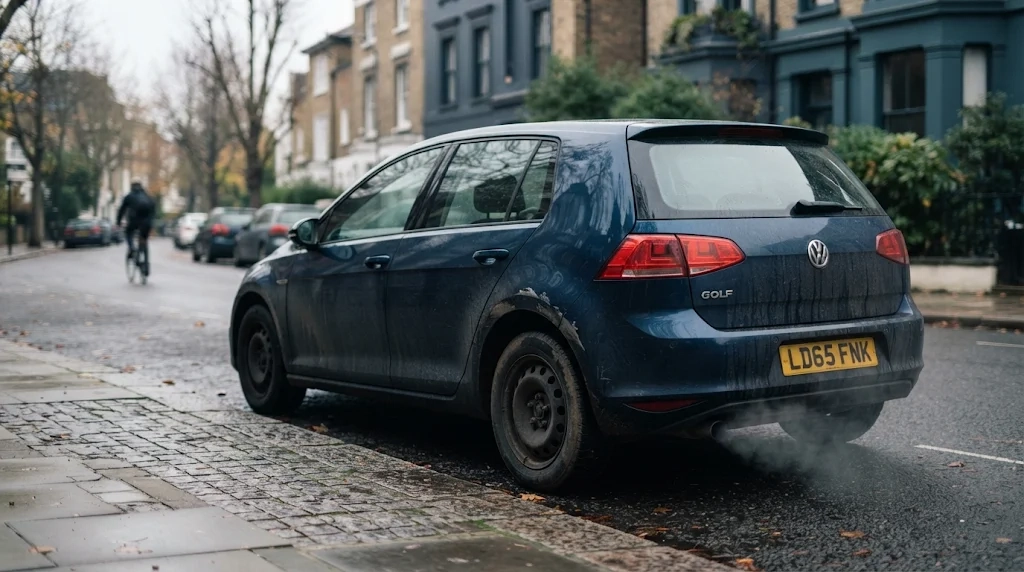
Smoke color helps narrow the possibilities, but it is not a complete diagnosis. Lighting and mixed symptoms can make colors difficult to judge.
- White: Often visible water vapor; persistent thick clouds may indicate coolant or incomplete diesel combustion.
- Blue or blue-gray: More often associated with engine oil entering the combustion process.
- Black: Often linked to excess fuel or poor air and fuel mixing during combustion.
Pay closer attention to when smoke appears than to the color alone. Startup-only vapor, acceleration smoke, and smoke at idle can have different causes.
Keep in mind that smoke from the hood is not exhaust smoke. An external fluid leak requires a different inspection from smoke leaving the tailpipe.
How Can You Prevent Repeat White Smoke Problems?
You cannot prevent every visible cold-start vapor cloud because condensation is normal. Preventable problems involve coolant leaks, overheating, and ignored engine faults.
Follow the vehicle’s coolant service instructions and use the specified coolant. Check levels when the engine is cool, especially after unexplained drops.
Have cooling-system leaks repaired rather than repeatedly adding fluid. Watch for temperature warnings, wet patches, or a sweet odor around the vehicle.
For diesel cars, maintain the starting and fuel systems according to the manufacturer’s schedule. Check a hard-start complaint before repeated rough starts cause additional trouble.
Do not install a head gasket additive simply because the tailpipe looks white. An additive cannot replace a diagnosis and may not address the fault.
OBD2 Code Reader
An OBD2 code reader can show stored engine fault codes, although it cannot identify the cause of white smoke by itself.
As an Amazon Associate I earn from qualifying purchases.
Frequently Asked Questions
Can a head gasket leak without milky engine oil?
A head gasket can leak coolant into a cylinder without mixing it into the engine oil. The leakage path determines which symptoms appear. Clear-looking oil does not prove the gasket is healthy, so persistent white smoke and coolant loss still warrant testing.
Is water dripping from the exhaust pipe normal?
Small amounts of clear water from a tailpipe can be normal because combustion creates moisture. Water may collect in a cold exhaust and drain out during startup. The concern rises if visible exhaust persists with overheating, rough running, or dropping coolant.
Will a check engine light always appear with white smoke?
White exhaust does not always trigger a check engine light because the car may not detect every underlying cause. Some mechanical coolant leaks produce no stored fault code. A missing warning light should not override signs such as heavy smoke, fluid loss, or overheating.
Can the starter motor itself cause white exhaust smoke?
A starter motor does not normally create white exhaust smoke because it does not supply coolant or fuel to the cylinders. However, weak cranking may complicate diesel combustion during startup. Diagnosing a hard-start complaint requires checking the starting and fuel systems separately.
Can white smoke appear without a coolant leak?
White exhaust can appear without any coolant leak when water vapor condenses in cold air. Diesel fuel that does not burn completely can also produce white smoke. Duration, fuel odor, running quality, and fluid levels help distinguish those causes.
Should I add coolant if the white smoke keeps coming?
Adding coolant does not fix the source of persistent white exhaust smoke. If the level is low, the system needs inspection for leaks and possible engine damage. Never open a hot cooling system, and do not continue driving an overheating vehicle.
Conclusion
White smoke when starting a car engine is often normal condensation if it fades quickly and the car runs normally. If the cloud stays thick or comes with coolant loss, rough running, or overheating, stop if necessary and arrange a professional diagnosis.

Alex Carter is an automotive content writer at VastAutoParts, focusing on car parts, vehicle troubleshooting, automotive tools, product research, and practical car care guides.