
Reasons a Car Won’t Start: Causes and First Checks
Quick Answer
The most common reasons a car won’t start are a dead or weak battery, loose battery connections, a faulty starter motor, fuel delivery problems, or a failing charging system. Ignition faults, security systems, and engine problems can also prevent starting. The sounds and dashboard behavior during a starting attempt help narrow down the cause.
- Rapid clicking or slow cranking often suggests a weak battery.
- A single click without cranking may indicate starter trouble.
- Normal cranking without starting suggests fuel, ignition, or engine control problems.
- Repeated dead batteries may point to charging problems or unwanted electrical drain.
- Simple checks can identify the likely cause before replacing parts.
You turn the key or press the start button, but your engine refuses to start. The problem might be simple, or it could require professional diagnosis.
Understanding the most common reasons a car won’t start helps you identify the symptoms and avoid unnecessary repairs. This guide covers common gasoline and diesel vehicle problems, safe troubleshooting checks, and signs that require a mechanic.
In this article
- What are the most common reasons a car won’t start?
- What do different starting sounds mean?
- How can you troubleshoot a car that won’t start?
- How can you tell if the battery or starter is bad?
- Why won’t your car start even after a jump?
- When should you call a mechanic?
- How can you prevent starting problems?
- Frequently Asked Questions
- Conclusion
What Are the Most Common Reasons a Car Won’t Start?
The main causes of a car not starting involve the battery, starter, charging system, fuel delivery, ignition, or engine controls. The first step is determining whether the engine turns when you attempt to start it.
A gasoline engine needs enough electrical power, fuel, air, compression, and properly timed ignition to start. Diesel engines use compression ignition instead of spark plugs, but still depend on working electrical and fuel systems.
The following problems are common causes of starting failure.
1. Dead or Weak Car Battery
A weak or discharged battery is one of the most common reasons a car won’t start. The battery supplies the high electrical current needed to operate the starter motor.
When battery power is insufficient, the engine may crank slowly, make clicking noises, or fail to turn at all.
Common signs include:
- Dim or flickering dashboard lights.
- Rapid clicking when turning the key.
- Slow engine cranking.
- Electrical accessories becoming weak or unresponsive.
- Starting successfully after a jump.
Car batteries can become discharged when lights remain on, the vehicle sits unused, or the charging system fails. Internal battery deterioration can also reduce starting power.
Check whether the headlights and dashboard lights become noticeably dimmer during a starting attempt. A battery load test provides stronger evidence than checking dashboard lights alone.
According to AAA’s starting problem guide, battery trouble is a leading cause of failed starts. The guide also identifies several other starting system failures.
2. Loose or Corroded Battery Connections
Loose or corroded battery terminals can prevent enough electrical current from reaching the starter. The battery itself may still have a usable charge.
Corrosion often appears as a white, blue, or greenish deposit around a terminal. A loose connection may cause intermittent starting, flickering lights, or sudden electrical power loss.
Look for these signs:
- Visible buildup around the battery terminals.
- Battery cables that appear loose or damaged.
- Dashboard lights that disappear when starting.
- Electrical power that returns intermittently.
Inspect the connections visually with the engine off. Do not touch damaged wiring, exposed conductors, or leaking battery material.
Secure connections and clean terminals using the procedure in your vehicle’s service instructions. If you are unfamiliar with battery disconnection, ask a qualified technician.
Warning
A swollen, cracked, leaking, or unusually hot battery can cause serious injury. Do not jump-start or handle it. Contact roadside assistance instead.
3. Faulty Starter Motor
A faulty starter motor can prevent the engine from turning even when the battery is charged. The starter uses battery power to rotate the engine during startup.
Starter failure may develop gradually or appear without much warning. The electrical controls connected to the starter can also fail.
Typical symptoms include:
- A single loud click without engine cranking.
- Dashboard lights operating normally.
- Whirring or grinding when attempting to start.
- Intermittent starting failures.
- No improvement after a correctly performed jump-start.
A single click is a useful clue, but it does not prove the starter is defective. Poor connections, weak batteries, and faulty starter relays can produce similar symptoms.
A technician can test the starter circuit, battery supply, and starter motor before recommending replacement.
4. Failing Alternator or Charging System
A failing alternator can leave the battery without enough charge to start the engine. The alternator normally supplies electrical power and recharges the battery while the engine runs.
An alternator problem may first appear as an electrical warning while driving. The vehicle may continue operating temporarily before the battery becomes discharged.
Possible warning signs include:
- A battery or charging warning light.
- Headlights becoming dim or unstable.
- Electrical accessories operating unpredictably.
- Repeated starting failures after driving.
- A battery that keeps losing its charge.
A discharged battery does not automatically mean the alternator has failed. A worn battery, damaged charging cable, slipping belt, or electrical drain can produce similar results.
A charging system test can check whether the alternator supplies the electrical output required by your vehicle.
5. Empty Fuel Tank or Fuel Delivery Problems
An engine can crank normally without starting when it receives insufficient fuel. The fuel system must deliver the correct quantity of fuel at the required pressure.
Running out of fuel is an obvious possibility, but the fuel gauge can sometimes be inaccurate. Mechanical and electrical fuel system faults can also prevent starting.
Potential causes include:
- An empty fuel tank.
- A failing electric fuel pump.
- A blocked fuel filter.
- Damaged fuel pump wiring or a failed relay.
- Fuel pressure regulation problems.
- Faulty or clogged fuel injectors.
Some fuel delivery problems begin with hesitation, reduced performance, or engine stalling. Others appear suddenly when the vehicle is parked.
Check the fuel level first. Fuel pressure testing and electrical checks are appropriate when the engine cranks normally but fuel delivery remains uncertain.
6. Faulty Spark Plugs or Ignition Coils
Gasoline engines may fail to start when the ignition system cannot produce a properly timed spark. Spark plugs ignite the compressed fuel and air mixture inside the cylinders.
Ignition coils provide the high voltage required by the spark plugs. Worn plugs, damaged coils, and ignition wiring problems can interrupt combustion.
Related symptoms include:
- Engine cranking without starting.
- Rough running before the failure.
- Engine misfires.
- Hesitation under acceleration.
- An illuminated check-engine light.
Ignition faults are not the only cause of these symptoms. Fuel problems and engine sensor failures can produce similar behavior.
A diagnostic scan may identify misfire information or related trouble codes. The underlying cause still needs confirmation before replacing parts.
7. Faulty Engine Sensors or Electrical Components
A failed engine sensor or electrical control can prevent the engine from starting. The engine control module uses sensor information to manage fuel delivery and ignition timing.
A crankshaft position sensor tells the engine computer about crankshaft movement and position. A severe sensor fault may prevent the system from controlling ignition or injection correctly.
Other possible causes include faulty relays, damaged wiring, blown fuses, or control module power problems.
Possible clues include:
- Normal cranking without starting.
- Unexpected stalling before the failure.
- Intermittent starting trouble.
- Warning lights or stored fault codes.
These faults often require electrical testing and scan tool diagnosis. A stored trouble code identifies an affected circuit or condition, not necessarily a defective part.
8. Security System or Key Recognition Problems
A vehicle’s immobilizer may prevent starting when it cannot recognize an authorized key. An immobilizer is an electronic security system designed to prevent unauthorized engine operation.
Some push-button vehicles may also fail to detect a key fob with a depleted battery.
Signs include:
- A key symbol or security warning on the dashboard.
- A message indicating the key was not detected.
- The engine starting briefly and then stopping.
- The start button responding without engine startup.
Try an available spare key and check the owner’s manual for the emergency key detection procedure. Some vehicles allow a depleted fob to be placed near a designated detection point.
If the vehicle still rejects the key, professional security system diagnosis may be necessary.
9. Incorrect Gear Selection or Starting Interlock Failure
A starting interlock can prevent engine cranking when the vehicle’s required starting conditions are not met. This is an intentional safety feature.
Automatic transmissions generally require Park or Neutral. Manual transmission vehicles commonly require the clutch pedal to be pressed.
Push-button vehicles may also require the brake pedal to be depressed before starting.
If the correct procedure does not work, a faulty brake switch, clutch switch, or transmission range sensor could be involved.
Confirm the gear position and follow your vehicle’s normal starting procedure. Avoid bypassing safety switches because doing so can allow unexpected vehicle movement.
10. Internal Engine or Timing Problems
Mechanical engine damage can prevent starting even when the battery and starter operate correctly. The engine needs sufficient compression and correct valve timing to run.
A failed timing belt or timing chain can disrupt the relationship between the crankshaft and camshaft. Some failures can cause extensive internal engine damage.
Concerning symptoms include:
- Cranking that sounds unusually fast or uneven.
- Sudden failure after abnormal engine noise.
- Unexpected engine shutdown while driving.
- Mechanical knocking or grinding.
Stop attempting to start the vehicle if significant mechanical damage is suspected. A technician may need to inspect timing components and perform compression testing.
What Do Different Car Starting Sounds Mean?
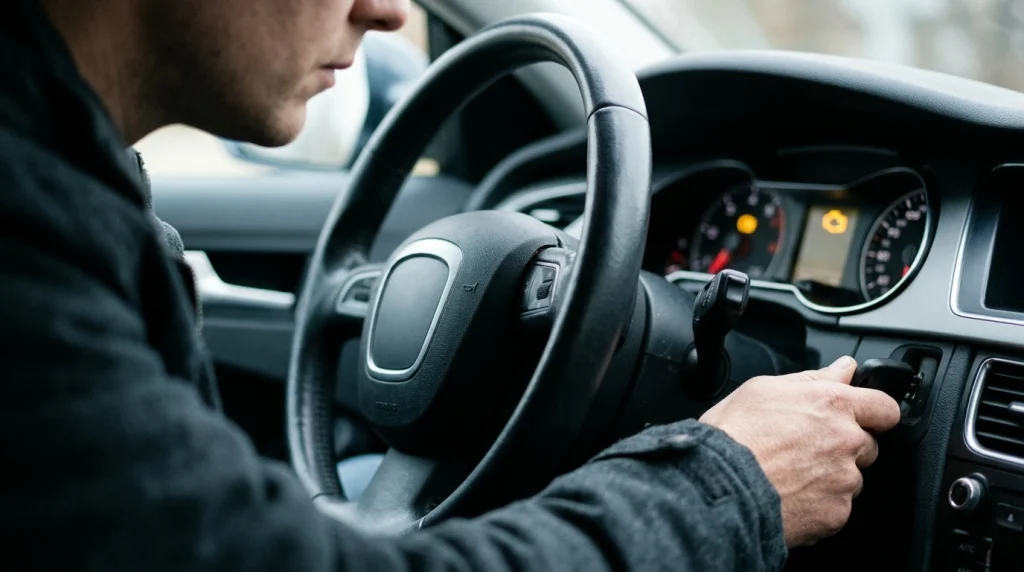
The sound your car makes during a starting attempt helps separate electrical, starter, fuel, and mechanical problems. No single sound confirms a diagnosis, but it helps identify the next check.
The following table compares common starting symptoms and the systems worth checking first.
| Starting symptom | Possible cause | First check |
|---|---|---|
| Rapid clicking | Weak battery or poor connection | Battery and terminals |
| Single loud click | Starter or starter circuit | Battery supply and starter |
| Slow cranking | Weak battery or electrical resistance | Battery load test |
| Cranks normally | Fuel, ignition, or sensor fault | Fuel level and warning lights |
| No sound or lights | Battery, connection, or main power fault | Electrical power supply |
| Starts then stalls | Fuel delivery or engine control fault | Fuel and warning indicators |
| Grinding noise | Starter engagement or mechanical problem | Stop and inspect professionally |
Rapid clicking generally suggests a different problem from normal cranking without ignition. The AA starting sound guide provides additional explanations of these symptoms.
The most useful distinction is whether the starter is turning the engine. If the engine turns normally, investigate fuel, ignition, engine controls, and mechanical condition.
How Can You Troubleshoot a Car That Won’t Start?
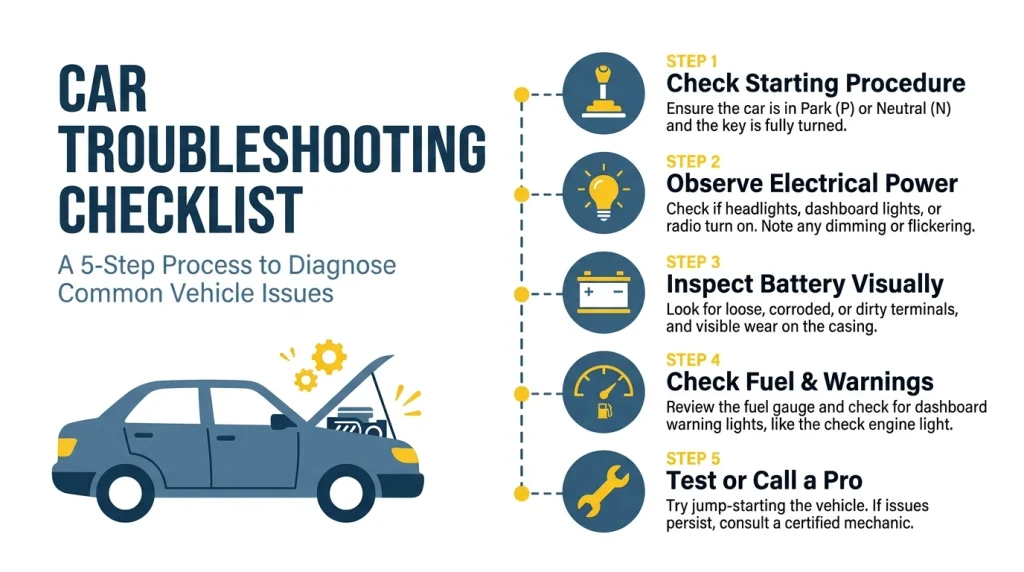
You can narrow down a no-start problem by checking the vehicle’s starting conditions, electrical power, fuel supply, and warning indicators. Begin with observations that do not require dismantling components.
Park safely, apply the parking brake, and switch off unnecessary electrical accessories before starting these checks.
Step 1
Check the Starting Procedure
Confirm Park or Neutral and press the required brake or clutch pedal. Check for key recognition warnings.
Step 2
Observe the Electrical Power
Check the headlights and dashboard indicators. Notice whether they dim or disappear when you attempt to start.
Step 3
Inspect the Battery Visually
Look for corrosion, loose connections, swelling, or damage. Do not handle a battery showing signs of leakage or overheating.
Step 4
Check Fuel and Warning Indicators
Confirm the fuel level and note any security or engine warning messages. Record what happens when the engine cranks.
Step 5
Test or Request Professional Diagnosis
Use appropriate battery testing equipment if you know the correct procedure. Request electrical, fuel, or engine diagnosis when basic checks reveal no clear cause.
These checks help separate a simple starting condition from an electrical or mechanical failure. Avoid replacing parts solely because their symptoms resemble another failure.
If a jump-start appears appropriate, follow your vehicle manufacturer’s instructions and the AAA battery jump-start safety guide. Hybrid and electric vehicles may require different procedures.
How Can You Tell if the Battery or Starter Is Bad?
A weak battery often causes slow cranking or rapid clicking, while a failing starter may produce a single click without turning the engine. Neither symptom provides a certain diagnosis by itself.
The battery and starter work together, so a problem anywhere in the high-current starting circuit can produce similar results.
What points toward a battery problem?
Battery problems become more likely when several electrical accessories are weak or the engine cranks slowly. A successful jump-start also suggests insufficient starting power.
However, a jump-start response does not identify whether the battery is worn out, discharged by another problem, or affected by poor connections.
What points toward a starter problem?
Starter trouble becomes more likely when the battery passes a proper load test but the engine does not crank. A single click or grinding sound can support that suspicion.
Starter circuit testing should include the relay, solenoid, cables, grounds, and motor. Replacing the starter without checking these components may fail to solve the problem.
The safest diagnostic approach is to test battery condition first, then check starter operation if adequate power is available.
Why Won’t Your Car Start Even After a Jump?
A car may fail to start after a jump because the problem involves more than a discharged battery. A jump supplies additional electrical energy but cannot correct every starting system fault.
Possible explanations include:
- Jumper cables or connections are not supplying enough current.
- The battery has an internal failure.
- The starter motor or its electrical circuit is faulty.
- The engine lacks fuel or ignition.
- An immobilizer or starting interlock prevents startup.
- The engine has an internal mechanical problem.
A failed jump-start does not automatically mean the starter needs replacement. Check the symptoms and confirm whether the engine cranks.
If the engine starts with a jump but the battery becomes discharged again, test the battery and charging system. An alternator problem or unwanted electrical drain may be responsible.
Repeated jump-starting without identifying the cause can leave you stranded again. Arrange testing rather than assuming a temporary successful start means the problem is resolved.
When Should You Call a Mechanic for Starting Problems?
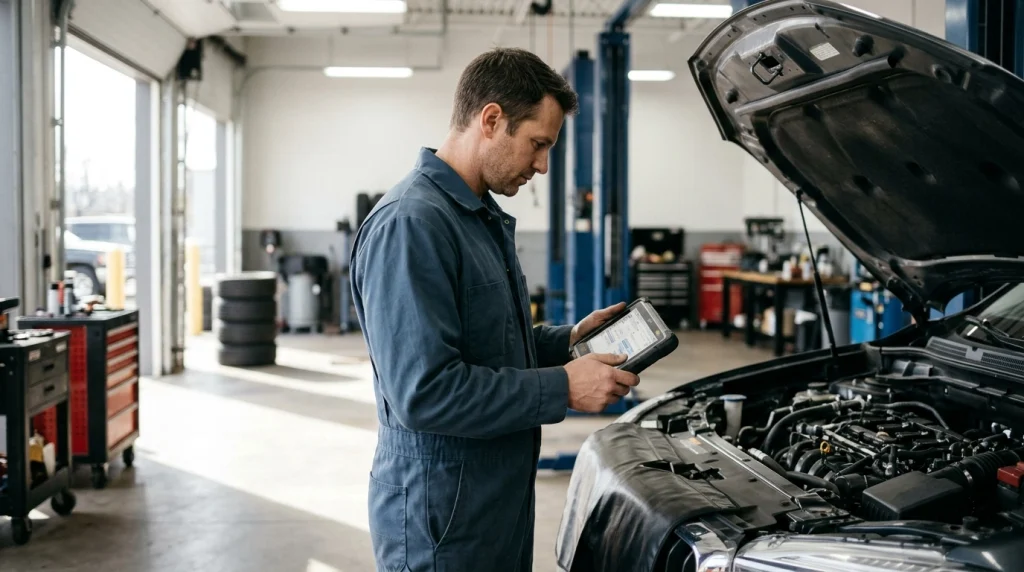
Call a mechanic when basic checks fail, the vehicle repeatedly refuses to start, or the symptoms suggest mechanical or electrical damage. Some failures require specialized diagnostic equipment.
Professional assistance is especially appropriate when:
- The engine makes grinding or unusual mechanical noises.
- There is smoke, a burning smell, or damaged wiring.
- The battery is swollen, leaking, or overheating.
- The engine cranks normally but never starts.
- The car repeatedly stalls after starting.
- A security system continues rejecting the key.
- The vehicle loses power while driving.
Fuel system testing can involve pressurized fuel and electrical equipment. These procedures are better handled by trained technicians when the cause is uncertain.
If the engine stopped while driving or mechanical damage is suspected, arrange roadside recovery. Driving a vehicle that may stall again creates additional safety risks.
A mechanic can use battery testing, circuit measurements, diagnostic scans, fuel pressure checks, and mechanical inspection to identify the fault.
How Can You Prevent Common Car Starting Problems?
Regular battery care, electrical checks, and scheduled maintenance can reduce avoidable starting problems. Some component failures still occur without warning, so preventive maintenance cannot eliminate every risk.
Useful maintenance habits include:
- Have the battery tested when slow cranking or electrical weakness appears.
- Keep battery connections secure and free from excessive corrosion.
- Investigate repeated charging warnings instead of ignoring them.
- Follow the manufacturer’s fuel filter and spark plug service schedule.
- Check unusual electrical drains before leaving a vehicle unused.
- Replace weak key fob batteries when warning signs appear.
- Address intermittent starting symptoms before they become persistent.
Pay attention to changes in cranking speed, warning indicators, and electrical behavior. These clues can help identify problems before a complete starting failure.
A battery tester can help evaluate battery condition as part of maintenance. More complex charging and starting problems require suitable testing equipment and an accurate diagnostic procedure.
Car Battery Tester
A car battery tester can help assess battery condition when checking slow cranking, weak starting power, or repeated battery trouble.
Frequently Asked Questions
Why does my car struggle to start in cold weather?
Cold weather can reduce battery starting performance while increasing the effort needed to turn a cold engine. A battery that works in mild conditions may struggle during colder mornings. Have the battery tested if the engine cranks slowly, and check the vehicle’s recommended cold-weather maintenance procedures.
Why does my car start cold but not hot?
A car that starts cold but fails when hot may have a temperature-sensitive electrical, sensor, or fuel system fault. Some damaged components work normally until heat affects their operation. Record whether the engine cranks during the failure, since that detail helps identify which system needs testing.
Can heavy rain cause a car to stop starting?
Rainwater can contribute to starting problems when moisture enters damaged electrical connections, ignition components, or wiring. A healthy, properly sealed vehicle should not normally lose starting ability simply because it rains. If failures repeatedly follow wet weather, have the affected circuits inspected for water intrusion and corrosion.
Why won’t my car start right after refueling?
Starting trouble immediately after refueling can sometimes involve fuel vapor control problems, including a faulty evaporative emissions purge valve. This valve helps control fuel vapors entering the engine. A malfunction may disturb the air and fuel mixture during startup. Diagnosis should confirm the fault before any component is replaced.
Does a check-engine light explain why a car won’t start?
A check-engine light can indicate that the vehicle’s computer has detected a monitored fault, but the light alone cannot identify the cause. The light may also illuminate during normal ignition-on checks. Reading stored diagnostic trouble codes and testing the related systems provides more useful information.
Can a hybrid vehicle have problems starting despite having fuel?
A hybrid vehicle can fail to enter its ready-to-drive mode because of low-voltage electrical problems, safety interlocks, or hybrid system faults. Its starting process may differ from a conventional gasoline vehicle. Follow the manufacturer’s diagnostic and roadside assistance instructions, particularly around high-voltage electrical components.
Conclusion
The most common reasons a car won’t start involve the battery, starter, charging system, fuel delivery, ignition, or engine controls. Starting sounds, dashboard behavior, and simple electrical checks help narrow down the problem.
If basic checks do not reveal the cause, arrange professional testing before replacing parts or making repeated starting attempts.

Alex Carter is an automotive content writer at VastAutoParts, focusing on car parts, vehicle troubleshooting, automotive tools, product research, and practical car care guides.