
Can a Bad Fuel Pump Prevent a Car From Starting? How to Tell
Quick Answer
Yes, a bad fuel pump can prevent a car from starting. The pump pushes fuel from the tank to the engine at pressure, and an engine that gets no fuel cannot fire. A dead pump stops the car cold, while a weak pump causes long cranks, stalling, or a no-start that comes and goes.
- The engine still cranks at normal speed, because only fuel is missing.
- Listen for a short hum from the rear when you turn the key to ON. Silence can mean the pump has no power or has failed.
- Check the fuse and relay first. Either one can stop a good pump.
- A fuel pressure test against your carmaker’s figure is the proof. A hum alone does not prove the pump delivers enough fuel.
A bad fuel pump can prevent a car from starting, because a dead pump cuts fuel to the engine and the engine cranks but never fires. This guide is for any driver facing that no-start, in the driveway or on the road. You will learn the signs to check and the tests that prove the pump is at fault before you pay for a repair.
In this article
- How does a bad fuel pump stop a car from starting?
- What are the signs of a bad fuel pump?
- Will the engine still crank with a bad fuel pump?
- How do you test a fuel pump?
- What else can cause the same no-start?
- Can a fuel pump fail without warning?
- What should you do if your car will not start?
- Could a recall cover your fuel pump?
- How can you help a fuel pump last longer?
- Frequently Asked Questions
- Conclusion
How does a bad fuel pump stop a car from starting?
A bad fuel pump stops a car from starting by cutting off the fuel the engine needs to fire. The pump sits inside the tank and pushes gasoline to the injectors at pressure, so a pump that cannot build pressure starves the engine.
When you turn the key to ON, the pump runs for about 2 seconds to prime the fuel rail. A pump that primes weakly leaves the rail short of fuel, so the engine cranks longer before it catches.
A dead pump delivers no fuel at all, so the engine cranks and never fires. A weak pump delivers some fuel but not enough pressure, so the car may start and die, run rough, or stall under load.
What are the signs of a bad fuel pump?
A bad fuel pump shows up as a long crank or no start, stalling, power loss under load, rough running, or a new whine from the tank. Each sign comes from an engine getting less fuel than it asks for.
- Long crank or no start. The starter turns the engine longer than usual, or the engine cranks and never catches. A weak pump can let pressure bleed away while the car sits.
- Stalling, or dying right after it starts. The engine cuts out while you drive, or starts and dies within seconds. It may restart after sitting a few minutes while the pump motor cools.
- Power loss under load. The car sputters or hesitates when you merge, climb a hill, or tow, then smooths out when you ease off. The engine needs the most fuel then, and a tired pump cannot keep up.
- Rough running with warning lights. The engine shakes, stumbles, or misfires while the check engine light comes on. A low fuel pressure code such as P0087 points the same way, but it does not prove the pump failed.
- A new whine or buzz from the tank. A wearing pump motor can grow louder than the short hum you hear at key-on. It is the least certain sign on its own.
A car that starts after multiple attempts may have a pump that needs extra cranking to build pressure, so treat a growing crank time as a warning.
Will the engine still crank with a bad fuel pump?

Yes, the engine still cranks with a bad fuel pump, because the starter and the pump do different jobs. The starter turns the engine, while the pump delivers fuel, so a dead pump leaves the crank sounding normal.
The same split sorts out a car that has power but won’t start, since lights and radio need far less power than the starter.
The table below matches what you hear when you turn the key to the most likely cause.
| What you hear | What it points to | What to check first |
|---|---|---|
| Engine cranks at normal speed, never fires | Fuel or spark is missing | Pump hum, fuel gauge, trouble codes |
| Engine cranks slowly or drags | Weak battery or starter trouble | Battery test, clean terminals |
| Single click or silence, lights on | Starter circuit or ignition fault | Shifter, spare key, fuses |
| Rapid clicking, dim lights | Battery too weak to engage the starter | Jump start, then battery test |
A normal-speed crank that never fires is the pattern that points to the fuel pump, so listen to the crank before you blame the battery.
How do you test a fuel pump?
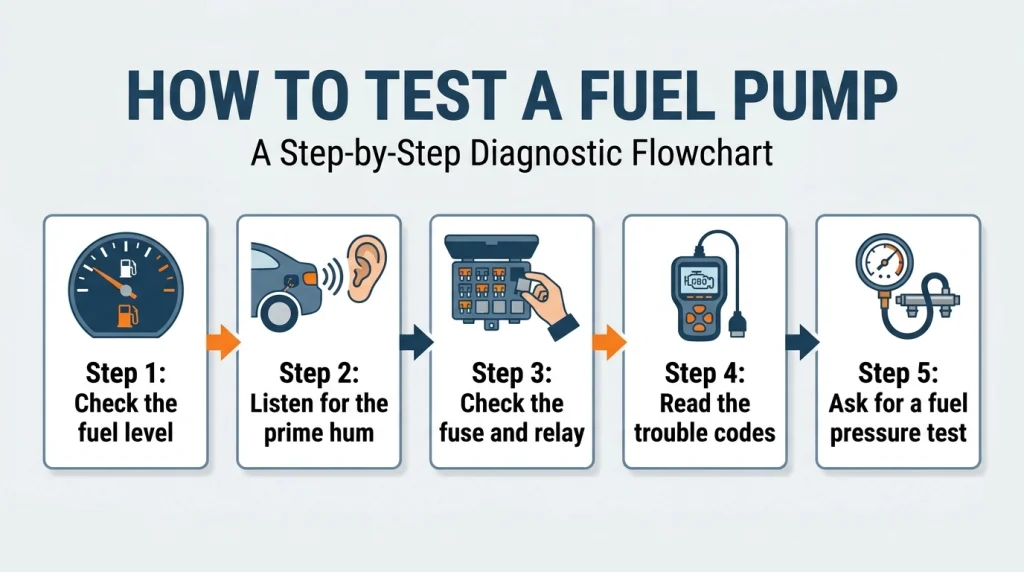
You test a fuel pump by starting with the free checks and ending with a pressure test. The free checks rule out the cheap parts, and the gauge reading against your carmaker’s figure proves whether the pump delivers enough fuel.
Step 1
Check the fuel level
Look at the gauge and add a few gallons if it reads low. A gauge can lie, and a pump that runs near empty gets hot and can be starved.
Step 2
Listen for the prime hum
Turn the key to ON without cranking and listen near the rear of the car. A short hum for 2 to 3 seconds is normal, while silence means the pump may have no power or has failed.
Step 3
Check the fuse and relay
Find the fuel pump fuse and relay in the fuse box. A blown fuse or a bad relay stops a good pump, so check both before you blame the pump.
Step 4
Read the trouble codes
Use a code reader or ask a shop to pull the codes. A low fuel pressure code such as P0087, or a pump circuit code such as P0230, points to the fuel system, but neither proves the pump failed.
Step 5
Ask for a fuel pressure test
A gauge on the fuel rail shows the pressure the pump delivers. Compare the reading to your carmaker’s figure, since most port-injected engines need about 30 to 60 psi.
A fuel pressure test is the step that settles the question, since a pump you can hear may still fall short under load.
What else can cause the same no-start?
Several cheaper parts can cause the same crank-no-start as a bad fuel pump. Check each one before you pay for a pump, since a fuse, a relay, or a clogged filter can stop a good pump.
The fuse and relay switch power to the pump, so a blown fuse or a failed relay leaves the pump silent. A bad relay can also fail only when hot, which makes the car stall and restart after it cools. Your owner’s manual shows which relay runs the pump.
Tip
Swap the fuel pump relay with an identical relay from the same fuse box, such as the air conditioning relay. If the pump runs after the swap, the relay was the fault.
A clogged fuel filter or a dirty strainer at the pump inlet blocks flow the same way a weak pump does. Dirt and rust from the tank collect at the inlet, and a clogged strainer can starve even a healthy pump.
The fuel pressure regulator holds pressure steady behind the injectors. A leaking regulator bleeds pressure away, so the engine cranks long or will not start, even with a healthy pump.
Spark and security faults can also mimic a fuel problem. A failed crankshaft position sensor can stop both spark and injection, and a flashing security light means the anti-theft system has cut fuel on purpose. When a jump did not help, the fault is rarely the battery, so fuel or spark is the place to look.
Can a fuel pump fail without warning?
A fuel pump can fail without warning, but most pumps give signs first. Sudden failure usually means an electrical fault, such as a blown fuse, a failed relay, or a broken wire, rather than a worn-out pump motor.
A worn pump motor usually fades over weeks, with longer cranks, hesitation, or a new whine before it quits. A pump that dies at once, with no hum at key-on and no earlier signs, often lost power rather than wearing out. That is why the fuse and relay come before the pump in any diagnosis.
Heat can make the failure come and go. A worn motor can overheat and shut down, then run again after it cools, so the car starts only sometimes and the pattern looks random. If the car stalls hot and restarts after a short wait, a failing pump sits near the top of the suspect list.
What should you do if your car will not start?
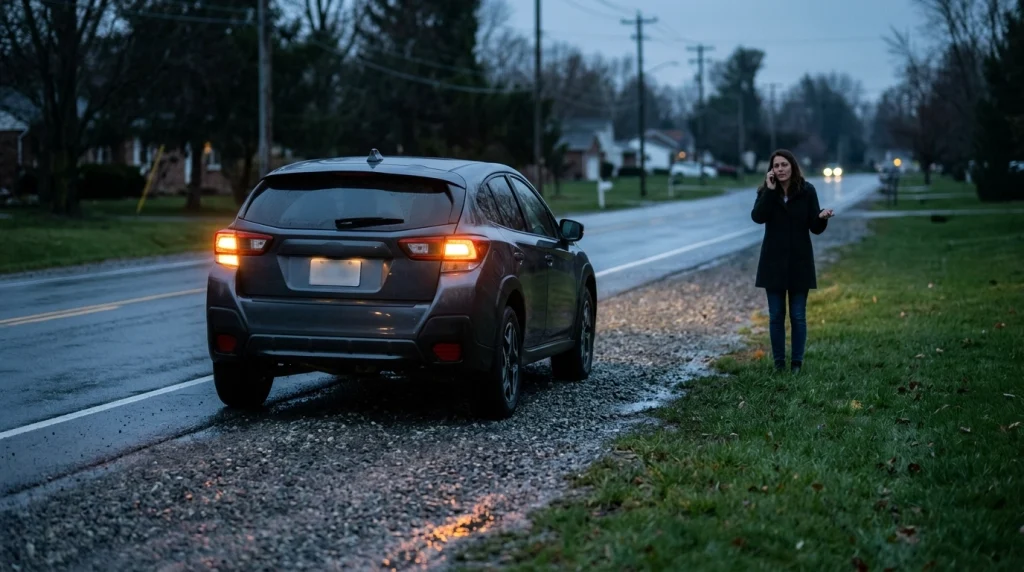
If your car will not start, run the safe checks once, then stop cranking and call for help. A failing pump can start the car once and stall it a short drive later, so a tow beats a second breakdown.
Cycle the key to ON two or three times without cranking, then crank. The pump runs for a couple of seconds each time and builds pressure before the engine turns. If the car starts, drive it straight to a shop on a short route and stay off the highway.
Warning
If you smell raw fuel or see fuel dripping, stop and do not drive the car. Fuel vapor can catch fire, so move away and call for help.
If the car stalls on the road, steer to a safe spot, switch on the hazards, and call for a tow. Tell the shop what you heard: whether the pump hummed, how long the crank lasted, and whether the car died hot or cold.
Do
- Check the fuel level and listen for the pump hum
- Cycle the key to ON two or three times, then crank
- Call for a tow if the car stalls in traffic
Avoid
- Spraying starting fluid into the engine
- Wiring the pump straight to the battery
- Replacing the pump before a pressure test
Could a recall cover your fuel pump?
A recall could cover your fuel pump, so check before you pay for a repair. Toyota, Honda, and Ford have all recalled vehicles for fuel pumps that can stall the engine.
Run your 17-character VIN through the NHTSA recall lookup to see if your car has an open recall. The VIN sits on the lower left of the windshield or on the registration card. If a recall covers your car, a dealer will fix it at no charge.
A recall lookup shows only unrepaired recalls, and it does not show recalls more than 15 years old. Ask a dealer about warranty programs too, since the lookup does not show those.
How can you help a fuel pump last longer?
You can help a fuel pump last longer by keeping fuel in the tank, using clean fuel, and following the service schedule for the filter. The pump has no set replacement interval, so habits and fuel quality decide how long it runs.
Keep the tank above a quarter full. Fuel around the pump acts as a coolant, so a pump that runs near empty runs hotter and wears faster. The Car Care Council also advises drivers to keep the tank at least half full in cold weather, to stop moisture forming in the fuel lines.
Dirty fuel, rust, and water can damage the pump and clog the inlet strainer. Change the fuel filter on the schedule in your owner’s manual, since a clogged filter makes the pump work harder.
Fuel Pump
A replacement fuel pump restores the fuel pressure your engine needs to start and run.
Frequently Asked Questions
Can you jump-start a car with a bad fuel pump?
A jump start will not fix a bad fuel pump, because the fault is missing fuel, not missing power. A jump powers the starter, while the pump still cannot deliver fuel. If a jump gets the car going, have the battery tested, and ask for a pressure test if the long crank returns.
Will a bad fuel pump turn on the check engine light?
A bad fuel pump can turn on the check engine light, often with code P0087 for low fuel pressure or P0230 for a pump circuit fault. The light alone does not prove the pump failed, since a clogged filter or a bad regulator can set the same codes. A fuel pressure test still settles the question.
Can you drive with a bad fuel pump?
You can drive a short distance with a failing fuel pump, but the next sign can be a stall in traffic. If the car has already stalled or lost power on the road, have it towed. If it only takes longer to start, keep the drive to a shop short.
How long does a fuel pump last?
An electric fuel pump typically lasts between 100,000 and 200,000 miles under normal driving conditions. Some last the life of the vehicle, while others fail earlier from low fuel levels or dirty fuel. There is no set replacement interval, so a pump is changed only when it fails or shows clear signs of wear.
Can running low on fuel damage the fuel pump?
Running low on fuel can damage the fuel pump over time, because the fuel around the pump acts as a coolant. A pump that runs near empty runs hotter and wears faster, and it can draw in sediment from the bottom of the tank. One low tank will not kill a healthy pump, but a habit of driving on empty will shorten its life.
Can a bad fuel pump lower fuel economy?
A bad fuel pump can lower fuel economy when it delivers too much fuel to the engine. A failing pressure valve can let excess fuel through, so the engine burns more than it needs. Many parts affect economy, so check the pump only when other symptoms point to it.
Conclusion
A bad fuel pump can prevent a car from starting, and a normal crank that never fires is the clearest sign. Check the fuel level, listen for the prime hum, and test the fuse and relay first. If the car still will not start, ask a shop for a fuel pressure test and check your VIN for a recall.

Alex Carter is an automotive content writer at VastAutoParts, focusing on car parts, vehicle troubleshooting, automotive tools, product research, and practical car care guides.