
Why Does a Car Struggle to Start in Cold Weather? Causes
Quick Answer
Cold weather drains power from your car battery and thickens the engine oil. Your battery makes less power because the reaction inside it slows down in the cold. Your engine needs more power because thick oil makes it harder to turn. That double squeeze is why a car that starts fine in warm weather can struggle on a cold morning.
- A weak battery is the most common cause, and cold exposes a battery that was already fading.
- Thick oil, frozen water in fuel lines, and worn starters also cause slow or failed starts.
- Listen to the crank: a slow crank points to the battery, while a fast crank with no start points to fuel or spark.
- Turn off lights and heaters before you crank, and try a jump start if the battery is flat.
- A battery test before winter and a full fuel tank prevent most cold-morning failures.
A car that struggles to start in cold weather usually has a battery, oil, or fuel problem that the cold has exposed. This guide walks through each cause, shows how to read the sound your car makes, and gives a 5-step check you can do on a cold morning. You will also learn simple habits that keep the problem from coming back.
In this article
- Why Does Cold Weather Make Starting Harder?
- What Are the Main Causes of Cold-Weather Starting Trouble?
- What Does the Sound Tell You About the Cause?
- What Should You Try on a Cold Morning?
- Why Do Diesel Cars Struggle More in the Cold?
- How Can You Prevent Cold-Weather Starting Problems?
- Should You Warm Up Your Car Before Driving?
- Frequently Asked Questions
- Conclusion
Why Does Cold Weather Make Starting Harder?
Cold weather makes starting harder because it cuts the power supply and raises the power demand at the same time.
A car battery makes power through a chemical reaction between lead plates and acid. Cold slows that reaction, so the battery delivers less current to the starter. The National Highway Traffic Safety Administration notes that battery power drops as the temperature drops, and engines need more power to start in the cold.
At the same time, cold oil thickens and resists flow through the engine. Thick oil forces the starter to work harder to spin the engine. Short trips make the problem worse, because the alternator gets little time to recharge the battery between starts.
Winter driving also draws more power from the battery. Lights, heater fans, heated seats, and defrosters all run at once on a cold morning. Short trips may not give the alternator time to replace that power, so the battery starts each morning a little weaker.
What Are the Main Causes of Cold-Weather Starting Trouble?
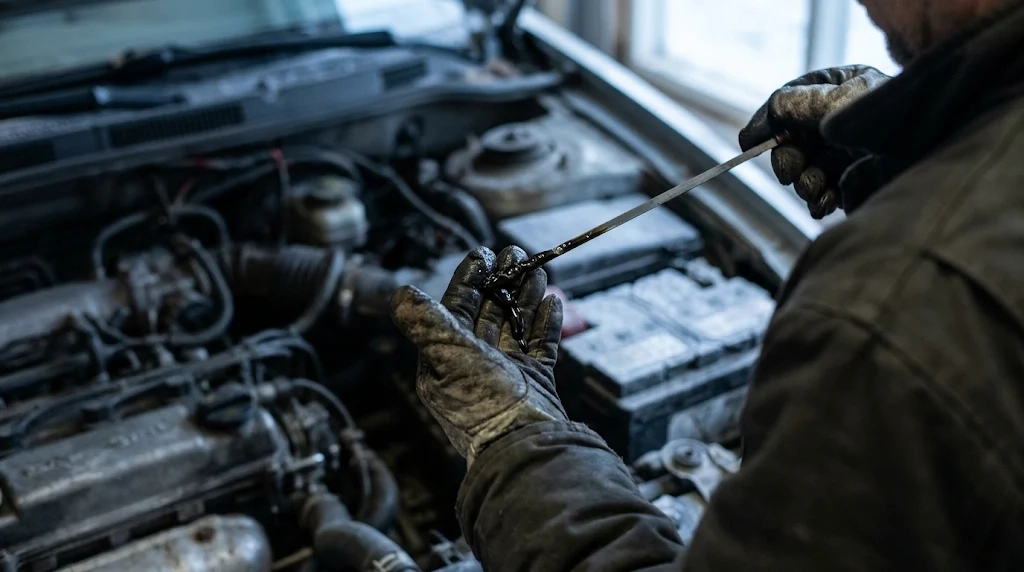
Five parts cause most cold-weather starting trouble: the battery, the oil, the fuel system, the starter, and the sensors.
A weak or aging battery
A weak battery is the most common reason a car struggles on a cold morning.
Batteries lose strength with age, and heat from past summers speeds that wear. AAA notes that a battery lasts about 3 to 5 years, so an older battery deserves a test before winter. The Family Handyman notes that even a battery in good condition loses about half its power at 0 F.
If you hear a rapid clicking sound when you turn the key, the battery may be too weak to spin the starter.
Warning
Never jump start a battery that looks frozen, swollen, or cracked. A frozen battery can burst and spray acid, so have a mechanic check it instead.
Thick engine oil
Thick oil makes the engine harder to turn, so the starter draws more current from an already weak battery.
Oil thickens as the temperature falls, and old oil thickens more than fresh oil. Your manual lists an oil grade for cold weather, and the right grade flows faster on a cold morning. A lower first number, such as 0W or 5W, means thinner oil at low temperatures.
Water in the fuel system
Water that gathers in the fuel tank can freeze in the lines and block fuel from reaching the engine.
Condensation builds up in the tank as temperatures swing, and water sinks below the gasoline. When the temperature falls below 32 F, that water can freeze in narrow fuel lines or jam the fuel pump. Gasoline also vaporizes less in the cold, so the engine gets a weaker fuel mix at startup.
A worn starter or alternator
A worn starter or a weak alternator can fail only in the cold, when the load on both is highest.
The starter needs full battery power to spin a cold engine, and worn brushes may not pass enough current. The alternator recharges the battery while you drive, so a weak one leaves the battery short after short trips. A car can still struggle with a brand-new battery if the alternator, starter, or a corroded cable is the real fault.
Faulty sensors
A faulty coolant temperature sensor can send the wrong signal and starve a cold engine of fuel.
A cold engine needs a richer fuel mix to start, and the sensor tells the computer how cold the engine is. If the sensor reads warm when the engine is cold, the mix stays lean and the engine may crank without firing. A check engine light with hard cold starts points to a sensor or wiring fault.
What Does the Sound Tell You About the Cause?
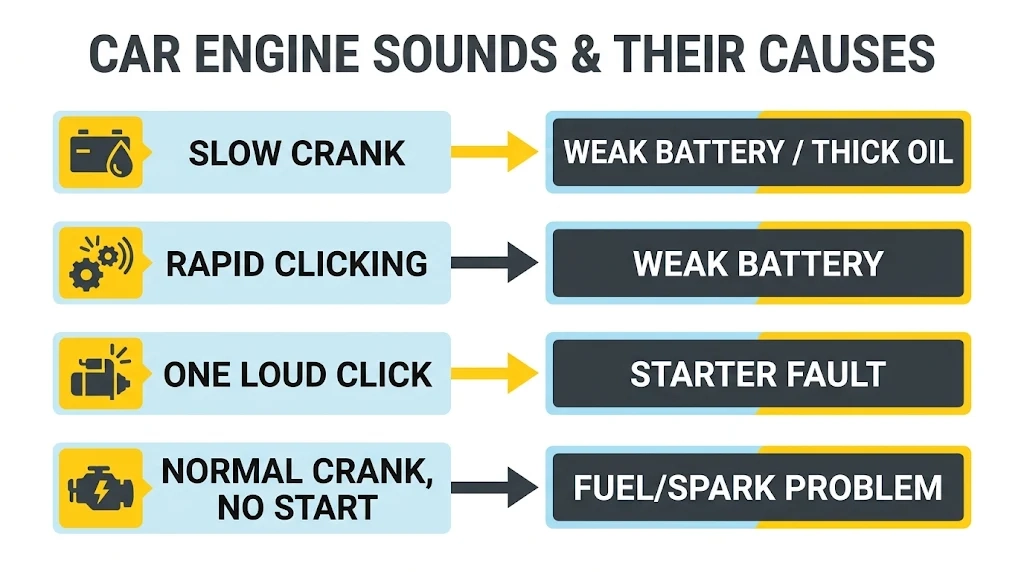
The sound your car makes when you turn the key points to the part that is failing.
This table matches each sound to its most likely cause and the first check to try.
| What you hear | Likely cause | First check |
|---|---|---|
| Slow, labored crank | Weak battery or thick oil | Test the battery and check the oil grade |
| Rapid clicking | Battery too weak to run the starter | Clean the terminals and try a jump start |
| One loud click | Starter or solenoid fault | Have the starter and solenoid tested |
| Normal crank, no start | Fuel or spark problem | Listen for the fuel pump hum at key-on |
| Silence and no lights | Dead battery or loose cable | Check the cable clamps and main fuses |
A slow crank almost always means a weak battery or thick oil, while a normal crank with no start means no fuel or spark.
If the engine needs several attempts to start, the cause may sit in the fuel system rather than the battery. Low fuel pressure and worn spark plugs both cause repeated failed starts.
What Should You Try on a Cold Morning?
Work through these five steps in order, and stop as soon as the engine starts.
Step 1
Turn everything off
Switch off the lights, heater, fan, and heated seats so the battery sends all its power to the starter.
Step 2
Turn the key to on and wait
Wait a few seconds with the key on so the fuel pump can prime the lines before you crank.
Step 3
Crank in short bursts
Crank for about 10 seconds at most, then wait a minute before you try again so the starter can cool.
Step 4
Try a jump start
If the crank stays slow, jump the car from a helper vehicle or a portable jump starter, and follow your manual.
Step 5
Drive for 30 minutes
Once the engine starts, drive for at least 30 minutes so the alternator can recharge the battery.
If the car starts with a jump but dies again the next morning, the battery may not hold a charge or the alternator may not recharge it.
Tip
Park facing out if you may need a jump start, so the helper vehicle can reach your battery with ease.
Why Do Diesel Cars Struggle More in the Cold?
Diesel cars struggle more in the cold because they start by compressing air until it is hot enough to ignite the fuel.
Cold air compresses to a lower temperature, so the engine needs glow plugs to heat the cylinders before it can fire. Worn glow plugs are the most common cause of hard diesel starts in winter. Diesel fuel can also thicken in severe cold, which slows fuel flow through the filter and lines.
If you drive a diesel, wait for the glow plug light to go out before you crank. Use winter-grade diesel when it is offered, and keep the tank full to limit condensation. A block heater warms the coolant overnight, which makes the first start of the day much easier.
How Can You Prevent Cold-Weather Starting Problems?
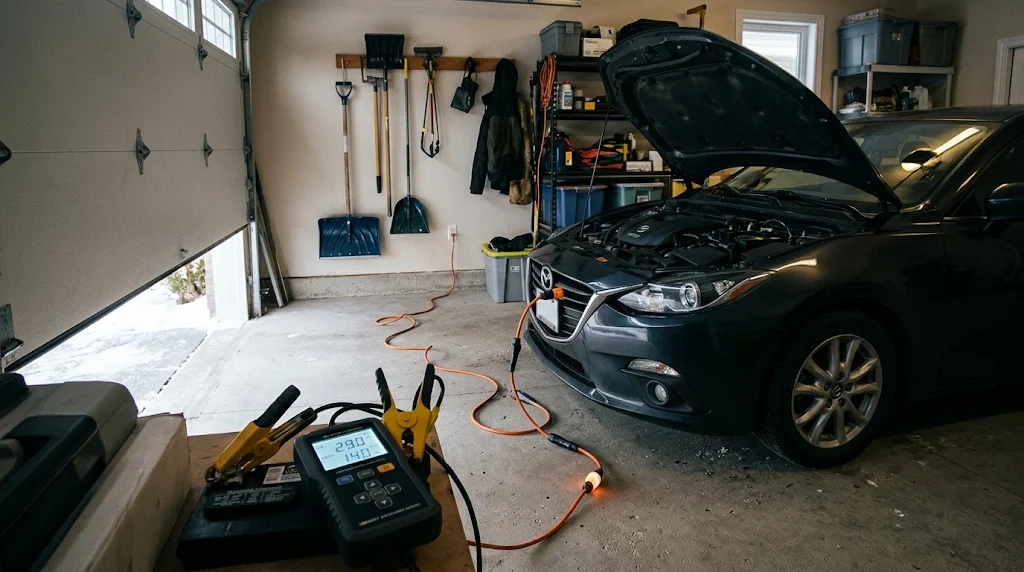
Most cold-morning failures are preventable with a battery test, a full tank, and the right oil.
AAA advises having the battery tested before winter, since a test can catch a weak battery before it fails on a cold morning.
Do
- Have the battery tested before winter
- Keep the fuel tank at least half full
- Park in a garage or a sheltered spot
Avoid
- Cranking for more than 10 seconds at a time
- Leaving lights and heaters switched on overnight
- Letting the fuel tank run near empty
A garage keeps the battery a few degrees warmer overnight, even without heat. A battery blanket or block heater helps in severe cold, and both plug into a normal outlet overnight.
Should You Warm Up Your Car Before Driving?
A modern car needs only a short idle before you drive gently away.
The engine warms up faster under light load than it does sitting still, and long idling wastes fuel. Drive gently for the first few minutes, and avoid hard acceleration until the temperature gauge rises. If ice covers the glass, clear it and run the defroster before you set off.
Older carburetor cars need a longer warm-up, because the choke must set before the engine runs smoothly.
Portable Jump Starter
A portable jump starter lets you restart a dead battery on your own, without a helper vehicle.
Frequently Asked Questions
How cold must it be before a car will not start?
A healthy car should start well below freezing, but a weak battery can fail near 32 F. The risk rises as the temperature falls, because battery power drops and oil thickens. A battery that is old or partly charged may fail on the first frosty morning.
Can a car battery freeze in winter?
A fully charged battery resists freezing, but a discharged battery can freeze and crack in severe cold. The acid inside a charged battery has a much lower freezing point than the weak acid in a flat one. Keeping the battery charged is the best defense against freezing.
Does pumping the gas pedal help start a cold car?
Pumping the gas pedal does not help a modern fuel-injected car and can flood the engine with fuel. Fuel injection meters the fuel on its own, so the pedal adds nothing useful. On older carburetor cars, one slow press can set the choke, but repeated pumping still floods the engine.
Why does my car start fine in summer but not in winter?
Summer heat wears a battery down over months, and winter cold exposes that hidden wear on the first frosty morning. Heat speeds up the wear inside the battery, while cold slows the chemical reaction that makes power. A battery that copes in warm weather may fail when the first cold morning asks more of it.
How long should I wait between starting attempts?
Wait about one minute between cranking attempts, and crank for no more than 10 seconds each time. Short bursts protect the starter motor from overheating. If the car does not start after three tries, stop cranking and check the battery, fuel, and connections instead.
Do electric cars struggle to start in cold weather?
Electric cars start in cold weather, but cold cuts their driving range and slows charging speeds. Their batteries store and deliver less energy at low temperatures, and the car uses power to heat the battery itself. Plugging in overnight keeps the battery in its best temperature range.
Conclusion
A car struggles to start in cold weather because the battery makes less power while the engine needs more. If your car cranks slowly on cold mornings, have the battery tested and check the oil grade before the next cold snap.

Alex Carter is an automotive content writer at VastAutoParts, focusing on car parts, vehicle troubleshooting, automotive tools, product research, and practical car care guides.