
Fix a Bad Ignition Switch Without Replacing It: 5 Fixes
Quick Answer
Heat kills most starter motors. A starter motor is built for short bursts of hard work. Long cranking, a weak battery, and poor connections force it to draw too much current and overheat. Oil leaks, dirt, and worn parts finish the job. Most failures trace back to heat, electricity, or wear, and many are preventable.
- Long cranking is the fastest killer: limit each try to 10 to 15 seconds.
- A weak battery forces the starter to pull more current, which builds heat.
- Oil leaks and corrosion attack the starter from the outside in.
- Worn brushes and a tired solenoid end the life of old starters.
Your starter motor works for only a few seconds each time you turn the key, yet it draws hundreds of amps on every start. That hard, short life makes it easy to kill. This guide explains what kills a starter motor, the warning signs to watch for, and the habits that help one last.
In this article
- What kills a starter motor most often?
- Can a weak battery kill a starter motor?
- How does long cranking burn out a starter?
- How do oil leaks and dirt damage a starter?
- What happens when a starter stays engaged?
- How does normal wear kill a starter motor?
- What are the signs a starter motor is dying?
- How can you make a starter motor last longer?
- Frequently Asked Questions
- Conclusion
What kills a starter motor most often?
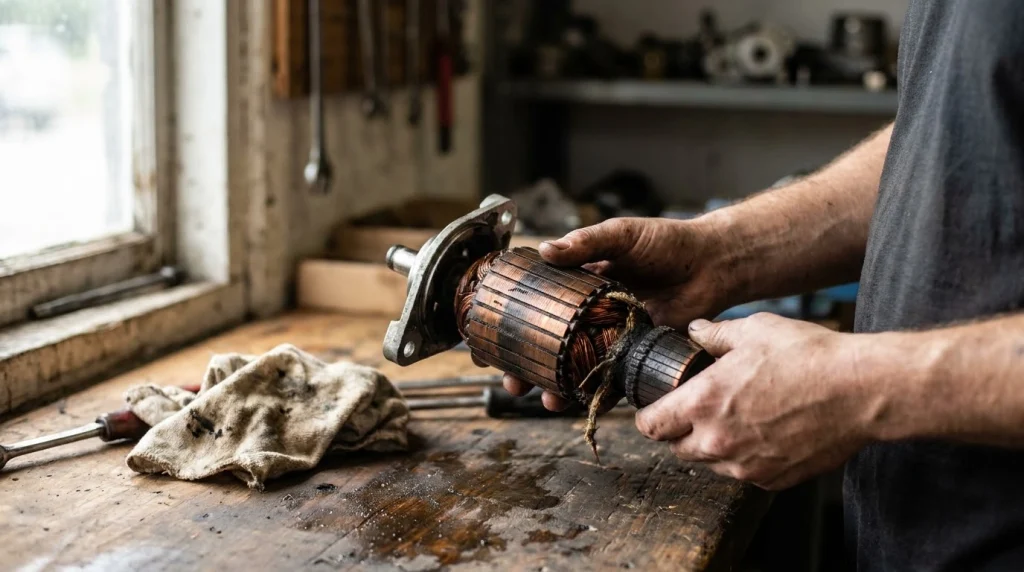
Heat kills a starter motor more often than any single part failure. A starter is a powerful electric motor built for short bursts, and it has no fan or cooling system. When anything makes it work too long or too hard, heat builds up inside and breaks down its windings, brushes, and insulation.
Seven killers account for most starter failures. Each one ends the same way: excess heat, excess current, or friction inside a motor that was never built to run for long.
- A weak battery that forces the starter to draw more current
- Corroded or loose connections that starve the starter of voltage
- Long cranking that overheats the windings
- Oil leaks that soak the brushes and cause shorts
- Dirt and moisture that jam moving parts and corrode terminals
- A stuck solenoid or switch that keeps the starter engaged
- Normal wear of brushes, bearings, and contacts over thousands of starts
Most dead starters suffer from more than one of these at once. A weak battery leads to long cranking, and long cranking builds the heat that finishes a worn starter. That is why fixing the outside causes matters as much as replacing the part.
Can a weak battery kill a starter motor?
Yes, a weak battery can kill a starter motor by forcing it to work harder on less voltage. A starter needs full battery power to spin the engine, and low voltage means it must pull more current to do the same job. That extra current turns into heat inside the copper windings.
Corroded or loose battery terminals cause the same harm. Corrosion acts like a resistor in the cable, so less voltage reaches the starter and the motor strains on every start. Engineer Fix notes that this resistance creates a cycle: low voltage raises current draw, and high current builds more heat.
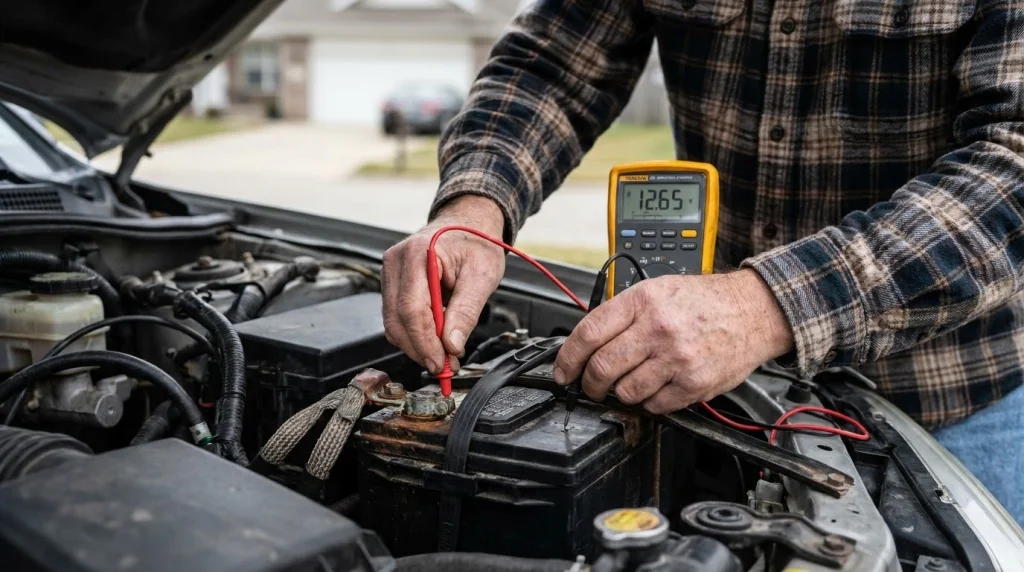
If your engine cranks slowly, test the battery before you blame the starter. A battery can look fine and still fail under load, so a voltage test tells you more than the dashboard lights. Watch for weak battery warning signs and replace a failing one early, before it takes the starter with it.
How does long cranking burn out a starter?
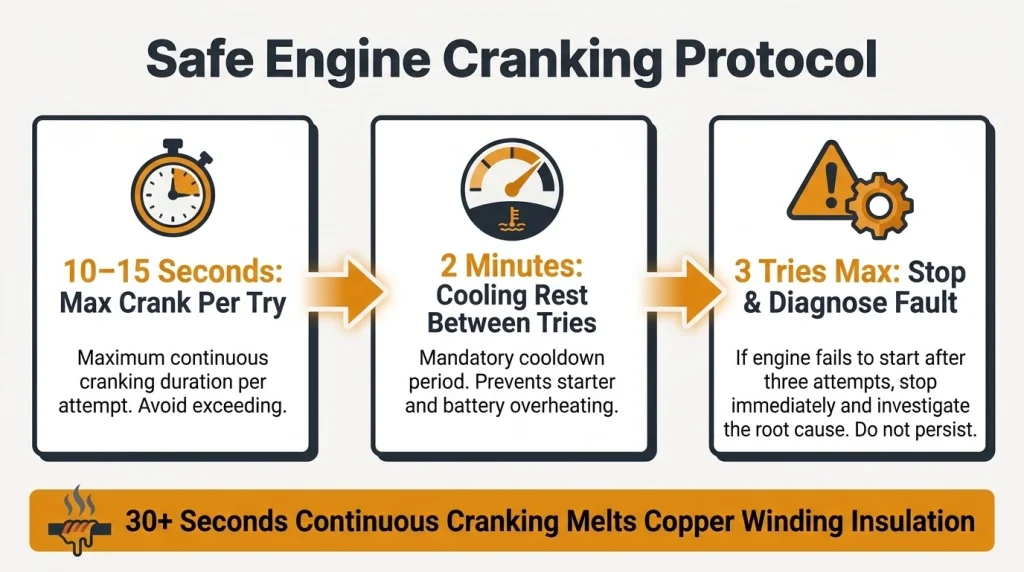
Long cranking burns out a starter because the motor has no cooling system and heats up fast. Engineer Fix explains that a starter is built for short bursts of 10 to 15 seconds, with a cooling rest between tries. Past that point, heat builds in the copper windings and melts the insulation around them.
Once the insulation melts, the bare wires touch each other or the motor housing and short out. Engineer Fix notes that cranking for 30 seconds or more without a break can reach that point in one attempt. The damage is permanent, and the starter will not recover on its own.
Warning
If the engine does not start after two or three short tries, stop cranking and find the cause. More cranking only heats the starter and drains the battery.
Engineer Fix recommends at least two minutes of cooling between attempts, and no more than three short tries before you stop and diagnose. A hard-starting engine has a cause, such as a fuel or spark fault, and cranking will not fix it. Finding that cause saves both the starter and the battery.
10 to 15 seconds
Longest safe crank per try
Source: Engineer Fix
2 minutes
Cooling rest between tries
Source: Engineer Fix
3
Short tries before you stop
Source: Engineer Fix
How do oil leaks and dirt damage a starter?
Oil leaks and dirt damage a starter by getting inside the housing and breaking down its parts. The starter sits low on the engine, close to seals and the road, so leaks and grime reach it easily. Damage builds slowly, and the first sign is often a starter that already struggles.
Engine oil is the worst of these invaders. HELLA explains that oil contamination on the starter motor soaks the carbon brushes, which then wear faster and mix with debris to form a conductive mass. That mass causes short circuits and contact problems until the starter fails.
Oil on the starter is also a sign of a leak that needs repair in its own right.
Dirt causes a slower kind of harm. Clutch dust and grit mix with grease inside the housing and form a thick paste that stops the pinion gear from sliding freely. The gear then disengages late, grinds against the flywheel, and wears out the teeth on both parts.
Moisture and road salt corrode the main power terminal, which adds resistance and heat to every start.
Fix oil leaks near the starter as soon as you spot them, and keep the area clean when the starter is replaced. A new starter fitted into a dirty, oily bay faces the same fate as the old one.
What happens when a starter stays engaged?
A starter that stays engaged after the engine starts spins far faster than it was built to spin. The running engine drives the small pinion gear through the flywheel, and the armature over-speeds within seconds. Centrifugal force and heat then destroy the windings, the commutator, and the bearings.
The usual causes sit outside the starter: a stuck solenoid, a jammed ignition switch, or a short in the wiring. Holding the key in the start position after the engine fires does the same thing. HELLA calls this a runaway starter and notes that it can wreck the motor in a short time.
You may hear a high whirring or ringing sound after the engine starts, or smell burning. If that happens, switch the engine off and get help instead of driving on. A starter that keeps running can overheat fast, and AAA warns that it can even produce smoke.
How does normal wear kill a starter motor?
Normal wear kills a starter motor one start at a time, as brushes, bearings, and contacts wear down. The carbon brushes press against a spinning copper commutator on every start, and they shorten a little with each one. When they grow too short, spring pressure drops and current stops flowing to the armature.
Other parts wear with them. Solenoid contacts pit and erode from arcing each time they close, and worn bearings let the armature rub against the field coils.
Each worn part adds friction or resistance, so the motor works harder and runs hotter. Wear is slow, but it is also certain.
AAA says most starter motors last 100,000 to 150,000 miles, which for many cars is the better part of the car’s life. A starter on a high-mileage car that cranks slowly has often simply reached the end of its service life. Age alone is a fair reason to replace it rather than repair it.
Do short trips wear out a starter faster?
Yes, short trips wear out a starter faster because each trip adds starts without adding miles. A delivery car or a city car racks up far more starts than a highway car. Mileage alone hides that wear, so count starts, not just miles, when you judge a starter’s age.
What are the signs a starter motor is dying?
A dying starter motor usually warns you with slow cranking, clicking, or grinding before it fails. Each sound points to a different fault, so listening at startup is the simplest check you own. The table below matches each warning sign to its likely cause and your next step.
| Warning sign | Likely cause | What to do |
|---|---|---|
| Slow cranking | Weak battery or worn starter | Test the battery first |
| Single loud click | Failed solenoid or poor connection | Check terminals and wiring |
| Rapid clicking | Low battery voltage | Charge or replace the battery |
| Grinding noise | Damaged pinion or flywheel teeth | Stop cranking and book a repair |
| Whirring with no crank | Motor spins without engaging | Book a repair soon |
| Smoke or burning smell | Overheated windings | Stop and get help right away |
Slow cranking and clicks often trace back to the battery or connections, while grinding and whirring point to the starter itself.
Do not ignore these signs and hope the car starts tomorrow. A starter that struggles today can refuse tomorrow, often in the worst place. Read the full list of failing starter motor symptoms to match what you hear with what it means.
How can you make a starter motor last longer?
You can make a starter motor last longer by keeping its power supply strong and its cranking time short. Most starter killers are outside the starter, so the habits that protect it are simple. Start with the battery, the connections, and the way you crank.
Tip
Clean your battery terminals at each oil change and tighten the clamps until they do not move. A clean, tight connection gives the starter full voltage on every start.
Short cranking tries and a healthy battery do most of the work. Fix slow starts early instead of cranking through them, and repair oil leaks before oil reaches the starter. These steps cost little and save the part that starts your car every day.
Do
- Keep the battery charged and test it at each service
- Fix oil leaks near the starter right away
- Wait two minutes between start attempts
Avoid
- Cranking for more than 15 seconds at a time
- Ignoring slow starts, clicks, or grinding
- Tapping the starter with a hammer
If you suspect the starter is already weak, you can check a bad starter without removing it, using simple tests at home. A voltmeter and a careful listen tell you whether the fault sits in the battery, the wiring, or the starter itself.
Some faults need no new parts at all. A loose cable, a dirty terminal, or a tired battery can mimic a dead starter, and each one is a simple fix. Learn how to fix a starter without replacing it before you pay for a new unit.
Starter Motor
If your starter has failed, a replacement starter motor is the part you need to get the car starting again.
Frequently Asked Questions
Can cold weather kill a starter motor?
Cold weather strains a starter motor because thick oil makes the engine harder to turn and a cold battery delivers less power. That mix forces longer, harder cranking on the coldest mornings. A strong battery and short cranking tries protect the starter in winter.
Can a bad alternator kill a starter motor?
A bad alternator can kill a starter motor indirectly by leaving the battery undercharged after every drive. The starter then cranks on low voltage, draws extra current, and overheats. Fix charging faults early, before low voltage wears out the starter.
Can tapping a starter motor damage it?
Tapping a starter motor can damage it, because some starters use brittle ferrite magnets that crack under hammer blows. HELLA warns against striking the housing during tests. If tapping ever frees a stuck starter, treat it as a warning and book a repair.
Does a starter motor die suddenly or slowly?
A starter motor usually dies slowly, giving warnings such as slow cranking, clicks, or missed starts before it stops. Sudden failure still happens, often from a stuck solenoid or a broken part inside. Any change in starting sound deserves a check.
Can a starter motor be repaired instead of replaced?
A starter motor can sometimes be repaired when only one part has failed, such as the solenoid, brushes, or drive gear. A full replacement makes more sense for an old, high-mileage starter with several worn parts. A mechanic can test the unit and advise which route fits.
Will a new starter fail if the cause is not fixed?
A new starter can fail again when the original cause stays in place, such as a weak battery, an oil leak, or corroded wiring. HELLA notes that fixing outside influences early prevents repeated failure. Always find and fix the cause before fitting a new starter.
Conclusion
Heat, weak power, and wear are what kills a starter motor, and most of that damage starts outside the starter itself. If your car cranks slowly or clicks, test the battery and check the connections before the starter pays the price.

Alex Carter is an automotive content writer at VastAutoParts, focusing on car parts, vehicle troubleshooting, automotive tools, product research, and practical car care guides.