
How to Fix a Starter Without Replacing It: 7 Checks
Quick Answer
You can often fix a starter without replacing it by correcting a weak battery, cleaning corroded terminals, tightening loose ground connections, or repairing a faulty starter relay. Start with simple electrical checks before blaming the starter motor. If its internal parts are damaged, professional rebuilding or replacement may still be necessary.
- Check the battery’s charge and condition.
- Clean and tighten the battery terminals.
- Inspect the engine ground and starter cables.
- Check the starter fuse, relay, and safety switches.
- Have the starter circuit tested before replacing parts.
Turning your key and hearing a click instead of the engine starting can be frustrating. Fortunately, learning how to fix a starter without replacing it may help you avoid an unnecessary repair.
Many starting problems involve the battery, wiring, or electrical controls rather than a failed starter motor. This guide explains what to inspect, which repairs are reasonable, and when professional help is the safer choice.
In this article
- Can You Fix a Starter Without Replacing It?
- How to Identify Starter Problems
- Safety Precautions
- 7 Steps to Fix Starting Problems
- Repairing Internal Starter Components
- Does Tapping the Starter Help?
- When Replacement Is Necessary
- Preventing Future Starter Problems
- Frequently Asked Questions
- Conclusion
Can You Fix a Starter Without Replacing It?
Yes, a car starter can sometimes work again without replacing the complete starter motor. The solution depends on whether the fault is outside the starter or inside its housing.
A starter motor is an electric motor that turns the engine during startup. Its solenoid is an electromagnetic switch that helps engage the drive gear and supplies power to the motor.
When you turn the ignition key or press the start button, the starting circuit activates the starter assembly. The starter then rotates the engine until it can run independently.
Several external problems can prevent this process even when the starter itself remains functional.
Problems You Can Often Fix Without a New Starter
- Weak battery: Charging or replacing the battery may restore normal cranking.
- Corroded terminals: Cleaning battery connections may restore electrical current flow.
- Loose ground cable: Securing the engine ground may correct an intermittent starting problem.
- Faulty starter relay: Replacing the relay may restore the start signal.
- Blown starter fuse: Repairing the cause and replacing the fuse may restore circuit operation.
- Damaged wiring: Repairing a broken or loose wire may restore power delivery.
- Worn starter contacts: Some starter designs allow individual components to be serviced.
These faults do not all require removing the starter motor. Checking the external electrical system first can prevent unnecessary work.
When the Starter Itself Needs Repair
An internally damaged starter may require professional repair or rebuilding. Certain designs allow replacement of brushes, solenoid contacts, or other serviceable components.
However, not every starter is designed for practical component-level repair. Some assemblies are sealed, difficult to access, or uneconomical to rebuild.
Testing the complete starting circuit helps determine whether rebuilding the original unit makes sense.
How Can You Tell Whether the Starter Is Bad?
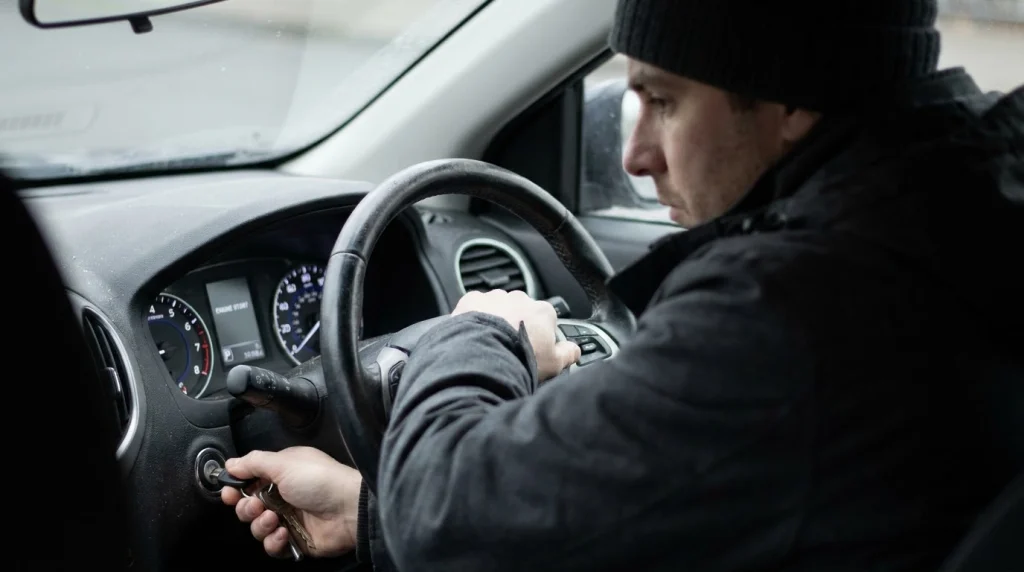
Starter symptoms provide useful clues, but no single sound proves that the starter motor has failed. Battery and electrical problems often produce similar behavior.
Listen carefully when attempting to start the engine. Notice whether the engine turns, whether the dashboard lights dim, and whether any clicking occurs.
The following table compares common symptoms, possible causes, and sensible next checks.
| Symptom | Possible Cause | Next Check |
|---|---|---|
| Rapid clicking | Weak battery or poor connection | Battery load test |
| Single loud click | Solenoid, cable, battery, or motor fault | Power and ground tests |
| No click or crank | Fuse, relay, switch, or wiring fault | Starter control circuit |
| Slow cranking | Low battery power, resistance, or motor wear | Battery and voltage-drop tests |
| Grinding noise | Starter gear or flywheel damage | Professional mechanical inspection |
| Engine cranks but will not start | Fuel, ignition, or engine control fault | Engine starting diagnosis |
A clicking sound alone is not enough to justify buying a starter. Confirm battery condition and electrical supply before making that decision.
What Safety Precautions Should You Take?
Starter troubleshooting must begin with a parked, secured vehicle and safe electrical working conditions. Starter cables carry substantial current and can create dangerous shorts.
Park on level ground, apply the parking brake, and switch off the ignition. Keep the transmission in Park for an automatic or Neutral for a manual transmission.
Wear eye protection and remove jewelry before handling battery connections.
Warning
Starter terminals can cause severe electrical shorts. Disconnect the battery before working on connections, and never bridge starter terminals or bypass safety switches.
Follow the vehicle manufacturer’s battery-disconnection instructions before electrical repairs. Some vehicles require special procedures to protect electronic settings and systems.
Never work underneath a vehicle supported only by a hydraulic jack. If starter access requires lifting the vehicle, use properly rated support equipment or a qualified mechanic.
Do not attempt charging or jump-starting if the battery is swollen, leaking, or physically damaged. Arrange professional assistance instead.
How to Fix a Starter Without Replacing It: 7 Checks
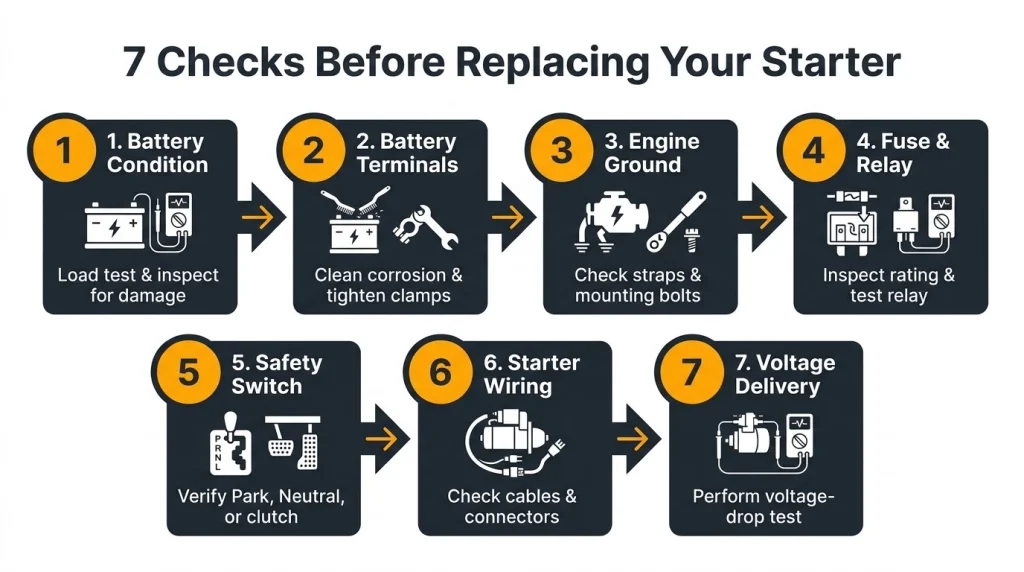
Fixing a starter problem without replacing the motor starts with the battery and moves through the electrical circuit. Each check helps eliminate a possible cause before more advanced testing.
These steps focus on common external faults. They do not require opening the starter motor or bypassing the vehicle’s safety equipment.
Step 1: Check the Battery Condition
A weak battery can prevent a healthy starter motor from turning the engine. Check the battery before spending money on starter repairs.
Turn on the headlights with the engine off and observe their brightness. Dim lights may suggest weak battery power or a poor connection.
However, bright headlights do not prove that the battery can deliver enough power to crank the engine. A proper load test provides better evidence.
- Switch off the ignition and electrical accessories.
- Inspect the battery for swelling, leakage, or physical damage.
- Have the battery tested with suitable equipment.
- Charge a discharged battery using the correct charging procedure.
- Retest the starting system after confirming battery condition.
If a weak battery caused the problem, restoring adequate battery power may resolve it. If the battery passes testing, continue checking the connections.
Step 2: Clean Corroded Battery Terminals
Corroded battery terminals can restrict current and make the starter operate poorly. Cleaning them may restore proper electrical contact.
Look for white, blue, or greenish buildup around the battery posts and cable clamps. Also check for loose clamps or visible cable damage.
Follow the manufacturer’s instructions when disconnecting the battery. For conventional systems, disconnect the negative cable before removing the positive cable.
- Disconnect the battery using the correct procedure.
- Inspect both terminal clamps for corrosion and damage.
- Use a battery terminal cleaning brush to remove accessible corrosion.
- Keep cleaning residue and moisture away from battery openings and electronics.
- Reconnect the positive cable first, then the negative cable, where the manufacturer specifies that sequence.
- Tighten the clamps securely according to the vehicle instructions.
Do not force a damaged or cracked terminal clamp into place. Damaged connections should be repaired or replaced.
For additional guidance, review AAA’s battery maintenance instructions.
Step 3: Inspect the Engine Ground Connection
A loose or corroded engine ground can prevent the starter from receiving a complete electrical circuit. The ground connection allows current to return toward the battery.
Many vehicles use a ground cable or strap connecting the engine to the battery or vehicle body. Corrosion or damage at these connections can cause starting problems.
With the ignition off and battery safely disconnected, inspect accessible ground points.
- Look for loose mounting bolts.
- Check for damaged or frayed ground straps.
- Inspect exposed terminals for corrosion.
- Check whether a cable connection appears overheated.
Clean accessible corrosion and secure connections using manufacturer specifications. A damaged ground cable may need replacement even when the starter motor is functional.
If the fault remains, a technician can perform a ground-side voltage-drop test.
Step 4: Check the Starter Fuse and Relay
A faulty starter relay or failed fuse can interrupt the electrical signal needed to activate the starter. These components should be checked before replacing the motor.
Locate the relevant fuse and relay using your vehicle’s owner’s manual. Their locations vary between vehicles.
Inspect the fuse only with the ignition off and follow the manufacturer’s instructions.
If the fuse is blown, investigate why it failed before installing a replacement. Use only the specified fuse type and rating.
A starter relay can sometimes be tested by temporarily exchanging it with an identical, compatible relay. This method is appropriate only when the manufacturer permits it.
Do not bridge relay contacts or insert wires into the fuse box to force the starter to operate.
AutoZone explains the proper procedures in its starter relay testing guide.
Step 5: Check the Park, Neutral, or Clutch Switch
A faulty transmission safety switch can prevent starter activation even when the motor works. These switches help prevent unintended vehicle movement during startup.
Automatic vehicles may use a park-neutral safety switch. Manual transmission vehicles commonly require the clutch pedal to be depressed before starting.
For an automatic vehicle, hold the service brake and apply the parking brake. Confirm that the shifter is fully seated in Park.
If the owner’s manual permits starting in Neutral, try that position with the vehicle secured. Starting in one position but not the other may suggest a switch or adjustment problem.
For a manual vehicle, confirm that the clutch pedal moves normally and reaches its required starting position.
Do not bypass either switch. Have a qualified technician inspect the interlock circuit if a fault is suspected.
Step 6: Inspect Accessible Starter Wiring
Loose, corroded, or damaged starter wiring may prevent normal operation. The starter relies on both a high-current battery cable and a control connection.
First, consult the vehicle’s repair information to identify the starter location. Access varies significantly between engine layouts.
With the battery disconnected, visually inspect accessible wiring and connectors. Look for damaged insulation, loose plugs, corrosion, or signs of overheating.
Do not touch exposed starter terminals or remove wiring without the correct repair procedure.
Repairing a damaged connector or cable may restore starting without replacing the starter assembly. Cable repairs must use materials suitable for the circuit’s electrical load.
If the starter is difficult to access, leave the inspection to a professional. Removing unrelated components without repair information can cause additional problems.
Step 7: Test Voltage Delivery to the Starter
Voltage-drop testing can reveal electrical resistance that prevents the starter from working properly. It is especially useful when the battery tests well but cranking remains weak.
A voltage-drop test measures voltage lost across a cable or connection while electrical current flows. Excessive loss may indicate corrosion, loose connections, or damaged wiring.
A qualified technician can test the positive supply and ground return circuits. The results help identify whether the fault is outside the starter.
The technician can also check whether the solenoid receives the correct start signal.
If the starter receives suitable power, ground, and control signals but still fails, an internal fault becomes more likely.
Automotive component manufacturer HELLA provides further detail in its starter troubleshooting guide.
Can You Repair Parts Inside the Starter Motor?
Some starter motors can be repaired internally without replacing the complete assembly. Whether this is practical depends on the design, damage, and availability of service parts.
Internal repairs generally require starter removal, specialized tools, and accurate electrical testing.
Replacing Worn Starter Brushes
Starter brushes transfer electrical current to the rotating parts of certain starter motors. Worn or sticking brushes can interrupt motor operation.
Some serviceable starters allow replacement of brushes and related parts. However, replacing the brushes will not repair damaged motor windings or a badly worn commutator.
A commutator is the contact surface that works with the brushes to deliver current within the motor.
A rebuild specialist can inspect these parts and determine whether brush replacement is worthwhile.
Servicing Starter Solenoid Contacts
Worn solenoid contacts can prevent electrical power from reaching the starter motor. Some starter designs allow their contacts or solenoid assembly to be serviced separately.
Other starters use integrated or non-serviceable arrangements. In those cases, replacing the complete assembly may be the practical repair.
A clicking solenoid does not automatically mean its contacts are functioning. Proper testing is needed before choosing a repair.
Cleaning Internal Components
Contaminated or sticking internal components can sometimes be cleaned during a professional starter rebuild. However, cleaning cannot restore badly burned windings or broken mechanical parts.
Oil or coolant contamination also requires attention to the original leak. Otherwise, the repaired unit may develop problems again.
Do not spray lubricants or cleaning chemicals into an installed starter without manufacturer instructions. Unsuitable chemicals can damage electrical insulation and internal components.
Can Tapping a Starter Make It Work Again?
Tapping a failing starter may occasionally change its behavior, but it does not provide a dependable repair. A temporary response can suggest worn or sticking internal components.
Some worn starter motors operate intermittently when internal electrical contact changes. However, a successful start after a tap does not prove which component failed.
Striking the starter can damage its housing, nearby wiring, connectors, or internal components.
Reaching a starter from beneath a vehicle can also expose you to moving parts and electrical hazards.
Instead of relying on tapping, have the battery, cables, solenoid, and motor tested. A temporary return to normal starting should not be treated as proof that the fault is gone.
When Is Starter Replacement Necessary?
Starter replacement may be necessary when internal damage remains after the battery, wiring, control circuit, and ground connections are verified.
Not every defective starter needs immediate replacement, but some failures cannot be corrected through external maintenance.
Common reasons for considering replacement include:
- Severely damaged internal motor windings.
- A worn or damaged starter drive mechanism.
- Extensive internal heat damage.
- Damaged components without available repair parts.
- Persistent failure despite proper electrical supply.
- Internal mechanical damage that makes rebuilding impractical.
A grinding noise or a starter that spins without turning the engine may indicate drive gear problems. Related damage to the flywheel or flexplate can also require inspection.
Stop attempting to start the engine if loud grinding occurs. Repeated attempts may worsen mechanical damage.
If the starter continues running after the engine starts, switch the engine off when safe. Arrange professional diagnosis before driving again.
Should You Repair, Rebuild, or Replace the Starter?
Choose a repair based on confirmed test results rather than symptoms alone.
If you
Find a weak battery, dirty terminal, or loose external connection.
Choose external repair, because the starter itself may still be healthy.
If you
Have a serviceable starter with confirmed brush or contact wear.
Choose professional rebuilding when parts and labor make the repair practical.
If you
Have confirmed severe internal damage or a non-serviceable assembly.
Choose replacement after confirming the correct part and repair procedure.
A professional diagnosis is especially valuable when several starting-system faults produce the same symptoms.
How Can You Prevent Future Starter Problems?
Keeping the battery and electrical connections in good condition can reduce preventable starter problems. Maintenance cannot stop all internal wear, but it can help avoid unnecessary electrical strain.
Inspect the battery area during routine vehicle maintenance. Look for corrosion, damaged cables, and insecure connections.
Have the battery and charging system checked if the engine cranks slowly or the battery repeatedly loses charge.
Avoid repeated starting attempts when the engine fails to turn normally. Continued cranking can drain the battery and add stress to starting components.
Investigate fluid leaks around the starter and surrounding wiring. Oil or coolant contamination may affect electrical parts.
Keep engine and electrical repairs consistent with the manufacturer’s service instructions. Correct cable routing, mounting, and heat protection matter for reliable starting.
Tip
Ask for a battery load test and starting-circuit voltage-drop test before approving starter replacement. These checks help separate external resistance from motor failure.
Address intermittent starting problems before they become complete no-start conditions. A car that starts after several attempts may still have an unresolved electrical or mechanical fault.
Battery Terminal Cleaning Brush
A battery terminal cleaning brush helps remove accessible corrosion from battery posts and clamps during routine electrical maintenance.
Frequently Asked Questions
Can a jump-start help a car with starter trouble?
A jump-start may help when low battery power prevents the starter from operating, but it cannot repair a damaged starter motor. If the vehicle starts with additional battery power, test its battery and charging system. Follow the manufacturer’s jump-start procedure and never jump-start a damaged battery.
Can a failing alternator cause starter problems?
A failing alternator can leave the battery undercharged, preventing an otherwise functional starter from turning the engine. The alternator normally replenishes battery charge while the engine runs. If the battery repeatedly becomes discharged after charging, have the charging system tested before replacing the starter.
Why does my starter work when the engine is cold?
A starter that works when cold but fails when hot may have heat-sensitive electrical or mechanical problems. Worn internal parts, electrical connections, or other starting-system faults can contribute to intermittent operation. A technician should test the vehicle during the conditions that reproduce the problem.
Can the dashboard lights work with a bad starter?
Dashboard lights can illuminate even when the starter motor cannot turn the engine because lights require less electrical power. A weak battery or poor connection may still be responsible. Battery load testing and starter circuit checks help distinguish these conditions from a failed motor.
Can a car security system prevent starter operation?
A vehicle security or immobilizer system can prevent starter operation when it does not authorize the starting process. Depending on the vehicle, a warning light or message may appear. Follow the owner’s manual for key recognition and security troubleshooting rather than bypassing the system.
Is it safe to drive after a temporary starter fix?
Driving after a temporary starter improvement may leave you stranded because the original fault can return without warning. If a loose connection was repaired correctly and normal operation was verified, the situation may be different. Seek professional inspection when the fault remains intermittent or unexplained.
Conclusion
You can often learn how to fix a starter without replacing it by checking the battery, terminals, ground connections, relays, and wiring first. These simple checks can reveal problems outside the starter motor.
If the starting circuit tests correctly but the motor still fails, arrange professional diagnosis to decide whether rebuilding or replacement is necessary.

Alex Carter is an automotive content writer at VastAutoParts, focusing on car parts, vehicle troubleshooting, automotive tools, product research, and practical car care guides.