
Can I Still Drive With a Bad Starter? What to Do Next
Quick Answer
Yes, you can drive with a bad starter if the engine is running and the car runs normally. The starter works only for a few seconds during startup, then it disengages from the engine. Driving does not use the starter, so steering, braking, and power stay normal. The main risk is the next restart, which may fail without warning.
- Drive straight to a repair shop or a safe place to park.
- Avoid extra stops, because each stop needs another start.
- Do not drive if you hear grinding, smell burning, or see smoke.
- Get the battery and starter tested before you replace any part.
You turned the key, heard a click or a slow crank, and the engine finally started. Now you wonder whether the trip ahead is safe.
This guide answers the question, can I still drive with a bad starter? It shows when a short drive makes sense, when towing is safer, and what to check next.
In this article
- What Does a Starter Do Once the Engine Runs?
- How Long Can You Drive With a Bad Starter?
- When Is a Short Trip With a Bad Starter Okay?
- When Should You Stop and Call a Tow?
- What Are the Signs of a Bad Starter?
- Is It the Starter or the Battery?
- How Can You Start the Car Temporarily?
- Can a Bad Starter Damage Other Parts?
- What Should You Do Next?
- Frequently Asked Questions
- Conclusion
What Does a Starter Do Once the Engine Runs?
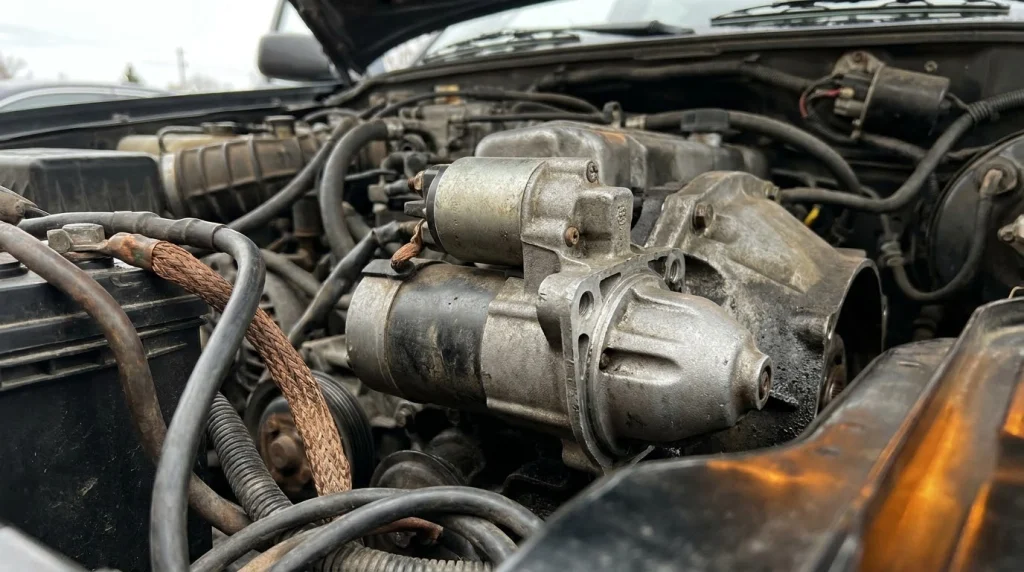
A starter motor turns the engine only until combustion can keep the engine running on its own. When you turn the key or press the start button, the starter solenoid moves a small pinion gear against the flywheel.
The solenoid is an electrical switch, and the flywheel is the large ring gear on the engine. The starter spins the engine, and the gear pulls back once the engine fires.
The AA guide to common starter motor problems explains that the starter disengages and turns off once the engine runs. That fact explains why a failing starter rarely changes how a car drives. Steering, braking, shifting, and engine power run without the starter after startup.
A starter fault is a starting problem, not a driving problem, in most cases. If the engine will not turn at all, the failing starter motor symptoms can help you narrow the cause before you blame the starter. A car that stalls or loses power while driving usually has a different fault, such as a fuel, ignition, or charging problem.
How Long Can You Drive With a Bad Starter?
No safe time or distance limit exists for driving with a bad starter, because failure of the next start cannot be predicted. The engine can keep running for a long trip once it starts, since the starter plays no part in driving. That mechanical fact does not make a long trip a good plan.
Every stop creates a restart, and each restart can be the one that fails. Fuel stops, school pickup, and heavy traffic all add chances to stall or switch off. A starter that works sometimes often fails more often as its parts wear.
Treat the car as a one-trip vehicle until it is fixed. Drive to one useful destination, such as home or a repair shop, and park where help can reach you. Do not plan a route that needs fuel, food stops, or a return leg the same day.
If the engine stalls in traffic, a bad starter turns a small problem into a blocked lane. Keep your phone charged and know where roadside help can meet you. A short drive with a plan beats a long drive with hope.
When Is a Short Trip With a Bad Starter Okay?
A short, direct trip can make sense when the engine runs smoothly, no warning lights point to a charging fault, and you have a safe destination. The trip should have one purpose and one parking spot at the end. If the car starts only after many tries, drive to a repair shop, not to errands.
Check four things before you leave. The battery warning light should be off, the engine should idle smoothly, the lights should stay bright, and the car should shift and brake normally. If any of those checks fails, the fault may reach past the starter.
- Drive directly home or directly to a repair shop.
- Avoid stops that force you to switch the engine off.
- Keep the route short and stay near help if you can.
- Park where a tow truck can reach the car.
The cards below match three common situations to the safer choice.
If you
Engine started after a slow crank and runs smoothly
Choose a direct drive to a repair shop, because each extra stop adds a restart risk.
If you
Need fuel, food, and other errands today
Choose one trip home first, because errands can wait until the car starts reliably.
If you
Hear a click, then the engine starts on a later try
Choose diagnosis before a long drive, because an intermittent starter can fail on the next attempt.
When Should You Stop and Call a Tow?
A tow is the safer choice when the car will not start, shows signs of electrical heat, or has a starter that stays engaged after startup. A starter that keeps grinding after the engine runs can damage gear teeth fast. Smoke or a burning smell points to overheating wires or a short circuit.
Stop driving and arrange a tow when any of these warning signs appear.
- The engine will not crank or start at all.
- Grinding or whining continues after the engine starts.
- You smell burning insulation or see smoke.
- The battery warning light stays on while you drive.
- Headlights or dashboard lights fade while you drive.
- The engine stalls, runs rough, or will not hold idle.
Repeated cranking can drain the battery and overheat the starter, cables, or wiring. A tow costs less than a damaged flywheel or a burned wire harness. If the car sits in an unsafe spot, move to safety first and call for help from there.
Warning
Grinding, smoke, or a burning smell means stop trying to start the engine. Continued cranking can damage the flywheel and overheat wiring, so arrange a tow instead.
What Are the Signs of a Bad Starter?
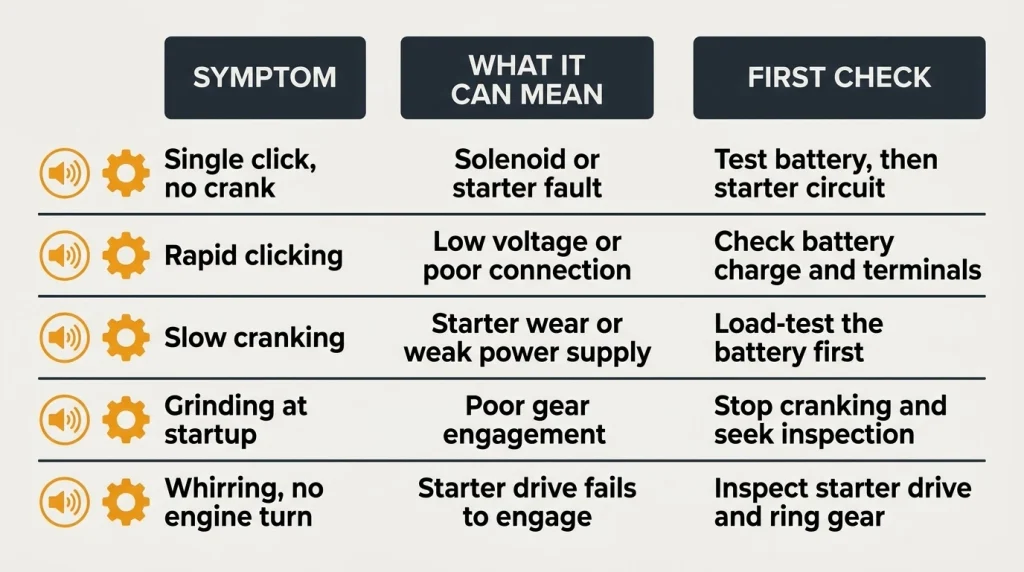
Bad starter signs include a single click with no crank, slow cranking, grinding, whirring without engine movement, and starts that work only sometimes. Each sign points to a part of the starting system, but none proves the starter alone has failed. Note the sound, the dashboard lights, and whether the engine turns at all.
The table compares common starting symptoms with their likely meaning and the first check for each one.
| Symptom | What it can mean | First check |
|---|---|---|
| Single click, no crank | Solenoid or starter fault | Test the battery, then the starter circuit |
| Rapid clicking | Low voltage or poor connection | Check battery charge and terminals |
| Slow cranking | Starter wear or weak power supply | Load-test the battery first |
| Grinding at startup | Poor gear engagement | Stop cranking and seek inspection |
| Whirring, no engine turn | Starter drive fails to engage | Inspect the starter drive and ring gear |
Sounds narrow the search, but no sound alone proves the starter has failed.
Intermittent starts deserve attention even when the car starts fine today. A starter can work in the morning and fail at the fuel pump in the afternoon. Keep a note of when the fault happens, since heat and repeated tries can change the result.
Is It the Starter or the Battery?
A weak battery can look like a bad starter, because both faults can cause clicks, slow cranking, or silence when you turn the key. The battery supplies power, while the starter turns the engine with that power. A fault in either part can leave the engine still.
Rapid clicking with dim lights usually points to low power reaching the starter. A single firm click with bright lights points more toward the starter circuit, but bright lights do not prove the battery is healthy. Corroded cables and loose clamps can also starve a good starter of power.
A fully charged battery may read about 12.6 volts with the engine off, but voltage alone cannot confirm battery health. A load test shows whether the battery can deliver power under demand. Use this guide to tell whether the starter or battery is the cause before you order parts.
A jump-start that works points to a power supply problem, not proof that the battery itself has failed. A failed jump-start does not prove the starter is bad, since poor cable contact can also block the start. Test the battery, cables, and charging system before you replace the starter.
How Can You Start the Car Temporarily?
Temporary starting methods can move the car to a safe place, but none of them repairs a failed starter. Use them only to reach help, and stop if you hear grinding or smell burning. Work away from traffic, moving belts, and hot engine parts.
A jump-start helps only when weak battery power is part of the problem. Follow the AAA jump-start safety guide for cable order and battery checks before you try a jump-start. Check the owner manual first, since some makers warn against jump-starting to protect the electronics.
Lightly tapping the starter housing can free a stuck solenoid or restore worn contact for one more start. This trick is unreliable, and you should never reach near moving or hot parts to try it. Push-starting works only with a manual transmission, a safe clear area, and a rolling car in gear.
Do not bypass the starter solenoid with a tool unless a trained mechanic does the work. Bridging live terminals can cause sparks, burns, and damage to the wiring. Before you try a temporary start, starter checks without removal can rule out a loose cable or a weak battery.
The lists below separate safe short-term steps from moves that add risk.
Do
- Drive straight to a repair shop.
- Keep jumper cables or a jump pack in the car.
- Note the sound and lights for the mechanic.
Avoid
- Repeated long cranking attempts.
- Bypassing the solenoid with a tool.
- Push-starting in traffic or on a steep slope.
A temporary start buys one trip, not a fixed car. Park at the repair shop or at home, and switch the engine off only when you are ready to leave the car there. If the car will not start again, call for a tow rather than forcing more attempts.
Tip
Park where a tow truck can reach the car easily if the next start fails. A flat, open spot near the street saves time and keeps you clear of traffic.
Can a Bad Starter Damage Other Parts?
A bad starter can damage nearby parts when grinding wears gear teeth, a stuck starter stays engaged, or repeated cranking overheats wiring. Grinding can wear the flywheel ring gear, which turns a starter job into a larger repair. A starter that stays engaged spins at engine speed and can wreck its own drive gear.
Repeated starting attempts also drain the battery and strain the cables and solenoid. Heat from long cranking can melt insulation and damage connections. Fixing the starter early keeps one fault from creating several repair bills.
What Should You Do Next?
A starting-system test is the next step, and you should drive only as far as needed to reach help until the fault is confirmed. A test should cover the battery, cables, charging system, and starter circuit. Ask the shop to name the failed test before you approve any part.
- Drive straight to a repair shop or a safe parking spot.
- Write down the sound, the lights, and how many tries it took.
- Ask for a battery load test and a starter circuit test.
- Ask for a written estimate before you approve the repair.
- Keep roadside help numbers ready until the car starts reliably.
Ask for a written estimate so you can compare the starter repair cost with the diagnosis before you approve the work. A starter job can also reveal worn cables or a damaged ring gear, so ask what the estimate covers. The cheapest fix is the one that repairs the confirmed fault.
Portable Jump Starter
A portable jump starter can help when a weak battery is part of the starting problem, but it cannot fix a failed starter motor.
Frequently Asked Questions
How long does a car starter last?
A car starter often lasts about 100,000 to 150,000 miles, according to Vehicle Codex, but heat, moisture, short trips, and start cycles change that span. A starter can fail sooner when oil leaks onto it or the battery stays weak. Test the starting system at the first sign of trouble, even when the car still starts.
Can you push-start an automatic car?
An automatic car cannot be push-started, because its transmission cannot turn the engine from the rolling wheels in the same way. Push-starting works only with a manual transmission and a safe, clear area. If an automatic car will not start, arrange a jump-start test or a tow instead of pushing it.
Can cold weather make starter problems worse?
Cold weather can make starter problems worse, because cold thickens engine oil and lowers the battery power available for cranking. A weak starter may crank slowly on a cold morning and work fine after the engine warms. Keep the battery charged and have slow cold cranking tested before it turns into a no-start.
Can a bad starter drain the car battery?
A bad starter does not drain a parked battery by itself, but repeated failed cranking attempts can run the battery down. Each attempt draws a large current without starting the engine. Stop after a few tries, check the battery, and arrange a test instead of cranking until the battery dies.
Is a bad starter an emergency repair?
A bad starter is an urgent repair, but it is not a safety emergency like failing brakes or steering. The car can lose its ability to start without warning, which can strand you in an unsafe place. Book a diagnosis soon, and avoid trips that depend on several restarts.
What should you do if the car stalls with a bad starter?
A stalled car with a bad starter needs a safe stop first, then help, because the engine may not restart. Move clear of traffic if you can, switch on the hazard lights, and set the parking brake. Call roadside assistance instead of cranking the engine many times in traffic.
Conclusion
You can still drive with a bad starter once the engine is running, but every shutdown is a gamble on the next start. Drive straight to a repair shop or a safe parking spot, and book a starting-system test before the starter fails completely.

Alex Carter is an automotive content writer at VastAutoParts, focusing on car parts, vehicle troubleshooting, automotive tools, product research, and practical car care guides.