
Fix a Bad Ignition Switch Without Replacing It: 5 Fixes
Quick Answer
Yes, you can fix a bad ignition switch without replacing it when the fault is dirt, a worn key, or a loose connection. Cleaning the contacts, using the spare key, freeing a locked steering column, and tightening the wiring often restore normal starting. A switch with burned contacts or a broken internal part still needs a new switch.
- Test the spare key first to rule out a worn key.
- Disconnect the battery before you touch any switch wiring.
- Clean dirty contacts with electrical contact cleaner and a soft cloth.
- Replace the switch if the car stalls while driving or the key will not turn at all.
Your key turns, but nothing happens, or the dash lights flicker each time you twist it. This guide covers the fixes you can try at home, in order, before you pay for a new switch. You need only basic tools, and you can work through the checks from simplest to hardest.
In this article
- Can You Fix a Bad Ignition Switch Without Replacing It?
- First, Confirm the Ignition Switch Is the Problem
- Try the Spare Key and Lighten the Key Ring
- Free a Stuck Key and a Locked Steering Column
- Clean the Ignition Switch Contacts
- Tighten and Clean the Wiring Connections
- Swap the Starter Relay and Check the Fuses
- How to Start the Car While the Switch Is Faulty
- When a Repair Will Not Work
- How to Keep the Ignition Switch Working Longer
Can You Fix a Bad Ignition Switch Without Replacing It?
A bad ignition switch can often be fixed without a new part when the cause is dirt, a worn key, or a loose wire. These faults stop the switch from making a clean electrical connection, and cleaning or tightening restores it. A switch with burned contacts, a cracked body, or broken internal parts cannot be repaired, and it needs replacement.
Start with the simplest checks first. A spare key test and a look at the wiring cost nothing and rule out the most common causes. Work through the fixes in this guide in order, and stop at the first one that restores normal starting.
If you
turn the key and nothing happens at all
Choose the spare key test and the wiring check, because a worn key or a loose wire is the likely cause.
If you
see the dash lights flicker when you move the key
Choose contact cleaning, because dirty contacts break the connection as the key moves.
If you
cannot turn the key at all
Choose the steering lock check, because a locked column jams the key before the switch can work.
First, Confirm the Ignition Switch Is the Problem
An ignition switch fault shows up as a key that turns with no crank, dash lights that flicker or die, or an engine that stalls while you drive. These signs point to the switch because it feeds power to the starter and the dash circuits. A weak battery or a bad starter can cause the same no-crank symptom, so check those first.
Turn the key to the run position and watch the dash lights. Lights that stay bright while the starter stays silent point away from the battery. A key that feels loose, or one that slips out while the switch is on, points to a worn switch or cylinder.
Several faults mimic a bad ignition switch, so rule them out before you open anything. A weak battery, a bad starter, and a blown fuse can each stop the engine from cranking. Read about problems that look like a bad starter to compare the symptoms before you blame the switch.
An immobilizer fault can also block starting while the key and switch work fine. If the security light flashes on the dash, the anti-theft system may be the cause. An immobilizer can stop a car from starting, so check that path when the switch tests fine.
Try the Spare Key and Lighten the Key Ring
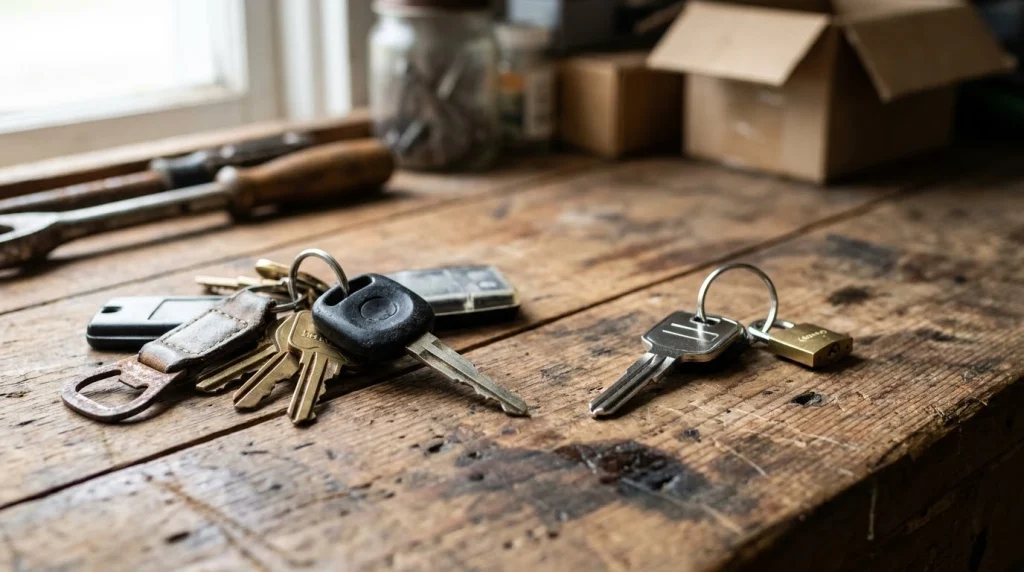
A worn key is the simplest cause of a switch that will not turn or start the car. Key teeth wear down over years of use, and a worn key cannot move the pins inside the lock cylinder fully. Try the spare key before you touch any wiring.
Use the spare key for a few starts, not just one. A switch that works fine with the spare key has a key problem, not a switch problem. Get a new key cut from the factory code, not copied from the worn key.
Lighten the key ring at the same time. A heavy ring pulls down on the key while you drive and wears the cylinder and switch faster. Keep only the car key and one or two small keys on the ring, and move the rest to a separate ring.
Free a Stuck Key and a Locked Steering Column
A key that will not turn often means the steering lock has jammed, not that the switch has failed. The lock pin engages when you turn the wheel after switching the engine off, and it holds the key cylinder in place. Freeing the lock takes seconds and needs no tools.
- Put your foot on the brake and keep the car in Park.
- Turn the steering wheel gently left and right while you turn the key.
- Use light pressure on the key, since force can snap the key inside the cylinder.
- Once the key turns, start the car and turn the wheel fully both ways to check the lock releases.
If the key still will not turn, check that the key is fully seated and the shifter is in Park or Neutral. A car that does not sense Park will not let the key turn to the start position. Move the shifter to Neutral and back to Park, then try again.
Clean the Ignition Switch Contacts
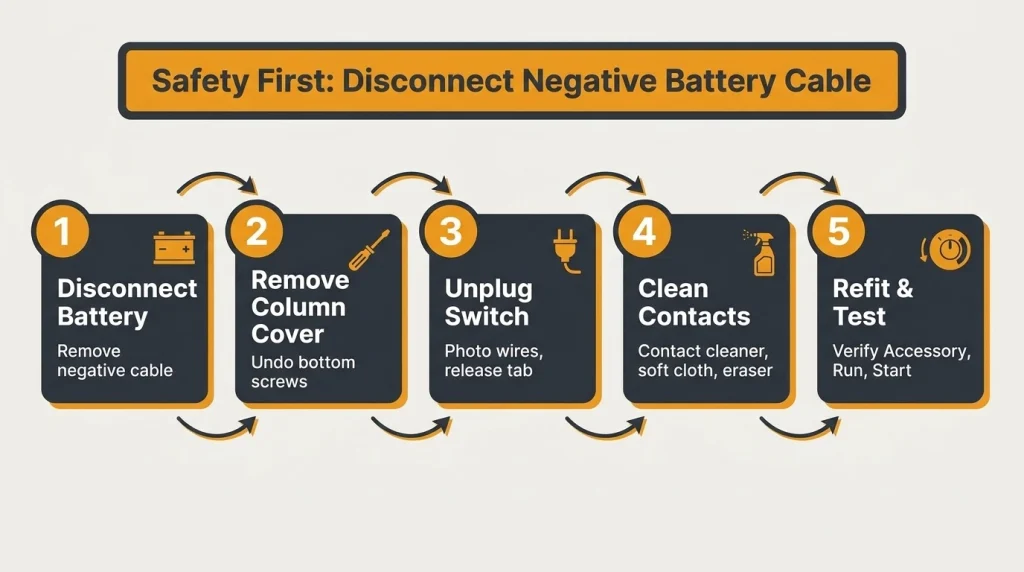
Dirty or corroded contacts are the most common repairable fault inside an ignition switch. The contacts carry current each time you start the car, and arcing leaves a layer of carbon that blocks the connection. Cleaning them restores the contact and often fixes intermittent starting.
Warning
Disconnect the negative battery cable before you remove the switch. Live switch wiring can short, blow fuses, or crank the engine by accident.
Work in a clear space and keep track of each screw as you remove it. Take a photo of the wiring connector before you unplug it, so you can refit each wire in the right place.
Step 1
Disconnect the battery
Remove the negative cable from the battery and set it aside so it cannot touch the terminal.
Step 2
Remove the steering column cover
Take out the screws under the column and lift the cover off to reach the switch.
Step 3
Unplug the switch and remove it
Press the release tab, unplug the wiring connector, and undo the screws that hold the switch.
Step 4
Clean the contact faces
Wipe the metal contact faces with electrical contact cleaner and a soft cloth. A pencil eraser lifts light carbon, and fine sandpaper clears heavier buildup.
Step 5
Refit and test
Put the switch back, reconnect the battery, and turn the key through each position to check every circuit works.
Test each key position after cleaning: accessory, run, and start. Dash lights, wipers, and the radio should all work in the run position. If one position still fails, that contact set may be burned past cleaning.
Tighten and Clean the Wiring Connections
Loose or corroded wiring at the switch causes the same symptoms as a failed switch. Vibration loosens the connector over time, and moisture leaves green or white corrosion on the pins. A firm, clean connection often ends the fault.
Unplug the connector and look at each pin. Clean corrosion with contact cleaner and a small brush, then push the connector home until it clicks. Check the ground wire too, since a weak ground limits the current that reaches the switch.
Look along the wires for cracked insulation or rubbed spots where they pass through the column. A wire that shorts against metal can blow a fuse or cut power without warning. Wrap a damaged section in electrical tape as a short-term fix, and plan a proper repair.
Swap the Starter Relay and Check the Fuses
A bad starter relay can mimic a bad ignition switch because the switch signals the relay to crank the engine. Swap the starter relay with an identical relay from the fuse box, such as the horn relay, and try to start the car. A car that starts after the swap had a relay fault, not a switch fault.
Check the fuses next. Pull the starter and ignition fuses and look for a broken metal strip inside. A blown fuse can stop a car from starting, and a new fuse of the same rating fixes it in minutes.
Do not fit a fuse with a higher rating than the old one. A larger fuse lets too much current through and can damage the wiring or start a fire. Match the number printed on the old fuse exactly.
How to Start the Car While the Switch Is Faulty
A jumper wire can start the car in an emergency by sending power straight to the starter solenoid. This bypasses the switch, so use it only to reach a repair shop or a safe place. The key must stay in the run position so the engine can fire.
Connect one end of a fused jumper wire to the battery positive terminal and the other to the small terminal on the starter solenoid. Keep the wire clear of belts and moving parts, and remove it as soon as the engine starts. AutoZone’s guide to starting a car with a faulty ignition switch shows the same method with a switch inline for safer control.
Do not leave the bypass in place as a daily fix. It removes the safety interlocks that stop the starter from engaging while the engine runs. Fix or replace the switch before you drive the car again.
Tip
Keep a fused jumper wire in the trunk for emergencies. A fused wire lets you start the car without risking a short in the starter circuit.
When a Repair Will Not Work
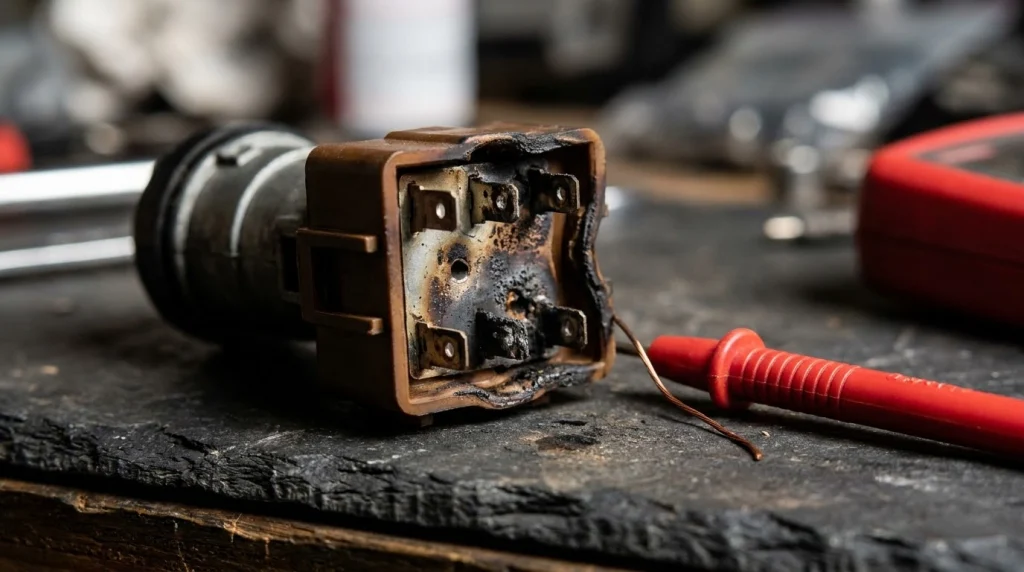
Some switch faults cannot be fixed by cleaning or tightening. Burned or melted contacts, a cracked switch body, and a cylinder that spins freely all mean the part has failed inside. Replacement is the only fix for these faults.
The table below shows which symptoms respond to a repair and which ones call for a new switch.
| What you see | What it means | What to do |
|---|---|---|
| Key turns, nothing happens, spare key works | Worn key | Cut a new key from the factory code |
| Dash lights flicker as you move the key | Dirty contacts | Clean the switch contacts |
| Engine stalls while driving | Failing switch contacts | Replace the switch |
| Burning smell or smoke from the column | Overheated wiring | Stop driving and replace the switch |
Stalling and smoke are safety faults, so book a repair before you drive the car again.
Check for a recall before you pay for the repair. Ignition switches have been recalled on many models, and a recall repair costs you nothing at the dealer. You can check for open recalls with your VIN on the NHTSA site.
If your tests point to the starter instead of the switch, the fix may still be simple. You can fix a starter without replacing it when the fault is a loose cable or a dirty connection.
How to Keep the Ignition Switch Working Longer
A few habits extend the life of an ignition switch and stop the fault from coming back. Keep the key ring light, and never hang heavy items from the ignition key. Turn the key with light pressure, and never force it when it resists.
Keep the key clean and dry, and wipe grit off before you insert it. Dirt in the cylinder wears the pins and ends up on the switch contacts. Fix a stiff key early, since forcing it wears both the key and the switch faster.
Multimeter
A multimeter lets you test for power at the switch and confirm the fault before you take anything apart.
Frequently Asked Questions
Does jiggling the key fix a bad ignition switch?
Jiggling the key can help a worn switch make contact for one start, but it does not repair the fault. The trick works because moving the key presses the contacts together for a moment. Treat it as a way to get home, then clean or replace the switch.
Can you bypass an ignition switch permanently?
You cannot bypass an ignition switch permanently and keep the car safe and legal to drive. A bypass removes the key interlock and the anti-theft system, and it leaves the starter circuit unprotected. Use a bypass only as an emergency way to reach a repair shop.
Is it safe to drive with a bad ignition switch?
Driving with a bad ignition switch is not safe when the engine stalls or the dash loses power while you drive. A stalled engine cuts power steering and braking assist, which raises the risk of a crash. Drive only to a repair shop, and only when the car starts and runs without stalling.
Can a bad ignition switch drain the battery?
A bad ignition switch can drain a battery when its contacts stick and keep a circuit live after you switch the engine off. The drain is slow, so the battery dies after the car sits parked for a while. Test for a drain by checking whether accessories stay on with the key out.
How long does a repaired ignition switch last?
A cleaned switch often keeps working well when dirt or corrosion caused the fault. The fix lasts while the contacts stay clean and the key ring stays light. A switch with worn metal inside will fail again, so plan a replacement.
How much does an ignition switch repair cost?
An ignition switch repair costs less than a full replacement when cleaning or a new key solves the fault. A shop charges for diagnosis time plus any small parts, while a replacement adds the price of the switch itself. Ask for a quote before you approve the work.
Conclusion
Fixing a bad ignition switch without replacing it works when dirt, a worn key, or a loose wire causes the fault. Clean the contacts, test the spare key, and check the wiring before you buy a new switch. If the car stalls while driving or the switch smells burned, book a replacement and stop driving until it is fixed.

Alex Carter is an automotive content writer at VastAutoParts, focusing on car parts, vehicle troubleshooting, automotive tools, product research, and practical car care guides.