
Car Shuts Off While Driving, Then Restarts: Causes
Quick Answer
If your car shuts off while driving but starts back up, a problem may be cutting off fuel, ignition, sensor signals, or electrical power for a moment. Common suspects include a fuel pump, crankshaft position sensor, ignition switch, wiring connection, or charging system. A successful restart does not mean the car is safe to drive.
- Move to a safe place and turn on your hazard lights.
- Notice whether the engine sputtered or stopped without warning.
- Record dashboard warnings and how long restarting took.
- Arrange an inspection before driving again.
A car that suddenly loses engine power can leave you stranded in traffic, even if it starts again moments later. The restart is useful evidence, but it does not identify the failed part. This guide explains the likely causes, warning signs, and safe diagnostic steps.
In this article
- What to do when the engine shuts off
- Why a car stalls and restarts
- Main causes of sudden engine shutdown
- Symptoms and possible causes
- How to diagnose the problem
- Special stalling patterns
- Whether it is safe to drive
- How to avoid unnecessary repairs
- Frequently asked questions
- Conclusion
What Should You Do If Your Car Shuts Off While Driving?
When your engine stops in traffic, your first job is to move the vehicle out of danger, not diagnose it. Steering and braking may require more effort after the engine stops.
- Keep control of the wheel. Look ahead and steer toward a safe shoulder, turnout, or parking area.
- Turn on your hazard lights. Warn surrounding drivers while you move out of traffic.
- Brake smoothly and firmly. Avoid sudden steering or braking that could cause a collision.
- Stop in a safe place. Secure the vehicle, select Park when appropriate, and apply the parking brake.
- Call for assistance. If you are exposed to traffic, overheating, or another hazard, request roadside help.
AAA’s roadside breakdown guidance advises drivers to pull over carefully, alert other road users, and seek assistance. Stay belted inside a safely parked vehicle when traffic outside is dangerous, unless fire or another immediate threat requires leaving.
If the engine died in standing water, do not attempt to restart it. If the temperature warning is high, steam appears, or the engine makes new harsh noises, leave it off and request a tow.
Warning
A sudden stall can reduce steering or brake assistance. Do not treat a successful restart as proof that another stall will not happen in traffic.
Why Does a Car Shut Off and Start Back Up?
A car may stop and restart when an intermittent fault briefly interrupts something the engine needs to run. Once the lost fuel, electrical supply, or sensor signal returns, the engine may start normally.
Engine control relies on several systems working together. A gasoline engine needs fuel delivery, spark at the correct time, adequate air, and electrical power for its controls.
An intermittent failure differs from a permanently broken component. Heat, vibration, moisture, or an unstable connection can make a fault appear and disappear.
For example, an electrical connector may briefly lose contact over a bump. A heat-sensitive sensor may stop sending a useful signal, then work again after cooling.
The restart pattern helps narrow the search. It cannot, by itself, prove that one specific sensor, pump, or relay needs replacement.
What Causes a Car to Stall While Driving and Restart?
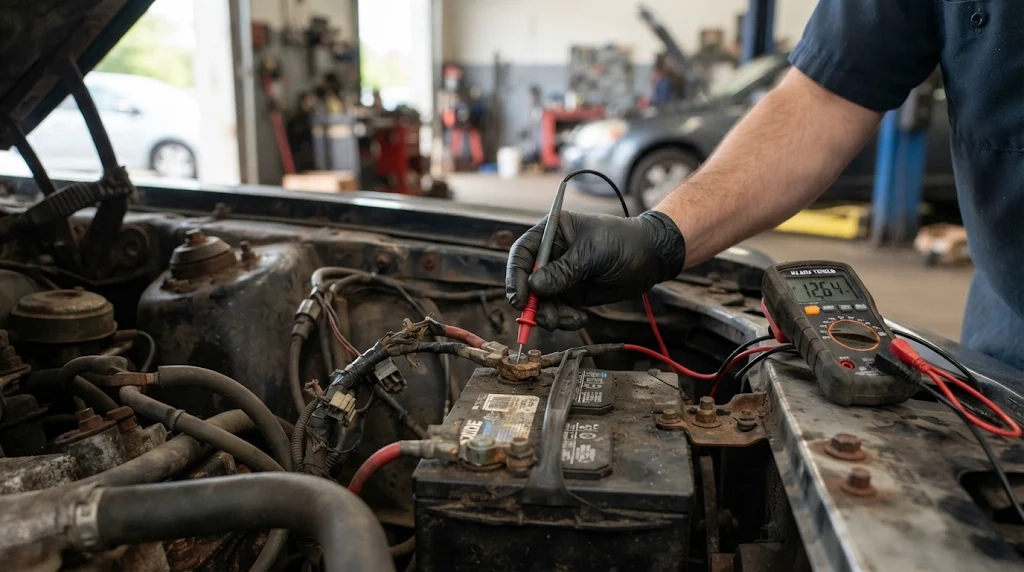
Fuel delivery, engine-position signals, ignition power, main wiring, and charging problems can all cause a car to stall and restart. Each system leaves different clues.
Crankshaft or Camshaft Position Sensor Failure
A faulty crankshaft position sensor can interrupt the engine computer’s information about engine rotation. Some vehicles may stop running when that signal disappears.
The camshaft position sensor provides related timing information. Either sensor or its wiring can develop an intermittent fault, although the effect depends on vehicle design.
Heat-related failure is one possibility. The car may work cold, stall after warming up, and restart after the sensor or circuit cools.
Weak Fuel Pump or Interrupted Fuel Supply
A weak fuel pump may fail to deliver enough fuel during acceleration or sustained driving. Some failing pumps also stop working intermittently.
Fuel restriction, pump wiring, relays, or a fuel-pressure control problem can produce similar symptoms. A driver may notice hesitation, sputtering, or reduced power before the engine stops.
Professional technicians compare fuel pressure and delivery with the vehicle’s service specifications. They should test the supply circuit before condemning the pump.
Loose Battery Cable or Bad Ground Connection
A loose main power or ground connection can briefly interrupt electrical power to engine controls. Corrosion, damaged wiring, and poor terminal contact are possible causes.
If the radio, gauges, or clock reset during the stall, look closely at the main electrical supply. A bump-related stall can also point toward a loose connector.
Visual checks may reveal damage, but electrical testing under load is often needed. Never disconnect battery cables while the engine is running.
Failing Ignition Switch, Relay, or Ignition Circuit
A worn ignition switch or failing relay can interrupt power to an engine-control circuit. The engine may stop abruptly, almost as if someone switched it off.
On some vehicles, an ignition module or shared ignition-power connection can cause a similar shutdown. A problem affecting one individual ignition coil often causes a misfire instead.
A mechanic should check the circuit while the problem is present. Replacing several ignition parts without testing can leave the original fault untouched.
Alternator or Charging System Trouble
A charging system fault can eventually leave the engine controls without enough electrical power. Dimming lamps or low-voltage warnings before the stall strengthen this possibility.
However, the battery warning light may also illuminate after an ordinary stall. An alternator stops producing power when the engine is no longer turning, so timing matters.
A technician can check the alternator, drive belt, battery condition, and power connections. Testing prevents confusing a result of stalling with its cause.
Airflow, Throttle, or Idle Control Problems
Dirty throttle passages, air leaks, or idle-control faults can cause an engine to stall as you slow down. Such faults are more likely at a stop than during steady highway driving.
An older car may use an idle air control valve. Other vehicles regulate idle through an electronic throttle body, so the correct test depends on the design.
A stuck exhaust gas recirculation valve or another air-related fault may also disrupt idle. These causes should be checked only when the symptoms fit.
Professional repair guidance from Underhood Service describes how fuel-pressure loss, ignition interruption, and idle-control problems produce different stalling patterns.
Which Symptoms Point to the Most Likely Cause?
The conditions surrounding the stall provide better clues than the restart alone. Compare what happened immediately before the engine stopped.
| What you noticed | Possible cause | Useful next check |
|---|---|---|
| Engine cut off without sputtering | Sensor signal or ignition power | Check crank signal and power feeds |
| Sputtering before a stall | Fuel delivery or misfire | Test fuel pressure and ignition |
| Dashboard and radio went dark | Main electrical connection | Inspect battery cables and grounds |
| Stalls when coming to a stop | Idle airflow or throttle control | Inspect idle and air systems |
| Fails only when hot | Heat-sensitive sensor or circuit | Capture data during hot failure |
| Lights dim before shutdown | Charging or voltage loss | Test charging system under load |
These patterns suggest where to begin testing, not which part to purchase. Different faults can produce nearly identical symptoms.
How Can You Diagnose an Intermittent Engine Stall?
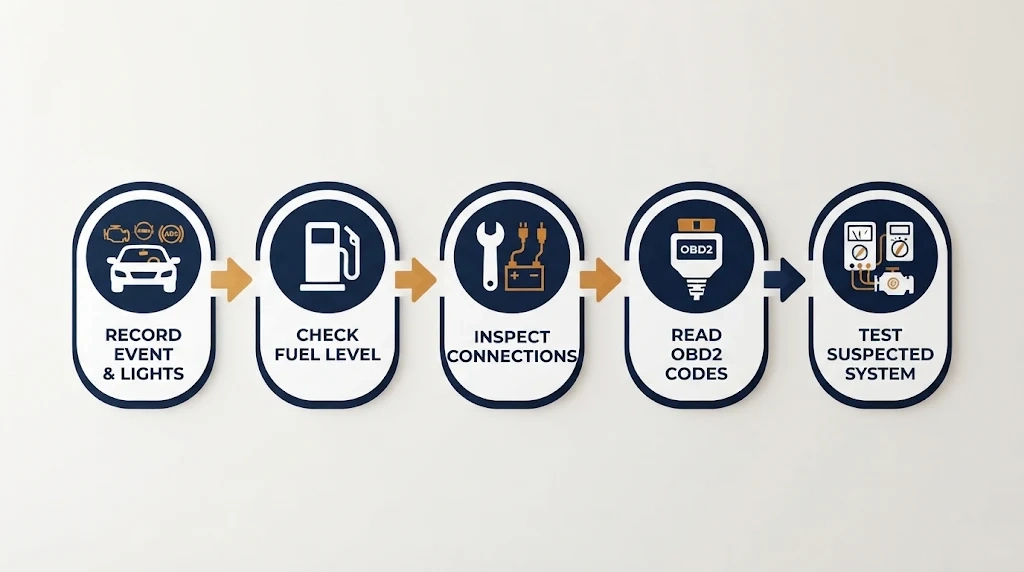
A safe diagnosis starts with the stall history, stored fault codes, and basic visual checks. More involved testing should be done by a qualified technician.
- Write down the event. Note whether the car stalled on a hill, over a bump, during acceleration, or while braking.
- Record warning lights. Remember whether the battery light appeared before or after the engine stopped.
- Check the fuel level. Confirm there is enough fuel and note whether the problem happens when the tank is low.
- Inspect visible connections. With the engine off, look for obvious battery corrosion, loose terminals, or damaged wiring.
- Read diagnostic codes. Use an OBD2 code reader, or ask a repair shop to scan stored and pending trouble codes.
- Test the suspected system. A mechanic can inspect crank signals, fuel pressure, charging output, and circuit power under the right conditions.
An OBD2 code reader retrieves fault information from the vehicle’s onboard computer. A code names a problem area, but it does not always identify a failed component.
Stored codes and recorded data can give a technician valuable clues. Keep that information instead of immediately clearing it or buying a part named in a code description.
Tip
Before the appointment, write down whether the dash stayed lit, the engine sputtered, and whether it restarted immediately or after cooling.
Intermittent problems may not appear during a short shop visit. Ask whether the mechanic can inspect stored history and monitor relevant signals when the fault occurs.
Never recreate a dangerous stall on a public road to gather evidence. A shop should choose controlled diagnostic methods that fit the vehicle and risk.
Why Does the Car Stall Only in Certain Situations?
When a car stalls only under specific conditions, those conditions help narrow the fault. Heat, deceleration, road vibration, and engine load affect different systems.
Why Does My Car Shut Off After Warming Up?
A hot-only stall may involve a sensor, ignition module, relay, or electrical connection that fails as temperature rises. Some faults disappear again after cooling.
Other possibilities include a fuel pump that cuts out under heat or load. Temperature alone cannot confirm which part is responsible.
Why Does My Car Die When Braking or Stopping?
A stall while slowing down often points toward idle airflow or engine-speed control. The engine must keep running as the throttle closes and road speed falls.
Possible issues include throttle buildup, air leaks, or a malfunctioning idle-control system. On some automatic vehicles, a transmission-related fault can also cause stalling at a stop.
Why Does My Car Stall on Bumps or Turns?
A stall after a bump may be caused by wiring that briefly loses contact. A stall on turns can also be affected by fuel supply or a connection disturbed by movement.
Do not assume the cause is the fuel pump solely because the tank is low. Note the fuel level, road conditions, and whether dashboard power disappeared.
Why Does It Stall Under Acceleration?
A stall during acceleration may happen when fuel delivery cannot keep up with demand. Ignition faults, airflow problems, and electrical failures can also occur under load.
If the engine hesitates first, fuel-pressure and misfire testing become useful. If everything switches off abruptly, investigate electrical and timing signals as well.
Is It Safe to Drive a Car That Restarts After Stalling?
A car that stalls unexpectedly while moving should not be considered safe simply because it starts again. Another shutdown could occur during a turn, merge, or busy intersection.
If the vehicle has stalled more than once, request a tow for diagnosis. A single unexplained stall also deserves prompt professional attention before normal driving resumes.
Stop attempting to run the engine if you notice overheating, smoke, severe vibration, fuel leakage, or unusual mechanical sounds. Those signs may indicate a separate urgent risk.
You can also check whether your vehicle has an unrepaired safety recall. The NHTSA recall lookup allows searches using vehicle information, including a VIN.
For a parked vehicle, keep occupants protected from passing traffic while waiting for help. If there is fire, smoke, or another immediate threat, move to a safe place away from the vehicle.
How Do You Fix the Problem Without Guessing at Parts?
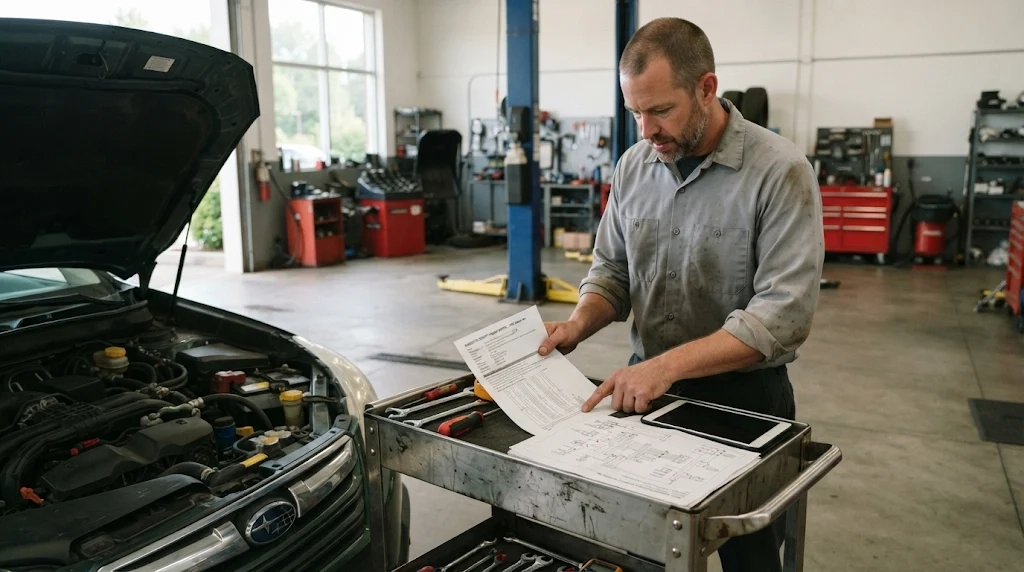
The right repair follows a confirmed diagnosis, not a list of commonly replaced parts. A car that restarts after stalling could have several very different underlying faults.
If testing reveals low fuel pressure, the technician should confirm whether the pump, power supply, filter, or regulator caused it. Replacing a pump without testing its electrical supply may not solve the stall.
If the fault points toward a crankshaft sensor, wiring and connector checks still matter. A broken wire can imitate a failed sensor and produce similar trouble codes.
If the dashboard loses power, focus on the battery connections, grounds, main feeds, and ignition circuitry. Charging problems need a separate test rather than an automatic alternator replacement.
After the repair, the shop should verify normal operation under the conditions that previously triggered the stall. Ask what evidence identified the cause and how the fix was confirmed.
OBD2 Code Reader
An OBD2 code reader can show stored trouble codes that may help a technician investigate an intermittent stall.
Frequently Asked Questions
Can low engine oil make my car shut off?
Low engine oil or dangerously low oil pressure can damage an engine and may contribute to a shutdown. An oil pressure warning requires immediate attention. Stop safely, switch off the engine, and have the oil level and pressure concern checked before restarting.
Can a bad gas cap cause sudden stalling?
A loose gas cap usually does not cause an otherwise healthy car to shut off while driving. It can trigger an evaporative-system warning, depending on the vehicle. Do not assume tightening the cap has fixed an unexpected engine stall.
Can a transmission problem cause stalling at stoplights?
Some automatic transmission faults can make an engine stall as a vehicle slows to a stop. A torque converter clutch that fails to release is one possible cause. A technician should distinguish that condition from idle airflow and engine-control problems.
Why is there no check engine light after stalling?
An intermittent engine stall may happen without a visible check engine light or a stored fault code. Some faults resolve before the computer identifies a reportable problem. A mechanic can still inspect the stall history and test suspected circuits.
Can a clogged catalytic converter shut off an engine?
A severely restricted exhaust system can reduce engine power and may cause stalling. The car may struggle under load or lose power as it runs. Exhaust backpressure testing can help a technician confirm a restriction instead of guessing.
Is automatic stop-start the same as sudden stalling?
Automatic stop-start is a designed feature that switches the engine off during certain stops and restarts it when needed. An unexpected shutdown while driving is different. Check your owner’s manual if you are unsure which behavior your vehicle should have.
Conclusion
If you are wondering why your car shuts off while driving but starts back up, the likely issue is an intermittent fuel, sensor, ignition, or electrical fault. Move to safety, record the symptoms, and arrange a professional diagnosis before relying on the vehicle again.

Alex Carter is an automotive content writer at VastAutoParts, focusing on car parts, vehicle troubleshooting, automotive tools, product research, and practical car care guides.