
Car Trouble Starting With Check Engine Light: Causes
Quick Answer
Car trouble starting with the check engine light on can involve fuel delivery, ignition, engine sensors, or an electrical fault. First, notice whether the engine turns over normally, slowly, or not at all. Then read stored fault codes and match them with the symptoms before replacing parts.
- A check engine light before the engine starts can be normal.
- Slow cranking often points toward a battery or starting circuit issue.
- Normal cranking without starting calls for fuel, spark, sensor, and security checks.
- A flashing check engine light while the engine runs needs urgent attention.
You turn the key, but your car hesitates, struggles, or refuses to start. The check engine light makes the problem seem more serious, yet the light alone cannot identify the failed part.
This guide explains what each starting symptom means, what you can safely inspect, and when a mechanic should take over.
In this article
- What the check engine light means
- Starting symptoms and likely causes
- Common faults behind hard starting
- A practical diagnostic sequence
- When the engine cranks but will not start
- When the engine does not crank
- Intermittent and temperature-related trouble
- When to stop trying or driving
- What to tell the repair shop
- Frequently asked questions
- Conclusion
What Does the Check Engine Light Mean During Starting?
The check engine light shows that the engine management system is running a warning check or has detected a fault. Its timing matters more than its presence alone.
Light on before the engine starts
A check engine light with the ignition on and the engine off is often a normal dashboard self-check. Other warning lights may also appear because the engine is not running.
The EPA check engine light guidance explains that the warning should normally go out during proper operation. A light seen only before starting does not prove an engine fault.
If your car will not crank, pay closer attention to battery power, starter operation, and security warnings.
Light stays on after the engine starts
A check engine light that stays on while the engine runs indicates a detected problem requiring diagnosis. The fault may or may not be responsible for the difficult start.
A scan tool reads diagnostic trouble codes stored by the vehicle computer. Those codes identify affected systems, but they do not automatically prove which component needs replacement.
For example, a misfire code might involve a spark plug, ignition coil, fuel delivery problem, or another cause. The symptoms and tests decide which explanation fits.
Light flashes while the engine is running
A flashing check engine light can warn of severe misfiring that may damage the catalytic converter. Rough shaking, loss of power, and fuel odors make the situation more concerning.
Reduce engine load, stop somewhere safe, and arrange prompt help. If the engine is shaking badly or stalls, avoid driving it to a shop.
Which Starting Symptom Does Your Car Have?
Starting behavior divides the problem into different diagnostic paths. Listen for cranking, which is the sound of the starter turning the engine.
The table compares common observations and the next check that makes sense.
| What happens | Possible fault area | First useful check |
|---|---|---|
| Rapid clicking, no crank | Weak battery or poor connection | Battery and terminal inspection |
| One click, no crank | Battery, cables, or starter circuit | Battery test and starter circuit check |
| Slow engine cranking | Low available power or excessive load | Battery and cable testing |
| Normal crank, no start | Fuel, ignition, sensors, or security | Read codes and check fuel level |
| Starts, then stalls | Fuel, airflow, or key authorization | Observe warning lights and read codes |
| Long crank, rough start | Fuel mixture or weak ignition | Read codes and note rough running |
Normal cranking points away from the basic starter circuit. Clicking or slow cranking makes electrical checks a better starting point.
What Causes Hard Starting With a Check Engine Light?
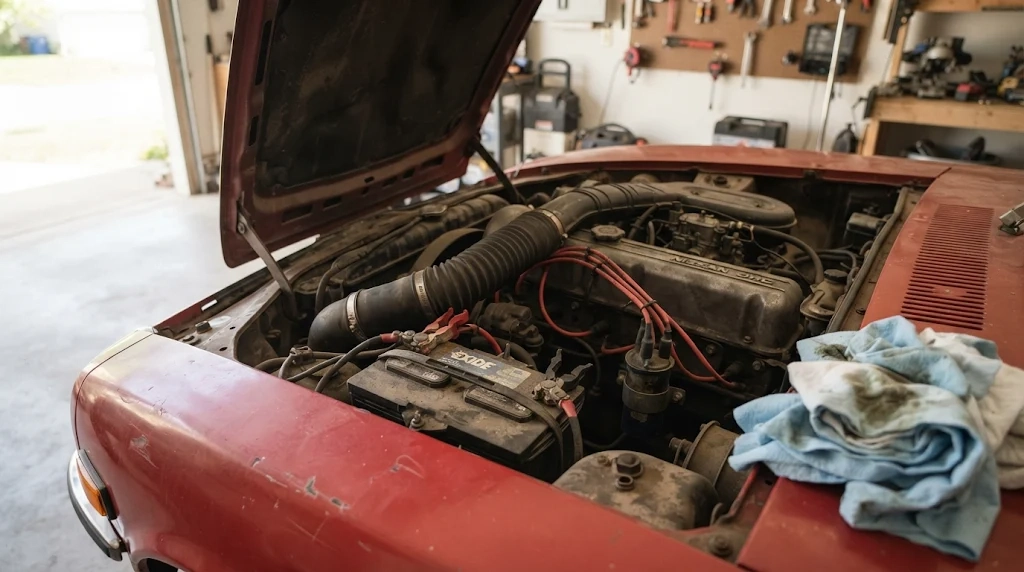
Hard starting and a check engine warning can share one cause, but they can also be separate problems. The strongest clues come from cranking speed, engine behavior, and stored codes.
Weak battery or poor electrical connections
A weak battery or corroded cable can make the engine turn too slowly to start reliably. Some vehicles also show warning messages when voltage becomes unstable.
Watch for dimming lights, clicking, or displays that reset during starting. A battery load test and cable inspection are more useful than replacing a sensor based on the check engine light.
Worn spark plugs or ignition coil trouble
Worn spark plugs or faulty ignition coils can weaken combustion and cause rough starting. A gasoline engine may shake, hesitate, or misfire after it finally starts.
Ignition trouble can also trigger engine fault codes. AAA identifies faulty spark plugs among the potential reasons a vehicle will not start properly.
Inspect ignition parts only after the code and symptoms support that direction. Replacing every coil without testing can waste money.
Fuel pressure or fuel pump problems
Low fuel pressure can delay starting because the engine receives too little fuel at the needed time. The vehicle might crank normally but take several attempts to fire.
A failing pump, relay, restricted filter, or pressure-control fault can interrupt fuel delivery. A technician may need a pressure test or live data to isolate the cause.
Crankshaft and camshaft sensor faults
Crankshaft and camshaft position sensors help the engine computer track rotational position and valve timing. Missing or unreliable signals can prevent proper spark or fuel injection timing.
Some sensor faults create intermittent no-start conditions, including trouble after the engine warms up. A scan tool and circuit tests can help distinguish a failed sensor from damaged wiring.
Air intake or engine temperature signal problems
Incorrect airflow or temperature information can cause the engine computer to choose an unsuitable fuel mixture. A damaged intake hose or faulty sensor may produce rough starts.
Check for obvious loose intake connections with the engine off. A technician can compare sensor readings with actual engine conditions before ordering replacement parts.
Fuel vapor purge valve problems
A purge valve stuck open may allow excess fuel vapor into the intake during a start attempt. Hard starting soon after refueling can be a useful clue.
This pattern is not proof that the valve has failed. Fuel system tests and fault-code information are needed to rule out other causes.
Security system or engine computer power issues
An immobilizer, which checks whether the key is authorized, can prevent the engine from starting. Some vehicles block cranking, while others crank or start briefly.
A flashing security symbol, key warning, or missing engine computer communication helps narrow the issue. Try the spare key or the manual’s backup start procedure before assuming an engine part has failed.
How Can You Diagnose the Starting Problem?
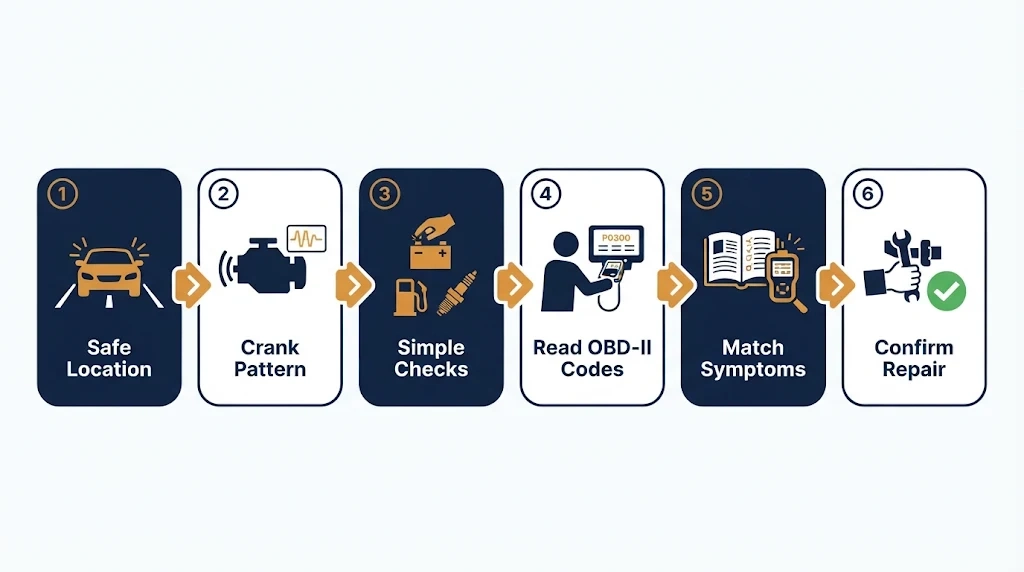
A sound diagnosis starts with simple observations and moves to targeted tests. The aim is to confirm a fault instead of replacing the first part named by a code.
- Confirm a safe location. Park securely, set the brake, and keep clear of moving engine parts. Stop if you notice smoke, leaking fuel, or a strong fuel smell.
- Identify the crank pattern. Note silence, clicking, slow cranking, normal cranking, or starting followed by stalling. Record whether the warning stays on after the engine runs.
- Inspect simple causes. Check the fuel level, obvious battery cable looseness, and visible intake damage with the engine off. Do not touch damaged wiring or leaking fuel lines.
- Read diagnostic codes. Connect a compatible OBD-II scanner when the vehicle supports one. Save stored and pending codes before anyone clears them.
- Match codes with symptoms. A misfire clue leads toward combustion checks. A normal crank without combustion leads toward fuel, spark, sensor, or security tests.
- Confirm the repair. Have the suspected circuit or component tested and fix the cause. Verify that the starting behavior improves and the fault does not return.
Diagnostic trouble codes are clues, not replacement instructions. Even a code naming a sensor can reflect wiring, power supply, or a related engine condition.
Tip
Photograph the scanner results before clearing anything. Stored and pending codes can help a technician investigate an intermittent starting fault.
What If the Engine Cranks but Will Not Start?
Normal cranking with no start usually shifts attention toward fuel delivery, ignition, sensor signals, security authorization, and mechanical timing. The starter has already shown it can turn the engine.
Check whether the fuel gauge shows an empty tank and whether a security warning is active. Listen for an unusual change in cranking sound, especially if it becomes much faster than normal.
An engine that turns unusually fast may have lost compression or proper mechanical timing. Stop further attempts and request an inspection if that change appears suddenly.
Do not spray starting fluid into the intake as a shortcut. Improper use creates a fire risk and can complicate diagnosis.
If the engine briefly catches and then dies, note the delay before stalling. That detail can help distinguish fuel delivery loss, airflow problems, and key authorization faults.
What If the Engine Does Not Crank?
No cranking means the engine is not turning during the start attempt. Battery power, starter controls, connections, and start-permission systems deserve attention first.
Lights and radio operation do not prove the battery can supply enough power for starting. A starter demands much more current than many accessories.
Look for loose or corroded battery terminals without touching exposed damaged conductors. AAA’s guide to weak car battery symptoms includes slow cranking and clicking among the warning signs.
For an automatic transmission, confirm the selector is in Park. If permitted by the owner’s manual, a careful attempt in Neutral may reveal a shifter or range-switch issue.
If the battery passes testing, the starter motor, relay, ground cable, ignition switch, and control circuit become stronger suspects.
Why Does Starting Trouble Come and Go?
Intermittent hard starting often reflects a fault that changes with temperature, vibration, or the time the vehicle sits. Keep a short symptom log instead of assuming the problem has disappeared.
Hard starting after the car sits overnight
Long cranking after sitting may indicate a weak battery or fuel pressure that falls while the engine is off. Cold conditions can make battery weakness more noticeable.
Tell the shop how long the vehicle sat and whether it starts normally later. That pattern helps determine whether battery or fuel-pressure testing should happen first.
Hard restarting after a warm drive
Warm restart trouble can point toward a heat-sensitive electrical connection or engine sensor. Fuel-pressure problems may also change after the engine stops.
Note whether the starter turns slowly or at normal speed when the engine is hot. These observations separate starting circuit trouble from combustion trouble.
Hard starting right after refueling
Difficulty starting soon after filling the tank may point toward a vapor purge fault. The timing is useful, but the repair still requires confirmation.
Record whether the problem occurs after every fill-up or only under certain conditions. Avoid topping off the tank beyond the pump’s automatic shutoff.
When Should You Stop Trying to Start or Drive?
Stop repeated starting attempts when symptoms suggest a fire, mechanical damage, or serious running fault. Getting the car moving is not worth making the underlying problem worse.
A flashing check engine light while running, severe shaking, strong fuel smell, or repeated stalling calls for prompt professional help. Arrange towing when the vehicle cannot run safely.
Warning
A flashing check engine light with rough running may signal damaging misfires. Stop in a safe place and seek assistance instead of continuing the trip.
Grinding during cranking or an unexpected fast-spinning engine sound also justifies stopping. Continued attempts can worsen mechanical damage.
If the light is steady and the car runs smoothly, the situation may be less urgent. Still, arrange diagnosis because the hard start could become a complete no-start.
What Information Should You Give a Mechanic?
A short, accurate description of the starting pattern can save unnecessary testing. Explain what the engine did rather than guessing which part failed.
- Whether the engine cranks normally, slowly, or not at all.
- Whether the check engine light is steady, flashing, or visible only before starting.
- Whether the problem happens cold, hot, after sitting, or after refueling.
- Whether the engine runs roughly, stalls, or smells of fuel.
- Any saved fault codes or dashboard warning messages.
- Whether a jump-start changed the symptoms.
Ask the shop which test confirmed the failed part and whether a related circuit was checked. A clear diagnosis should connect the repair to the symptom.
OBD-II Scan Tool
A compatible scan tool lets you read stored diagnostic codes before deciding what needs testing.
As an Amazon Associate I earn from qualifying purchases.
Frequently Asked Questions
Can a check engine light go away without repairs?
A check engine light can turn off after an intermittent fault stops meeting the vehicle’s warning conditions. That does not confirm the cause has been repaired. If hard starting returns, ask for a scan of stored and pending information before clearing anything.
Can a loose gas cap make a car hard to start?
A loose gas cap can trigger an emissions warning, but it does not usually explain an engine that struggles to start. Two problems can happen at the same time. If the cap is loose, tighten it, then investigate the starting symptom separately.
Can an OBD scanner work if the engine is off?
An OBD-II scanner can often read codes with the ignition switched on even when the engine is not running. The vehicle still needs enough electrical power for the scanner and computer. Follow the scanner’s instructions and your vehicle manual for the correct ignition position.
Should I disconnect the battery to reset the warning?
Disconnecting the battery is not a sound substitute for diagnosing a check engine warning. Doing so may erase information that helps identify an intermittent fault, and some vehicles require additional setup afterward. Save the codes and repair the cause before considering any reset.
Why are there no codes after the car starts badly?
A hard-start problem can occur without a stored code when the vehicle has not detected a monitored fault. Mechanical and electrical issues may also escape a basic scan. A technician should use symptoms, live data, and direct tests rather than rely on codes alone.
Can a weak battery cause lights to come on?
A weak battery can disrupt starting and sometimes cause multiple dashboard warnings when electrical power becomes unstable. Warning lights alone cannot confirm that the battery has failed. A battery and charging-system test helps separate a supply problem from an unrelated engine fault.
Conclusion
Car trouble starting with the check engine light on needs a symptom-based diagnosis, not a guessed replacement part. First determine whether the engine cranks normally, then save fault codes and test the systems that fit the symptoms.
If the light flashes or the car runs badly, stop safely and arrange professional help.

Alex Carter is an automotive content writer at VastAutoParts, focusing on car parts, vehicle troubleshooting, automotive tools, product research, and practical car care guides.