
Signs of a Bad Ignition Switch: 7 Symptoms to Check
Quick Answer
The signs of a bad ignition switch are no crank, an engine that starts and stalls, and stalling while driving. Flickering dashboard lights, accessories that cut out, and a key that sticks or will not turn are signs too. These faults come from worn contacts that stop sending power to the starter, engine controls, or accessories.
- No crank with a silent starter points to the switch when the battery is strong.
- Stalling while driving is the most serious sign, so treat it as a safety fault.
- Flickering lights and dead accessories mean the switch is losing contact in one position.
- A stiff or stuck key can mean wear in the lock cylinder or the switch behind it.
- A mechanic can confirm the fault with a multimeter test of each switch position.
Your key turns, but the car stays silent. Or the engine dies without warning on the road.
This article is for any driver with a key-start car who sees one of these faults and wants to know if the ignition switch is the cause. You will learn the seven signs, how to tell the switch apart from a bad battery or starter, and the safe checks to run first.
In this article
- What Does the Ignition Switch Do?
- 7 Signs of a Bad Ignition Switch
- Is It the Ignition Switch or Something Else?
- How to Confirm a Bad Ignition Switch
- What Causes an Ignition Switch to Fail?
- Can You Drive With a Bad Ignition Switch?
- How to Prevent Ignition Switch Problems
- Frequently Asked Questions
- Conclusion
What Does the Ignition Switch Do?
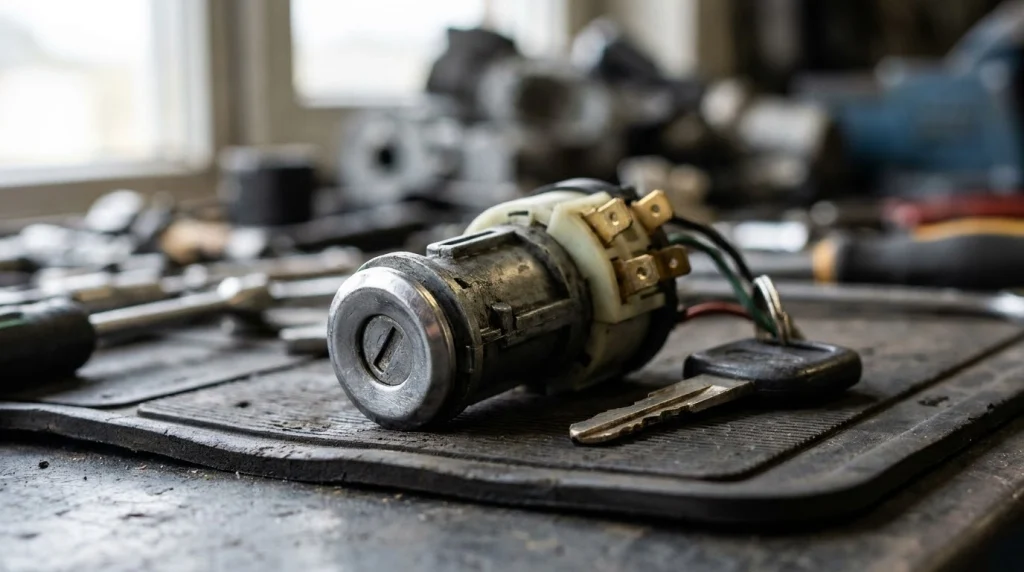
The ignition switch routes battery power to the starter, engine controls, and accessories based on the key position. It sits behind the lock cylinder on the steering column, and the key turns the cylinder, which moves the switch.
The switch has four positions, and each one powers a different set of circuits. The four positions of the ignition switch are Off, Accessory, Run, and Start.
- Off cuts power and locks the steering wheel.
- Accessory powers the radio and windows without the engine.
- Run powers the engine controls and dash.
- Start sends power to the starter motor for a few seconds.
The lock cylinder and the switch are two parts, and either one can fail. The cylinder is the keyhole you see, while the switch is the electrical part behind it.
A key that will not turn points to the cylinder, while a key that turns with no result points to the switch. Cars with push-button start use a start module instead of a key switch, so the signs in this article apply mainly to key-start cars.
7 Signs of a Bad Ignition Switch
A failing switch rarely shows every sign at once. One or two of these signs, seen more than once, point to the switch. Note which signs you see and when they happen, since the pattern helps a mechanic find the fault.
Key Turns but the Engine Does Not Crank
A key that turns to Start with no crank and no sound is one of the clearest signs of a bad ignition switch. The switch fails to send the start signal to the starter solenoid, the small switch that powers the starter motor, so the starter never runs.
The dash lights may still come on, since the Run circuit can work while the Start circuit fails. This silence differs from a weak battery, which gives rapid clicking or slow cranking. If the lights work but the starter stays silent, that matches power but no start.
Engine Starts and Then Stalls Right Away
An engine that fires and dies the moment you release the key points to the Run circuit inside the switch. The Start contacts work, but the Run contacts fail to hold power to the fuel pump and ignition coils.
The stall happens in seconds, with no sputter and no warning. An anti-theft fault can cause the same pattern, so a mechanic should check for a security light on the dash. This pattern also matches a car that starts and then dies, so rule out the other causes there too.
Engine Stalls While You Drive
An engine that cuts out without warning while you drive is the most dangerous sign of a bad ignition switch. Heat and vibration can break the worn contact for a moment, and power to the engine controls drops at once.
The stall is sudden and silent, with no sputter first. The steering gets heavy and the brakes need more force, since both lose power assist with the engine. If the car restarts right away, the contact has closed again, but the fault will return.
Warning
A stalling engine can leave you without power steering and power brakes in traffic. If your car stalls more than once, stop driving it and have it towed to a mechanic.
Note what happens to the dash lights when the engine dies. If the whole cluster goes dark at the same time, the switch has lost its main power feed. That clue points to the switch more than to fuel or spark faults.
Dashboard Lights Flicker or Go Dark
Dashboard lights that flicker, dim, or cut out while you drive point to worn contacts inside the switch. The cluster loses power each time the contact separates for a moment.
Watch for the flicker to match bumps, turns, or a touch of the key. A loose battery cable can cause the same flicker, so check the terminals first. If the terminals are tight and clean, the switch is the likely fault.
Accessories Work Only Sometimes
A radio, fan, or power window that cuts out for no clear reason can mean the switch is failing in one position. Each key position feeds its own set of circuits, so one worn contact can kill one group of accessories.
The fault may show only in Accessory or only in Run. If the radio dies when you hit a bump but returns on its own, the contact is breaking and closing again. One dead accessory alone points to its own fuse or motor, not the switch.
Key Is Hard to Turn or Stuck
A key that sticks, binds, or will not turn can mean wear in the lock cylinder or the switch behind it. Dirt and wear build up over thousands of key turns, and the parts stop lining up.
Try the spare key before you blame the switch. If the spare turns with ease, the first key is worn.
If the steering wheel is locked, turn it gently to one side while you turn the key. Never force a stuck key, since it can snap off in the cylinder.
Engine Keeps Running After You Remove the Key
An engine that keeps running after you take the key out is a rare but clear sign of a bad ignition switch. The contacts have stuck in the Run position, so power keeps flowing to the engine controls.
Set the parking brake and stay with the car. Do not walk away from a running car with the key in your pocket. A mechanic needs to replace the switch, since no safe home fix frees stuck contacts.
Is It the Ignition Switch or Something Else?
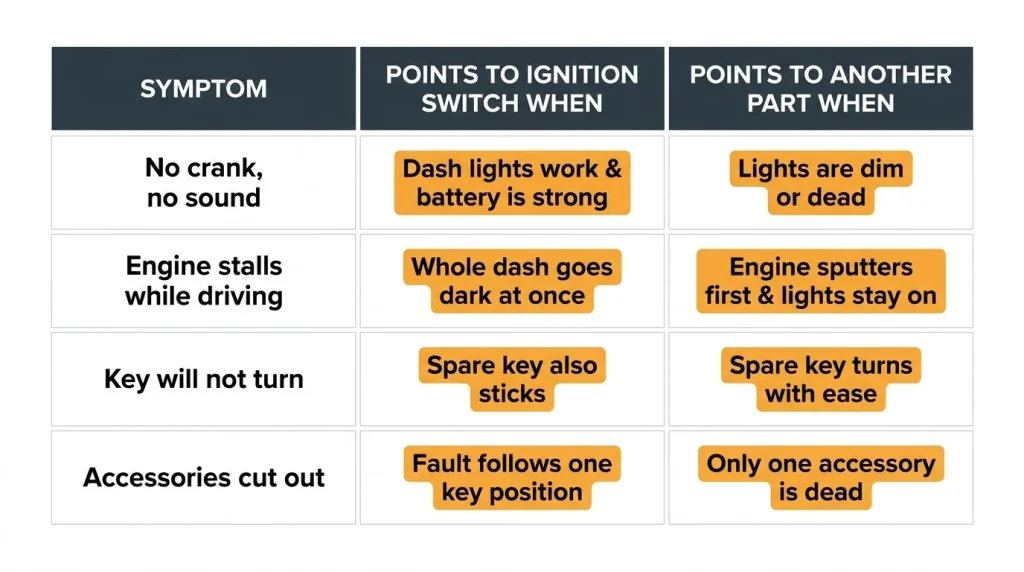
Several faults share these signs, so compare the pattern before you blame the switch. The table below shows how the same symptom points to a different part.
| Symptom | Points to the ignition switch when | Points to another part when |
|---|---|---|
| No crank, no sound | Dash lights work and the battery is strong | Lights are dim or dead |
| Engine stalls while driving | The whole dash goes dark at the same time | The engine sputters first and lights stay on |
| Key will not turn | The spare key also sticks | The spare key turns with ease |
| Accessories cut out | The fault follows one key position | Only one accessory is dead |
The switch is the likely fault when several circuits fail at once or when the fault follows a key position. A single dead part, a dim battery, or a sputtering engine points elsewhere. Before you order parts, check the bad starter look-alikes to rule out the faults that mimic a starter failure.
How to Confirm a Bad Ignition Switch
No single sign proves the switch is bad, so run these checks in order to rule out the simple faults first. Stop at the step that finds the fault. For the full sequence, learn to diagnose a no-start car step by step.
Step 1
Check the battery and terminals
Look for white or green crust on the terminals and check that the cables are tight. A weak battery or a loose cable mimics a switch fault, so rule it out first.
Step 2
Turn the key to Run and watch the dash
The warning lights should come on and the fuel gauge should move. A dark dash with a good battery points to the switch.
Step 3
Try the spare key
A worn key can fail to turn the cylinder all the way. If the spare key starts the car, the first key is the fault.
Step 4
Listen at the Start position
Silence points to the switch or the starter circuit. Rapid clicks point to a weak battery, and a single loud click points to the starter.
Step 5
Ask a mechanic for a multimeter test
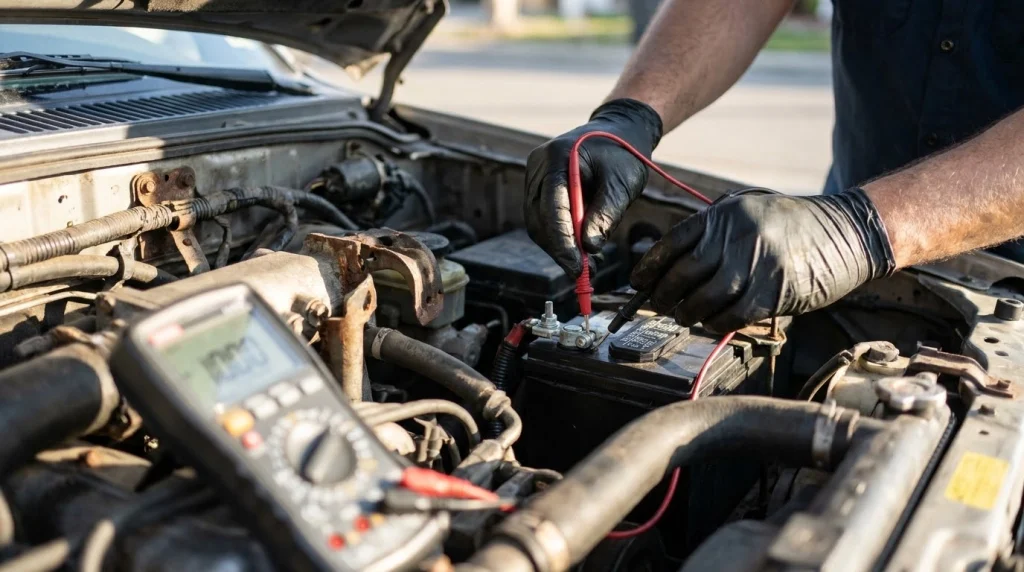
A mechanic can test each switch position and confirm that full battery voltage, about 12 volts, reaches the right terminal. This test proves the fault before you pay for parts.
What Causes an Ignition Switch to Fail?
Wear from thousands of key turns is the main cause of ignition switch failure. Each turn rubs the contacts, and the metal wears thin or builds up a carbon layer that blocks power.
Heavy keychains speed up the wear, since the weight pulls on the cylinder with each bump and turn. Corrosion on the terminals, loose wiring, and damage from a theft attempt can also break the switch. The causes of a failing ignition switch all share one result: a contact that no longer makes a clean connection.
Can You Drive With a Bad Ignition Switch?
You should not keep driving a car with a bad ignition switch once it stalls or fails to start. A stall in traffic can leave you with heavy steering and weak brakes at the worst moment.
A car that fails to start may also strand you far from help. If the engine stalls more than once, have the car towed to a mechanic. The repair needs a pro, since the work sits near the steering column airbag.
How to Prevent Ignition Switch Problems
You cannot service the switch, but you can slow the wear that kills it. Light keys and a gentle touch keep the cylinder and contacts in shape for more key turns.
Tip
Keep your car key on its own ring with no more than one or two light keys. Heavy keychains pull on the cylinder and wear the switch sooner.
Fix a sticking key early, before it jams or snaps. A small fault in the cylinder can grow into a switch failure if you keep forcing the key.
Do
- Keep the car key on a light, separate ring
- Turn the key with a light touch
- Fix a sticking key before it jams
Avoid
- Hanging heavy keychains from the ignition key
- Forcing a key that will not turn
- Ignoring a stall or flicker that happens twice
Ignition Switch
If a mechanic confirms the switch is faulty, a replacement ignition switch is the part the repair needs.
Frequently Asked Questions
Can a bad ignition switch drain the battery?
A bad ignition switch can drain a battery when worn contacts keep a circuit live after you remove the key. The drain is slow, so the battery may still start the car for days before it goes flat. If the battery drains overnight with no lights left on, a mechanic can test for a power drain and check the switch.
Can you start a car with a bad ignition switch?
You can sometimes start a car with a bad ignition switch by jiggling the key gently while you turn it or by using the spare key. These tricks work only when the contacts are worn and not fully broken. If the car still will not crank, stop trying and call for a tow.
How long does an ignition switch last?
An ignition switch lasts through thousands of key cycles and often serves the car for its full life. Heavy keychains and rough key handling wear it out sooner. There is no fixed service life, so replace it only when signs of failure appear.
Does a bad ignition switch trigger the check engine light?
A bad ignition switch can trigger the check engine light when lost power sets a fault code in the engine computer. The light is not a reliable sign on its own, since many faults set it. A scan tool read at a shop can show which codes are stored.
Can a worn key cause the same symptoms?
A worn key can cause the same symptoms as a bad ignition switch, since a bent or worn key may fail to turn the cylinder fully. The spare key is the quick test: if it starts the car with no trouble, the key is the fault. A locksmith or dealer can cut a fresh key from the code.
Will a bad ignition switch affect a push-button car?
A push-button car has no key switch, so it cannot show the same faults, but its start module can fail in similar ways. A dead fob battery, a faulty brake switch, or a weak car battery are more likely causes of a no-start. Check the fob battery first, since it is the cheapest fix.
Conclusion
The signs of a bad ignition switch are no crank, stalling, flickering lights, dead accessories, and a key that sticks or keeps the engine running. If you see two or more of these signs, book a diagnosis soon. If the engine stalls while you drive, have the car towed instead of driving it.

Alex Carter is an automotive content writer at VastAutoParts, focusing on car parts, vehicle troubleshooting, automotive tools, product research, and practical car care guides.