
Car Hard to Start After Sitting for 30 Minutes? Causes
Quick Answer
If your car is hard to start after sitting for 30 minutes, heat soak or lost fuel pressure may be responsible. A warm engine can expose weak sensors, starter connections, or fuel-system faults that are less obvious when cold. The sound the engine makes while starting is the fastest clue to where you should look.
- Normal cranking with a delayed start often points toward fuel delivery or engine control.
- Slow cranking or a single click suggests a battery, cable, or starter problem.
- A short stop after driving can create a hot-soak condition.
- Testing during the failure is more useful than guessing after the car cools.
You park after driving, return about half an hour later, and your engine suddenly struggles to start. It may crank longer than usual, turn slowly, or refuse to fire until it cools.
This guide explains why that pattern happens, how to separate its causes, and which checks can help before you pay for repairs.
In this article
- Why the short stop matters
- What the starting sound tells you
- Common causes
- Cold starts versus warm starts
- Safe checks you can make
- How technicians confirm the fault
- Signs that need urgent attention
- Likely repairs
- Preventing repeat trouble
- Frequently asked questions
- Conclusion
Why Does a 30-Minute Stop Make Starting Hard?
A short stop after driving can leave engine parts hotter than they were while air moved through the engine bay. This pattern is called heat soak.
When the engine stops, airflow drops and hot metal continues transferring heat to nearby components. Wiring, sensors, fuel lines, and the starter may respond differently to that added heat.
That timing is a clue, not a diagnosis. A weak fuel system can also lose pressure while parked, even if heat is not the main cause.
A car that starts normally overnight but struggles after a quick errand often needs testing while the engine is still warm. Waiting until it starts easily again can hide the fault.
Does the Engine Crank Slowly or Crank Without Starting?
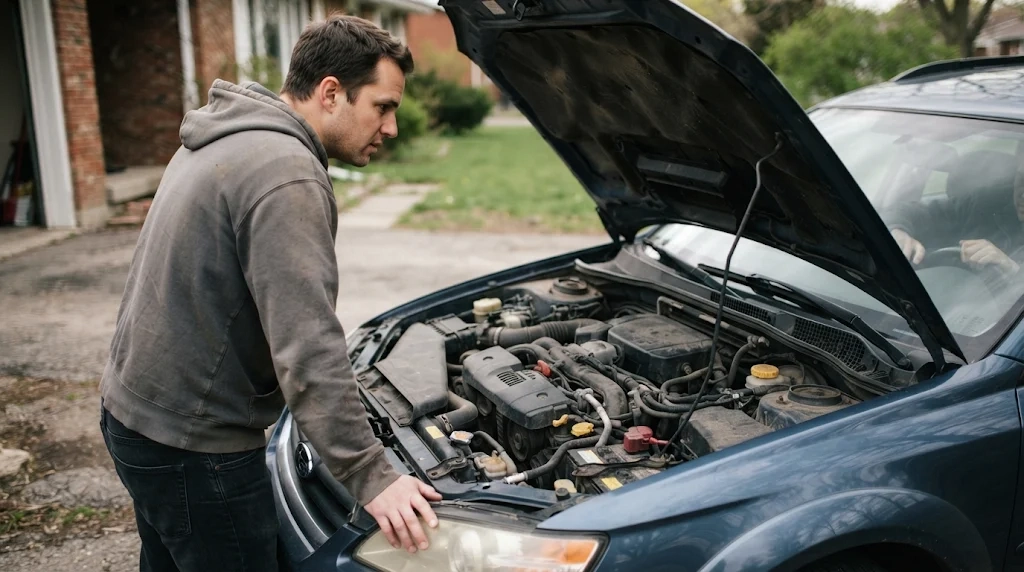
The first diagnostic step is to tell slow cranking from normal cranking without ignition. These symptoms point toward different systems.
Cranking means the starter is turning the engine. An engine can crank strongly yet fail to start because fuel, spark, or control signals are missing.
The table compares the symptoms you may hear and the checks they suggest.
| What happens | Possible problem | Useful next check |
|---|---|---|
| Cranks normally but takes longer | Fuel pressure loss or mixture problem | Fuel pressure and stored codes |
| Cranks normally but never fires | Engine sensor, fuel, or ignition fault | Live RPM signal and fuel delivery |
| Turns over sluggishly | Battery, connections, or starter | Battery load and cable voltage drop |
| Clicks without turning | Starting circuit or starter motor | Battery terminals and starter circuit |
| Starts, then runs rough | Excess fuel vapor, injector, or ignition issue | Codes and warm-running data |
The key distinction: slow cranking starts with the electrical starting system, while strong cranking shifts attention toward fuel and engine controls.
What Causes Hard Starting After Sitting for 30 Minutes?
The most useful causes to investigate are fuel pressure loss, heat-sensitive sensors, vapor control faults, and starter circuit problems. Their symptoms often overlap.
Fuel pressure drains away after shutdown
Some fuel-injected engines are designed to retain pressure after you turn them off. A leaking pump check valve, pressure regulator, or injector can let that pressure fall.
The pump then needs extra time to restore the fuel supply when you restart. AutoZone explains this pattern in its fuel pump symptom guide.
A worn injector may also let fuel enter the engine after shutdown, making the mixture too rich. A technician can distinguish these faults with a pressure leak-down test.
A crankshaft or camshaft sensor fails when hot
A weak engine-position sensor may stop sending a dependable signal after it gets hot. The engine computer needs these signals to coordinate ignition and fuel injection.
The starter may turn the engine at normal speed without a successful start. Sensor function can return after cooling, making the fault intermittent.
AutoZone’s camshaft sensor guide describes hard starting, stalling, and heat-related wiring damage. Testing the signal is better than replacing a sensor based on timing alone.
An EVAP purge valve lets too much vapor into the engine
A purge valve stuck open can allow unwanted fuel vapor to enter the intake while the engine is parked. EVAP means evaporative emissions control.
The added vapor may cause a rich mixture and a longer warm restart. The clue becomes stronger when the engine also starts poorly after refueling.
A purge valve is not the only possible cause of a fuel smell or rough start. Fuel pressure and injector problems can produce similar symptoms.
The starter, battery cable, or ground struggles with heat
A hot starter or weak electrical connection can turn the engine more slowly than normal. Heat may expose resistance that causes a marginal circuit to fail.
A clicking sound or noticeably slow engine rotation makes this possibility more relevant. AAA describes starter and connection symptoms that help separate these faults.
The battery may still have enough power for the dashboard and radio. Those lights do not prove it can supply enough current to crank the engine.
Ignition, temperature sensing, or fuel vapor issues
Ignition coils and related wiring can become unreliable with heat and interrupt spark. An incorrect engine-temperature signal can also affect how fuel is delivered during restart.
Older carbureted engines may experience fuel percolation or vapor lock after a hot shutdown. Modern fuel-injected cars are generally less prone to classic carburetor-related vapor lock.
These are secondary possibilities, not reasons to replace several parts at once. The starting sound and a warm-engine test should guide the next step.
Why Does My Car Start Cold but Struggle When Warm?
A car that starts cold but struggles warm may have a fault that appears only at higher temperatures. Heat-sensitive electronics and fuel behavior deserve closer attention.
Cold and warm starts use different engine conditions. After a drive, the engine, fuel system, and under-hood wiring are already heated.
If your car starts easily right after shutdown but struggles after a short wait, heat soak becomes a useful clue. If it struggles after sitting overnight too, a wider range of faults becomes possible.
- Only after a warm stop: investigate residual fuel pressure and heat-related failures.
- Cold and warm: consider battery condition, fuel supply, ignition, and general engine health.
- After buying gas: add the purge valve and EVAP system to the diagnostic list.
- After rain or washing: inspect relevant wiring and connectors for moisture or corrosion.
The pattern helps narrow the tests, but none of these clues proves a single failed part.
What Can You Safely Check Before Taking It to a Shop?
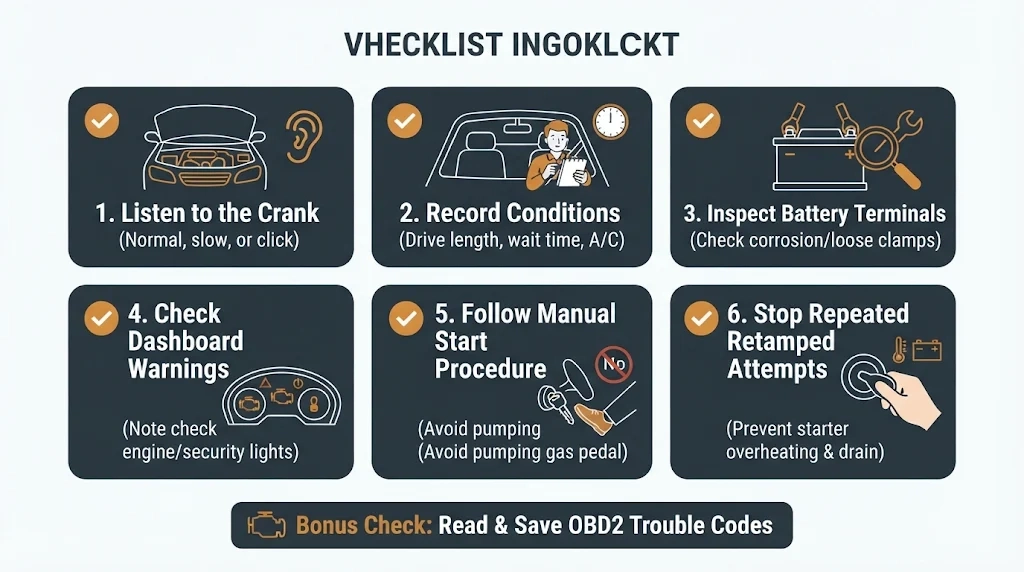
You can gather useful evidence without opening fuel lines or touching hot engine parts. Start with observations and basic electrical checks.
- Listen to the crank. Note whether the engine spins normally, turns slowly, or only clicks. Describe the sound rather than saying it will not start.
- Record the conditions. Note the length of the drive, how long the car sat, and whether the air conditioning was running. Include whether the engine was hot or cold.
- Look at the battery terminals. With the engine off, check for visible corrosion or loose clamps. Do not touch damaged or swollen battery parts.
- Check for dashboard warnings. Record any check engine or security light. A code can guide testing but does not automatically identify the failed component.
- Try the manufacturer-approved start procedure. Follow your owner’s manual for a failed start or flooded engine. Avoid pumping the accelerator unless the vehicle instructions call for it.
- Stop repeated attempts. If the engine keeps failing to start, arrange testing rather than draining the battery and overheating the starter.
A basic OBD2 code reader can retrieve stored diagnostic trouble codes on compatible vehicles. Some scanners also show live data, such as engine speed while cranking.
Write down codes before clearing them. A blank code list does not rule out a hot-start fault.
Warning
Pressurized fuel and hot engine parts can cause injury or fire. Leave fuel-line opening and pressure testing to a qualified technician.
How Does a Mechanic Diagnose a Warm Restart Problem?
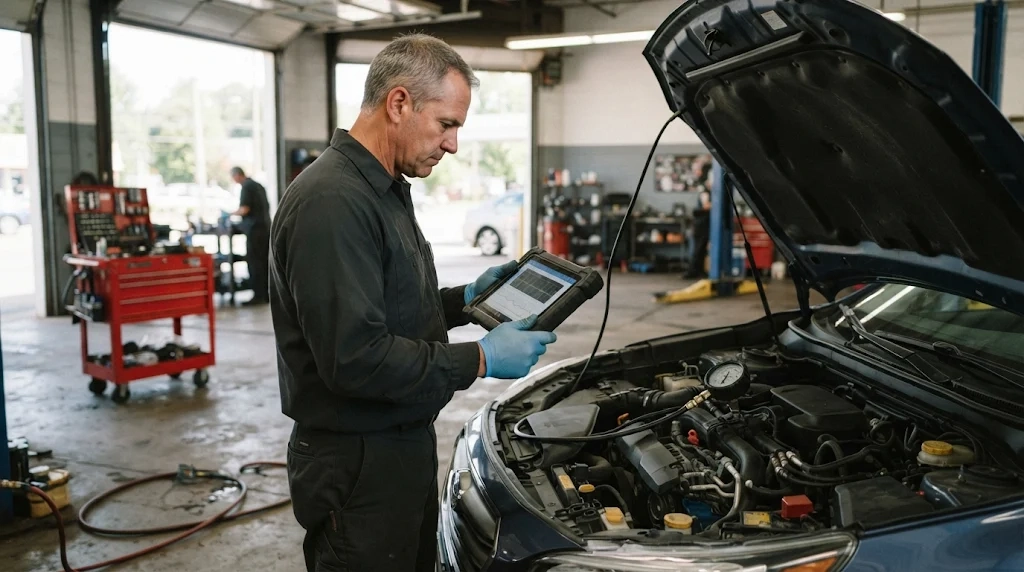
A mechanic should reproduce the symptom after a normal drive and short stop. Testing only after the engine has cooled may miss the failure.
Check fuel pressure before and after shutdown
A fuel pressure test shows whether the system builds pressure and retains it as designed. The correct values depend on the vehicle.
A rapid pressure drop may lead the technician toward the pump check valve, regulator, or injectors. Further testing separates them rather than treating low pressure as proof of a bad pump.
Watch sensor readings while the engine cranks
Live scan data can show whether the engine computer receives a usable speed signal during the failed start. A missing or erratic reading may point toward a sensor or wiring fault.
A technician can also check whether ignition spark and injector commands are present. These tests help isolate the missing part of the starting process.
Measure battery condition and circuit voltage drop
A battery load test and voltage-drop checks reveal problems that a simple dashboard light cannot show. The technician measures the electrical supply while the starter is working.
Weak cables, grounds, or starter components may behave differently when hot. Testing them during the slow-crank event can prevent an unnecessary battery replacement.
When Is a Hard Warm Start a Safety Concern?
A hard warm start needs urgent attention when it comes with stalling, fuel leakage, smoke, or electrical overheating. These symptoms can create hazards beyond being stranded.
Do not drive if the engine repeatedly stalls in traffic or you suspect a fuel leak. Arrange a tow or professional assistance.
- Strong raw gasoline smell or visible wet fuel
- Smoke or burning electrical odor
- Engine stalls without warning while driving
- Battery case looks swollen or damaged
- Starter or cables become unusually hot after repeated attempts
If your only symptom is a longer crank, schedule diagnosis before it becomes a no-start condition. Avoid assuming the issue is harmless because the car eventually starts.
How Do You Fix a Car That Starts Hard After 30 Minutes?
The correct fix depends on which system fails during the warm restart. Replacing parts from a symptom list can waste money.
This table connects a confirmed finding with the usual repair direction.
| Confirmed finding | Likely repair | What to verify |
|---|---|---|
| Fuel pressure leaks down | Repair the leaking pump valve, regulator, or injector | Pinpoint the leakage source first |
| Sensor signal fails when hot | Repair sensor, connector, or wiring | Confirm signal and circuit fault |
| Purge valve sticks open | Repair or replace the purge valve | Check valve operation and vapor flow |
| Slow cranking with voltage loss | Repair the battery connection, ground, or starter circuit | Load-test battery and cables |
A successful repair should be checked under the same conditions that caused the original problem. A cold start alone cannot prove a hot-start issue is gone.
How Can You Prevent Hard Starts After Short Stops?
Prevention starts with maintaining the battery connections and addressing early fuel or ignition symptoms. Some heat-related component failures cannot be prevented by routine care.
Keep the battery terminals secure and free from heavy corrosion. Follow the vehicle’s service schedule for ignition and fuel-system maintenance.
Investigate recurring long cranks instead of adding fuel treatments or replacing sensors at random. Keeping a record of the exact symptoms also makes later diagnosis easier.
After a repair, test the car following a normal drive and the same short parking interval. Repeat the check if the problem used to happen only under certain weather conditions.
OBD2 Code Reader
An OBD2 code reader can help you record trouble codes before a technician investigates the warm-start problem.
Frequently Asked Questions
Can a failing fuel pump work while driving normally?
A weak fuel pump can still supply enough fuel for some driving conditions yet struggle during a restart. A leaking check valve may chiefly affect pressure after shutdown. A pressure test can help separate this problem from inadequate fuel delivery while driving.
Will the check engine light always appear?
A warm-start fault may occur without turning on the check engine light, even when the car repeatedly struggles to start. Some intermittent failures do not produce a stored trouble code. Live readings during the actual failure may still reveal a missing engine-speed signal or a fuel-system problem.
Can low fuel level make warm starting worse?
A low fuel level may add stress to some in-tank fuel pumps, but it does not prove why a warm engine starts poorly. The same symptom can occur with a full tank. Check pressure and other evidence before blaming fuel quantity.
Do push-button cars experience the same starting problem?
Push-button cars can develop the same heat-related fuel, sensor, and starter faults as cars with traditional ignition keys. Their starting controls differ, but the engine still needs proper cranking and fuel delivery. A key detection message adds another separate clue.
Does a successful jump-start prove the battery is bad?
A successful jump-start suggests the starting system benefited from extra electrical power, but it does not prove the battery is defective. Weak connections or a dragging starter may also be involved. A battery test and circuit inspection are needed before replacement.
Can a loose gas cap cause a hot no-start?
A loose gas cap usually triggers an evaporative-system warning rather than directly preventing the engine from starting. A stuck purge valve is a different fault and may affect warm restarts. Inspect the EVAP system when symptoms and diagnostic codes support it.
Conclusion
If your car is hard to start after sitting for 30 minutes, first note whether it cranks slowly or spins normally without firing. Then have the fuel pressure, engine-position signals, and starting circuit tested during the warm failure. That approach is more reliable than replacing parts by guesswork.

Alex Carter is an automotive content writer at VastAutoParts, focusing on car parts, vehicle troubleshooting, automotive tools, product research, and practical car care guides.