
Car Won’t Start After Cleaning Battery Corrosion? 5 Checks to Fix It
Quick Answer
A car that will not start after cleaning battery corrosion usually has a loose cable clamp or a missed patch of corrosion inside the clamp. The battery may also be too weak to crank the engine, and cleaning cannot recharge it. Check the clamps first, then test the battery.
- A clamp that twists by hand is too loose to carry the current the starter needs.
- Corrosion hides inside the cable clamp, so clean the inside of each clamp, not just the post.
- A healthy battery reads about 12.6 volts with the engine off, so a low reading points to the battery.
- A blown main fuse or a tripped anti-theft system can also follow a battery disconnect.
You cleaned the white crust off the battery terminals, expecting the car to start, and now it does less than before. This guide explains why that happens, shows the checks to run in order, and tells you when the battery itself is the fault. You will work from the cheapest fix to the deeper causes, so you replace nothing you do not need to.
In this article
- Why Won’t Your Car Start After Cleaning the Terminals?
- What Should You Check First at the Battery?
- What Does Each Symptom Mean After Cleaning?
- How Do You Fix a No-Start After Cleaning Corrosion?
- Could the Battery Itself Be the Problem?
- Did Disconnecting the Battery Reset Something?
- How Can You Clean Terminals Without a No-Start Next Time?
- Frequently Asked Questions
- Conclusion
Why Won’t Your Car Start After Cleaning the Terminals?
Your car will not start after cleaning because cleaning changes the connection, and the connection is what carries power to the starter.
The starter needs a large surge of current for a few seconds to turn the engine. A clamp that looks clean can still sit loose on the post, and a loose clamp cannot pass that surge. Lights and the radio need far less power, so they can work while the starter gets nothing.
Cleaning can also expose a fault that the crust was hiding. Corrosion sometimes fills the gap between a worn clamp and a thin post, so removing it leaves the clamp slack. A cable that was already cracked or green inside its insulation may fail once you move it.
Moving the cables can also disturb a post that was already loose in the case. A post that wobbles in the battery case has lost its seal, and no amount of cleaning restores it. That battery needs a test, and often a replacement, because acid can leak from the loose seal.
A flat battery is the other common cause. Cleaning removes corrosion, but it does not add charge, so a battery that was already drained stays drained. If you hear a click and nothing else, the cause is often the same as when a car clicks but won’t start.
What Should You Check First at the Battery?
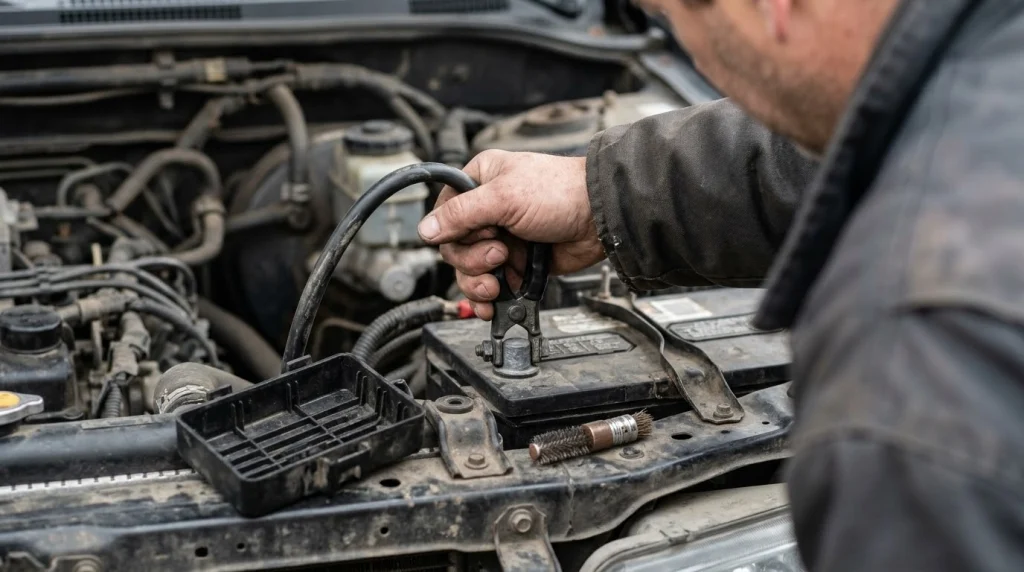
Check the clamps, the ground cable, and the main fuse first, because these three checks fix most no-starts after cleaning.
Are the cable clamps tight?
A clamp that twists by hand is too loose, even if it looks tight.
Grip each clamp and try to twist it on the post. If it moves, loosen the bolt, push the clamp down onto the post, and tighten it until it will not move. Do not force the bolt past that point, because a cracked post leaks acid and ruins the battery.
Is corrosion still hiding inside the clamp?
Corrosion hides inside the cable clamp, where a quick wipe cannot reach it.
Take each clamp off the post and look inside it. Scrub the inside of the clamp and the post with a wire brush until both show bright metal. Follow the sequence in the AAA battery charging guide, which advises removing the negative cable first and refitting the positive cable first.
Warning
A wrench that touches both terminals at once can spark and melt metal. Disconnect the negative cable first and keep tools away from the positive post while you work.
Is the ground cable clean and tight?
The ground cable is the return path for current, and a dirty ground stops the starter as surely as a dirty positive clamp.
Follow the black cable from the battery to the bolt where it meets the body or engine block. Clean that contact point with a wire brush and tighten the bolt. The ground side is easy to miss, because most drivers check only the two posts on top of the battery.
Did cleaning blow the main fuse?
A slipped wrench can blow the main fuse, and a blown main fuse cuts power to the whole car.
If nothing works at all, no lights, no dash, no click, open the fuse box and look for the large main fuse. A broken wire inside the fuse means it has blown, and a matching replacement restores power. Your manual shows the fuse layout and the correct rating.
What Does Each Symptom Mean After Cleaning?
Each symptom after cleaning points to a different fault, so match what you see and hear before you change any parts.
This table matches each symptom to its most likely cause and the first check to try.
| Symptom | Most likely cause | First check |
|---|---|---|
| Nothing at all, no lights | Main fuse blown or cable not fitted | Check the main fuse and both clamps |
| Dash lights work, rapid clicking | Loose clamp or weak battery | Tighten the clamps, then test the battery |
| One loud click, no crank | Poor starter connection or starter fault | Check the starter wiring, then test the starter |
| Engine cranks but will not fire | Fuel or spark fault, not the battery | Check fuel and spark, not the terminals |
Match the sound first, because each sound points to a different part of the starting system.
A car that dies the moment you turn the key may have a different fault from a car that never had power at all. If the dash lights vanish when you crank, the fault may be the same one that makes a car lose all power when you try to start it.
How Do You Fix a No-Start After Cleaning Corrosion?
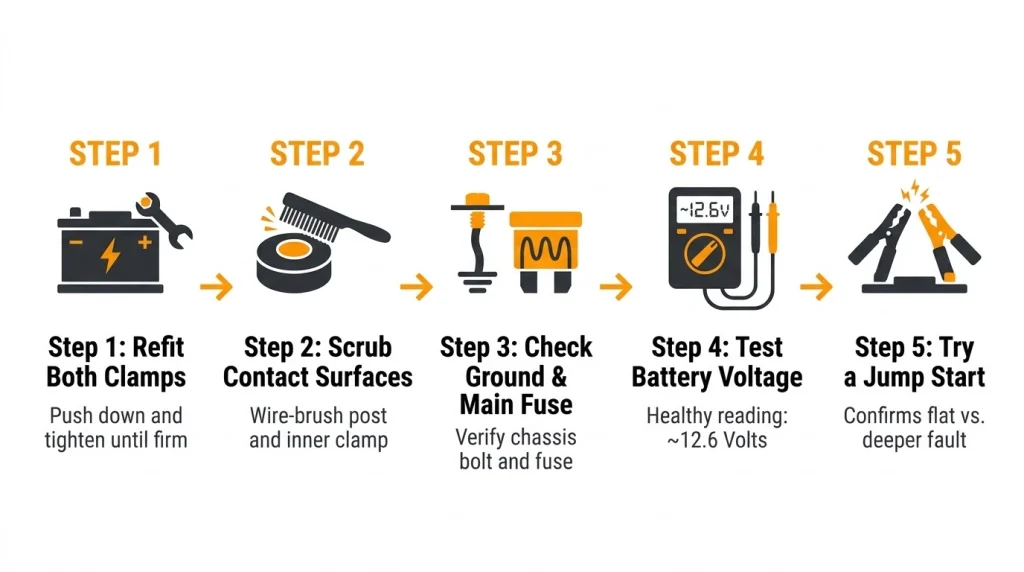
Fix a no-start after cleaning by working from the clamps outward, testing the battery before you suspect the starter.
These steps follow the same order used when diagnosing a no-start, starting with the cheapest checks and ending with the parts that cost money.
Step 1
Refit both clamps
Loosen each clamp, push it fully down onto the post, and tighten it until it will not twist by hand. Try the key after each clamp, so you know which one was at fault.
Step 2
Scrub the contact surfaces again
Take the clamps off and scrub the posts and the inside of each clamp with a wire brush. Refit them only when both surfaces show bright metal and feel dry.
Step 3
Check the ground and the main fuse
Follow the black cable to its bolt on the body or engine and tighten it. Open the fuse box and look for a blown main fuse if the car has no power at all.
Step 4
Test the battery voltage
A multimeter across the terminals shows the state of charge. A healthy battery reads about 12.6 volts with the engine off, so a lower reading means the battery needs a charge or a test.
Step 5
Try a jump start
A jump start tells you whether the battery is the fault. If the car starts with a jump, the battery was flat. If it still will not start, the fault lies past the battery.
Could the Battery Itself Be the Problem?
The battery itself can be the problem, because cleaning cannot restore charge to a battery that is flat or worn out.
Test the voltage before you blame the cleaning. Family Handyman notes in its jump-start guide that a healthy battery reads about 12.6 volts with the engine off. A reading well below that means the battery needs charging or testing.
Age matters too. AAA lists a battery age of 3 to 5 years among the signs that a new battery may be due.
An older battery deserves a test at a parts store. Most parts stores test a battery free of charge, and a load test shows whether it can still deliver the surge the starter needs.
A jump start or a charger can confirm the diagnosis. If the car starts with a jump and keeps starting after a drive, the battery was drained but still holds a charge. If it needs a jump again the next morning, the battery no longer holds a charge, or something drains it overnight.
Corrosion alone does not condemn a battery. Interstate Batteries notes that corrosion by itself does not mean a battery has gone bad, and only a test shows whether the battery is weak. If the battery tests fine but the car still will not crank, the next step is to work out whether the starter or battery is at fault.
Did Disconnecting the Battery Reset Something?
Disconnecting the battery can reset the car’s computers, and some cars need a short relearn before they behave as before.
Some anti-theft systems treat a power loss as tampering and block the starter until you lock the car with the key fob and open it again. Your manual lists the reset steps for your model, and a flashing security light on the dash is the usual sign.
The engine computer also forgets its idle settings when power is cut. The car may idle roughly or stall once or twice after it starts, then settle after a short drive. Radio presets, the clock, and seat memory may reset too, which is normal after a disconnect.
A memory saver avoids these resets by feeding the car a small current while the battery is out. Interstate Batteries suggests connecting a memory saver before you clean the terminals, so the computers keep their settings.
How Can You Clean Terminals Without a No-Start Next Time?
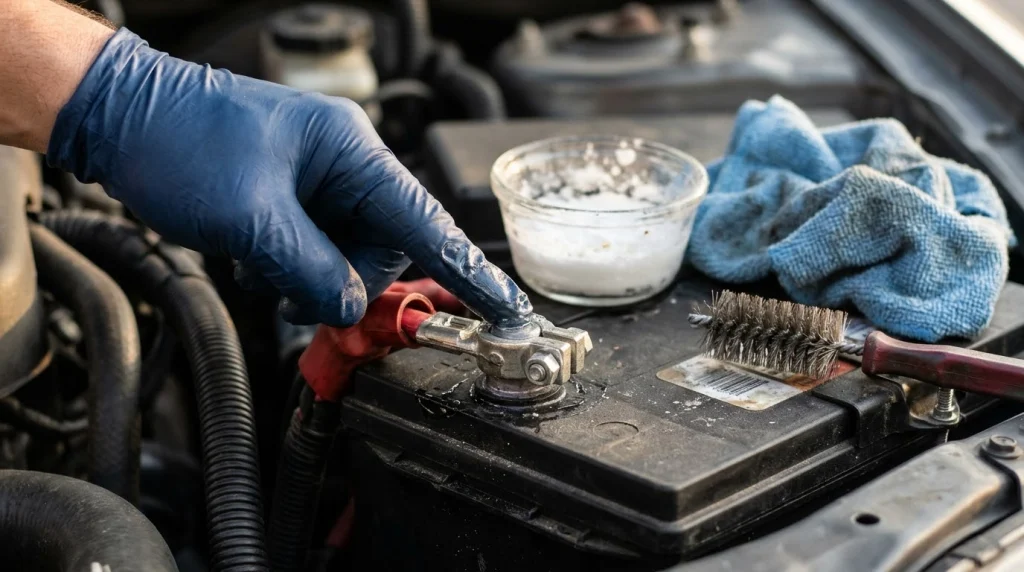
You can clean terminals without a no-start by keeping the right cable order, drying every surface, and tightening each clamp before you turn the key.
Work with the engine off and the key out of the ignition. Take the negative cable off first and put it back last, so a slipped wrench cannot short the battery.
Scrub the posts and the inside of each clamp with a wire brush and a paste of baking soda and water. Rinse lightly and dry the metal fully.
Protect the clean metal after you reconnect, not before. A thin layer of petroleum jelly or dielectric grease on the outside of each clamp seals out moisture.
Grease between the post and the clamp blocks the contact, so keep it on the outside. The Interstate Batteries corrosion cleaning guide shows the full sequence, including a memory saver for cars that reset when power is cut.
Tip
Apply a thin layer of petroleum jelly or dielectric grease to the outside of each clamp after you reconnect it. The coating seals out moisture and slows new corrosion.
Check the terminals every few months, and clean them again at the first sign of white or blue crust. A quick check takes minutes and keeps a small crust from turning into a no-start.
Do
- Disconnect the negative cable first
- Scrub the inside of each clamp
- Dry the posts before you reconnect
Avoid
- Putting grease between the post and the clamp
- Forcing a clamp bolt until the post cracks
- Letting cleaning water run into the battery vents
Battery Terminal Cleaner
A battery terminal cleaner brush scrubs both the posts and the inside of the cable clamps, where corrosion hides after a wipe-down.
Frequently Asked Questions
How long should I wait before starting after cleaning?
Start the car once the posts and clamps are dry to the touch, with no fixed wait beyond that. Wet metal can short or corrode again, so wipe the posts, the clamps, and the top of the case with a dry cloth first. Drying takes a few minutes in open air, and a dry connection cranks better than a damp one.
Can I use vinegar or cola to clean battery corrosion?
Baking soda and water is the right cleaner for battery corrosion, not vinegar or cola. Vinegar is an acid, so it adds acid to a problem caused by acid. Cola leaves a sticky residue that attracts dirt, and Interstate Batteries warns that it can interfere with parts near the battery.
Why does corrosion keep coming back after cleaning?
Corrosion returns when the battery vents gas or leaks acid at the post, and cleaning alone cannot stop either cause. Overcharging makes the battery vent more gas, and a cracked case lets acid seep onto the terminals. A battery test and a charging system check find the cause when the crust returns within weeks.
Is it safe to clean battery terminals with the engine running?
Cleaning battery terminals with the engine running is unsafe, so switch the engine off and take the key out first. A running engine keeps the charging system live, which raises the risk of a spark or a short while you work. The alternator also charges the battery while the engine runs, so the terminals stay live.
What does white powder on battery terminals mean?
White powder on battery terminals is corrosion, formed when gas from the battery reacts with the metal posts and clamps. Hydrogen gas escapes through the vent and attacks lead, zinc, or aluminum, leaving a white crust behind. The powder itself is not a verdict on the battery, so clean it off and test the battery if starting stays weak.
Should I replace the battery cables or just clean them?
Clean the cables when the metal is sound, and replace them when the damage runs deeper than the surface. Replace a cable if the clamp is pitted or cracked, the insulation is swollen, or green corrosion runs under the insulation. A cable that fails any of those checks cannot carry full current, even after a careful clean.
Conclusion
A car that will not start after cleaning battery corrosion usually needs a tighter clamp, a cleaner contact surface, or a battery test, not new parts. If the clamps are tight and the battery reads low, charge or replace the battery before you look at the starter.

Alex Carter is an automotive content writer at VastAutoParts, focusing on car parts, vehicle troubleshooting, automotive tools, product research, and practical car care guides.