
What Can Be Mistaken for a Bad Starter? 10 Causes to Check
Quick Answer
What can be mistaken for a bad starter? A weak battery, corroded terminals, faulty cables, poor engine grounds, starter relays, ignition switches, and safety switches can all prevent an engine from cranking. Charging problems, security systems, and mechanical engine faults can produce similar symptoms. Test these possible causes before replacing the starter motor.
- Rapid clicking or dim lights often suggest a battery or connection problem.
- A single click does not confirm starter motor failure.
- Normal engine cranking usually points away from the starter.
- Battery load testing and electrical circuit checks help identify the actual fault.
Your car refuses to start, and the starter motor seems like the obvious problem. However, several electrical and mechanical faults can create nearly identical symptoms.
Replacing the starter without checking those possibilities can waste money and leave your car unable to start. This guide explains which problems commonly mimic starter failure and how to narrow down the cause safely.
In this article
- Why starter problems are often misdiagnosed
- 10 problems mistaken for a bad starter
- What different starting sounds mean
- How to check for a bad starter safely
- Tests that identify the actual fault
- When the starter itself is likely faulty
- Mistakes to avoid during diagnosis
- Frequently Asked Questions
- Conclusion
Why Are Starter Problems Often Misdiagnosed?
Starter problems are often misdiagnosed because several components must work together before an engine can crank. A fault anywhere in that electrical path can make a healthy starter appear defective.
The starter motor uses electrical power from the battery to turn the engine. A starter solenoid acts as a heavy-duty electrical switch and helps engage the starter gear.
The ignition switch, relay, wiring, and safety controls must also allow the starting process. If one component interrupts that process, the engine may remain silent.
Three different conditions are commonly confused:
- No crank: The engine does not rotate when starting is requested.
- Slow crank: The engine rotates more slowly than normal.
- Crank but no start: The engine rotates normally but fails to run.
A no-crank problem can involve the starter, battery, cables, or control system. Slow cranking can involve weak electrical power or excessive engine resistance.
Normal cranking without startup usually shifts attention toward fuel delivery, ignition, engine controls, or security systems. These distinctions help prevent unnecessary starter replacement.
What Can Be Mistaken for a Bad Starter? 10 Causes
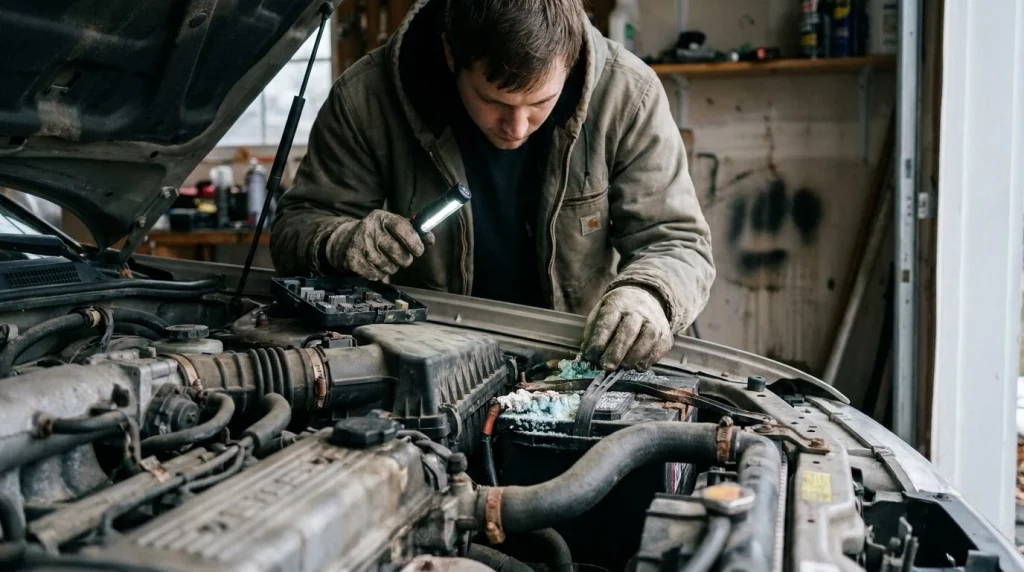
Ten common fault categories can resemble a failing starter motor. Each affects the electrical supply, starting controls, or the engine’s ability to rotate.
1. A Weak or Discharged Car Battery
A weak battery is one of the first problems to investigate when a car will not crank. The battery might still power interior lights while failing to supply enough current for starting.
Common clues include slow cranking, rapid clicking, and lights that become noticeably dimmer during a start attempt.
A battery can also show a reasonable voltage reading while lacking sufficient starting capacity. Measuring resting voltage alone cannot confirm its condition.
A battery load test checks how well the battery performs under demand. It is a useful step before blaming the starter.
2. Loose or Corroded Battery Terminals
Loose or corroded battery terminals can interrupt the electrical current needed to operate the starter. Even a healthy battery cannot deliver power effectively through a poor connection.
Corrosion may appear as white, blue, or green deposits around the cable clamps. A loose clamp may also move on the battery post.
Typical symptoms include:
- Intermittent starting failures.
- Clicking without normal engine rotation.
- Power disappearing during a start attempt.
- Electrical accessories operating inconsistently.
Inspect the visible battery connections with the engine switched off. Follow the vehicle’s service instructions before cleaning or disconnecting anything.
Do not handle a leaking, swollen, or visibly damaged battery. Such conditions require appropriate professional attention.
3. Damaged Battery Cables or Poor Engine Grounds
Damaged battery cables and poor ground connections can create starter symptoms even when the battery tests well. High electrical resistance prevents enough power from reaching the motor.
The positive battery cable supplies power to the starting circuit. The negative cable and engine ground straps provide the return path for electrical current.
A loose ground strap, damaged cable, or hidden internal corrosion can produce slow cranking or complete silence.
The problem may be difficult to see because the cable’s outer insulation can appear normal. A technician can locate excessive resistance using a voltage-drop test.
Automotive supplier DENSO’s starter troubleshooting guidance explains how resistance in battery cables, grounds, and control circuits reduces starter performance.
4. A Failing Alternator
A failing alternator can indirectly imitate starter failure by leaving the battery discharged. The alternator normally replenishes battery power while the engine runs.
If charging is inadequate, the battery may gradually lose the power needed for starting. The next attempt may produce clicking, slow cranking, or no crank.
Possible charging-system clues include:
- A battery or charging warning light during driving.
- A battery that repeatedly becomes discharged.
- Electrical equipment behaving unusually while driving.
- The engine stalling when the electrical supply becomes inadequate.
The alternator does not normally perform the starter motor’s job. Its failure creates starting trouble through the battery and vehicle electrical system.
If a charged battery becomes discharged again, have both the battery and charging system tested.
5. A Blown Starter Circuit Fuse
A blown fuse in the starter control circuit can prevent the starter from receiving the signal required to operate. The engine may remain silent despite functioning dashboard lights.
Fuse arrangements differ among vehicles. Some starting systems have dedicated starter fuses, while others share protection with additional control components.
Consult the owner’s manual or fuse-box diagram to identify the correct circuit. Inspect the fuse only with the vehicle in the required safe condition.
A blown fuse should be replaced only with the specified type and rating. If the replacement blows again, an underlying electrical problem needs diagnosis.
6. A Faulty Starter Relay
A faulty starter relay can stop the starting signal from reaching the solenoid. This may appear to be a failed starter motor.
The relay is an electrically controlled switch in the starting circuit. Its function is to help control when the starter receives its activation signal.
A defective relay may cause complete silence, intermittent starting, or clicking without engine rotation. These signs also occur with other starting-system faults.
Relay locations and wiring vary between vehicles. Testing must follow the appropriate circuit diagram and manufacturer procedures.
Never bridge unidentified relay terminals with wire or metal tools. An incorrect connection can cause electrical damage or unexpected starter operation.
7. A Faulty Ignition Switch or Start Control
A defective ignition switch can prevent the starter system from receiving a valid start request. A malfunctioning push-button control system can produce a similar result.
In key-start vehicles, the ignition switch sends an electrical request through the starting circuit. In push-button vehicles, electronic modules interpret the requested start.
Possible clues include inconsistent accessory operation, intermittent starting, or silence when the key or button is operated.
However, these symptoms do not prove the ignition switch is faulty. The starter relay, wiring, safety inputs, and control modules must also be considered.
8. A Faulty Neutral, Clutch, or Brake Safety Switch
A faulty starting safety switch can prevent an otherwise healthy starter from operating. These switches help stop the vehicle from starting under unsafe conditions.
Automatic transmission vehicles generally use a gear-position signal to permit starting in Park or Neutral. Manual transmission vehicles commonly require the clutch pedal to be depressed.
Many push-button vehicles also require a valid brake-pedal input.
If an automatic car will not crank in Park, a controlled attempt in Neutral may provide a clue. Apply the parking brake and follow the owner’s manual.
A successful start in Neutral suggests a possible gear-position or control problem. It does not identify the failed component by itself.
Firestone’s starter troubleshooting guide also recommends checking battery condition, connections, and transmission position before replacing the starter.
9. An Immobilizer or Electronic Key Problem
An immobilizer or electronic key problem can prevent starting even when the starter motor is functional. The security system must recognize an authorized key before allowing the required start functions.
Depending on the vehicle, an authorization problem may prevent cranking or allow cranking without engine startup.
Possible signs include:
- A security warning on the dashboard.
- A key recognition message.
- The vehicle failing to respond to its start button.
- Starting working with another authorized key.
A weak key-fob battery may also affect key recognition on some vehicles. Consult the owner’s manual for the correct emergency-start procedure.
Security warning messages and scan-tool information can help identify an authorization problem.
10. Engine Mechanical Problems or Damaged Ring Gear
Mechanical engine problems can imitate a weak or defective starter by preventing normal engine rotation. A damaged flywheel or flexplate ring gear can also interfere with engagement.
The ring gear is the toothed component that the starter pinion engages to rotate the engine.
Missing or worn teeth may cause grinding, failed engagement, or unusual free-spinning noises. Severe internal engine resistance can make the starter struggle despite adequate electrical supply.
The starter may be operating as designed but unable to turn the engine normally. Further electrical and mechanical inspection is needed to distinguish these conditions.
A mechanic can inspect the starter drive, ring gear, and engine rotation before recommending replacement.
What Do Different Starting Sounds Tell You?
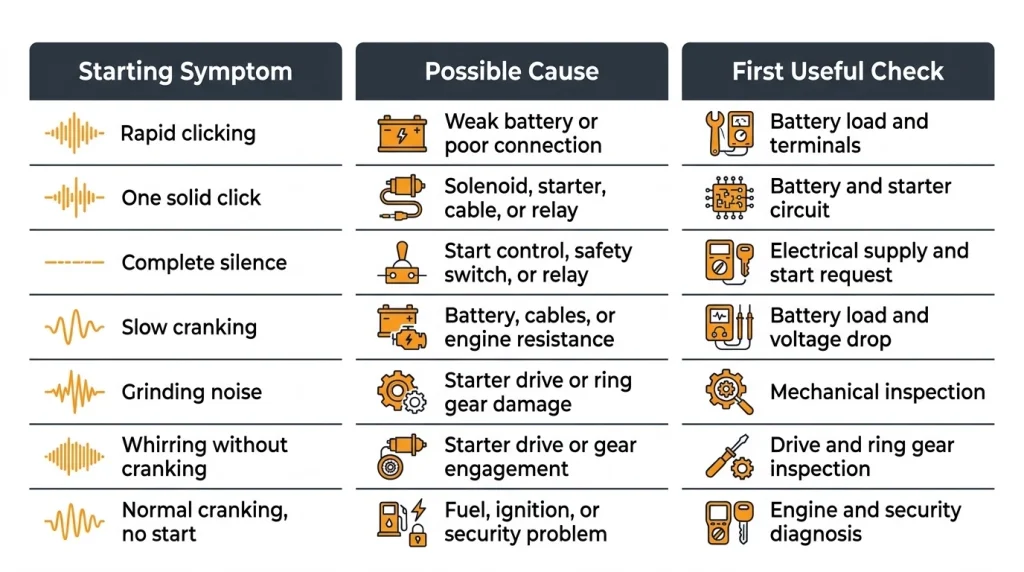
Starting sounds help narrow down possible faults, but no single sound confirms a bad starter. Combine what you hear with battery and electrical testing.
The following table compares common starting symptoms, possible causes, and the first useful check.
| Starting symptom | Possible cause | First useful check |
|---|---|---|
| Rapid clicking | Weak battery or poor electrical connection | Battery load and terminals |
| One solid click | Solenoid, starter, cable, or relay fault | Battery and starter circuit |
| Complete silence | Start control, safety switch, relay, or power supply | Electrical supply and start request |
| Slow cranking | Battery, cables, starter drag, or engine resistance | Battery load and voltage drop |
| Grinding noise | Starter drive or ring gear damage | Mechanical inspection |
| Whirring without cranking | Starter drive or gear engagement problem | Drive and ring gear inspection |
| Normal cranking without startup | Fuel, ignition, security, or engine control problem | Engine and security diagnosis |
Rapid clicks often make the battery and connections the first priority. Grinding or whirring needs closer attention to mechanical engagement, while silence requires checking the start-control path.
How Can You Check a Suspected Bad Starter Safely?
Start with simple observations and accessible checks before testing starter wiring. This approach helps narrow down the cause without unnecessarily replacing parts.
- Secure the vehicle. Park on level ground, apply the parking brake, and select Park or the correct starting position. Follow the owner’s manual.
- Identify the symptom. Listen for clicking, grinding, or silence. Determine whether the engine actually rotates when starting is requested.
- Inspect visible battery connections. Look for loose clamps, corrosion, damaged insulation, or a damaged battery case. Keep the ignition off during inspection.
- Check battery condition. Have the battery charged and load-tested if needed. A weak battery can imitate several starter faults.
- Consider a safe jump-start. Follow the vehicle manufacturer’s instructions using suitable equipment. A successful jump suggests an electrical supply problem but does not identify its exact source.
- Check the starting controls. Verify the transmission position, brake or clutch requirement, and any security messages. Inspect applicable fuses using the owner’s manual.
- Arrange circuit testing if needed. If the engine still will not crank, request battery cable, ground, relay, control-signal, and starter testing.
A failed jump-start does not automatically prove starter failure. Poor jumper connections, damaged cables, safety controls, or engine problems can still prevent cranking.
Likewise, bright headlights do not establish that a battery can deliver enough starting current. A proper battery test provides stronger evidence.
Which Tests Can Identify the Actual Starting Fault?
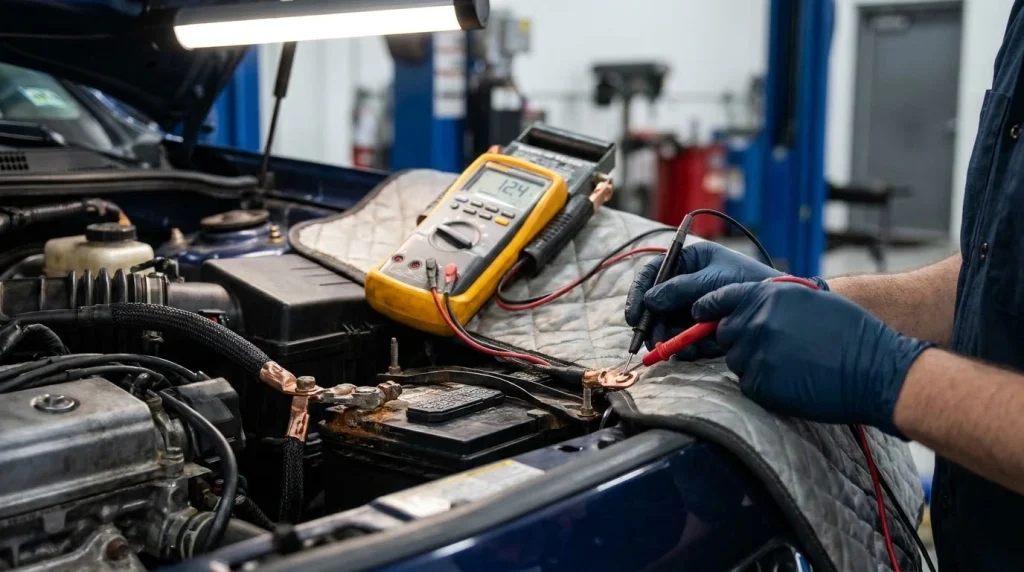
Battery load tests, voltage-drop tests, and starter control checks can separate a faulty starter from related electrical problems. The results must be interpreted against the vehicle manufacturer’s specifications.
Battery Load Testing
A battery load test checks whether the battery can deliver power under demand. A normal resting voltage cannot establish battery capacity by itself.
A typical fully charged conventional lead-acid car battery reads approximately 12.6 volts with the engine off. Battery type, temperature, and manufacturer instructions affect interpretation.
If the battery fails its test, investigate the battery and charging system before condemning the starter.
Voltage-Drop Testing
Voltage-drop testing identifies excessive resistance in cables and electrical connections while current flows. A technician can use it to inspect both the positive supply and ground return paths.
A cable can appear clean outside while hiding corrosion or internal damage. A voltage-drop reading under operating conditions may expose that problem.
The manufacturer’s limits and testing procedure should determine whether a measured drop is acceptable.
Starter Control and Current Testing
Starter control testing checks whether a valid start signal reaches the solenoid. Current testing helps assess how the motor and connected mechanical load behave.
If the control signal never reaches the starter, a relay, switch, wire, or electronic control may be responsible.
If the starter receives the correct electrical supply but cannot turn the engine, further motor and mechanical tests are needed. Excessive engine resistance must also be ruled out.
HELLA’s technical starter testing guide explains how electrical connections, solenoid faults, and mechanical drive problems affect starter operation.
Warning
Live starter terminals carry high current and may cause burns, sparks, or unexpected engine movement. Leave starter terminal probing and circuit bypass tests to qualified technicians.
When Is the Starter Motor Itself Likely Faulty?
The starter becomes a stronger suspect when battery, cable, ground, and control-system tests pass but the engine still cannot crank normally. Correct power delivery must be confirmed before replacement.
A genuine starter fault can involve worn motor brushes, damaged windings, faulty solenoid contacts, or a defective drive mechanism.
Symptoms that justify closer starter inspection include:
- Repeated no-crank events with verified electrical supply.
- Abnormal starter current draw or motor performance.
- Failure to operate despite a confirmed control signal.
- Grinding or free-spinning caused by a defective starter drive.
- Intermittent motor failure after other circuit faults are excluded.
These signs support further testing rather than automatic replacement. Ring gear damage or abnormal engine resistance may create similar results.
A technician may perform an installed-system test or remove the starter for bench testing. An intermittent fault may require testing under the conditions that produce the failure.
What Mistakes Should You Avoid During Diagnosis?
The biggest mistake is replacing the starter based only on clicking or silence. Those symptoms can originate from several other components.
Avoid these common diagnostic errors:
- Assuming bright dashboard lights prove the battery is healthy.
- Replacing the starter before checking battery cables and grounds.
- Assuming a failed jump-start confirms starter failure.
- Ignoring the difference between no crank and normal cranking.
- Replacing fuses repeatedly without finding why they blow.
- Bypassing safety switches or starter terminals without proper training.
- Continuing start attempts during grinding, smoke, or burning smells.
Repeated cranking attempts can overheat electrical components or worsen an existing mechanical problem. Stop if you notice grinding, smoke, a burning smell, or starter operation that continues after startup.
If the cause remains unclear, record the symptoms before visiting a repair shop. Include the sounds, dashboard behavior, and whether the problem occurs intermittently.
These details help a technician reproduce the complaint and select the correct tests.
Automotive Digital Multimeter
An automotive digital multimeter helps measure battery voltage and supports basic electrical checks when used with the correct testing procedure.
Frequently Asked Questions
Can a starter fail even after passing a bench test?
A starter can pass a bench test but still fail intermittently or under normal operating loads. Bench testing does not always reproduce the electrical and mechanical conditions inside the vehicle. A technician may need to check the installed starter, its power supply, and its performance during an actual failure.
Why does my car start again after cooling down?
A car that starts after cooling down may have a heat-sensitive electrical connection, relay, solenoid, or starter motor problem. Heat can change how worn contacts and electrical components behave. Recording the conditions around each failure helps a mechanic identify whether the problem is temperature-related or simply intermittent.
Will a diagnostic scanner always detect a starter problem?
A diagnostic scanner cannot detect every starter motor or electrical connection failure because many faults do not create a stored trouble code. Some vehicles may record relevant starting-control or security faults. Physical electrical testing is often needed when scan results do not explain a no-crank condition.
Can a starter problem cause the battery to drain overnight?
A normal starter motor does not draw power continuously while the vehicle is parked and its starting circuit is inactive. However, a stuck relay or abnormal circuit fault may create an unwanted electrical load. An overnight drain should be investigated with an appropriate battery and parasitic-current test rather than blamed on the starter automatically.
Can thick engine oil make a starter sound weak?
Thick engine oil can increase the force required to rotate an engine, especially in cold conditions. That added resistance may cause slower cranking even when the starter motor works. The battery also performs differently in cold weather, so both electrical supply and engine conditions should be evaluated.
What should I tell a mechanic about starting trouble?
Tell the mechanic whether the engine cranks, how the dashboard behaves, and what sounds occur during the failed start. Mention whether the failure happens after driving, sitting, or exposure to different temperatures. Also report any jump-start attempts, warning messages, repairs, or battery tests already completed.
Conclusion
A weak battery, poor connections, faulty relays, safety switches, and mechanical faults can all be mistaken for a bad starter. Clicking or silence alone cannot confirm the problem.
If your engine will not crank, check the battery and accessible connections first. Request a starting-circuit test before replacing the starter motor.

Alex Carter is an automotive content writer at VastAutoParts, focusing on car parts, vehicle troubleshooting, automotive tools, product research, and practical car care guides.