
7 Symptoms of a Bad Crankshaft Position Sensor Explained
Quick Answer
The 7 symptoms of a bad crankshaft position sensor include a check engine light, hard starting, and cranking without starting. Other signs are sudden stalling, misfires or rough idle, weak acceleration, and reduced fuel economy. These problems suggest a faulty timing signal, but testing is needed to confirm the cause.
- Sudden stalling and failure to restart need prompt attention.
- A running starter with no ignition differs from a starter that does not turn.
- A fault code can point to the sensor circuit, not necessarily the sensor itself.
- Check the connector, wiring, and live engine-speed data before replacing parts.
If your car struggles to start, stalls without warning, or shakes at idle, the crankshaft position sensor may be involved. Knowing the signs helps you avoid replacing a good sensor while overlooking a wiring or fuel problem. This guide shows what to watch for, what else can cause the same trouble, and which checks matter.
In this article
- What the sensor does
- Seven symptoms to watch for
- How symptoms compare with other faults
- How to check the sensor
- Other possible causes
- When to stop driving
- When replacement makes sense
- Frequently asked questions
- Conclusion
What Does a Crankshaft Position Sensor Do?
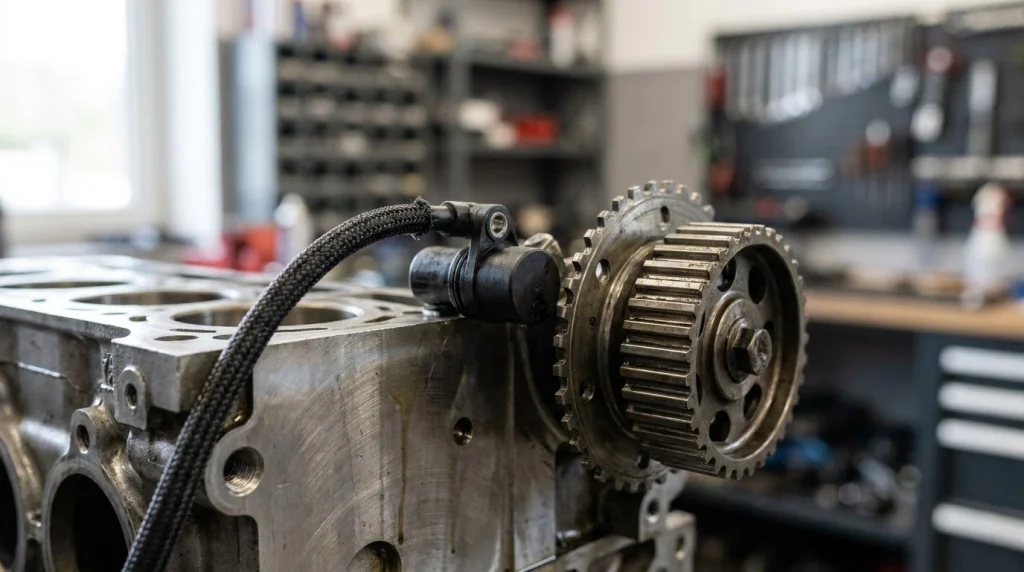
A crankshaft position sensor measures the rotation and position of the engine’s crankshaft. The engine control module, or ECM, uses that information to coordinate ignition and fuel injection. The sensor is also called a CKP sensor or crank sensor.
The sensor reads a rotating target, often called a reluctor wheel, and sends an electrical signal to the ECM. When that signal disappears or becomes unreliable, the engine may run poorly or fail to start. The exact reaction depends on the vehicle’s engine control system.
DENSO’s engine sensor guidance describes how these signals affect starting, acceleration, misfires, and stalling. Those effects explain why one small electrical component can cause several different driving problems.
What Are the 7 Symptoms of a Bad Crankshaft Position Sensor?
The seven warning signs involve engine starting, running, and performance. A failing sensor can cause several of these at once, or only one may appear. The pattern matters more than any isolated symptom.
1. The Check Engine Light Comes On
A faulty CKP signal can trigger the check engine light and store a diagnostic trouble code. Codes in the P0335 to P0339 group concern crankshaft position sensor signals or circuits. A code identifies a problem area, not the exact failed part.
The light may appear while the engine still seems to run normally. It can also appear with hesitation, poor starting, or stalling. Other engine faults can turn on the same light, so reading the code is a starting point.
Record any stored and pending codes before clearing them. Clearing codes too soon may erase useful evidence of an intermittent problem.
2. The Engine Takes Longer to Start
A weak or inconsistent crankshaft signal can make the engine crank longer before it starts. You may hear the starter turn normally, yet the engine takes extra attempts to fire. Sometimes it starts normally on the next attempt.
This happens because the ECM needs a dependable engine-speed and position reference. However, low fuel pressure, weak ignition, and battery problems can also produce slow starting. Check whether the engine turns at its usual speed before blaming the CKP sensor.
3. The Engine Cranks but Will Not Start
A complete loss of the crankshaft position signal can prevent some engines from starting. The starter may spin the engine, but the ECM may lack information needed to control ignition or injection. This is called a crank-no-start condition.
Crank-no-start is not the same as silence when you turn the key. If the starter does not rotate the engine, investigate the battery, starter, and starting circuit first. If the engine cranks normally, check fuel, spark, and engine-speed data.
A missing CKP signal is one possible explanation, not a certain diagnosis. An immobilizer fault or damaged engine timing components may create a similar result.
4. The Engine Stalls Without Warning
An intermittent CKP signal can cause the engine to shut off unexpectedly. The vehicle may stall at idle, after starting, or while moving. It may restart immediately or refuse to restart until the fault stops occurring.
Heat, vibration, and damaged wiring can sometimes make an electrical fault come and go. If stalling happens after the engine warms up, write down the conditions for diagnosis. A repeatable pattern helps a technician test the circuit while the fault is present.
Sudden loss of engine power is a safety concern, even if the car restarts. Do not assume a temporary restart means the vehicle is safe to drive.
5. The Engine Misfires or Idles Roughly
An unreliable crankshaft signal can contribute to misfires, shaking, and uneven idle. You may feel the engine stumble while stopped or hesitate as you pull away. The problem may be easier to notice under load.
A misfire means combustion does not occur as intended in a cylinder. Bad spark plugs, ignition coils, injectors, or air leaks can cause similar symptoms. A rough idle alone provides little evidence that the crank sensor needs replacement.
Look for a combination of misfire codes, CKP circuit faults, and abnormal sensor data. A technician can compare the crankshaft signal with other engine signals to narrow the cause.
6. Acceleration Becomes Uneven or Weak
An unstable CKP signal can make acceleration hesitant, jerky, or weaker than usual. The engine may stumble when you press the accelerator, then recover. Some vehicles may limit engine output when the control system detects a serious fault.
The crankshaft signal helps the ECM coordinate engine operation as speed and load change. However, weak acceleration can also result from fuel delivery issues, airflow problems, or exhaust restrictions. The sensor should not be replaced based on sluggish performance alone.
Delphi’s crank sensor symptom guide also identifies uneven acceleration, misfires, starting difficulty, and higher fuel use as possible signs.
7. Fuel Economy Gets Worse
A faulty crankshaft signal can contribute to higher fuel consumption when engine control becomes less efficient. You may notice more frequent refueling during similar trips. The change is not specific enough to identify the sensor by itself.
Tire pressure, driving conditions, dragging brakes, and other engine problems can affect fuel use. Compare similar driving conditions before treating a fuel economy change as a fault. When poor mileage appears alongside stalling or CKP trouble codes, the sensor circuit deserves attention.
Which Symptoms Point More Strongly to a CKP Problem?
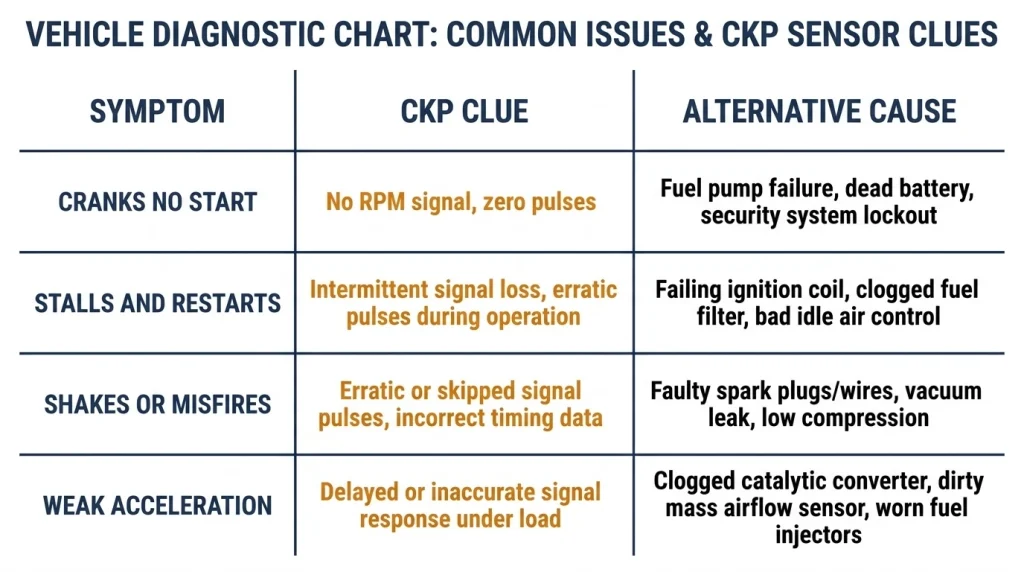
A combination of starting or stalling problems and CKP-related diagnostic evidence points more strongly toward a sensor circuit fault. No single driving symptom is conclusive. The table compares useful clues and common alternatives.
| What you notice | Possible CKP clue | Another cause to check |
|---|---|---|
| Cranks but will not start | No usable engine-speed signal during cranking | Fuel, spark, or immobilizer problem |
| Stalls and later restarts | Intermittent signal or circuit dropout | Fuel pump or electrical power loss |
| Shakes or misfires | Unstable timing reference with related codes | Spark plugs, coils, or injectors |
| Weak acceleration | Signal disruption under engine load | Fuel or airflow restriction |
A sensor fault becomes more plausible when the warning signs match a fault code and live data. Testing separates a suspected CKP problem from a lookalike fault.
How Do You Check a Crankshaft Sensor Before Replacing It?
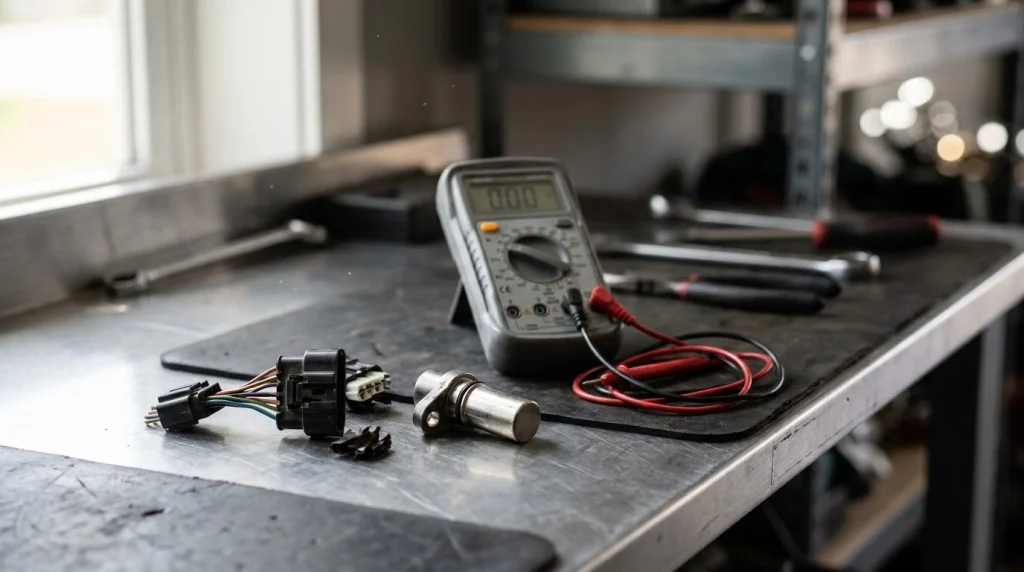
Start with fault codes, cranking behavior, and the sensor’s wiring before testing its electrical signal. The goal is to find the failed component or circuit, not simply replace the part named in a code. A basic OBD2 scan tool can help with the first checks.
- Describe the symptom. Note whether the engine cranks normally, starts slowly, stalls, or runs roughly. Record whether the problem appears during a cold start, after warming up, or under acceleration.
- Read fault codes. Use an OBD2 scan tool to read stored and pending trouble codes. Save the codes and available freeze-frame information before clearing anything.
- Check engine RPM while cranking. Look at live engine-speed data if your scanner supports it. Missing or implausible RPM information can suggest a lost CKP signal, but scanner behavior varies by vehicle.
- Inspect the connector and wiring. Look for loose plugs, corrosion, water intrusion, rubbed insulation, or wires exposed to exhaust heat. A damaged circuit can imitate a failed sensor.
- Inspect related components. Check for damage or contamination around the sensor and its rotating target, where accessible. Incorrect spacing or a damaged target wheel can interrupt a good sensor’s signal.
- Confirm the signal using service information. A technician can use the correct test method and an oscilloscope to examine the waveform. Sensor designs differ, so follow the vehicle manufacturer’s procedure.
HELLA’s crankshaft sensor diagnostic guide explains the difference between inductive and Hall-effect sensors. It also warns that an unsuitable resistance test can damage a Hall-effect sensor. Do not apply a generic multimeter procedure without identifying the sensor type.
What Else Can Look Like a Bad Crankshaft Sensor?
Several electrical and mechanical faults can produce the same symptoms as a bad crankshaft position sensor. Checking these possibilities prevents unnecessary replacement. The strongest alternative depends on whether your problem is starting, stalling, or rough running.
- Battery or starter problems: Slow or absent cranking suggests a starting system fault before a CKP diagnosis.
- Fuel delivery problems: Low fuel pressure can cause long cranking, hesitation, stalling, and no-start conditions.
- Ignition faults: Coils and spark plugs may cause misfires, shaking, and loss of power.
- Wiring and connector damage: Open circuits, shorts, and poor electrical connections can interrupt the signal from a working sensor.
- Camshaft sensor or timing problems: Related position signals and mechanical timing faults can confuse engine operation.
- Damaged reluctor wheel: A broken or contaminated rotating target can produce an abnormal signal even with a good sensor.
Pay special attention when the engine cranks but refuses to start. A CKP fault code should guide your inspection, not replace it. Electrical testing and vehicle-specific service information are the deciding steps.
Is It Safe to Drive With These Symptoms?
Driving with suspected crankshaft sensor failure can be unsafe when the engine stalls or loses power unexpectedly. A vehicle that stalls in traffic may be difficult to control and may not restart. Stop driving if the engine shuts off or repeatedly loses power.
An occasional check engine light without a change in driving behavior still needs diagnosis. Arrange inspection before an intermittent fault becomes more disruptive. Do not assume every check engine light means the CKP sensor is bad.
Warning
An engine that stalls while moving can leave you without normal power assistance. Pull over safely and arrange a tow instead of continuing to drive.
When Should the Crankshaft Position Sensor Be Replaced?
Replace the crankshaft position sensor when testing confirms that the sensor itself has failed. A trouble code, rough idle, or starting problem alone does not meet that standard. Repair damaged wiring or connectors instead when those components are the actual cause.
Replacement procedures vary by engine layout and sensor type. Some sensors are easy to reach, while others require access near the engine block, timing cover, or transmission housing. Use a replacement matched to the vehicle and follow the service manual.
After the repair, check that the engine starts and runs normally. Confirm that the original symptom is gone and that related fault codes do not return. Some vehicles may require a crankshaft position relearn procedure after replacement.
OBD2 Scan Tool
An OBD2 scan tool can help read engine fault codes and supported live data while investigating starting or stalling problems.
Frequently Asked Questions
Can a crank sensor fail without a fault code?
A crankshaft position sensor problem can occur without a stored fault code in some vehicles or under certain failure conditions. An intermittent signal may disappear before the computer records a useful fault. Check live data, wiring, and the sensor waveform when symptoms persist without a clear code.
Where is the crankshaft position sensor located?
The crankshaft position sensor is usually mounted near the crankshaft, often on the lower engine block or near the flywheel. The exact location varies by engine design. Consult the vehicle’s repair information before reaching around hot engine parts or removing covers to find it.
Can dirt make a crankshaft position sensor malfunction?
Contamination on a crankshaft sensor’s sensing surface can interfere with its operation, depending on the sensor and target design. Metal debris, damaged surfaces, and moisture are worth checking during diagnosis. Cleaning alone will not repair internal sensor damage or a broken wiring circuit.
Does a replacement crankshaft sensor need programming?
A replacement crankshaft position sensor does not always need programming, but some vehicles require a relearn procedure after installation. Requirements depend on the engine control system and repair performed. Check the factory service procedure rather than assuming that installing the sensor completes the repair.
Can camshaft and crankshaft sensors be swapped?
Camshaft and crankshaft sensors serve different position-measuring roles and should not be swapped unless the vehicle manufacturer specifies compatible parts. Even crankshaft sensors can use different signal designs. Match the replacement by vehicle application and part specification, not by connector shape alone.
Does a crankshaft position sensor have a replacement schedule?
Crankshaft position sensors generally do not have a fixed routine replacement interval. They are normally inspected when symptoms, trouble codes, or testing indicate a fault. Replacing a working sensor as ordinary maintenance may add expense without improving engine operation.
Conclusion
The 7 symptoms of a bad crankshaft position sensor include hard starting, no-start conditions, stalling, misfires, weak acceleration, poor fuel economy, and a check engine light. If several symptoms appear together, check fault codes and sensor signals before buying a replacement. If the engine stalls unexpectedly, stop driving and arrange a safe inspection.

Alex Carter is an automotive content writer at VastAutoParts, focusing on car parts, vehicle troubleshooting, automotive tools, product research, and practical car care guides.