
Can Bad Spark Plugs Cause a Car Not to Start? What to Check
Quick Answer
Yes. Bad spark plugs can cause a car not to start when they are too worn or fouled to make a strong spark. Without that spark, the fuel and air mixture in the cylinders never ignites, so the engine cranks but never fires. One bad plug rarely stops a car alone, but several worn plugs can.
- A strong crank with no fire and a fuel smell points to weak or missing spark.
- Long cranking, rough idle, and misfires often warn you before a full no-start.
- A scan for misfire codes P0300 to P0308 shows which cylinders fail to fire.
- Replacing all the plugs at once fixes worn plugs and keeps firing even.
Your car cranks but will not catch, and you suspect the spark plugs. This guide explains how worn or fouled plugs stop an engine from starting, the signs that point to them, and the checks that confirm it. By the end, you will know whether your plugs are the cause and what to do next.
In this article
- How Spark Plugs Start Your Engine
- How Bad Spark Plugs Stop a Car From Starting
- Signs Bad Spark Plugs Are Behind a No-Start
- Can One Bad Spark Plug Stop a Car From Starting?
- What Else Causes a Crank but No Start?
- How to Check If Spark Plugs Are the Problem
- How to Fix Bad Spark Plugs
- Can You Jump-Start a Car With Bad Spark Plugs?
- How to Keep Spark Plugs From Failing Again
- Frequently Asked Questions
- Conclusion
How Spark Plugs Start Your Engine
A spark plug makes one precisely timed spark inside a cylinder. That spark lights the compressed fuel and air mixture, and the burn pushes the piston down. Each cylinder fires this way thousands of times per minute while the engine runs.
An ignition coil sends high voltage to each plug through a wire or a coil that sits on the plug. The spark jumps a small gap between two electrodes at the plug tip. A new plug has a gap of about 0.7 to 1.1 mm, and the gap grows as the electrodes wear.
Gasoline engines need spark plugs to start and run. Diesel engines work differently and use glow plugs to warm the cylinders for cold starts, so this guide covers gasoline engines only.
How Bad Spark Plugs Stop a Car From Starting
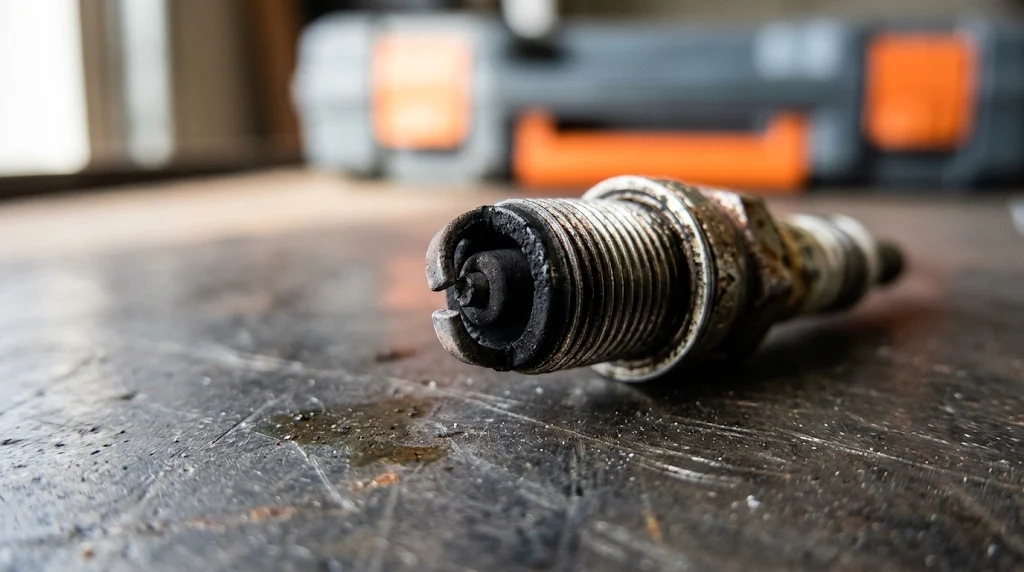
Worn electrodes widen the gap, and a wide gap needs more voltage to spark. The coil may fail to bridge the gap, so the cylinder gets a weak spark or none at all. When several cylinders fail to fire, the engine cannot build enough power to catch and run.
Fouling blocks the spark in a different way. Deposits coat the plug tip and give the voltage a path that skips the gap, so no spark forms where it should.
- Carbon fouling: dry black soot from a rich fuel mixture or short low-speed trips.
- Oil fouling: wet black deposits when oil leaks past worn rings or valve seals.
- Fuel fouling: a wet plug after failed starts flood the cylinders with unburned fuel.
Deposits on the insulator can also drain voltage away before a spark forms. Cold engines make every fault worse because cold fuel vaporizes poorly and needs a stronger spark to ignite. Plugs wear slowly, so starting trouble builds over weeks before a full no-start.
Long cranking on cold mornings is often the first sign. A car that starts after multiple attempts may already have plugs near the end of their life.
Signs Bad Spark Plugs Are Behind a No-Start
Bad plugs rarely fail without warning. The signs below point to weak or missing spark, and several signs together make plugs a strong suspect.
- Engine cranks at full speed but never fires
- Cranking takes longer than usual, above all on cold mornings
- A strong fuel smell from the exhaust after failed starts
- Rough or shaking idle in the days before the no-start
- Misfires, jerks, or hesitation when you press the gas
- A steady check engine light, or one that flashes during misfires
- Fuel economy that has slipped for no clear reason
AutoZone’s guide to bad spark plug symptoms notes that worn plugs can account for as much as a 30 percent loss in fuel economy. A flashing check engine light means active misfires that can overheat the catalytic converter. Stop driving soon and fix the misfire before it causes damage.
A code reader adds proof. Misfire codes start with P03, and P0300 means random misfires across cylinders. Codes P0301 to P0308 name the exact cylinder, so you know which plug to check first.
Can One Bad Spark Plug Stop a Car From Starting?
One bad plug rarely stops a car from starting on its own. The other cylinders still fire and keep the crankshaft turning, so the engine starts and runs rough on the dead cylinder.
Small engines feel one dead plug more. A four-cylinder engine has a wide gap between firing strokes, so one dead cylinder makes starting harder than it would in a six or eight-cylinder engine.
The catch is that plugs age together. When one plug is worn out, the rest have the same mileage and similar wear, so several weak plugs often fail at once. That is why a no-start caused by plugs usually means the full set is due, not one plug.
Two plugs per cylinder change the math. Some engines fire two plugs in each cylinder, and the second plug can still light the mixture when one fails.
What Else Causes a Crank but No Start?
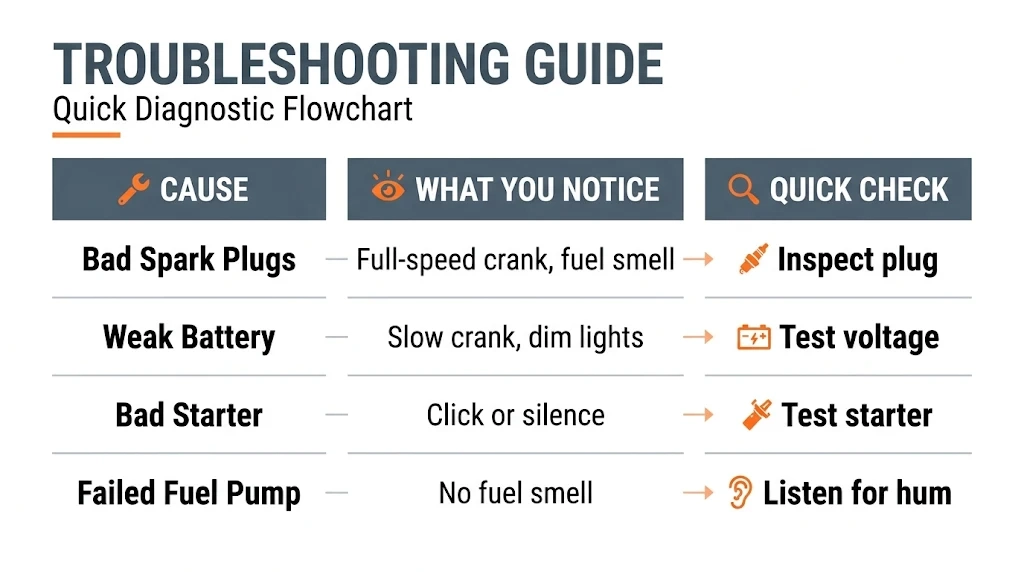
Spark plugs are only one part of the starting chain. An engine needs spark, fuel, air, and compression, and a fault in any one of them can leave you cranking with no fire.
If the dash lights up and the engine cranks, the battery is likely fine. A car that has power but won’t start can still suffer from a loose terminal, so check the connections first.
Sound also narrows the fault. A single loud click or rapid clicking with no crank points to the battery or starter, not the plugs. If your car clicks but won’t start, the ignition system is not the first place to look.
This table matches each common cause to what you notice and a quick check.
| Cause | What you notice | Quick check |
|---|---|---|
| Bad spark plugs | Full-speed crank, no fire, fuel smell | Inspect a plug for wear or fouling |
| Weak battery | Slow crank, dim lights, clicking | Test the voltage or try a jump |
| Bad starter | Click or silence, lights stay bright | Have the starter and wiring tested |
| Failed fuel pump | Full-speed crank, no fuel smell | Listen for the pump hum at key-on |
| Bad ignition coil | Crank, no fire, misfire codes | Swap the coil to another cylinder |
Spark plugs sit high on the list when the crank sounds strong and fuel reaches the engine. A weak crank or a click moves the blame to the battery and starter.
How to Check If Spark Plugs Are the Problem
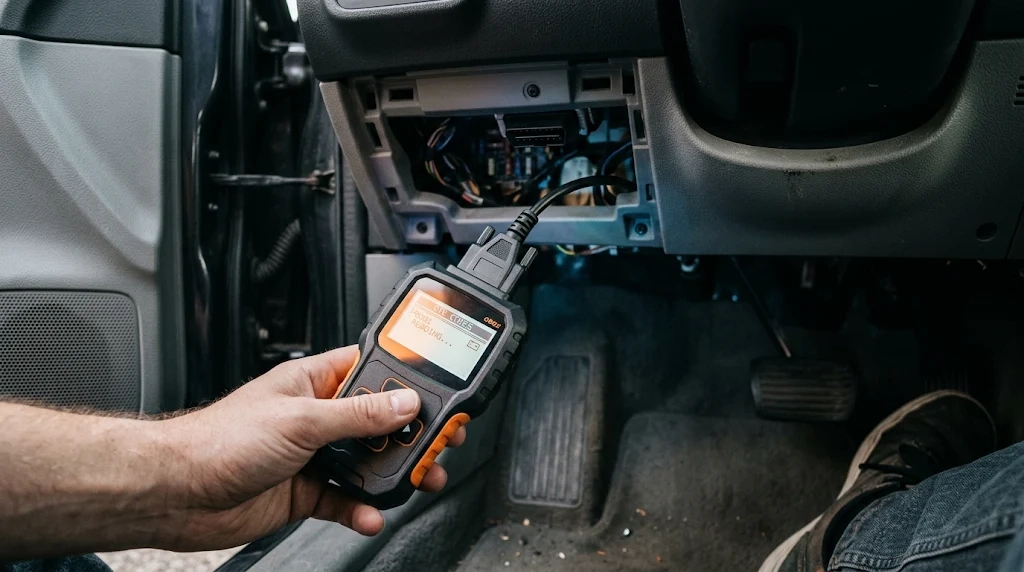
A few simple checks show whether the plugs are the fault. Each step below narrows the cause before you remove a single plug.
Step 1
Listen to the crank
Turn the key and listen. A fast, steady crank with no catch points to spark or fuel, while a slow crank or a click points to the battery or starter.
Step 2
Scan for misfire codes
Plug a code reader into the diagnostic port under the dash. Codes P0300 to P0308 show misfires, and the last digit names the cylinder.
Step 3
Smell for unburned fuel
After a failed start, sniff near the exhaust. A strong fuel smell means fuel reaches the engine, so spark is the missing piece.
Step 4
Pull and inspect one plug
Remove one plug from a cool engine and look at the tip. Dry black soot means carbon fouling, wet black deposits mean oil or fuel fouling, and rounded electrodes mean plain wear.
Step 5
Test the spark or swap cylinders
Use a spark tester to check for a strong blue spark, or swap the suspect plug to another cylinder. If the misfire code moves with the plug, the plug is bad.
A healthy plug has a light tan or gray tip with fairly sharp electrode edges. Any plug with heavy deposits, a cracked insulator, or a wide gap has reached the end of its life.
How to Fix Bad Spark Plugs
Replacement is the fix for worn or fouled plugs. A worn electrode cannot be restored, and a cracked insulator cannot be repaired, so a new set is the only lasting answer.
Warning
A hot engine can burn you, and a plug removed from a hot head can seize or strip the threads. Let the engine cool for at least 2 hours before you touch the plugs.
Match the new plugs to your owner’s manual for type, gap, and heat range. Check the gap on each plug before fitting, and tighten to the torque in the manual. Replace all the plugs at once so every cylinder fires evenly.
Do
- Replace all plugs in one session
- Check the gap on each new plug
- Clear debris from the plug wells first
Avoid
- Overtightening plugs in an aluminum head
- Mixing old and new plugs
- Fitting a different heat range
Buy the plug type your manual lists. Iridium plugs cost more but last longer than copper plugs, so they suit engines with hard-to-reach plugs. Never swap to a different heat range without checking the manual first.
Some engines need a mechanic. Rear-bank plugs on V6 and V8 engines often sit under the intake manifold, and plugs left in place for a long time can seize. If you lack a torque wrench or the plugs resist removal, let a shop handle it.
Can You Jump-Start a Car With Bad Spark Plugs?
A jump-start rarely helps when bad plugs are the cause. Extra current spins the starter faster, but it does not make a worn plug spark.
Borderline plugs are the exception. If repeated cranking has drained the battery, a jump can restore cranking speed and let weak plugs fire once more. The plugs still need replacement, and the car may fail to start again.
If the engine cranks well after a jump and still will not fire, spark or fuel is the fault, not the battery. A car that will not start even with a jump needs checks beyond the battery, starting with the ignition system.
How to Keep Spark Plugs From Failing Again
Follow the replacement interval in your owner’s manual. Copper plugs last about 20,000 to 30,000 miles, platinum about 40,000 to 60,000, and iridium about 60,000 to 100,000.
Fix the cause of fouling, not just the plugs. Oil on the plugs points to worn rings or valve seals, and heavy carbon points to a rich mixture or a dirty air filter. New plugs foul again fast when the cause stays.
AAA’s guide to bad spark plugs notes that dirty air filters, low-speed driving, and a wrong fuel and air mixture all wear plugs early. Short trips wear plugs faster because the engine rarely warms fully. Mix in longer drives when you can, and keep the air filter clean so the mixture stays right.
Spark Plugs
A fresh set of spark plugs restores the strong spark your engine needs to start and run smoothly.
Frequently Asked Questions
Can bad spark plugs cause a no crank no start?
Bad spark plugs cannot cause a no crank no start because plugs play no part in turning the engine. A silent key turn or a click points to the battery, the starter, or the ignition switch. Plugs only matter once the engine cranks.
How long do spark plugs last?
Spark plugs last about 20,000 to 100,000 miles, based on the plug type and the engine. Copper plugs last about 20,000 to 30,000 miles, platinum about 40,000 to 60,000, and iridium about 60,000 to 100,000. Your owner’s manual gives the exact interval for your car.
Will a car start with fouled spark plugs?
A car with lightly fouled plugs may start after long cranking, but heavily fouled plugs often stop it. Wet fuel fouling shorts the spark across the deposits instead of jumping the gap. Cleaning may help for a short time, but replacement is the lasting fix.
Can bad spark plugs drain the battery?
Bad spark plugs do not drain a battery on their own, since plugs draw no power when the engine sits. Repeated long cranking with weak plugs drains the battery fast, though, and strains the starter too. Fix the plugs before repeated cranking wears the battery down.
Can you drive with bad spark plugs?
You can drive short distances with worn plugs, but misfires send unburned fuel into the exhaust. That fuel can overheat and damage the catalytic converter, a costly part to replace. A flashing check engine light means stop soon and fix the misfire.
Why won’t my car start after changing spark plugs?
A car that will not start after a plug change often has a wrong gap, a loose plug, or a damaged wire. Cross-threaded plugs leak compression, and a cracked coil connector cuts voltage to the plug. Recheck the gap, the torque, and every connection you touched.
Conclusion
Bad spark plugs can cause a car not to start when wear or fouling kills the spark across several cylinders. If your engine cranks strongly but never fires, check the plugs and the misfire codes before you replace the battery or starter.

Alex Carter is an automotive content writer at VastAutoParts, focusing on car parts, vehicle troubleshooting, automotive tools, product research, and practical car care guides.