
Why Won’t My Car Start After Getting Gas? 5 Quick Checks
Quick Answer
Your car fails to start after getting gas when a purge valve stuck open lets excess fuel vapor flood the engine. Vapor from the tank flows into the intake while you refuel, so the mix turns too rich to ignite. The engine cranks but will not fire, though holding the gas pedal down while cranking often clears the flood.
- A stuck purge valve is the most common cause after a fill-up.
- Topping off the tank can soak the charcoal canister with liquid fuel.
- A flooded engine often starts with the gas pedal held to the floor.
- A strong fuel smell or a visible leak means stop and call for help.
You fill the tank, turn the key, and the engine cranks without catching. This guide explains why a car fails to start after getting gas and what to check at the pump. You will learn to tell a vapor flood from a fuel or battery fault, and when to call for help.
In this article
- What does it mean when a car won’t start after getting gas?
- Why is a stuck purge valve the most common cause?
- How can topping off the tank flood the engine?
- What symptoms point to each cause?
- What else can cause a no-start after fueling?
- How do you get the car started at the pump?
- What do the EVAP trouble codes mean?
- When should you stop trying and call for help?
- Frequently Asked Questions
- Conclusion
What does it mean when a car won’t start after getting gas?
A car that will not start right after getting gas usually has a fuel vapor fault, not a dead battery.
Refueling pushes vapor out of the tank as liquid fuel flows in. A fault in the vapor system shows up at the next key turn, when the engine gets too much vapor and too little air.
First, note what the engine does when you turn the key. An engine that cranks at normal speed but will not fire points to fuel or vapor trouble. An engine that clicks or stays silent points to the battery, starter, or a safety switch instead.
A car that cranks but won’t start follows a different test path than a car that will not crank at all.
Why is a stuck purge valve the most common cause?
A purge valve stuck open is the most common cause of a no-start right after refueling.
The evaporative emissions control system, called the EVAP system, traps fuel vapor from the tank in a charcoal canister. The purge valve is the door between the canister and the engine.
It stays shut while the engine is off and opens in short pulses while you drive. Each pulse lets the engine burn a little stored vapor at a time.
When the valve sticks open, filling the tank pushes a slug of raw vapor straight into the intake. The engine then tries to start on a mix that is far too rich to ignite. The result is long cranking, a rough catch, or no start at all.
A repair guide for this fault names a leaking purge valve as the strong suspect when an engine cranks normally but will not start after a fill-up.
These clues point to a stuck-open purge valve:
- Normal cranking speed, but the engine takes far longer than usual to catch.
- A no-start or a rough start on the first try after adding fuel.
- Rough idle or a stall in the first minute after the engine fires.
- Normal starts between fill-ups, with trouble only after refueling.
- A check engine light, often with an EVAP code stored.
How can topping off the tank flood the engine?
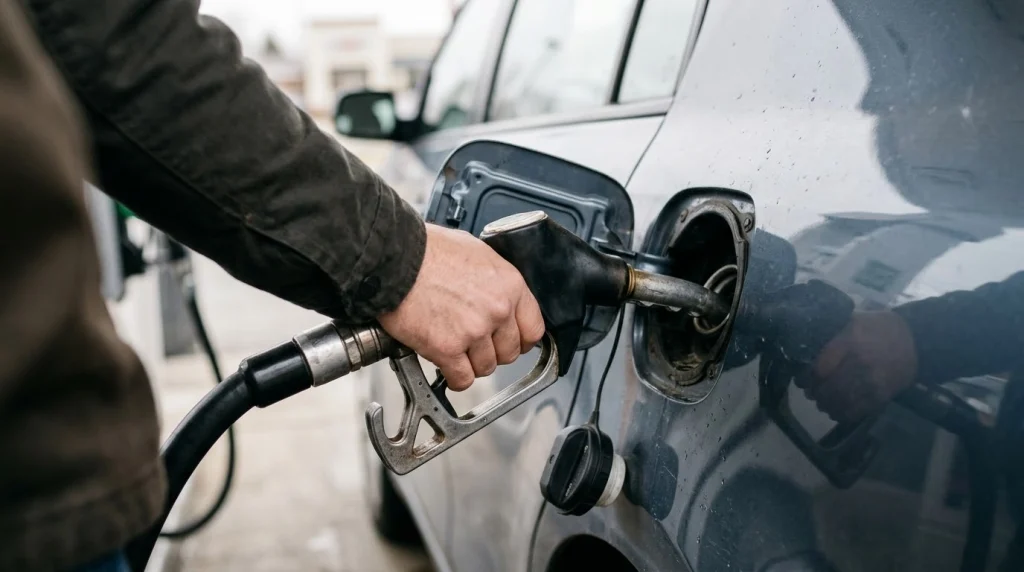
Topping off the tank can flood the engine by pushing liquid fuel into parts built only for vapor.
The charcoal canister holds fuel vapor, not liquid gasoline. When you keep squeezing the nozzle after the first click, liquid fuel can flow down the vapor line and soak the charcoal. A soaked canister feeds raw fuel into the engine at the next start, and the mix turns too rich to burn.
Liquid fuel also breaks the charcoal down over time. Charcoal dust can jam the purge valve open, so the fault returns at each fill-up even after the canister dries out. Stop filling when the nozzle clicks off the first time.
The EPA warns that topping off can damage the vapor recovery system and waste fuel you paid for.
Tip
Stop at the first click of the nozzle and never round the total up with extra squeezes. A full tank needs air space for fuel to expand on a warm day.
A canister soaked once can dry out and recover, but years of topping off can ruin it for good. If the no-start follows every fill-up, the canister and the valve both need a test.
What symptoms point to each cause?
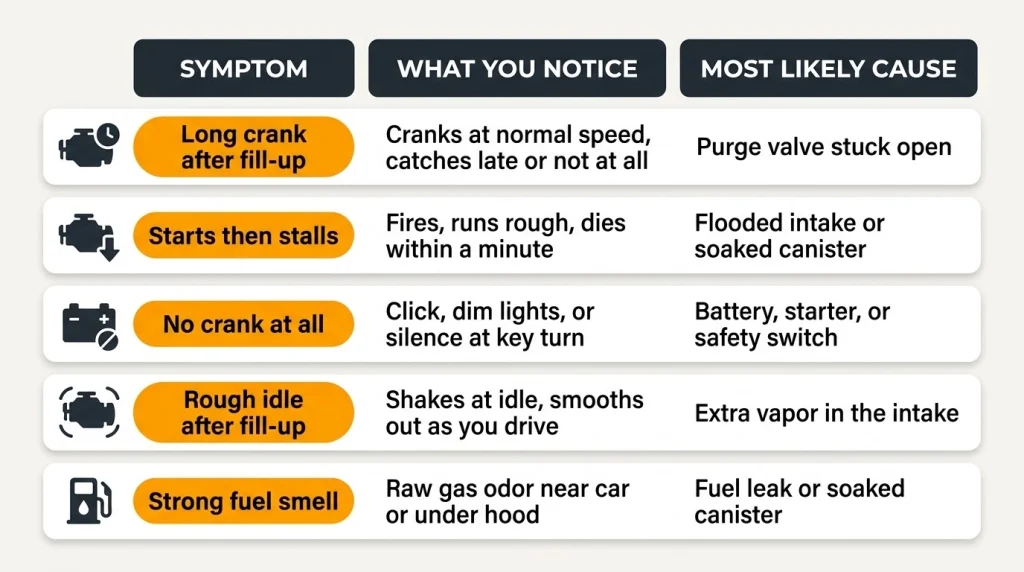
The symptom pattern points to the cause faster than any single test.
Match what you see and hear to one row of the table, then test that system first.
| Symptom | What you notice | Most likely cause |
|---|---|---|
| Long crank after fill-up | Cranks at normal speed, catches late or not at all | Purge valve stuck open |
| Starts then stalls | Fires, runs rough, dies within a minute | Flooded intake or soaked canister |
| No crank at all | Click, dim lights, or silence at the key turn | Battery, starter, or safety switch |
| Rough idle after fill-up | Shakes at idle, then smooths out as you drive | Extra vapor in the intake |
| Strong fuel smell | Raw gas odor near the car or under the hood | Fuel leak or soaked canister |
A long crank tied to fill-ups points to the purge valve, while a no-crank points past the fuel system entirely.
Write down when the fault happens. A fault that strikes only after a fill-up points to vapor, while a fault at random times points to a failing part that refueling only exposed.
What else can cause a no-start after fueling?
Other faults can cause a no-start after fueling, but most of them are coincidence rather than a vapor fault.
A weak fuel pump can fail at the gas station by chance. The pump works hard to reprime the lines after a hot stop, and a worn pump may not build pressure again. Listen for the short hum at key-on, and read the signs of a bad fuel pump before you blame the vapor system.
Wrong or contaminated fuel can also stop an engine right after a fill-up. Diesel in a gasoline tank, water in the fuel, or a bad batch from one station can all prevent a start. If other drivers at the same station report trouble, save your receipt and tell the station staff.
A weak battery or a failing starter can show up after a short stop at the pump. Heat under the hood makes a hot restart harder, so a marginal battery may crank slowly or not at all. A slow crank or a click points to the starting circuit, not to the fuel you just bought.
How do you get the car started at the pump?
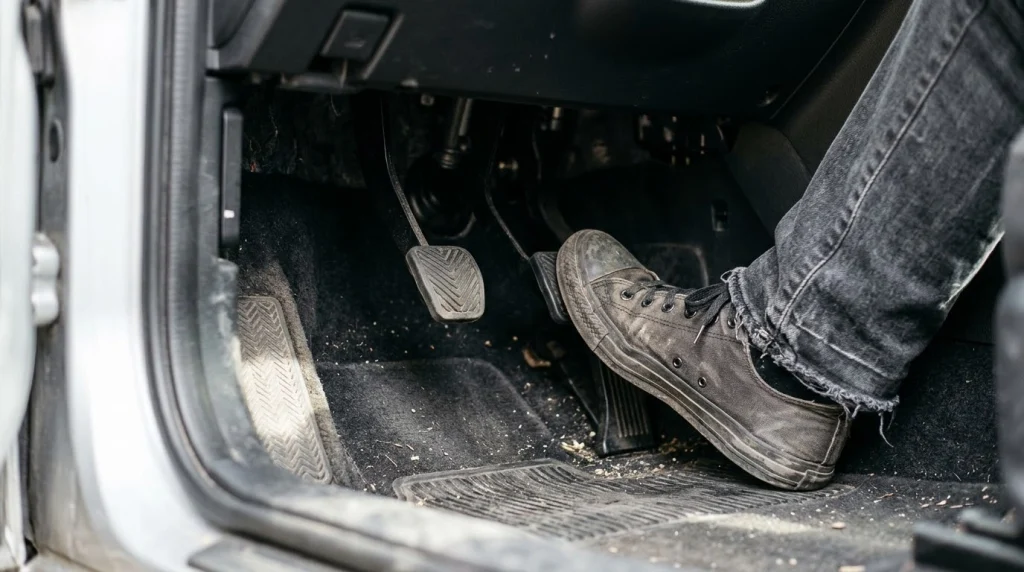
A short test sequence at the pump often gets the car going without tools.
Work through the steps in order and pause between cranking attempts, since long cranking drains the battery and heats the starter. A step-by-step guide to a car that won’t start covers the wider test path.
Step 1
Try the clear-flood start
Press the gas pedal to the floor and hold it there while you crank for a few seconds. The extra air clears the flooded mix, and the engine may catch. Release the pedal once the engine fires.
Step 2
Wait, then try again
Switch the key off and wait about a minute so vapor can clear from the intake. Crank again with the pedal untouched. Short tries with pauses beat one long crank.
Step 3
Check the cap and the gear
Twist the gas cap off and back on until it clicks, then check the shifter sits in Park. A loose cap or a car left in gear can each block a start.
Step 4
Listen for the fuel pump
Turn the key to On without cranking and listen near the rear seat for a short hum. A hum means the pump primes, while silence points to the pump, fuse, or relay.
Step 5
Scan for trouble codes
Plug an OBD2 scanner into the port under the dash and read stored codes. EVAP codes such as P0441 or P0496 point to the purge system, while fuel codes point past it.
If the clear-flood start works, drive to a shop before the next fill-up. The fault will return at the next tank of gas unless the valve or canister is fixed.
What do the EVAP trouble codes mean?
EVAP trouble codes tell you which part of the vapor system the computer distrusts.
Code P0441 means the purge flow does not match what the computer commanded. Code P0496 means vapor flows during a non-purge period, which fits a valve stuck open. Codes P0455 and P0456 mean the system found a large or a small leak.
A code points to a system, not to a single part. A purge valve, a cracked hose, a soaked canister, and a loose cap can each set the same EVAP code. Test the valve seal and inspect the hoses before you replace parts.
When should you stop trying and call for help?
Stop trying when the same fault repeats after the basic checks, or when fuel safety is in doubt.
A shop with a scan tool and a smoke machine can test the purge valve seal and find vapor leaks that home checks miss. Ask the shop to test the valve before it replaces parts, since a valve that clicks is not always a valve that seals.
Some models have recalls or service bulletins for hard starting after refueling, so check your VIN on the NHTSA recall lookup before you pay for a repair.
Warning
A strong fuel smell, a visible leak, or smoke near the car means stop. Switch the engine off, leave the car, and call for help from a safe distance.
If the engine fires and then dies instead of refusing to start, the fault follows a different pattern. Read the guide on a car that starts and then dies to match the stall to its cause.
Do
- Test the purge valve before replacing it
- Stop filling at the first click
- Scan for codes before buying parts
Avoid
- Cranking the engine over and over
- Topping off the tank to round up the total
- Ignoring a strong fuel smell
If the car will not start after the checks above, have it towed to the shop.
OBD2 Scanner
An OBD2 scanner reads the EVAP codes that point to the purge valve or the vapor leak behind the no-start.
Frequently Asked Questions
Can a loose gas cap stop a car from starting?
A loose gas cap alone rarely stops a car from starting, since it affects vapor sealing more than the starting mix. The cap sets a check engine light and an EVAP leak code long before it blocks a start. Tighten the cap until it clicks, then test the purge valve if the no-start stays.
Will the problem go away on its own?
A flooded intake clears on its own once the extra vapor burns off or escapes, so one no-start may never repeat. A purge valve stuck open stays stuck, so the fault returns at the next fill-up. If the no-start happens after two fill-ups, have the valve tested.
Can bad gas cause a car not to start?
Bad gas can stop a car from starting when water, diesel, or debris in the fuel blocks combustion. One bad batch often affects several drivers from the same station on the same day. Save your receipt and ask the station if other drivers report trouble.
Is it safe to drive after the car starts?
A car that starts and runs smoothly after a flooded start is usually safe to drive to a repair shop. Drive straight there and book the purge valve test before the next fill-up. If the engine runs rough, stalls again, or smells of fuel, stop and call for a tow.
Why does my car start fine between fill-ups?
A car starts fine between fill-ups because the purge fault only floods the engine when refueling pushes vapor into the intake. Between fill-ups the vapor load stays low, so the valve leak has little fuel to pass. The fill-up timing is what points to the vapor system.
Can a weak battery cause a no-start after fueling?
A weak battery can cause a no-start after fueling when a hot restart exposes a charge the battery can no longer hold. The crank turns slow or the dash lights dim, which points to the starting circuit. Test the battery voltage before you blame the fuel system.
Conclusion
A car that won’t start after getting gas usually floods on fuel vapor from a stuck purge valve or a soaked canister. Try the clear-flood start at the pump, stop topping off the tank, and scan for EVAP codes before the next fill-up. If the no-start repeats or you smell fuel, have the car towed to a shop.

Alex Carter is an automotive content writer at VastAutoParts, focusing on car parts, vehicle troubleshooting, automotive tools, product research, and practical car care guides.